1
Putting the ‘Micro’ into
Microservices with Stateful
Stream Processing
Ben Stopford
@benstopford
2
3
Last time: Event Driven Services
•  Interact through events, don’t talk to services
•  Evolve a Cascading Narrative
•  Query views, built inside your bounded context.
Related:
-Event Collaboration
-Service Choreography
-Event storming
4
The narrative should contain business
facts
It should read like:
“a day in the life of your business”
5
Base services on Event Sourcing
Domain Service
Kafka
Local View of
Customers
Service journals
state changes
(Facts)
6
Where stateful, reconstitute from log
Domain Service
Kafka
Local View of
Customers
Reconstitute
state
7
Use the narrative to move away from
legacy apps
Domain Service
Kafka
Local View of
Customers
8
Retain the Narrative
Kafka scales
9
What is this talk about?
Using SSP to build lightweight services that
evolve the shared narrative
1.  What’s in the SSP toolbox?
2.  Patterns for Streaming Services
3.  Sewing together the Big & the Small
4.  The tricky parts
10
Applying tools
from stateful
stream
processing
11
Aside: What is Stateful Stream
Processing?
A machine for converting a set of
streams into something more useful.
Output a stream
or output a table
12
Domain Service
Kafka
Local View of
Customers
View
(1) Drive processing from Events
(2) Build views that answer questions
13
The tools
14
Kafka
Producer
(1) Producer/Consumer APIs
Consumer
•  Simple & easy to
understand
•  Native in many
languages
•  Easy to integrate to
existing services
•  No joins, predicates,
groupings or tables
•  Includes transactions
in Kafka-11.
15
(2) KStreams DSL
•  Joins (including
windowing)
•  Predicates
•  Groupings
•  Processor API
Kafka
KTable
Inbound
Stream
(Windowed)
State Store Outbound Stream
Changelog
Stream
DSL
16
(3) The KTable
•  Recast a stream as a
table via a defined key
•  Tends to be backed
by compacted topic.
•  Materialized locally in
RocksDB
•  Provides guaranteed
join semantics (i.e. no
windowing concerns)
Kafka
KTable
(in RocksDB)
DSL
JVM boundary
17
The KTable
•  Behaves like a regular stream but
retains the latest value for each key,
from offset 0
•  Partitions spread over all available
instances
•  Partition counts must match for joins
•  Triggers processing
•  Initializes lazily.
18
(4) Global KTable
•  All partitions replicated
to all nodes
•  Supports N-way join
•  Blocks until initialized
•  Doesn’t trigger
processing (reference
resource)
Kafka
Global KTable
(in RocksDB)
DSL
19
Global-KTables vs. KTables
P1,3 P6,8 P2,7 P4,5
P1,2,
3,4,5,
6,7,8
P1,2,
3,4,5,
6,7,8
P1,2,
3,4,5,
6,7,8
P1,2,
3,4,5,
6,7,8
KTable
(Sharded)
Global KTable
(Replicated)
Given a service with four instances:
20
(5) State Store
•  RocksDB instance
•  Mutable
•  Backed by Kafka
•  Integrated into DSL
•  Can be instantiated
independently
•  Queryable via
Queryable state
•  Useful for custom
views or stateful
services.Kafka
State Store
(RocksDB)
Changelog
Stream
DSL
21
(6) Hot Replicas
-  By default KStreams
keeps state backed up on
a secondary node.
-  Single machine failure
doesn’t result in a re-
hydration pause.
=> Highly available, stateful
services.
Service instance 1 Service instance 2
22
(7) Transactions
Two problems:
1.  Failures create duplicates
•  Each message gets a unique ID
•  Deduplicate on write
2.  You need to write, atomically, to 2
or more topics
•  Chandy-Lamport Algorithm
NB: Transactions will be in the next Kafka release
23
Snapshot Marker Model
Commit/Abort
Begin
Commit/Abort
Begin
Buffer*
* The buffering is actually done in Kafka no the consumer
Producer Consumer
Topic A
Topic B
Elected Transaction
Coordinator
Consumer only sees
committed messages
24
Simple Example
//Orders -> Stock Requests and Payments
orders = ordersTopic.poll()
payments = paymentsFor(orders)
stockUpdates = stockUpdatesFor(orders)
//Send & commit atomically
producer.beginTransaction()
producer.send(payments)
producer.send(stockUpdates)
producer.sendOffsetsToTransaction(offsets(orders))
producer.endTransaction()
25
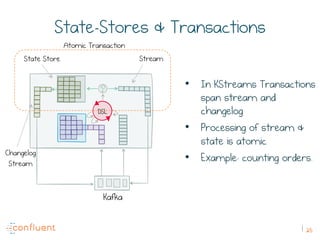
State-Stores & Transactions
•  In KStreams Transactions
span stream and
changelog
•  Processing of stream &
state is atomic
•  Example: counting orders.
Kafka
State Store Stream
DSL
Atomic Transaction
Changelog
Stream
26
All these tools scale horizontally and avoid
single points of failure
Sources Kafka KafkaService Layer Service Layer Kafka
27
Service patterns
(building blocks)
28
(1) Stateless Processor
e.g.
- Filter orders by region
-  Convert to local domain model
-  Simple rule
29
(2) Stateless, Data Enabled Processor
Similar to star schema
•  Facts are stream
•  Dimensions are GKTables
e.g. Enrich Orders with Customer Info & Account details
Stream
GKTable
GKTable
Stream-Table
Join
30
(3) Gates
e.g. rules engines or event correlation
When Order & Payment then …
Stream 1
Window
Window Stream-Stream
Join
Stream 2
31
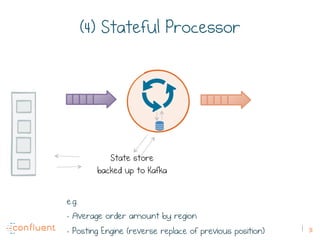
(4) Stateful Processor
e.g.
- Average order amount by region
- Posting Engine (reverse replace of previous position)
State store
backed up to Kafka
32
(5) Stream-Aside Pattern
State store
backed up to Kafka
public static
void main(…){
…
}
JVM
33
(7) Sidecar Pattern
State store
backed up to Kafka
34
Combine them:
1.  Stateless
2.  Data enriched
3.  Gates
4.  Stateful processors
5.  Stream-aside
6.  Sidecar
35
Query patterns covered in last talk
36
Building ON the
narrative
The big and the small
37
Evolutionary approach
Services should:
•  Fit in your head
•  Should be quick to stand up & get going
But sometimes bigger is the right answer
38
Event Driven First
•  Build on an event driven backbone
•  Add Request-Driven interfaces where
needed.
•  Prefer intra-context
REST
Kafka
39
Putting the Micro into Microservices
- Combine simple services that develop
the shared narrative
- Start stateless, make stateful if
necessary
40
Contexts within Contexts
Where services are
tiny, they will typically
be grouped together.
•  Shared domain?
•  Shared deployment?
•  Shared streams?
Several small
services
Single bounded
context
41
Layering within multi-service contexts
Kafka
Data layer:
-Stream enrichment
-View creation
-Streams maintenance
Business layer
encapsulates logic,
integrates with legacy
code etc.
Request-Driven layer
provides REST / RPC /
websotcket etc for UIs
etc
42
Kafka
Different levels of data
visibility within Kafka
Kafka
Contexts within Contexts
Accounting
Fulfillment
Online Services
43
Bringing it
together
44
Good architectures have little to
do with this:
45
It’s more about how systems evolves
over time
46
Sunk Cost vs Future Cost
Architecture: Sunk Cost Change: Future Cost
Balance
47
Part 1: Data dichotomy
Request-Driven Services don’t handle
shared data well
-  God service problem
-  The data erosion problem
Request-Driven Services struggle with
complex flows
-  the service entanglement problem
-  the batch processing problem.
48
Part 2: Building Event Driven Services
Solution is to part 1:
-  Event source facts into a Cascading
Narrative
-  Communication & State transfer
converge
-  Decentralize the role of turning facts
into queryable views
-  Keep these views as lightweight and
disposable as possible.
49
Putting the Micro in Microservices
-  Start lightweight, stateless functions
which compose and evolve
-  Leverage the stateful stream processing
toolkit to blend streams, state, views,
transactions.
-  Use layered contexts that segregate
groups of streams and services.
50
Highly
scalable
architecture
51
All order logic,
stateless service
Orders-by-Customer view
(KStreams + Queryable State API)
UI Service
Stream
Maintenance &
Monitoring
Highly available, stateful service
UI uses Orders-by-
Customer View directly
via Queryable State
History Service pushes data to
a local Elastic Search Instance
Orders
Service
Derived
View
UI joins data
Tables & Streams
Fulfillment Service
Analytics
OrdersProduct Custo-
mers KTables
KTables KTables
Schemas
52
Tips & Tricky parts
•  Reasoning about service choreography
•  Debugging multi-stage topologies
•  Monitoring/debug via the narrative
•  Segregate facts from intermediary streams
•  Retaining data comes at a cost
•  Schema migration etc
•  Accuracy over non trivial topologies
•  Often requires transactions
•  Transactions, causality & the flow of events
•  Avoid side effects
53
Event Driven Services
Create a cascading narrative of events,
then sew them together with stream
processing.
54
Discount code: kafcom17
‪Use the Apache Kafka community discount
code to get $50 off
‪www.kafka-summit.org
Kafka Summit New York: May 8
Kafka Summit San Francisco: August 28
Presented by
55
Thank You!
@benstopford

Putting the Micro into Microservices with Stateful Stream Processing

  • 1.
    1 Putting the ‘Micro’into Microservices with Stateful Stream Processing Ben Stopford @benstopford
  • 2.
  • 3.
    3 Last time: EventDriven Services •  Interact through events, don’t talk to services •  Evolve a Cascading Narrative •  Query views, built inside your bounded context. Related: -Event Collaboration -Service Choreography -Event storming
  • 4.
    4 The narrative shouldcontain business facts It should read like: “a day in the life of your business”
  • 5.
    5 Base services onEvent Sourcing Domain Service Kafka Local View of Customers Service journals state changes (Facts)
  • 6.
    6 Where stateful, reconstitutefrom log Domain Service Kafka Local View of Customers Reconstitute state
  • 7.
    7 Use the narrativeto move away from legacy apps Domain Service Kafka Local View of Customers
  • 8.
  • 9.
    9 What is thistalk about? Using SSP to build lightweight services that evolve the shared narrative 1.  What’s in the SSP toolbox? 2.  Patterns for Streaming Services 3.  Sewing together the Big & the Small 4.  The tricky parts
  • 10.
  • 11.
    11 Aside: What isStateful Stream Processing? A machine for converting a set of streams into something more useful. Output a stream or output a table
  • 12.
    12 Domain Service Kafka Local Viewof Customers View (1) Drive processing from Events (2) Build views that answer questions
  • 13.
  • 14.
    14 Kafka Producer (1) Producer/Consumer APIs Consumer • Simple & easy to understand •  Native in many languages •  Easy to integrate to existing services •  No joins, predicates, groupings or tables •  Includes transactions in Kafka-11.
  • 15.
    15 (2) KStreams DSL • Joins (including windowing) •  Predicates •  Groupings •  Processor API Kafka KTable Inbound Stream (Windowed) State Store Outbound Stream Changelog Stream DSL
  • 16.
    16 (3) The KTable • Recast a stream as a table via a defined key •  Tends to be backed by compacted topic. •  Materialized locally in RocksDB •  Provides guaranteed join semantics (i.e. no windowing concerns) Kafka KTable (in RocksDB) DSL JVM boundary
  • 17.
    17 The KTable •  Behaveslike a regular stream but retains the latest value for each key, from offset 0 •  Partitions spread over all available instances •  Partition counts must match for joins •  Triggers processing •  Initializes lazily.
  • 18.
    18 (4) Global KTable • All partitions replicated to all nodes •  Supports N-way join •  Blocks until initialized •  Doesn’t trigger processing (reference resource) Kafka Global KTable (in RocksDB) DSL
  • 19.
    19 Global-KTables vs. KTables P1,3P6,8 P2,7 P4,5 P1,2, 3,4,5, 6,7,8 P1,2, 3,4,5, 6,7,8 P1,2, 3,4,5, 6,7,8 P1,2, 3,4,5, 6,7,8 KTable (Sharded) Global KTable (Replicated) Given a service with four instances:
  • 20.
    20 (5) State Store • RocksDB instance •  Mutable •  Backed by Kafka •  Integrated into DSL •  Can be instantiated independently •  Queryable via Queryable state •  Useful for custom views or stateful services.Kafka State Store (RocksDB) Changelog Stream DSL
  • 21.
    21 (6) Hot Replicas - By default KStreams keeps state backed up on a secondary node. -  Single machine failure doesn’t result in a re- hydration pause. => Highly available, stateful services. Service instance 1 Service instance 2
  • 22.
    22 (7) Transactions Two problems: 1. Failures create duplicates •  Each message gets a unique ID •  Deduplicate on write 2.  You need to write, atomically, to 2 or more topics •  Chandy-Lamport Algorithm NB: Transactions will be in the next Kafka release
  • 23.
    23 Snapshot Marker Model Commit/Abort Begin Commit/Abort Begin Buffer* *The buffering is actually done in Kafka no the consumer Producer Consumer Topic A Topic B Elected Transaction Coordinator Consumer only sees committed messages
  • 24.
    24 Simple Example //Orders ->Stock Requests and Payments orders = ordersTopic.poll() payments = paymentsFor(orders) stockUpdates = stockUpdatesFor(orders) //Send & commit atomically producer.beginTransaction() producer.send(payments) producer.send(stockUpdates) producer.sendOffsetsToTransaction(offsets(orders)) producer.endTransaction()
  • 25.
    25 State-Stores & Transactions • In KStreams Transactions span stream and changelog •  Processing of stream & state is atomic •  Example: counting orders. Kafka State Store Stream DSL Atomic Transaction Changelog Stream
  • 26.
    26 All these toolsscale horizontally and avoid single points of failure Sources Kafka KafkaService Layer Service Layer Kafka
  • 27.
  • 28.
    28 (1) Stateless Processor e.g. -Filter orders by region -  Convert to local domain model -  Simple rule
  • 29.
    29 (2) Stateless, DataEnabled Processor Similar to star schema •  Facts are stream •  Dimensions are GKTables e.g. Enrich Orders with Customer Info & Account details Stream GKTable GKTable Stream-Table Join
  • 30.
    30 (3) Gates e.g. rulesengines or event correlation When Order & Payment then … Stream 1 Window Window Stream-Stream Join Stream 2
  • 31.
    31 (4) Stateful Processor e.g. -Average order amount by region - Posting Engine (reverse replace of previous position) State store backed up to Kafka
  • 32.
    32 (5) Stream-Aside Pattern Statestore backed up to Kafka public static void main(…){ … } JVM
  • 33.
    33 (7) Sidecar Pattern Statestore backed up to Kafka
  • 34.
    34 Combine them: 1.  Stateless 2. Data enriched 3.  Gates 4.  Stateful processors 5.  Stream-aside 6.  Sidecar
  • 35.
  • 36.
  • 37.
    37 Evolutionary approach Services should: • Fit in your head •  Should be quick to stand up & get going But sometimes bigger is the right answer
  • 38.
    38 Event Driven First • Build on an event driven backbone •  Add Request-Driven interfaces where needed. •  Prefer intra-context REST Kafka
  • 39.
    39 Putting the Microinto Microservices - Combine simple services that develop the shared narrative - Start stateless, make stateful if necessary
  • 40.
    40 Contexts within Contexts Whereservices are tiny, they will typically be grouped together. •  Shared domain? •  Shared deployment? •  Shared streams? Several small services Single bounded context
  • 41.
    41 Layering within multi-servicecontexts Kafka Data layer: -Stream enrichment -View creation -Streams maintenance Business layer encapsulates logic, integrates with legacy code etc. Request-Driven layer provides REST / RPC / websotcket etc for UIs etc
  • 42.
    42 Kafka Different levels ofdata visibility within Kafka Kafka Contexts within Contexts Accounting Fulfillment Online Services
  • 43.
  • 44.
    44 Good architectures havelittle to do with this:
  • 45.
    45 It’s more abouthow systems evolves over time
  • 46.
    46 Sunk Cost vsFuture Cost Architecture: Sunk Cost Change: Future Cost Balance
  • 47.
    47 Part 1: Datadichotomy Request-Driven Services don’t handle shared data well -  God service problem -  The data erosion problem Request-Driven Services struggle with complex flows -  the service entanglement problem -  the batch processing problem.
  • 48.
    48 Part 2: BuildingEvent Driven Services Solution is to part 1: -  Event source facts into a Cascading Narrative -  Communication & State transfer converge -  Decentralize the role of turning facts into queryable views -  Keep these views as lightweight and disposable as possible.
  • 49.
    49 Putting the Microin Microservices -  Start lightweight, stateless functions which compose and evolve -  Leverage the stateful stream processing toolkit to blend streams, state, views, transactions. -  Use layered contexts that segregate groups of streams and services.
  • 50.
  • 51.
    51 All order logic, statelessservice Orders-by-Customer view (KStreams + Queryable State API) UI Service Stream Maintenance & Monitoring Highly available, stateful service UI uses Orders-by- Customer View directly via Queryable State History Service pushes data to a local Elastic Search Instance Orders Service Derived View UI joins data Tables & Streams Fulfillment Service Analytics OrdersProduct Custo- mers KTables KTables KTables Schemas
  • 52.
    52 Tips & Trickyparts •  Reasoning about service choreography •  Debugging multi-stage topologies •  Monitoring/debug via the narrative •  Segregate facts from intermediary streams •  Retaining data comes at a cost •  Schema migration etc •  Accuracy over non trivial topologies •  Often requires transactions •  Transactions, causality & the flow of events •  Avoid side effects
  • 53.
    53 Event Driven Services Createa cascading narrative of events, then sew them together with stream processing.
  • 54.
    54 Discount code: kafcom17 ‪Usethe Apache Kafka community discount code to get $50 off ‪www.kafka-summit.org Kafka Summit New York: May 8 Kafka Summit San Francisco: August 28 Presented by
  • 55.