1
Building Event-Driven Services
with Apache Kafka
Ben Stopford
@benstopford
2
In this talk
1.  How we traditionally build services with
REST
2.  How Event Driven Services are different
3.  Building an Immutable, Shared Narrative.
4.  Leveraging Materialized Views.
5.  Relating to CQRS & Event Sourcing
6.  Pulling it all together
3
Companies evolve in different
ways
•  Internet companies
•  Enterprise companies
4
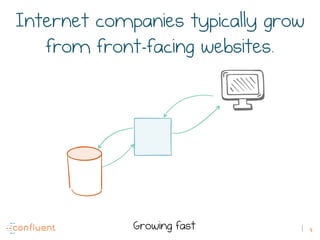
Internet companies typically grow
from front-facing websites.
pic
Growing fast
5
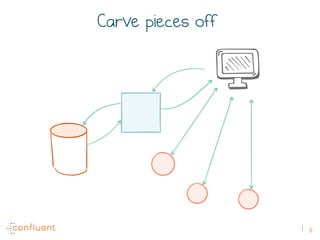
Carve pieces off
6
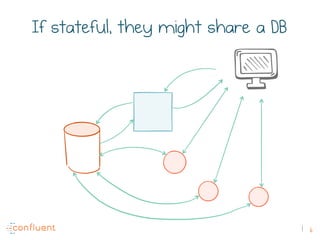
If stateful, they might share a DB
7
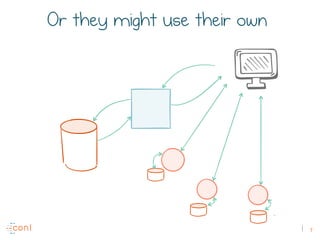
Or they might use their own
8
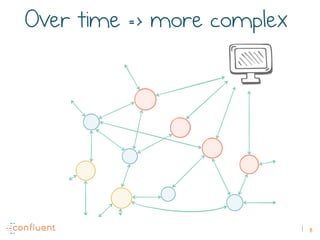
Over time => more complex
9
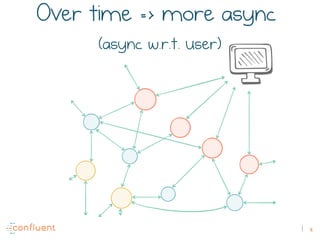
Over time => more async
(async w.r.t. user)
10
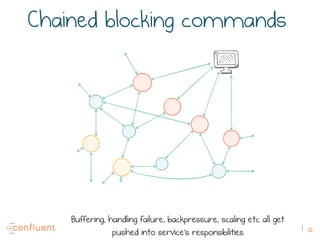
Chained blocking commands
Buffering, handling failure, backpressure, scaling etc all get
pushed into service’s responsibilities
11
The synchronous world of
request response protocols
leads to tight, point-to-point
couplings.
12
Enterprises are typically different
13
pic
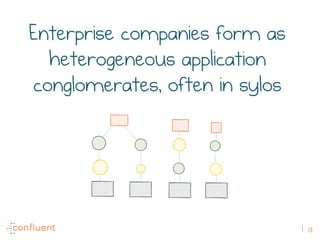
Enterprise companies form as
heterogeneous application
conglomerates, often in sylos
14
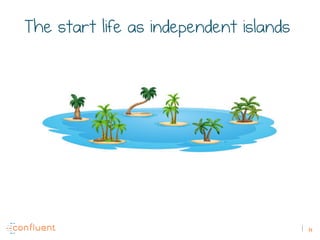
The start life as independent islands
15
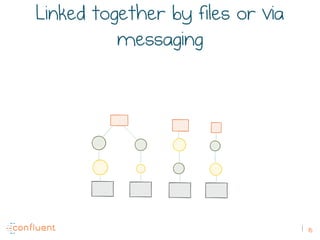
Linked together by files or via
messaging
pic
16
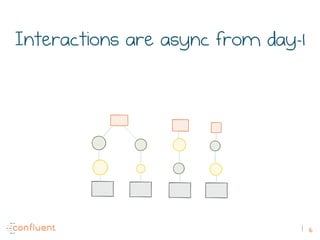
Interactions are async from day-1
pic
17
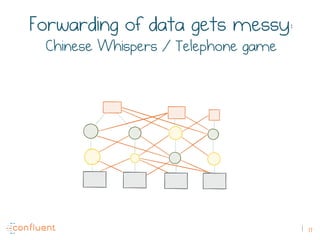
Forwarding of data gets messy:
Chinese Whispers / Telephone game
pic
18
Both these approaches often end up at
the same point, but for different
reasons
19
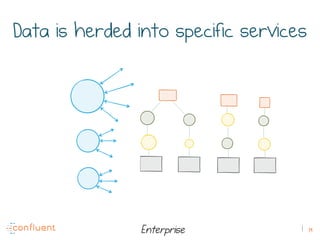
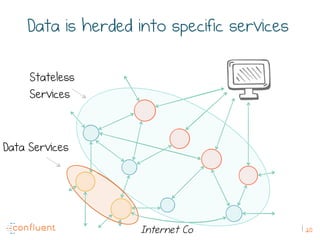
Data is herded into specific services
Enterprise
20
Data is herded into specific services
Data Services
Stateless
Services
Internet Co
21
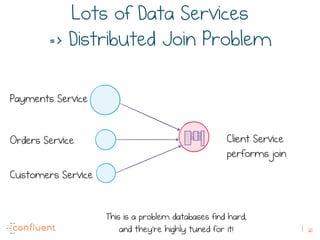
Lots of Data Services
=> Distributed Join Problem
pic
This is a problem databases find hard,
and they’re highly tuned for it!
Payments Service
Orders Service
Customers Service
Client Service
performs join
22
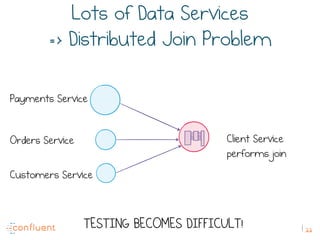
Lots of Data Services
=> Distributed Join Problem
pic
TESTING BECOMES DIFFICULT!
Client Service
performs join
Payments Service
Orders Service
Customers Service
23
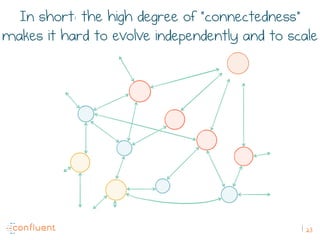
In short: the high degree of “connectedness”
makes it hard to evolve independently and to scale
24
LETS TRY
EVENT DRIVEN!
25
Interact through
Events,
Don't talk to
Services
26
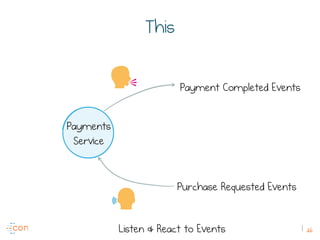
This
Payments
Service
Purchase Requested Events
Listen & React to Events
Payment Completed Events
27
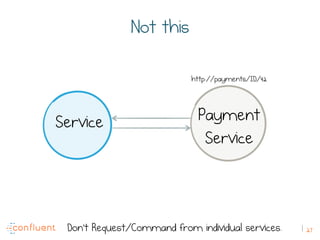
Not this
Service Payment
Service
http://payments/ID/42
Don’t Request/Command from individual services.
28
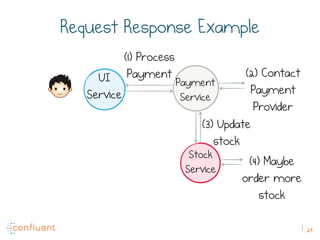
Let’s take an example...
29
UI
Service
Payment
Service
Stock
Service
(1) Process
Payment (2) Contact
Payment
Provider
(3) Update
stock
(4) Maybe
order more
stock
Request Response Example
30
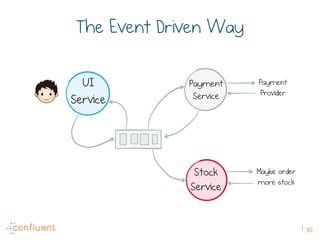
The Event Driven Way
UI
Service
Payment
Service
Stock
Service
Payment
Provider
Maybe order
more stock
31
UI
Service
Payment
Service
Stock
Service
Payment
Provider
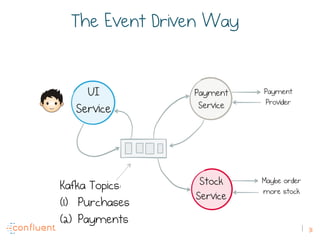
Kafka Topics:
(1)  Purchases
(2)  Payments
Maybe order
more stock
The Event Driven Way
32
UI
Service
Payment
Service
Stock
Service
Payment
Provider
Maybe order
more stock
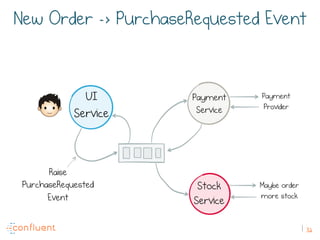
New Order -> PurchaseRequested Event
Raise
PurchaseRequested
Event
33
UI
Service
Payment
Service
Stock
Service
Payment
Provider
Maybe order
more stock
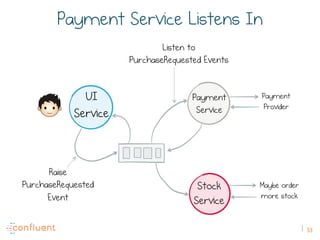
Payment Service Listens In
Raise
PurchaseRequested
Event
Listen to
PurchaseRequested Events
34
UI
Service
Payment
Service
Stock
Service
Payment
Provider
Maybe order
more stock
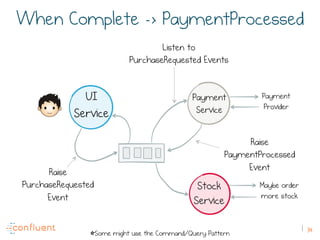
When Complete -> PaymentProcessed
Raise
PurchaseRequested
Event
Listen to
PurchaseRequested Events
Raise
PaymentProcessed
Event
*Some might use the Command/Query Pattern
35
UI
Service
Payment
Service
Stock
Service
Payment
Provider
Maybe order
more stock
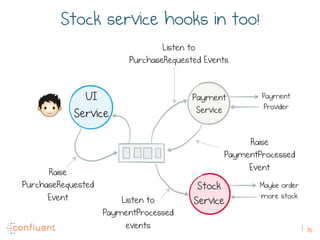
Stock service hooks in too!
Raise
PurchaseRequested
Event
Listen to
PurchaseRequested Events
Raise
PaymentProcessed
Event
Listen to
PaymentProcessed
events
36
UI
Service
Payment
Service
Stock
Service
Payment
Provider
Maybe order
more stock
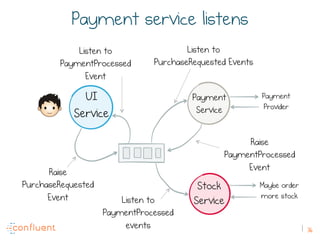
Payment service listens
Raise
PurchaseRequested
Event
Listen to
PurchaseRequested Events
Raise
PaymentProcessed
Event
Listen to
PaymentProcessed
events
Listen to
PaymentProcessed
Event
37
UI
Service
Payment
Service
Stock
Service
Payment
Provider
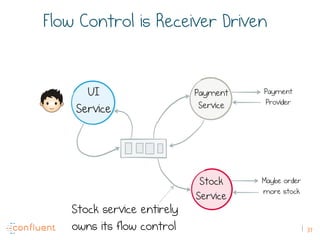
Stock service entirely
owns its flow control
Maybe order
more stock
Flow Control is Receiver Driven
38
UI
Service
Payment
Service
Stock
Service
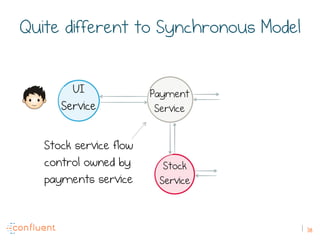
Quite different to Synchronous Model
Stock service flow
control owned by
payments service
39
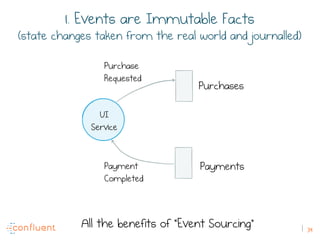
1. Events are Immutable Facts
(state changes taken from the real world and journalled)
UI
Service
Purchases
Payments
Purchase
Requested
Payment
Completed
All the benefits of “Event Sourcing”
40
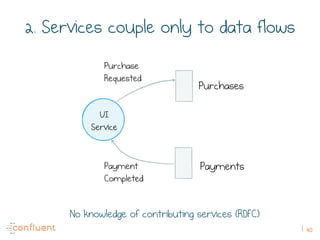
2. Services couple only to data flows
No knowledge of contributing services (RDFC)
UI
Service
Purchases
Payments
Purchase
Requested
Payment
Completed
41
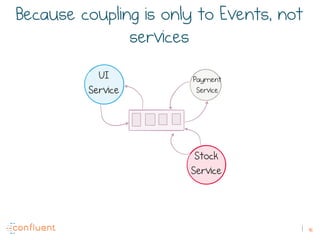
Because coupling is only to Events, not
services
Purchase Requests
PurchaseRequest TopicUI
Service
Payment
Service
Stock
Service
42
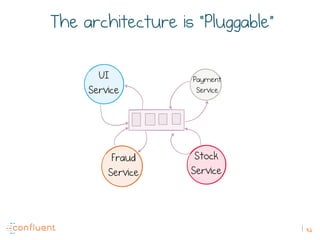
The architecture is “Pluggable”
Purchase Requests
PurchaseRequest TopicUI
Service
Payment
Service
Stock
Service
Fraud
Service
43
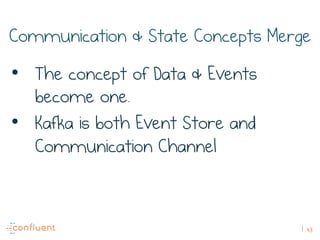
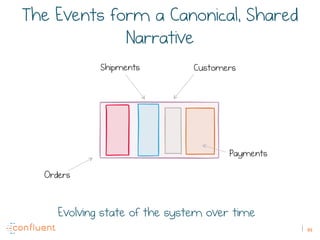
Communication & State Concepts Merge
•  The concept of Data & Events
become one.
•  Kafka is both Event Store and
Communication Channel
44
The Events form a Canonical, Shared
Narrative
Payments
Orders
Shipments Customers
Evolving state of the system over time
45
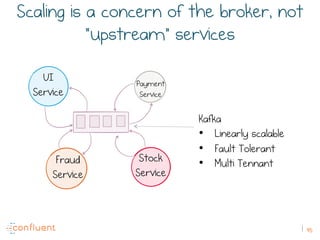
Scaling is a concern of the broker, not
“upstream” services
Purchase Requests
PurchaseRequest TopicUI
Service
Payment
Service
Stock
Service
Fraud
Service
Kafka
•  Linearly scalable
•  Fault Tolerant
•  Multi Tennant
46
But there is something missing!
How do we look things up?
(i.e. the Q in CQRS)
•  What is the address for this customer?
•  Is this user allowed to view this stock?
•  What is the contents of this user’s shopping basket?
47
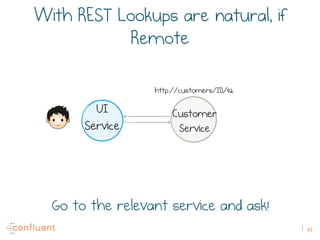
With REST Lookups are natural, if
Remote
UI
Service
Customer
Service
http://customers/ID/42
Go to the relevant service and ask!
48
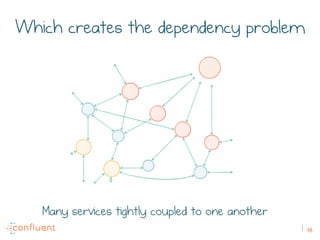
Which creates the dependency problem
Many services tightly coupled to one another
49
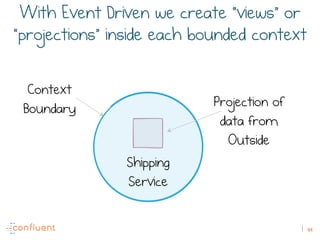
With Event Driven we create “views” or
“projections” inside each bounded context
Projection of
data from
Outside
Context
Boundary
Shipping
Service
50
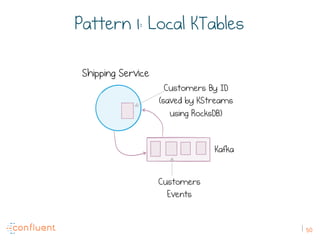
Pattern 1: Local KTables
Shipping Service
Customers
Events
Customers By ID
(saved by KStreams
using RocksDB)
Kafka
51
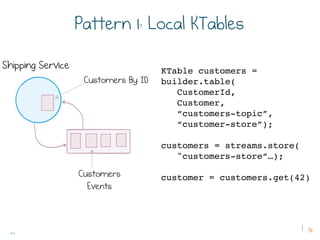
Pattern 1: Local KTables
Shipping Service
Customers
Events
Customers By ID
KTable customers =
builder.table(
CustomerId,
Customer,
“customers-topic”,
“customer-store”);
customers = streams.store(
"customers-store”…);
customer = customers.get(42)
52
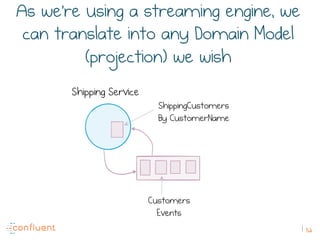
As we’re using a streaming engine, we
can translate into any Domain Model
(projection) we wish
Shipping Service
Customers
Events
ShippingCustomers
By CustomerName
53
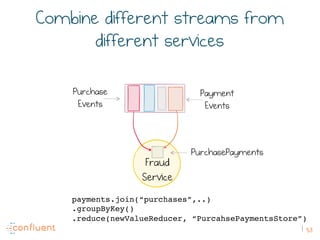
Combine different streams from
different services
Fraud
Service
Payment
Events
Purchase
Events
PurchasePayments
payments.join(“purchases”,..)
.groupByKey()
.reduce(newValueReducer, “PurcahsePaymentsStore”)
54
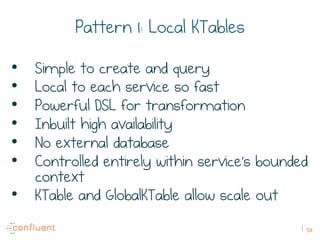
Pattern 1: Local KTables
•  Simple to create and query
•  Local to each service so fast
•  Powerful DSL for transformation
•  Inbuilt high availability
•  No external database
•  Controlled entirely within service’s bounded
context
•  KTable and GlobalKTable allow scale out
55
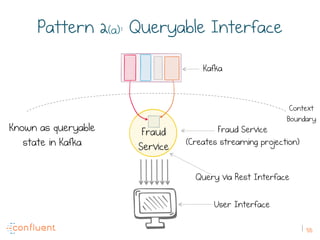
Pattern 2(a): Queryable Interface
Fraud
Service
Kafka
Fraud Service
(Creates streaming projection)
Query via Rest Interface
User Interface
Known as queryable
state in Kafka
Context
Boundary
56
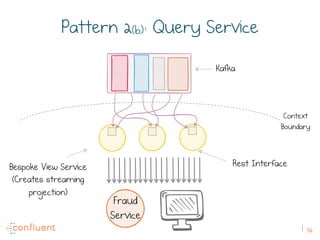
Pattern 2(b): Query Service
Kafka
Bespoke View Service
(Creates streaming
projection)
Rest Interface
Fraud
Service
Context
Boundary
57
Pattern 2: Exposing Materialised
Projections
•  Similar to Pattern 1 but with a
“Query Interface” (using Kafka’s
Queryable State feature)
•  Commonly used with UI’s
58
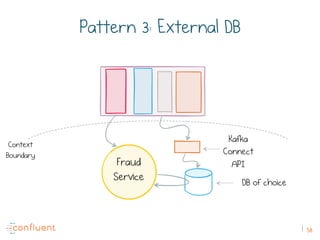
Pattern 3: External DB
DB of choice
Kafka
Connect
APIFraud
Service
Context
Boundary
59
Pattern 3: External DB
•  Again similar, but heavier weight
•  Use when you cannot pre-compute
the view (i.e. to do ad hoc queries)
•  Trick: start with only the data
(fields) you need today. You can
always go back for more.
60
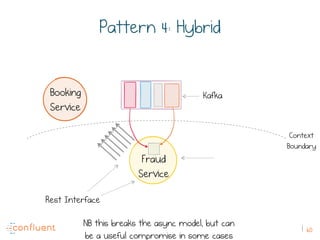
Pattern 4: Hybrid
Fraud
Service
Kafka
Rest Interface
Context
Boundary
Booking
Service
NB this breaks the async model, but can
be a useful compromise in some cases
61
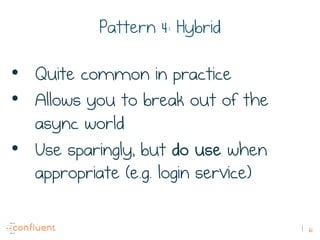
Pattern 4: Hybrid
•  Quite common in practice
•  Allows you to break out of the
async world
•  Use sparingly, but do use when
appropriate (e.g. login service)
62
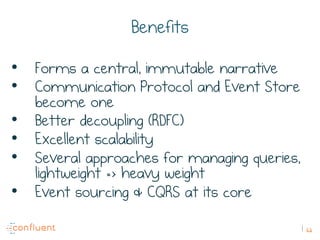
Benefits
•  Forms a central, immutable narrative
•  Communication Protocol and Event Store
become one
•  Better decoupling (RDFC)
•  Excellent scalability
•  Several approaches for managing queries,
lightweight => heavy weight
•  Event sourcing & CQRS at its core
63
Interact through
Events,
Don't talk to
Services
64
But it's ok to break
the rules!
65
Pulling it all together
66
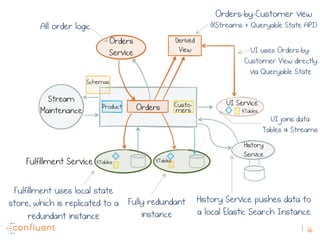
All order logic
Orders-by-Customer view
(KStreams + Queryable State API)
UI ServiceStream
Maintenance
Fulfillment uses local state
store, which is replicated to a
redundant instance
UI uses Orders-by-
Customer View directly
via Queryable State
History Service pushes data to
a local Elastic Search Instance
Orders
Service
Derived
View
UI joins data
Tables & Streams
Fulfillment Service
History
Service
Fully redundant
instance
OrdersProduct Custo-
mers KTables
KTables KTables
Schemas
67
Thank You!
@benstopford
68
Discount code: kafcom17
‪Use the Apache Kafka community discount
code to get $50 off
‪www.kafka-summit.org
Kafka Summit New York: May 8
Kafka Summit San Francisco: August 28
Presented by

Building Event-Driven Services with Apache Kafka