AJIT MAJUMDER
ABMFT 1601
DEPTT. OF ABMFT
FOOD LAWS
INTRODUCTION
The need to have a food regulator to oversee the standards of
food safety in the country was first felt in the early 2000s.
After much discussion and due deliberation, the Food Safety
and Standards Act (FSSA) was passed by the Indian
Parliament on August 4, 2006. This act repealed and
replaced the earlier regulations related to food safety
standards. Two years later, the Food Safety & Standards
Authority of India (FSSAI) was institutionalised in principle.
Post inception, FSSAI brought together the scientific
community and the various regulatory agencies in the
country to initiate an integrated food safety regulatory
framework.
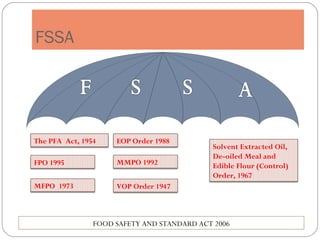
FSSA
The PFA Act, 1954
FPO 1995
MFPO 1973 VOP Order 1947
EOP Order 1988
MMPO 1992
Solvent Extracted Oil,
De-oiled Meal and
Edible Flour (Control)
Order, 1967
FOOD SAFETY AND STANDARD ACT 2006
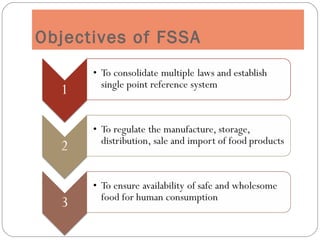
Objectives of FSSA
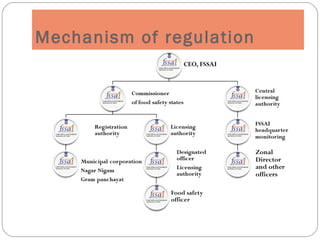
Mechanism of regulation
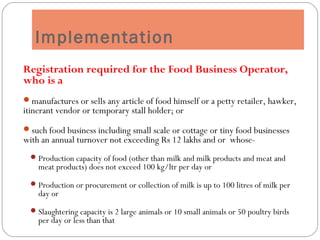
Implementation
Registration required for the Food Business Operator,
who is a
manufactures or sells any article of food himself or a petty retailer, hawker,
itinerant vendor or temporary stall holder; or
such food business including small scale or cottage or tiny food businesses
with an annual turnover not exceeding Rs 12 lakhs and or whose-
Production capacity of food (other than milk and milk products and meat and
meat products) does not exceed 100 kg/ltr per day or
Production or procurement or collection of milk is up to 100 litres of milk per
day or
Slaughtering capacity is 2 large animals or 10 small animals or 50 poultry birds
per day or less than that
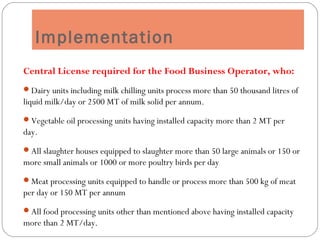
Implementation
Central License required for the Food Business Operator, who:
Dairy units including milk chilling units process more than 50 thousand litres of
liquid milk/day or 2500 MT of milk solid per annum.
Vegetable oil processing units having installed capacity more than 2 MT per
day.
All slaughter houses equipped to slaughter more than 50 large animals or 150 or
more small animals or 1000 or more poultry birds per day
Meat processing units equipped to handle or process more than 500 kg of meat
per day or 150 MT per annum
All food processing units other than mentioned above having installed capacity
more than 2 MT/day.
THE PREVENTION OF FOOD ADULTERATION ACT,
1954
The Prevention of Food Adulteration Bill was passed by both the house of
Parliament and received the assent of the President on 29th September, 1954.
It came into force on Ist June, 1955 as THE PREVENTION OF FOOD
ADULTERATION ACT, 1954 (37 of 1954). 
LIST OF ADAPTATION ORDER AND AMENDING ACTs
1. The Adaptation of Laws (No.3) Order, 1956.
2. The Prevention of Food Adulteration (Amendment) Act, 1964 (49 of
1964).
3. The Prevention of Food Adulteration (Amendment) Act, 1971 (41 of
1971).
4. The Prevention of Food Adulteration (Amendment) Act, 1976 (34 of
1976).
5. The Prevention of Food Adulteration (Amendment) Act, 1986 (70 of
1986).
Adulterated- an article of food shall be
deemed to be adulterated—
 if the article sold by a vendor is not of the nature, substance or quality demanded by the purchaser and is
to his prejudice,
 if the article contains any other substance which affects, or if the article is so processed as to affect,
injuriously the nature, substance or quality thereof;
 if any inferior or cheaper substance has been substituted wholly or in part for the article so as to affect
injuriously the nature, substance or quality thereof;
 if the article had been prepared, packed or kept under insanitary conditions whereby it has become
contaminated or injurious to health;
 if the article consists wholly or in part of any filthy, putrid, , rotten, decomposed or diseased animal or
vegetable substance or is insect-infested or is otherwise unfit for human consumption;
 if the article is obtained from a diseased animal;
 if the article contains any poisonous or other ingredient which renders it injurious to health;
 if any colouring matter other than that prescribed in respect thereof is present in the article, or if the
amounts of the prescribed colouring matter which is present in the article are not within the prescribed
limits of variability;
 if the article contains any prohibited preservative or permitted preservative in excess of the prescribed
limits;
 if the quality or purity of the article falls below the prescribed standard or its constituents are present in
quantities not within the prescribed limits of variability, but which renders it injurious to health;
 if pesticides, insecticide (except fumigant), veterinary drugs residues, antibiotic residues and
microbiological counts are used;
News
 The executive summary of National Survey of Milk Adulteration of 2011 show that more than 68% of
milk being sold in the country was adulterated and in some States is almost 100%
 8 March 2014: Delhi High Court said almost entire 1.75 crore people in Delhi eat fruits and vegetables
which are not fit for human consumption.
 18 March 2016: Hindustan Times: 2 out of 3 Indians drink milk laced with detergent, urea and paints.
  25 April 2017: Economic times: Defence's CSD suspends sale of Patanjali's Amla Juice. Patanjali says
its amla juice does not fall under FSSAI standards but those of the AYUSH ministry
 Milk –water, starch, vanaspati, urea, formalin, detergent,
 Ghee, milk powder- coal tyre dye
 Edible oil- prohibited colour
 Sugar-calk powder, urea
 Honey- sugar solution,
 Tea – carmoisine, sunset yellow, tartrazine for dark tan.
 Banana,mangoes- Calcium Carbide
 Brinjal: Chemical found is Heptachlor, 860% above the legal limit
 Rice: Chemical found is Chlorfenvinfos, 1324% above the legal limit
 Cauliflower: Chemical found is Aldrin, 320% above the legal limit
 Apple: Chemical found is Dichlorvas, 140% above the legal limit
Fruit Products Order, I955
Objectives:
Fruit Products Order-I955, formed under section 3 of the Essential Commodities Act -1955, with the
objective to manufacture fruit and vegetable(F&V) products maintaining sanitary and hygienic
condition in the premises
It is mandatory for all manufacturers of fruit and vegetable(F&V) products including some non food
products like non fruit vinegar, syrup and sweetened aerated water to obtain a license under this
order.
Following minimum requirements are laid down in the Fruit Product Order for hygienic production
and quality standards:
(i) Location and surroundings of the factory
(ii) Sanitary and hygienic conditions of premises
(iii) Personnel hygiene
(iv) Portability of water
(v) Machinery & Equipment with installed capacity
(vi) Quality control facility & Technical staff
(viii) Product Standards
(viii) Limits for preservatives & other additives
The Order lays down specifications and quality control requirements on
production and marketing of the following food products:
1) Fruit Juice, Pulp Concentrate, Squashes, Cordials, Crush, Fruit Syrups, Nectar, Aerated water
containing Fruit Juice or Pulp and Ready to serve Beverages ƒ
2) Fruit Nectar, Canned Mango Pulp (Natural & Sweetened), and Sweetened Aerated Waters with
no Fruit Juice or Fruit Pulp or containing less than 10% of Fruit Juice or Pulp
3) Sweetened Aerated Water with 10% or more of Fruit Juice of Fruit Pulp ƒ Barley Waters
(Lemon, orange, grape fruits etc)
4) Synthetic Syrup, Ginger Cocktail, Ginger Beer, Ginger Ale and Sharbats
5) Bottled and Canned Fruits and Vegetables ƒ 6) Pickles in Citrus Juice or in
Brine
7) Jams and Fruit Cheese 8) Dehydrated Onions
9) Fruit Jellies and Marmalades 10) Sun-dried and Dehydrated
Vegetables ƒ
11) Candied and Crystallised or 'Glazed Fruit and Peel 12) Mango Cereal Flakes
13) Preserves 14) Sun-dried and Dehydrated
Fruits ƒ
15) Fruit Chutneys 16) Oil Pickles
17) Tomato Juice and Soups ƒ 18) Pickles in Vinegar ƒ ƒ
19) Vegetable Soups 20) Brewed and Synthetic Vinegar
ƒ
With regard to packing, marking and labelling of containers of
fruit products, the following requirements have to be fulfilled:
-
 Packed shall bear the label as approved by the Licensing Officer.
 The bottle shall be so sealed that it cannot be opened without
destroying the license number of the special identification mark of
the manufacturer.
 The label should not contain any statement, claim, design or device,
which is false or misleading in any particular concerning the fruit
products etc.
 Every beverage should contain at least 25% of fruit juice in its
composition otherwise it will be treated as synthetic and in case of
artificial flavours the words 'Artificially Flavoured' shall also be
added.
Challenges Ahead
Setting of Food Safety Standards
Inform, Educate and Communicate to the consumers
Food Safety Management Systems
Research and Development
Conclusion
Till now FSSAI has standardized only 380 articles of food, that’s very poor
since International Food Standard has listed over 10,000 food articles.
FSSAI should not turn out to be another failure to set benchmark for Food
Safety And Standard. But after huge manace with maggie noodles FSSAI
look more very strong and confident and collaborating with many private
labs, research scientist etc. for delivering quality food to citizen of India.
As on april 12, 2017 FSSAI has entered into an agreement with US-based
Decernis Ltd which will enable it to access various international
regulations. With this tie up, FSSAI would get access to database of over
70,000 standards for food additives, food standards, food contact and
contaminants from over 170 countries. But sometimes we get confused
when FSSAI wants additional tax on packaged food items, beverages as
they are promoting production of packaged food items, beverages.
Fssai and food laws

Fssai and food laws

  • 1.
  • 2.
    INTRODUCTION The need tohave a food regulator to oversee the standards of food safety in the country was first felt in the early 2000s. After much discussion and due deliberation, the Food Safety and Standards Act (FSSA) was passed by the Indian Parliament on August 4, 2006. This act repealed and replaced the earlier regulations related to food safety standards. Two years later, the Food Safety & Standards Authority of India (FSSAI) was institutionalised in principle. Post inception, FSSAI brought together the scientific community and the various regulatory agencies in the country to initiate an integrated food safety regulatory framework.
  • 3.
    FSSA The PFA Act,1954 FPO 1995 MFPO 1973 VOP Order 1947 EOP Order 1988 MMPO 1992 Solvent Extracted Oil, De-oiled Meal and Edible Flour (Control) Order, 1967 FOOD SAFETY AND STANDARD ACT 2006
  • 4.
  • 5.
  • 6.
    Implementation Registration required forthe Food Business Operator, who is a manufactures or sells any article of food himself or a petty retailer, hawker, itinerant vendor or temporary stall holder; or such food business including small scale or cottage or tiny food businesses with an annual turnover not exceeding Rs 12 lakhs and or whose- Production capacity of food (other than milk and milk products and meat and meat products) does not exceed 100 kg/ltr per day or Production or procurement or collection of milk is up to 100 litres of milk per day or Slaughtering capacity is 2 large animals or 10 small animals or 50 poultry birds per day or less than that
  • 7.
    Implementation Central License requiredfor the Food Business Operator, who: Dairy units including milk chilling units process more than 50 thousand litres of liquid milk/day or 2500 MT of milk solid per annum. Vegetable oil processing units having installed capacity more than 2 MT per day. All slaughter houses equipped to slaughter more than 50 large animals or 150 or more small animals or 1000 or more poultry birds per day Meat processing units equipped to handle or process more than 500 kg of meat per day or 150 MT per annum All food processing units other than mentioned above having installed capacity more than 2 MT/day.
  • 8.
    THE PREVENTION OF FOODADULTERATION ACT, 1954 The Prevention of Food Adulteration Bill was passed by both the house of Parliament and received the assent of the President on 29th September, 1954. It came into force on Ist June, 1955 as THE PREVENTION OF FOOD ADULTERATION ACT, 1954 (37 of 1954).  LIST OF ADAPTATION ORDER AND AMENDING ACTs 1. The Adaptation of Laws (No.3) Order, 1956. 2. The Prevention of Food Adulteration (Amendment) Act, 1964 (49 of 1964). 3. The Prevention of Food Adulteration (Amendment) Act, 1971 (41 of 1971). 4. The Prevention of Food Adulteration (Amendment) Act, 1976 (34 of 1976). 5. The Prevention of Food Adulteration (Amendment) Act, 1986 (70 of 1986).
  • 9.
    Adulterated- an articleof food shall be deemed to be adulterated—  if the article sold by a vendor is not of the nature, substance or quality demanded by the purchaser and is to his prejudice,  if the article contains any other substance which affects, or if the article is so processed as to affect, injuriously the nature, substance or quality thereof;  if any inferior or cheaper substance has been substituted wholly or in part for the article so as to affect injuriously the nature, substance or quality thereof;  if the article had been prepared, packed or kept under insanitary conditions whereby it has become contaminated or injurious to health;  if the article consists wholly or in part of any filthy, putrid, , rotten, decomposed or diseased animal or vegetable substance or is insect-infested or is otherwise unfit for human consumption;  if the article is obtained from a diseased animal;  if the article contains any poisonous or other ingredient which renders it injurious to health;  if any colouring matter other than that prescribed in respect thereof is present in the article, or if the amounts of the prescribed colouring matter which is present in the article are not within the prescribed limits of variability;  if the article contains any prohibited preservative or permitted preservative in excess of the prescribed limits;  if the quality or purity of the article falls below the prescribed standard or its constituents are present in quantities not within the prescribed limits of variability, but which renders it injurious to health;  if pesticides, insecticide (except fumigant), veterinary drugs residues, antibiotic residues and microbiological counts are used;
  • 10.
    News  The executivesummary of National Survey of Milk Adulteration of 2011 show that more than 68% of milk being sold in the country was adulterated and in some States is almost 100%  8 March 2014: Delhi High Court said almost entire 1.75 crore people in Delhi eat fruits and vegetables which are not fit for human consumption.  18 March 2016: Hindustan Times: 2 out of 3 Indians drink milk laced with detergent, urea and paints.   25 April 2017: Economic times: Defence's CSD suspends sale of Patanjali's Amla Juice. Patanjali says its amla juice does not fall under FSSAI standards but those of the AYUSH ministry  Milk –water, starch, vanaspati, urea, formalin, detergent,  Ghee, milk powder- coal tyre dye  Edible oil- prohibited colour  Sugar-calk powder, urea  Honey- sugar solution,  Tea – carmoisine, sunset yellow, tartrazine for dark tan.  Banana,mangoes- Calcium Carbide  Brinjal: Chemical found is Heptachlor, 860% above the legal limit  Rice: Chemical found is Chlorfenvinfos, 1324% above the legal limit  Cauliflower: Chemical found is Aldrin, 320% above the legal limit  Apple: Chemical found is Dichlorvas, 140% above the legal limit
  • 11.
    Fruit Products Order,I955 Objectives: Fruit Products Order-I955, formed under section 3 of the Essential Commodities Act -1955, with the objective to manufacture fruit and vegetable(F&V) products maintaining sanitary and hygienic condition in the premises It is mandatory for all manufacturers of fruit and vegetable(F&V) products including some non food products like non fruit vinegar, syrup and sweetened aerated water to obtain a license under this order. Following minimum requirements are laid down in the Fruit Product Order for hygienic production and quality standards: (i) Location and surroundings of the factory (ii) Sanitary and hygienic conditions of premises (iii) Personnel hygiene (iv) Portability of water (v) Machinery & Equipment with installed capacity (vi) Quality control facility & Technical staff (viii) Product Standards (viii) Limits for preservatives & other additives
  • 12.
    The Order laysdown specifications and quality control requirements on production and marketing of the following food products: 1) Fruit Juice, Pulp Concentrate, Squashes, Cordials, Crush, Fruit Syrups, Nectar, Aerated water containing Fruit Juice or Pulp and Ready to serve Beverages ƒ 2) Fruit Nectar, Canned Mango Pulp (Natural & Sweetened), and Sweetened Aerated Waters with no Fruit Juice or Fruit Pulp or containing less than 10% of Fruit Juice or Pulp 3) Sweetened Aerated Water with 10% or more of Fruit Juice of Fruit Pulp ƒ Barley Waters (Lemon, orange, grape fruits etc) 4) Synthetic Syrup, Ginger Cocktail, Ginger Beer, Ginger Ale and Sharbats 5) Bottled and Canned Fruits and Vegetables ƒ 6) Pickles in Citrus Juice or in Brine 7) Jams and Fruit Cheese 8) Dehydrated Onions 9) Fruit Jellies and Marmalades 10) Sun-dried and Dehydrated Vegetables ƒ 11) Candied and Crystallised or 'Glazed Fruit and Peel 12) Mango Cereal Flakes 13) Preserves 14) Sun-dried and Dehydrated Fruits ƒ 15) Fruit Chutneys 16) Oil Pickles 17) Tomato Juice and Soups ƒ 18) Pickles in Vinegar ƒ ƒ 19) Vegetable Soups 20) Brewed and Synthetic Vinegar ƒ
  • 13.
    With regard topacking, marking and labelling of containers of fruit products, the following requirements have to be fulfilled: -  Packed shall bear the label as approved by the Licensing Officer.  The bottle shall be so sealed that it cannot be opened without destroying the license number of the special identification mark of the manufacturer.  The label should not contain any statement, claim, design or device, which is false or misleading in any particular concerning the fruit products etc.  Every beverage should contain at least 25% of fruit juice in its composition otherwise it will be treated as synthetic and in case of artificial flavours the words 'Artificially Flavoured' shall also be added.
  • 14.
    Challenges Ahead Setting ofFood Safety Standards Inform, Educate and Communicate to the consumers Food Safety Management Systems Research and Development
  • 15.
    Conclusion Till now FSSAIhas standardized only 380 articles of food, that’s very poor since International Food Standard has listed over 10,000 food articles. FSSAI should not turn out to be another failure to set benchmark for Food Safety And Standard. But after huge manace with maggie noodles FSSAI look more very strong and confident and collaborating with many private labs, research scientist etc. for delivering quality food to citizen of India. As on april 12, 2017 FSSAI has entered into an agreement with US-based Decernis Ltd which will enable it to access various international regulations. With this tie up, FSSAI would get access to database of over 70,000 standards for food additives, food standards, food contact and contaminants from over 170 countries. But sometimes we get confused when FSSAI wants additional tax on packaged food items, beverages as they are promoting production of packaged food items, beverages.
Editor's Notes