FOOD ADDITIVES
Student At:
Department of National Institute of Food
Science and Technology
UNIVERSITY OF AGRICULTURE, Pak
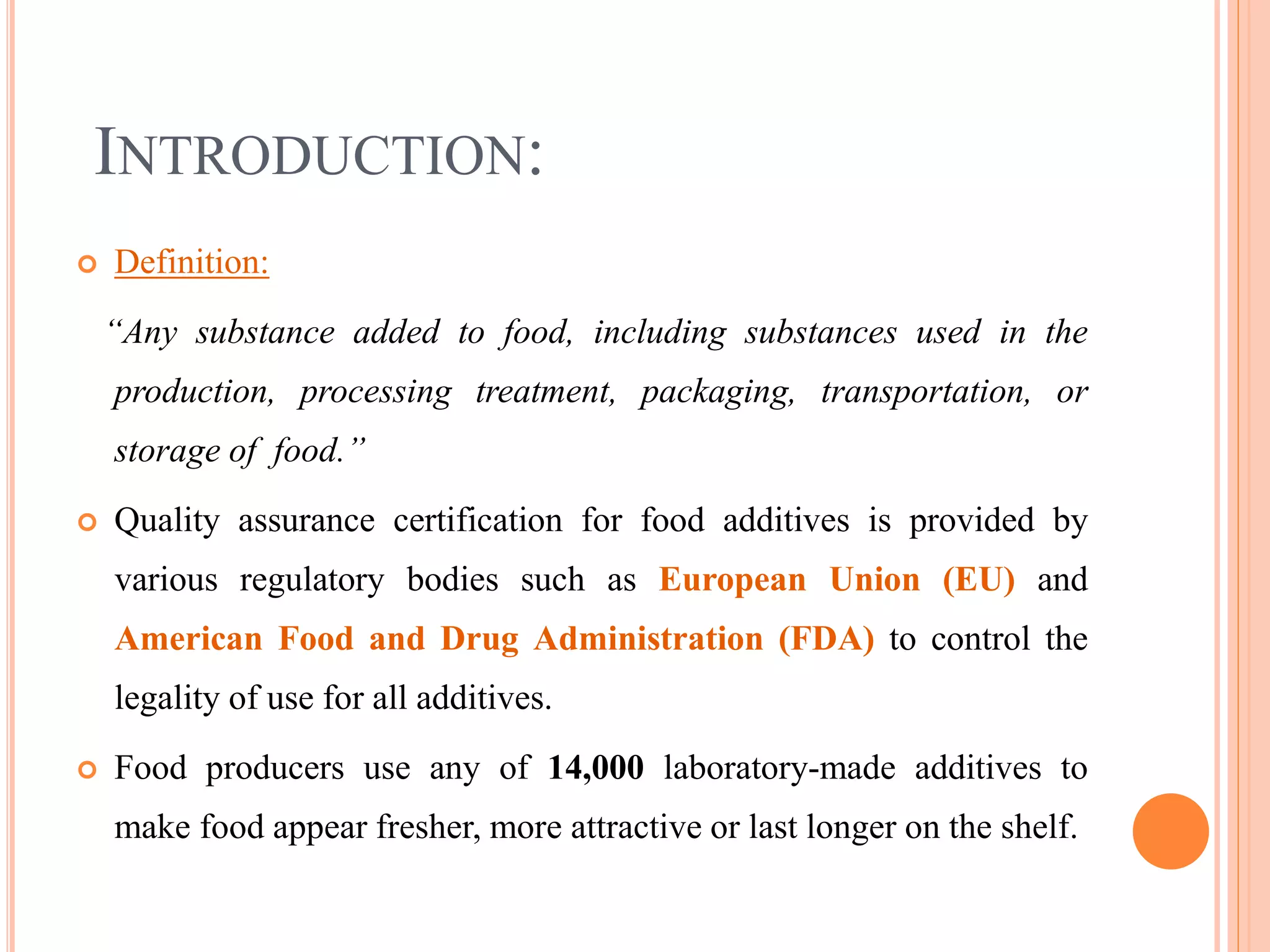
INTRODUCTION:
 Definition:
“Any substance added to food, including substances used in the
production, processing treatment, packaging, transportation, or
storage of food.”
 Quality assurance certification for food additives is provided by
various regulatory bodies such as European Union (EU) and
American Food and Drug Administration (FDA) to control the
legality of use for all additives.
 Food producers use any of 14,000 laboratory-made additives to
make food appear fresher, more attractive or last longer on the shelf.
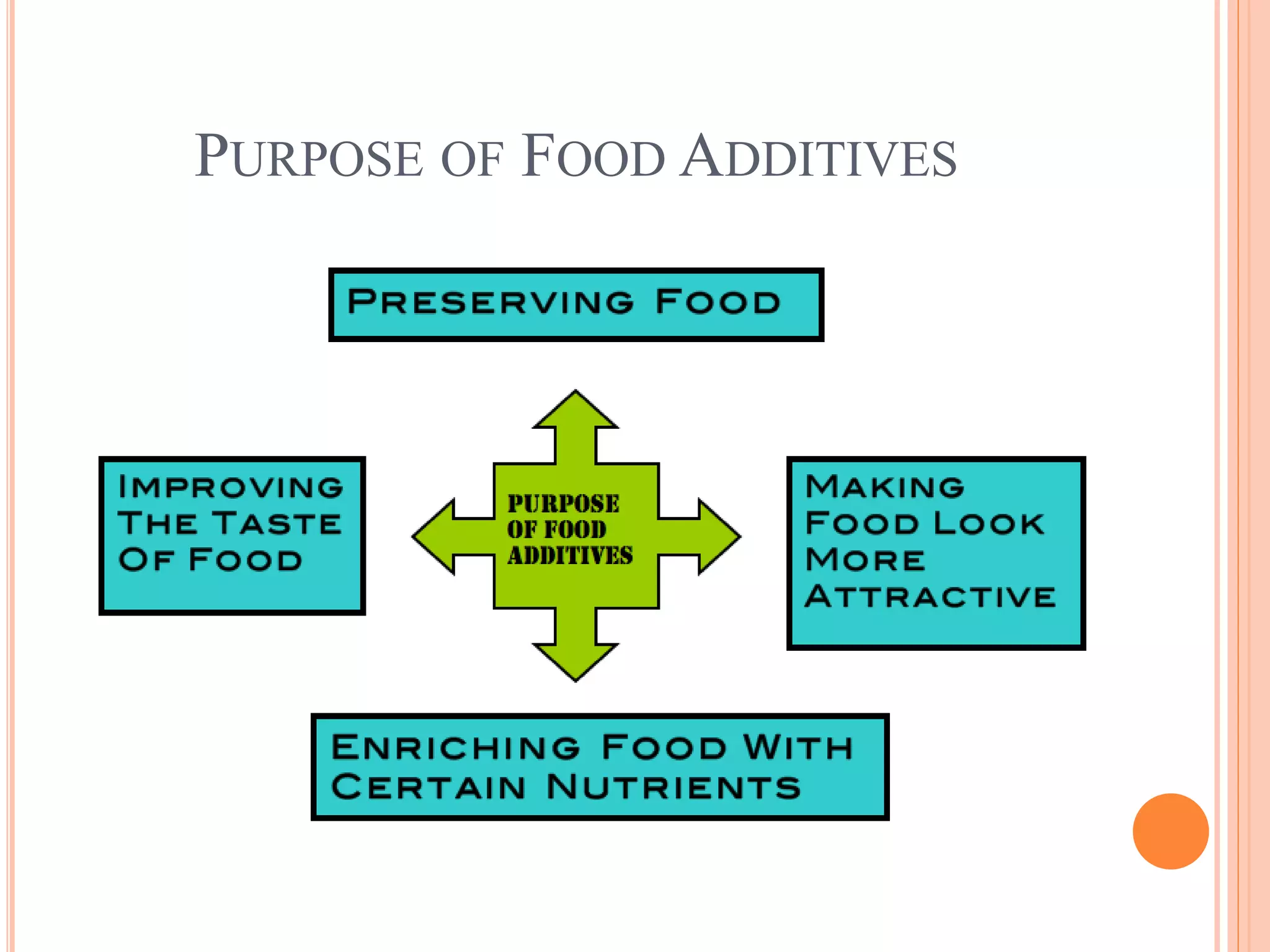
PURPOSE OF FOOD ADDITIVES
TYPES OF FOOD ADDITIVES
On basis of nature, have two types.
 Natural :
o These are naturally occurring substances. Usually considered harmless.
o Include salt, sugar, vinegar, alcohol and rosemary extract.
 Artificial:
o Comprised of several different types of additives .
o These are harmful and are mainly Chemical food additives.
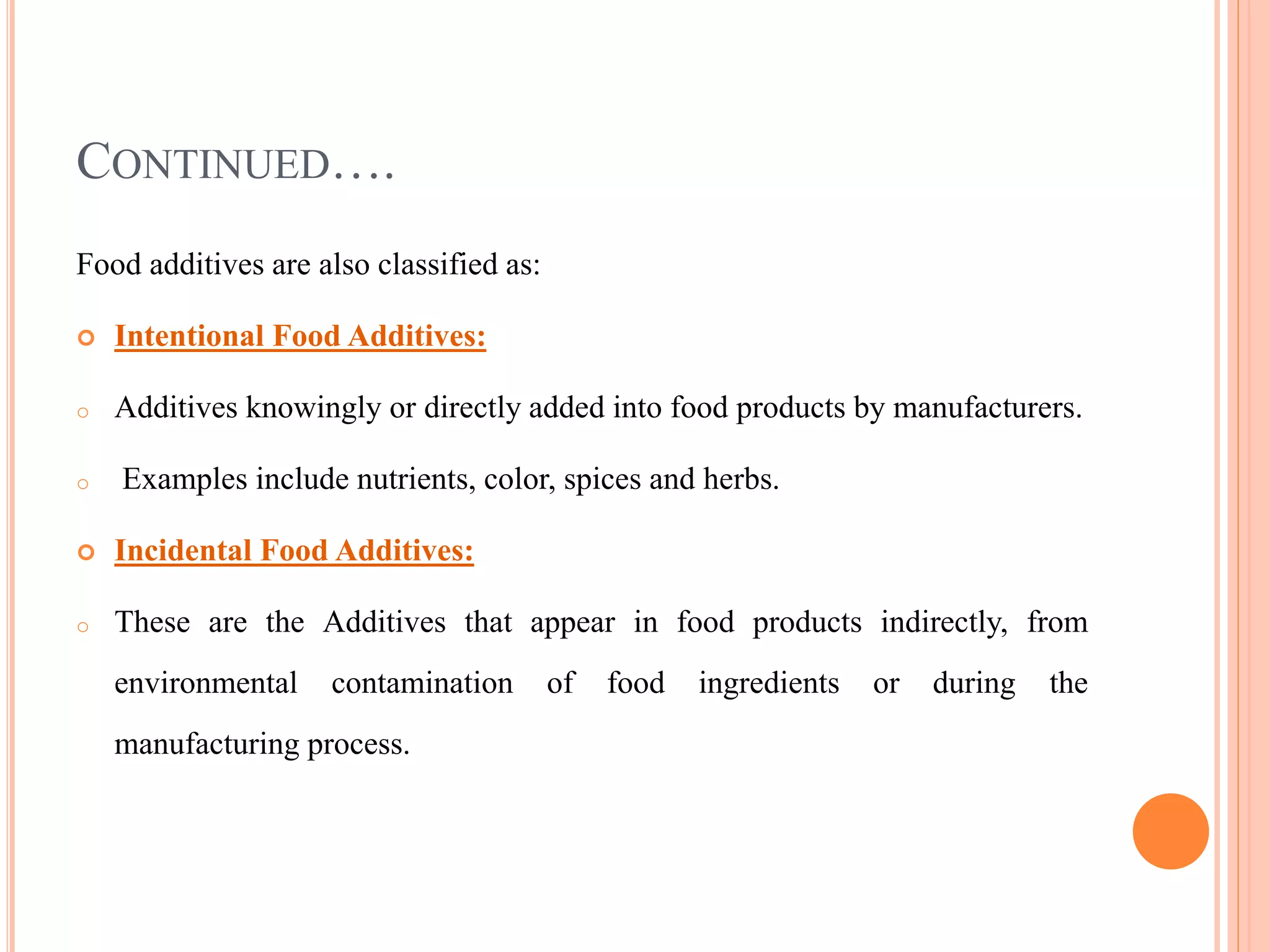
CONTINUED….
Food additives are also classified as:
 Intentional Food Additives:
o Additives knowingly or directly added into food products by manufacturers.
o Examples include nutrients, color, spices and herbs.
 Incidental Food Additives:
o These are the Additives that appear in food products indirectly, from
environmental contamination of food ingredients or during the
manufacturing process.
THE GRAS LIST
 In 1958, all food additives were put on a Generally Recognized as Safe
(GRAS) List established by FDA.
 A list of food additives that were considered safe for consumption at that
time.
 The substances present in the GRAS list are known as “GRAS substances”.
 Examples: acetic acid, baking soda, caffeine, calcium citrate, citric acid,
corn starch, carbon dioxide, sugar, salt and many more.
TESTING FOOD ADDITIVES
 Food additives are tested under FDA scrutiny for safety.
 No-observable-effect-level (NOEL):
The rationale for reducing NOEL by a 100-fold margin is that we assume
humans are at least 10 times more sensitive to food additives than are
laboratory animals .
 Delany Clause:
“This Clause prohibits intentionally adding to food a compound that was
introduced after 1958 and causes cancer.”
 For Incidental food additives, FDA sets an acceptable level .
OBTAINING APPROVAL FOR A NEW FOOD
ADDITIVE:
Manufacturers must give FDA information that:
 Identifies the new additive
 Gives its chemical composition
 States how it is manufactured
 Specifies laboratory methods used to measure its presence in the food
supply at the amount of intended use.
COMMON FOOD ADDITIVES
 Antimicrobials
 Anti-oxidants
 Coloring Agents
 Emulsifiers
 Flavoring Agents
 Dietary Supplements
 Neutralizing Agents and many others
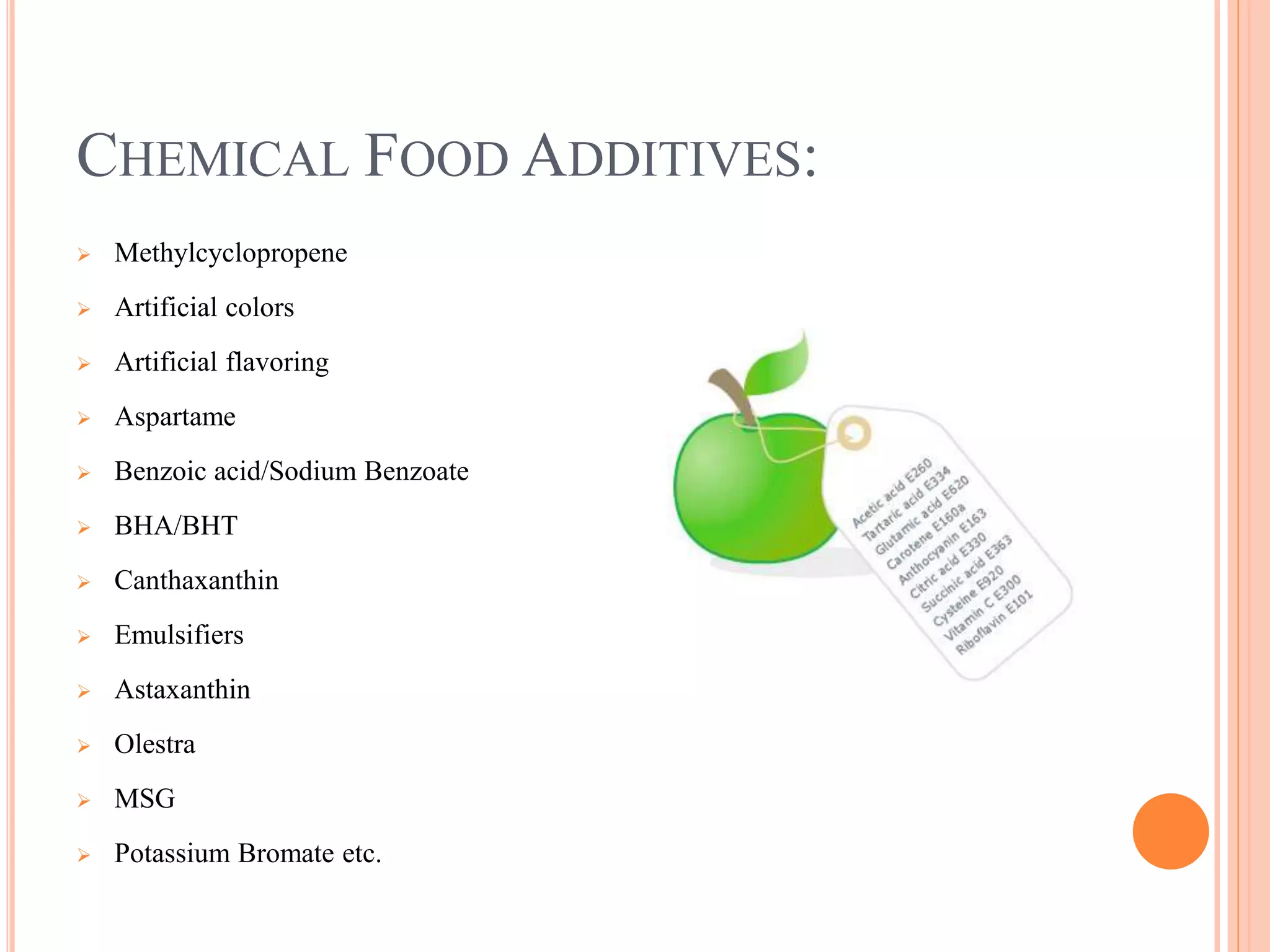
CHEMICAL FOOD ADDITIVES:
 Methylcyclopropene
 Artificial colors
 Artificial flavoring
 Aspartame
 Benzoic acid/Sodium Benzoate
 BHA/BHT
 Canthaxanthin
 Emulsifiers
 Astaxanthin
 Olestra
 MSG
 Potassium Bromate etc.
MAJOR FUNCTIONS
 Impart or maintain consistency
 Improve or maintain nutritional value
 Maintain palatability and wholesomeness
 Produce light texture; control alkalinity and acidity
 Improve sensory properties
 Impart desired color
 Control physical, chemical, and microbiological changes
 Facilitate handling and distribution of food stuff
ROLE IN IMPROVING NUTRITION
 Fortified foods are processed foods that have been ‘fortified’ or had vitamins
and minerals added to them. For example
 Breakfast Cereals
Can be fortified by manufacturers with
B group vitamins, iron & zinc.
 Margarine
Margarine and edible oil based spreads are
required to be fortified with vitamin D.
 Orange Juice
Some brands are fortified with calcium.
NEGATIVE EFFECTS
 Aggravates asthma and suspected to be a neurotoxin and carcinogen.
 Some additive may induce gastric irritation, nausea, diarrhea.
 May temporarily inhibit digestive enzyme function .
 BHA/BHT is may be carcinogenic to humans.
 Destroys nerve cells in brain.
 (HFCS) causes Obesity, Accelerated aging, Insulin sistance, Diabetes
resistance, Diabetes mellitus.
 MSG causes Bronchospasm, Chest pain, rapid heartbeat Headache, nausea,
Headache, nausea, drowsiness.
RECOMMENDATIONS
 The FDA and the United States Department of Agriculture (USDA)
supervise and regulate the use of additives in products sold in the United
States. However, people who have special diets or intolerances should be
careful in selecting products in the grocery store.
 The U.S. government requires everyone that manufactures food to list all
the ingredients on the label.
REFERENCES:
 Gordon M.Wardlaw. (1999), Perspectives in Nutrition, 4th Edition, WCB
McGraw-Hill, Boston Burr Ridge, IL Dubuque, IA Madison, WI New York
San Fransisco St, Louis: Colin H.wheatley.
 J.A. Awan. (2011), Food Processing and Preservation, Unitech
Communications: Faisalabad.
 Marie A.Boyle. (2001), Personal Nutrition, 4th Edition, Wadsworth
Thomson learning, United States of America: Peter Marshall.
Food additives

Food additives

  • 1.
    FOOD ADDITIVES Student At: Departmentof National Institute of Food Science and Technology UNIVERSITY OF AGRICULTURE, Pak
  • 3.
    INTRODUCTION:  Definition: “Any substanceadded to food, including substances used in the production, processing treatment, packaging, transportation, or storage of food.”  Quality assurance certification for food additives is provided by various regulatory bodies such as European Union (EU) and American Food and Drug Administration (FDA) to control the legality of use for all additives.  Food producers use any of 14,000 laboratory-made additives to make food appear fresher, more attractive or last longer on the shelf.
  • 4.
    PURPOSE OF FOODADDITIVES
  • 5.
    TYPES OF FOODADDITIVES On basis of nature, have two types.  Natural : o These are naturally occurring substances. Usually considered harmless. o Include salt, sugar, vinegar, alcohol and rosemary extract.  Artificial: o Comprised of several different types of additives . o These are harmful and are mainly Chemical food additives.
  • 6.
    CONTINUED…. Food additives arealso classified as:  Intentional Food Additives: o Additives knowingly or directly added into food products by manufacturers. o Examples include nutrients, color, spices and herbs.  Incidental Food Additives: o These are the Additives that appear in food products indirectly, from environmental contamination of food ingredients or during the manufacturing process.
  • 7.
    THE GRAS LIST In 1958, all food additives were put on a Generally Recognized as Safe (GRAS) List established by FDA.  A list of food additives that were considered safe for consumption at that time.  The substances present in the GRAS list are known as “GRAS substances”.  Examples: acetic acid, baking soda, caffeine, calcium citrate, citric acid, corn starch, carbon dioxide, sugar, salt and many more.
  • 8.
    TESTING FOOD ADDITIVES Food additives are tested under FDA scrutiny for safety.  No-observable-effect-level (NOEL): The rationale for reducing NOEL by a 100-fold margin is that we assume humans are at least 10 times more sensitive to food additives than are laboratory animals .  Delany Clause: “This Clause prohibits intentionally adding to food a compound that was introduced after 1958 and causes cancer.”  For Incidental food additives, FDA sets an acceptable level .
  • 9.
    OBTAINING APPROVAL FORA NEW FOOD ADDITIVE: Manufacturers must give FDA information that:  Identifies the new additive  Gives its chemical composition  States how it is manufactured  Specifies laboratory methods used to measure its presence in the food supply at the amount of intended use.
  • 10.
    COMMON FOOD ADDITIVES Antimicrobials  Anti-oxidants  Coloring Agents  Emulsifiers  Flavoring Agents  Dietary Supplements  Neutralizing Agents and many others
  • 11.
    CHEMICAL FOOD ADDITIVES: Methylcyclopropene  Artificial colors  Artificial flavoring  Aspartame  Benzoic acid/Sodium Benzoate  BHA/BHT  Canthaxanthin  Emulsifiers  Astaxanthin  Olestra  MSG  Potassium Bromate etc.
  • 12.
    MAJOR FUNCTIONS  Impartor maintain consistency  Improve or maintain nutritional value  Maintain palatability and wholesomeness  Produce light texture; control alkalinity and acidity  Improve sensory properties  Impart desired color  Control physical, chemical, and microbiological changes  Facilitate handling and distribution of food stuff
  • 13.
    ROLE IN IMPROVINGNUTRITION  Fortified foods are processed foods that have been ‘fortified’ or had vitamins and minerals added to them. For example  Breakfast Cereals Can be fortified by manufacturers with B group vitamins, iron & zinc.  Margarine Margarine and edible oil based spreads are required to be fortified with vitamin D.  Orange Juice Some brands are fortified with calcium.
  • 14.
    NEGATIVE EFFECTS  Aggravatesasthma and suspected to be a neurotoxin and carcinogen.  Some additive may induce gastric irritation, nausea, diarrhea.  May temporarily inhibit digestive enzyme function .  BHA/BHT is may be carcinogenic to humans.  Destroys nerve cells in brain.  (HFCS) causes Obesity, Accelerated aging, Insulin sistance, Diabetes resistance, Diabetes mellitus.  MSG causes Bronchospasm, Chest pain, rapid heartbeat Headache, nausea, Headache, nausea, drowsiness.
  • 15.
    RECOMMENDATIONS  The FDAand the United States Department of Agriculture (USDA) supervise and regulate the use of additives in products sold in the United States. However, people who have special diets or intolerances should be careful in selecting products in the grocery store.  The U.S. government requires everyone that manufactures food to list all the ingredients on the label.
  • 16.
    REFERENCES:  Gordon M.Wardlaw.(1999), Perspectives in Nutrition, 4th Edition, WCB McGraw-Hill, Boston Burr Ridge, IL Dubuque, IA Madison, WI New York San Fransisco St, Louis: Colin H.wheatley.  J.A. Awan. (2011), Food Processing and Preservation, Unitech Communications: Faisalabad.  Marie A.Boyle. (2001), Personal Nutrition, 4th Edition, Wadsworth Thomson learning, United States of America: Peter Marshall.