FOOD CONTAMINANTS ANDFOOD CONTAMINANTS AND
NATURALLY OCCURRINGNATURALLY OCCURRING
TOXICANTSTOXICANTS
Monika Jain
Department of Food Science and Nutrition
Banasthali Vidyapith, Rajasthan, India
Monika Jain
Food Contamination- DefinitionFood Contamination- Definition
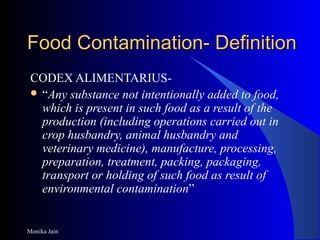
CODEX ALIMENTARIUS-
 “Any substance not intentionally added to food,
which is present in such food as a result of the
production (including operations carried out in
crop husbandry, animal husbandry and
veterinary medicine), manufacture, processing,
preparation, treatment, packing, packaging,
transport or holding of such food as result of
environmental contamination”
Monika Jain
Examples of Food ContaminationExamples of Food Contamination
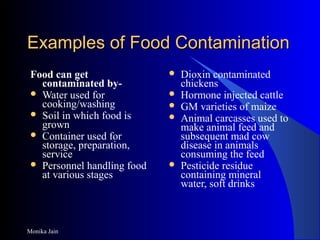
Food can get
contaminated by-
 Water used for
cooking/washing
 Soil in which food is
grown
 Container used for
storage, preparation,
service
 Personnel handling food
at various stages
 Dioxin contaminated
chickens
 Hormone injected cattle
 GM varieties of maize
 Animal carcasses used to
make animal feed and
subsequent mad cow
disease in animals
consuming the feed
 Pesticide residue
containing mineral
water, soft drinks
Monika Jain
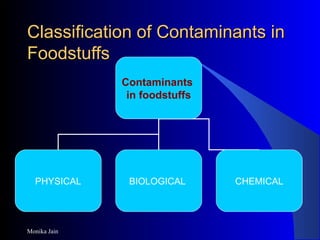
Classification of Contaminants inClassification of Contaminants in
FoodstuffsFoodstuffs
Contaminants
in foodstuffs
PHYSICAL BIOLOGICAL CHEMICAL
Monika Jain
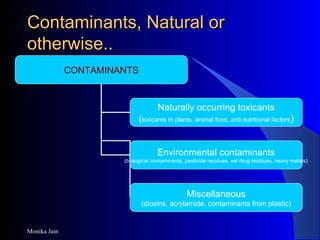
Contaminants, Natural orContaminants, Natural or
otherwise..otherwise..
CONTAMINANTS
Naturally occurring toxicants
(toxicants in plants, animal food, anti nutritional factors)
Environmental contaminants
(biological contaminants, pesticide residues, vet drug residues, heavy metals)
Miscellaneous
(dioxins, acrylamide, contaminants from plastic)
Monika Jain
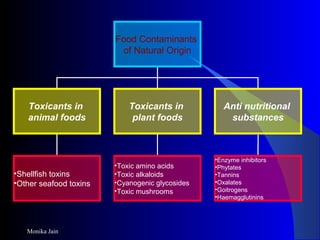
Food Contaminants
of Natural Origin
Toxicants in
animal foods
Toxicants in
plant foods
Anti nutritional
substances
•Shellfish toxins
•Other seafood toxins
•Toxic amino acids
•Toxic alkaloids
•Cyanogenic glycosides
•Toxic mushrooms
•Enzyme inhibitors
•Phytates
•Tannins
•Oxalates
•Goitrogens
•Haemagglutinins
Monika Jain
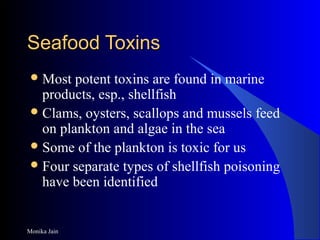
Seafood ToxinsSeafood Toxins
Most potent toxins are found in marine
products, esp., shellfish
Clams, oysters, scallops and mussels feed
on plankton and algae in the sea
Some of the plankton is toxic for us
Four separate types of shellfish poisoning
have been identified
Monika Jain
Types of Shellfish PoisoningTypes of Shellfish Poisoning
 PARALYTIC SP
 Most severe symptoms
of all
 Causative agent is
Saxitoxin
 It is neurotoxin produced
by Gonyaulax catenella
 Symptoms in 30 mins-
headache, floating
feeling, dizziness,
tingling, burning,
numbness, difficulty in
swallowing & speaking.
Death due to paralysis of
resp. sys.
 DIARRHOEIC SP
Mild gastro intestinal
symptoms
 NEUROTOXIC SP
Both gastrointestinal and
neurological symptoms
 AMNESIC SP
Gastrointestinal and
neurologic disorders.
Caused by the presence
of an unusual amino acid
Monika Jain
Other Toxicants Present inOther Toxicants Present in
SeafoodSeafood
Ciguatera toxin, a polyether, is found in
blue algae and protozoans. It’s known to
affect sensory, motor and muscular
activities.
Ingestion of improperly handled and stored
seafood causes Scombroid poisoning.
Maitoxin has been implicated. It releases
neurotransmitters and increases the
contraction of smooth, cardiac and skeletal
muscle.
Monika Jain
Tetrodotoxin (non pr neurotoxin) causes
Pufferfish poisoning. Symptoms are
cardiovascular and neurologic in nature.
Hallucinogenic fish poisoning can occur
with the ingestion of a no. of fish species.
 Miscellaneous shellfish poisonings
include oyster, abalone and red whelk
poisoning. Starfish ingestion may be
associated with nausea and vomiting as a
result of asteritoxin.
Monika Jain
Toxicants in Plant FoodsToxicants in Plant Foods
 Favism- Haemolytic anaemia after consuming
Fava beans. Initial symptoms include headache,
nausea, vomiting, pain and fever. This is
followed by Hb in urine, jaundice and death.
 Gossypol- Toxicant present in cottonseed may
come in cottonseed oil
 Erucic acid- linked to heart disease, is found in
mustard and rapeseed oil.
 Cucurbitacins- Toxin in bitter cucurbits. Results
in symptoms of severe cramps, diarrhoea and
collapse.
Monika Jain
Specific Toxicants found in PlantSpecific Toxicants found in Plant
FoodsFoods
TOXIC AMINO ACIDS
 Lathyrus sativus seeds contain BOAA. It causes
lathyrism.
 It is an excitotoxin, capable of over stimulating
& destroying nerve cells.
 Causes upper motor neuron disease.
 Classical symptom is spastic paraplegia,
paralysis of lower limbs.
 Consumption in lower quantities- painful spasms
in calf muscles, heaviness of lower limbs, pain in
knee and ankle, difficulty in walking.
Monika Jain
TOXIC ALKALOIDSTOXIC ALKALOIDS
 Alkaloids are N heterocycles which occur mainly
in plants as their salts of common carboxylic
acids.
 Potatoes contain glycoalkaloids, eg., solanine.
Consumption causes diarrhoea, vomiting,
abdominal pain, restlessness.
 Consumption of mustard oil with argemone oil
(contains toxic alkaloid sanguinarine) can cause
epidemic dropsy, in which there is oedema over
ankles, gastrointestinal disturbances & vascular
& cardiac complications which can result in
death.
Monika Jain
CYANOGENIC GLYCOSIDESCYANOGENIC GLYCOSIDES
Cassava is a rich source of CG
(Linamarin). It may be hydrolysed
chemically or enzymatically to yield the
poisonous hydrogen cyanide.
Acute cassava poisoning- headache,
breathlessness, gasping, paralysis, muscle
weakness, coma & death.
Lima beans contain cyanide precursors.
These inhibit oxidative processes of cells.
Monika Jain
MUSHROOM POISONINGMUSHROOM POISONING
Caused by consumption of raw or cooked
fruiting bodies of a no. of species of higher
fungi. Four types-
Protoplasmic poisons
Neurotoxins
Gastrointestinal irritants
Disulfirum- like toxins
Monika Jain
Anti Nutritional Factors in FoodAnti Nutritional Factors in Food
Interfere with the assimilation of nutrients
in the body
Protease inhibitors
Phytates
Oxalates
Tannins
Lectins
Goitogens
Monika Jain
Protease InhibitorsProtease Inhibitors
Interfere with the action of trypsin and
chymotrypsin
Found in oats, wheat, barley, maize, onion,
beetroot, peanuts
Trypsin inhibitors are found in legmes,
white of an egg
Raw soyabeans have high levels of TI.
These can cause growth retardation &
hypertrophy of pancreas.
Monika Jain
HaemagglutininsHaemagglutinins
 Globulin type of proteins
 Present in field bean, white bean, horse gram
 Have the property of agglutinating RBCs
 Agglutinins combine with the cell lining of
intestinal wall & thus interfere with nutrient
absorption
 Symptoms are nausea, vomiting , diarrhoea,
growth depression, decreased food intake, death.
Monika Jain
PhytatesPhytates
Unrefined cereals and millets are richest
sources of phytates
Phytates in cereals form insoluble
complexes with minerals such as Fe, Mg,
Zn & Ca & contibute to their poor
absorption from cereal based diets
Germination and overnight soaking reduce
phytate content
Monika Jain
TanninsTannins
 Interfere with the absorption of iron and reduce
the availability of proteins by binding to them
 Present in high amounts in seed coat of most
legumes, spices, tamarind, turmeric, certain
vegetables, fruits and particularly teaa
 A typical Indian diet may contain 2-3 g of
tannins
 Removal of seed coat of legumes, exclusion of
tamarind, avoiding tea with meals improve iron
absorption & reduce tannin content
Monika Jain
OxalatesOxalates
Mostly present in form of Ca salts
Interfere with Ca absorption
Hyperoxaluria- kidney stones
Rich sources are GLVs & some legumes
like horse gram & kesari dhal
Monika Jain
Goitrogens/Anti ThyroidGoitrogens/Anti Thyroid
SubstancesSubstances
Interfere with the uptake of iodine by the
thyroid gland
Can contribute to development of IDD
when I intakes are marginal
Thiocyanates, isothiocyanates & their
derivatives are the chief goitrogens present
in leaves & vegetables belonging to
Brassica genus & family Cruciferae
Monika Jain
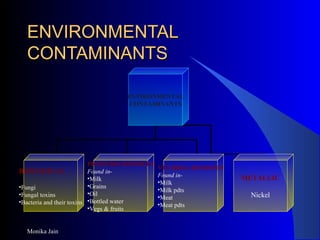
ENVIRONMENTALENVIRONMENTAL
CONTAMINANTSCONTAMINANTS
ENVIRONMENTAL
CONTAMINANTS
BIOLOGICAL
•Fungi
•Fungal toxins
•Bacteria and their toxins
PESTICIDE RESIDUES
Found in-
•Milk
•Grains
•Oil
•Bottled water
•Vegs & fruits
VET DRUG RESIDUES
Found in-
•Milk
•Milk pdts
•Meat
•Meat pdts
METALLIC
Nickel
Monika Jain

Food contaminants

  • 1.
    FOOD CONTAMINANTS ANDFOODCONTAMINANTS AND NATURALLY OCCURRINGNATURALLY OCCURRING TOXICANTSTOXICANTS Monika Jain Department of Food Science and Nutrition Banasthali Vidyapith, Rajasthan, India
  • 2.
    Monika Jain Food Contamination-DefinitionFood Contamination- Definition CODEX ALIMENTARIUS-  “Any substance not intentionally added to food, which is present in such food as a result of the production (including operations carried out in crop husbandry, animal husbandry and veterinary medicine), manufacture, processing, preparation, treatment, packing, packaging, transport or holding of such food as result of environmental contamination”
  • 3.
    Monika Jain Examples ofFood ContaminationExamples of Food Contamination Food can get contaminated by-  Water used for cooking/washing  Soil in which food is grown  Container used for storage, preparation, service  Personnel handling food at various stages  Dioxin contaminated chickens  Hormone injected cattle  GM varieties of maize  Animal carcasses used to make animal feed and subsequent mad cow disease in animals consuming the feed  Pesticide residue containing mineral water, soft drinks
  • 4.
    Monika Jain Classification ofContaminants inClassification of Contaminants in FoodstuffsFoodstuffs Contaminants in foodstuffs PHYSICAL BIOLOGICAL CHEMICAL
  • 5.
    Monika Jain Contaminants, NaturalorContaminants, Natural or otherwise..otherwise.. CONTAMINANTS Naturally occurring toxicants (toxicants in plants, animal food, anti nutritional factors) Environmental contaminants (biological contaminants, pesticide residues, vet drug residues, heavy metals) Miscellaneous (dioxins, acrylamide, contaminants from plastic)
  • 6.
    Monika Jain Food Contaminants ofNatural Origin Toxicants in animal foods Toxicants in plant foods Anti nutritional substances •Shellfish toxins •Other seafood toxins •Toxic amino acids •Toxic alkaloids •Cyanogenic glycosides •Toxic mushrooms •Enzyme inhibitors •Phytates •Tannins •Oxalates •Goitrogens •Haemagglutinins
  • 7.
    Monika Jain Seafood ToxinsSeafoodToxins Most potent toxins are found in marine products, esp., shellfish Clams, oysters, scallops and mussels feed on plankton and algae in the sea Some of the plankton is toxic for us Four separate types of shellfish poisoning have been identified
  • 8.
    Monika Jain Types ofShellfish PoisoningTypes of Shellfish Poisoning  PARALYTIC SP  Most severe symptoms of all  Causative agent is Saxitoxin  It is neurotoxin produced by Gonyaulax catenella  Symptoms in 30 mins- headache, floating feeling, dizziness, tingling, burning, numbness, difficulty in swallowing & speaking. Death due to paralysis of resp. sys.  DIARRHOEIC SP Mild gastro intestinal symptoms  NEUROTOXIC SP Both gastrointestinal and neurological symptoms  AMNESIC SP Gastrointestinal and neurologic disorders. Caused by the presence of an unusual amino acid
  • 9.
    Monika Jain Other ToxicantsPresent inOther Toxicants Present in SeafoodSeafood Ciguatera toxin, a polyether, is found in blue algae and protozoans. It’s known to affect sensory, motor and muscular activities. Ingestion of improperly handled and stored seafood causes Scombroid poisoning. Maitoxin has been implicated. It releases neurotransmitters and increases the contraction of smooth, cardiac and skeletal muscle.
  • 10.
    Monika Jain Tetrodotoxin (nonpr neurotoxin) causes Pufferfish poisoning. Symptoms are cardiovascular and neurologic in nature. Hallucinogenic fish poisoning can occur with the ingestion of a no. of fish species.  Miscellaneous shellfish poisonings include oyster, abalone and red whelk poisoning. Starfish ingestion may be associated with nausea and vomiting as a result of asteritoxin.
  • 11.
    Monika Jain Toxicants inPlant FoodsToxicants in Plant Foods  Favism- Haemolytic anaemia after consuming Fava beans. Initial symptoms include headache, nausea, vomiting, pain and fever. This is followed by Hb in urine, jaundice and death.  Gossypol- Toxicant present in cottonseed may come in cottonseed oil  Erucic acid- linked to heart disease, is found in mustard and rapeseed oil.  Cucurbitacins- Toxin in bitter cucurbits. Results in symptoms of severe cramps, diarrhoea and collapse.
  • 12.
    Monika Jain Specific Toxicantsfound in PlantSpecific Toxicants found in Plant FoodsFoods TOXIC AMINO ACIDS  Lathyrus sativus seeds contain BOAA. It causes lathyrism.  It is an excitotoxin, capable of over stimulating & destroying nerve cells.  Causes upper motor neuron disease.  Classical symptom is spastic paraplegia, paralysis of lower limbs.  Consumption in lower quantities- painful spasms in calf muscles, heaviness of lower limbs, pain in knee and ankle, difficulty in walking.
  • 13.
    Monika Jain TOXIC ALKALOIDSTOXICALKALOIDS  Alkaloids are N heterocycles which occur mainly in plants as their salts of common carboxylic acids.  Potatoes contain glycoalkaloids, eg., solanine. Consumption causes diarrhoea, vomiting, abdominal pain, restlessness.  Consumption of mustard oil with argemone oil (contains toxic alkaloid sanguinarine) can cause epidemic dropsy, in which there is oedema over ankles, gastrointestinal disturbances & vascular & cardiac complications which can result in death.
  • 14.
    Monika Jain CYANOGENIC GLYCOSIDESCYANOGENICGLYCOSIDES Cassava is a rich source of CG (Linamarin). It may be hydrolysed chemically or enzymatically to yield the poisonous hydrogen cyanide. Acute cassava poisoning- headache, breathlessness, gasping, paralysis, muscle weakness, coma & death. Lima beans contain cyanide precursors. These inhibit oxidative processes of cells.
  • 15.
    Monika Jain MUSHROOM POISONINGMUSHROOMPOISONING Caused by consumption of raw or cooked fruiting bodies of a no. of species of higher fungi. Four types- Protoplasmic poisons Neurotoxins Gastrointestinal irritants Disulfirum- like toxins
  • 16.
    Monika Jain Anti NutritionalFactors in FoodAnti Nutritional Factors in Food Interfere with the assimilation of nutrients in the body Protease inhibitors Phytates Oxalates Tannins Lectins Goitogens
  • 17.
    Monika Jain Protease InhibitorsProteaseInhibitors Interfere with the action of trypsin and chymotrypsin Found in oats, wheat, barley, maize, onion, beetroot, peanuts Trypsin inhibitors are found in legmes, white of an egg Raw soyabeans have high levels of TI. These can cause growth retardation & hypertrophy of pancreas.
  • 18.
    Monika Jain HaemagglutininsHaemagglutinins  Globulintype of proteins  Present in field bean, white bean, horse gram  Have the property of agglutinating RBCs  Agglutinins combine with the cell lining of intestinal wall & thus interfere with nutrient absorption  Symptoms are nausea, vomiting , diarrhoea, growth depression, decreased food intake, death.
  • 19.
    Monika Jain PhytatesPhytates Unrefined cerealsand millets are richest sources of phytates Phytates in cereals form insoluble complexes with minerals such as Fe, Mg, Zn & Ca & contibute to their poor absorption from cereal based diets Germination and overnight soaking reduce phytate content
  • 20.
    Monika Jain TanninsTannins  Interferewith the absorption of iron and reduce the availability of proteins by binding to them  Present in high amounts in seed coat of most legumes, spices, tamarind, turmeric, certain vegetables, fruits and particularly teaa  A typical Indian diet may contain 2-3 g of tannins  Removal of seed coat of legumes, exclusion of tamarind, avoiding tea with meals improve iron absorption & reduce tannin content
  • 21.
    Monika Jain OxalatesOxalates Mostly presentin form of Ca salts Interfere with Ca absorption Hyperoxaluria- kidney stones Rich sources are GLVs & some legumes like horse gram & kesari dhal
  • 22.
    Monika Jain Goitrogens/Anti ThyroidGoitrogens/AntiThyroid SubstancesSubstances Interfere with the uptake of iodine by the thyroid gland Can contribute to development of IDD when I intakes are marginal Thiocyanates, isothiocyanates & their derivatives are the chief goitrogens present in leaves & vegetables belonging to Brassica genus & family Cruciferae
  • 23.
    Monika Jain ENVIRONMENTALENVIRONMENTAL CONTAMINANTSCONTAMINANTS ENVIRONMENTAL CONTAMINANTS BIOLOGICAL •Fungi •Fungal toxins •Bacteriaand their toxins PESTICIDE RESIDUES Found in- •Milk •Grains •Oil •Bottled water •Vegs & fruits VET DRUG RESIDUES Found in- •Milk •Milk pdts •Meat •Meat pdts METALLIC Nickel
  • 24.