DOMESTIC
REGULATIONS
AKANKSHA
M.SC. FOOD TECHNOLOGY
22412FST001
Food Standards
 Food standard are something that are set up by
expert or an authority for measuring quantity,
weight, extent, value and quality of substance.
Food laws implemented for 2 reasons : –
 (1) Regulation of specification of food
 (2) Regulation of hygienic conditions of
processing/manufacturing.
Objective of food laws and regulation
 The main objective of formulating Food Laws in India was to ensure proper
hygiene and gain proper market access.
 To meet a country’s sanitary and phytosanitary requirements, food must
comply with the local laws and regulations to gain market access.
 These laws ensure the safety and suitability of food for consumers.
 FSSAI was formulated for the purpose of laying down science-based
standards for articles of food and to regulate their manufacture, storage,
distribution, sale, and import. It is also framed to ensure the availability of
safe and wholesome food for human consumption.
NATIONAL
ORGANIZATION
GOVERNING FOOD
INDUSTRY IN INDIA
AGMARK (AGRICULTURE MARKING)
 The word AGMARK is derived from Agricultural marketing.
 The AGMARK standard was set up by Directorate of Marketing &
Inspection (DMI) under the Ministry of Agriculture and Farmers Welfare, of
the Government of India for agricultural products in 1937.
 AGMARK Head quarter is now at Faridabad and branched head quarter is
at Nagpur.
 It covers quality guidelines for more than 200 different commodities
ranging from pulses to cereals, from essential oils to semi-processed food
like vermicelli.
 Agricultural commodities are categorized into various grades such as
Special, good, fair, ordinary etc depending upon the degree of quality in
each case.
OBJECTIVE OF AGMARK
 The Objectives of AGMARK is -
i. To assure the consumers a product of pre-
tested quality & purity.
ii. To enable the producer of good quality
products to have better returns.
iii. To have a sale of the product in the market with
a uniform composition and well defined quality.
iv. To eliminate the malpractice of adulteration in
the movement of the product from producer to
consumer.
AGMARK LABELLING
 Before affixing AGMARK label, there are 4 stages:-
I. Preliminary testing
II. From the product, inspecting officer take the samples.
III. Technically qualified and experienced officers test the samples
and assign AGMARK quality grades.
IV. Afterwards commodity is packed using AGMARK label or
AGMARK replica on pouches/ containers.
 Even after sending the distributing markets, AGMARK products are
subjected to continuous inspection.
BIS (Bureau of Indian Standards)
 BIS came into existence from 1st April, 1987 under the
BIS Act 1986.
 It is a national standards body of India – responsible
for formulating National Standards for various types
of articles (both edible & non-edible e.g. Live stock
feed, cattle housing, Equipment, dairy products, food
additives, food hygiene), testing apparatus and
methods etc.
 The old name of this organization was ISI (Indian
Standards Institution), which was established in 1947.
ORGANIZATIONAL NETWORK
 It has five Regional Offices (ROs) located at
 Chandigarh (Northern),
 Mumbai (Western),
 Chennai (Southern), Kolkata (Eastern) and Delhi (Central) and
main headquarter is located at New Delhi. Under regional
offices there are various Branch Offices (BOs). These branch
offices are responsible for maintaining the link between the
State Governments, technical institutions, companies and
consumer organizations etc and they are located at different 28
locations namely Ahmadabad, Bhubaneswar, Bengaluru,
Chandigarh, Chennai, Delhi, Dehradun, Durgapur, Faridabad,
Guwahati, Ghaziabad, Hyderabad, Jammu, Jamshedpur, Jaipur,
Kolkata, Kochi, Lucknow, Mumbai, Nagpur, Pune, Patna, Rajkot,
Raipur and Vishakhapatnam.
Continued
 BIS is involved in :-
 Standards Formulation
 Product Certification Scheme
 Hall Marking Scheme, 2000
 Laboratory Services (8)
 Laboratory Recognition Scheme
 Sale of Indian Standards
 Consumer Affairs Activities
 Promotional Activities
 Training Services, NITS
 Information Services
FSSA,2006
 This act was introduced in 2006 but came into force in 2011.
 It protects consumer health and ensured the production of good quality of food. It also regulates
the matters related to the import of food, functions allotted to the authorities, penalties and
surveillance etc.
FOOD LAWS IMPLEMENTING MINISTRY AREA OF FOOD
PFA .1954 MINISTRY OF HEALTH AND FAMILY
WELFARE, DIRECTORATE GENERAL OF
HEALTH SERVICES
ALL FOOD COMMODITY
FPO,1955 MINISTRY OF FOOD PROCESSING,
GOVT. OF INDIA FOOD AND
NUTRITION BOARD
ALL FRUITS AND FRUIT BEVERAGES
MFPO, 1973 MINISTRY OF AGRICULTURE AND
RURAL DEVELOPMENT, DIRECTORATE
OF MARKETING AND INSPECTION
ALL MEAT AND MEAT PRODUCTS.
VEGETABLE OIL PRODUCTS
(CONTROL) ORDER ,1947
MINISTRY OF INDUSTRY, GOVT. OF
INDIA. DIRECTORATE OF VANASPATI
VANASPATI AND EDIBLE OILS USED
FOR HYDROGENATION
EDIBLE OILS PACKAGING
(REGULATION) ORDER 1998
MINISTRY OF CIVIL SUPPLIES AND
CONSUMER AFFAIRS
ALL EDIBLE OIL PRODUCTS
SOLVENT EXTRACTED OIL, DE-OILED
MEAL AND EDIBLE FLOUR ORDER,
1967
MINISTRY OF CIVIL SUPPLIES AND
CONSUMER AFFAIRS
ALL EDIBLE OILS/FLOURS AND
SIMILAR PRODUCTS
MILK AND MILK PRODUCTS ORDER,
1992
MINISTRY OF AGRICULTURE, GOVT.
OF INDIA, MILK AND MILK
PRODUCTS ADVISORY BOARD
ALL MILK PRODUCTS AND FLUID
MILK
PREVENTION OF FOOD ADULTERATION
 Fresh, pure and nutritious food is most important for the health as it
prevents malnutrition But most of food gets adulterated to make more
profit and to increase its quantity while reducing its quality by the addition of
inferior substances replacing the valuable ones.
OBJECTIVE -
 To make provision for the prevention of adulteration of food.
 To preventing import, manufacture, sale or distribution of adulterated and
misbranded food
 To prevent all types of food adulterations
ADMINISTRATIVE BODIES
 1. CENTRAL COMMITTEE FOR FOOD STANDARDS (CCFS)
 2. CENTRAL FOOD LABORATORY
 3. PUBLIC ANALYST
 4. FOOD INSPECTOR
FRUIT PRODUCT ORDER (FPO),1955
 Promulgated under section 3 of Essential
Commodities Act,1955.
 Enforced by Directorate of Fruit and vegetable
processing, FSSAI.
 To manufacture fruit & vegetable products FPO
license is required.
 Covers all fruit & vegetable products and also
some non fruit products like syrup, vinegar, SAW.
 License is granted after fulfillment of sanitary &
hygienic requirement
SANITARY AND HYGIENIC
REQUIREMENT
 SURROUNDING
 CONSTRUCTION
 PREMISES
 STORAGE
 MACHINERY AND EQUIPMENT
 POTABLE WATER
 PERSONNEL HYGIENE
 CLEANING OF PROCESSING HALL
MACHINERY & EQUIPMENTS
 Washing of raw materials, bottles etc.
 Preparation of foods & vegetables
 Extraction of Juice/ Pulp
 Heat Processing
 Filling & Sealing ,
 Blanching, Exhausting, Processing etc.
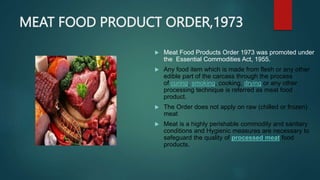
MEAT FOOD PRODUCT ORDER,1973
 Meat Food Products Order 1973 was promoted under
the Essential Commodities Act, 1955.
 Any food item which is made from flesh or any other
edible part of the carcass through the process
of curing, smoking, cooking, drying or any other
processing technique is referred as meat food
product.
 The Order does not apply on raw (chilled or frozen)
meat
 Meat is a highly perishable commodity and sanitary
conditions and Hygienic measures are necessary to
safeguard the quality of processed meat food
products.
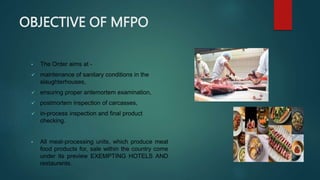
OBJECTIVE OF MFPO
• The Order aims at -
 maintenance of sanitary conditions in the
slaughterhouses,
 ensuring proper antemortem examination,
 postmortem inspection of carcasses,
 in-process inspection and final product
checking.
• All meat-processing units, which produce meat
food products for, sale within the country come
under its preview EXEMPTING HOTELS AND
restaurents.
VEGETABLE OIL PRODUCTS ORDER
(CONTROL), 1947
 With growing population the consumption rate of vegetable oil is
increased rapidly.
 In 2017 it was reached at 23 million tons and expected to exceed 34 million
tons by 2030.
 Most of oil varieties including soy oil, palm oil and sunflower oil are
imported from Malaysia, Indonesia and South America.
 To fulfill the consumers demand and to enhance oil production rate
government replaced the Vegetable Oil Products (Control) Order, 1947 and
Vegetable Oil Products (Standards of Quality) Order, 1975 by Vegetable Oil
Products (Regulation) Order, 1998.
 It properly regulates the processing of oil products through Directorate of
Vanaspati, Vegetable oils and Fats, Department of Food and Public
Distribution.
THE SOLVENT EXTRACTED OIL, DE OILED
MEAL, AND EDIBLE FLOUR (CONTROL)
ORDER, 1967
 To satisfy the demand of growing population large amount of oil cakes
(castor, peanut, sunflower, cottonseed, linseed) are processed.
 Extraction of oil from oil-bearing substances includes the use of solvents
like hexane to achieve highest oil yield.
 So, Solvent Extracted Oil, De oiled Meal, and Edible Flour (Control) Order,
1967 set quality standards to provide consumer protection by inhibit the
use of oil without get refined.
 It also defines standards for the use of solvent (hexane) during the oil
extraction process and regulates the manufacturing and transportation of
solvent extracted oils etc.
MILK AND MILK PRODUCT ORDER
 To maintain & increase the supply of liquid milk of
desired quality in the country and to regulate
production , supply and distribution of milk & milk
products MMPO-92 was promulgated on 09.06.1992
under Section 3 of EC Act,1955.
 Earlier the MMPO was implemented by Dept. of
Animal Husbandry, Dairying & Fisheries, Ministry of
Agriculture, Government of India, presently it is
implemented by FSSAI, Ministry of Health & Family
Welfare, GOI.
FOOD SAFETY AND STANDARDS
AUTHORITY OF INDIA (FSSAI)
 • It has been established under food safety and standards act 2006, which
consolidates various acts and orders that have hitherto and handled food
related issues in various ministries departments.
 FSSAI has been created for laying down science based standards for their
manufacture, storage, distribution, sale and import to ensure availability of
safe and wholesome food for human consumption.
REGISTRATION AND LICENSING
 First step to get FSSAI License and
FSSL number is registration and it
will take 32- 52 working days. Main
types of FSSAI License – Basic,
State and Central License.
 The license validity is 1-5 years and
its renewal is possible.
 The basic registration documents
will include latest passport sized
photographs, identification proof
(PAN card), a copy of Property
papers and rental agreement.
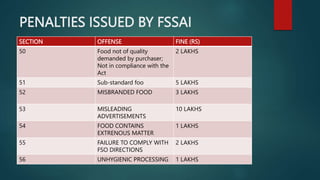
PENALTIES ISSUED BY FSSAI
SECTION OFFENSE FINE (RS)
50 Food not of quality
demanded by purchaser;
Not in compliance with the
Act
2 LAKHS
51 Sub-standard foo 5 LAKHS
52 MISBRANDED FOOD 3 LAKHS
53 MISLEADING
ADVERTISEMENTS
10 LAKHS
54 FOOD CONTAINS
EXTRENOUS MATTER
1 LAKHS
55 FAILURE TO COMPLY WITH
FSO DIRECTIONS
2 LAKHS
56 UNHYGIENIC PROCESSING 1 LAKHS
REFERENCES
 Chengappa, P.G. (2004). Emerging trends in agro-processing in
India. Indian Journal of Agricultural Economics, 59(902-2016-68029).
 Dudeja, P., & Singh, A. (2017). Role of government authorities in food
safety. In Food Safety in the 21st Century (pp. 243-256). Academic Press.
 FSSAI (Food Safety and Standards Authority of India). About FSSAI. 2011
 Trienekens, J., & Zuurbier, P. (2008). Quality and safety standards in the
food industry, developments and challenges. International Journal of
Production Economics, 113(1), 107- 122
Food safety assignment.pptx

Food safety assignment.pptx

  • 1.
  • 2.
    Food Standards  Foodstandard are something that are set up by expert or an authority for measuring quantity, weight, extent, value and quality of substance. Food laws implemented for 2 reasons : –  (1) Regulation of specification of food  (2) Regulation of hygienic conditions of processing/manufacturing.
  • 3.
    Objective of foodlaws and regulation  The main objective of formulating Food Laws in India was to ensure proper hygiene and gain proper market access.  To meet a country’s sanitary and phytosanitary requirements, food must comply with the local laws and regulations to gain market access.  These laws ensure the safety and suitability of food for consumers.  FSSAI was formulated for the purpose of laying down science-based standards for articles of food and to regulate their manufacture, storage, distribution, sale, and import. It is also framed to ensure the availability of safe and wholesome food for human consumption.
  • 4.
  • 5.
    AGMARK (AGRICULTURE MARKING) The word AGMARK is derived from Agricultural marketing.  The AGMARK standard was set up by Directorate of Marketing & Inspection (DMI) under the Ministry of Agriculture and Farmers Welfare, of the Government of India for agricultural products in 1937.  AGMARK Head quarter is now at Faridabad and branched head quarter is at Nagpur.  It covers quality guidelines for more than 200 different commodities ranging from pulses to cereals, from essential oils to semi-processed food like vermicelli.  Agricultural commodities are categorized into various grades such as Special, good, fair, ordinary etc depending upon the degree of quality in each case.
  • 6.
    OBJECTIVE OF AGMARK The Objectives of AGMARK is - i. To assure the consumers a product of pre- tested quality & purity. ii. To enable the producer of good quality products to have better returns. iii. To have a sale of the product in the market with a uniform composition and well defined quality. iv. To eliminate the malpractice of adulteration in the movement of the product from producer to consumer.
  • 7.
    AGMARK LABELLING  Beforeaffixing AGMARK label, there are 4 stages:- I. Preliminary testing II. From the product, inspecting officer take the samples. III. Technically qualified and experienced officers test the samples and assign AGMARK quality grades. IV. Afterwards commodity is packed using AGMARK label or AGMARK replica on pouches/ containers.  Even after sending the distributing markets, AGMARK products are subjected to continuous inspection.
  • 8.
    BIS (Bureau ofIndian Standards)  BIS came into existence from 1st April, 1987 under the BIS Act 1986.  It is a national standards body of India – responsible for formulating National Standards for various types of articles (both edible & non-edible e.g. Live stock feed, cattle housing, Equipment, dairy products, food additives, food hygiene), testing apparatus and methods etc.  The old name of this organization was ISI (Indian Standards Institution), which was established in 1947.
  • 9.
    ORGANIZATIONAL NETWORK  Ithas five Regional Offices (ROs) located at  Chandigarh (Northern),  Mumbai (Western),  Chennai (Southern), Kolkata (Eastern) and Delhi (Central) and main headquarter is located at New Delhi. Under regional offices there are various Branch Offices (BOs). These branch offices are responsible for maintaining the link between the State Governments, technical institutions, companies and consumer organizations etc and they are located at different 28 locations namely Ahmadabad, Bhubaneswar, Bengaluru, Chandigarh, Chennai, Delhi, Dehradun, Durgapur, Faridabad, Guwahati, Ghaziabad, Hyderabad, Jammu, Jamshedpur, Jaipur, Kolkata, Kochi, Lucknow, Mumbai, Nagpur, Pune, Patna, Rajkot, Raipur and Vishakhapatnam.
  • 10.
    Continued  BIS isinvolved in :-  Standards Formulation  Product Certification Scheme  Hall Marking Scheme, 2000  Laboratory Services (8)  Laboratory Recognition Scheme  Sale of Indian Standards  Consumer Affairs Activities  Promotional Activities  Training Services, NITS  Information Services
  • 11.
    FSSA,2006  This actwas introduced in 2006 but came into force in 2011.  It protects consumer health and ensured the production of good quality of food. It also regulates the matters related to the import of food, functions allotted to the authorities, penalties and surveillance etc.
  • 12.
    FOOD LAWS IMPLEMENTINGMINISTRY AREA OF FOOD PFA .1954 MINISTRY OF HEALTH AND FAMILY WELFARE, DIRECTORATE GENERAL OF HEALTH SERVICES ALL FOOD COMMODITY FPO,1955 MINISTRY OF FOOD PROCESSING, GOVT. OF INDIA FOOD AND NUTRITION BOARD ALL FRUITS AND FRUIT BEVERAGES MFPO, 1973 MINISTRY OF AGRICULTURE AND RURAL DEVELOPMENT, DIRECTORATE OF MARKETING AND INSPECTION ALL MEAT AND MEAT PRODUCTS. VEGETABLE OIL PRODUCTS (CONTROL) ORDER ,1947 MINISTRY OF INDUSTRY, GOVT. OF INDIA. DIRECTORATE OF VANASPATI VANASPATI AND EDIBLE OILS USED FOR HYDROGENATION EDIBLE OILS PACKAGING (REGULATION) ORDER 1998 MINISTRY OF CIVIL SUPPLIES AND CONSUMER AFFAIRS ALL EDIBLE OIL PRODUCTS SOLVENT EXTRACTED OIL, DE-OILED MEAL AND EDIBLE FLOUR ORDER, 1967 MINISTRY OF CIVIL SUPPLIES AND CONSUMER AFFAIRS ALL EDIBLE OILS/FLOURS AND SIMILAR PRODUCTS MILK AND MILK PRODUCTS ORDER, 1992 MINISTRY OF AGRICULTURE, GOVT. OF INDIA, MILK AND MILK PRODUCTS ADVISORY BOARD ALL MILK PRODUCTS AND FLUID MILK
  • 13.
    PREVENTION OF FOODADULTERATION  Fresh, pure and nutritious food is most important for the health as it prevents malnutrition But most of food gets adulterated to make more profit and to increase its quantity while reducing its quality by the addition of inferior substances replacing the valuable ones. OBJECTIVE -  To make provision for the prevention of adulteration of food.  To preventing import, manufacture, sale or distribution of adulterated and misbranded food  To prevent all types of food adulterations
  • 14.
    ADMINISTRATIVE BODIES  1.CENTRAL COMMITTEE FOR FOOD STANDARDS (CCFS)  2. CENTRAL FOOD LABORATORY  3. PUBLIC ANALYST  4. FOOD INSPECTOR
  • 15.
    FRUIT PRODUCT ORDER(FPO),1955  Promulgated under section 3 of Essential Commodities Act,1955.  Enforced by Directorate of Fruit and vegetable processing, FSSAI.  To manufacture fruit & vegetable products FPO license is required.  Covers all fruit & vegetable products and also some non fruit products like syrup, vinegar, SAW.  License is granted after fulfillment of sanitary & hygienic requirement
  • 16.
    SANITARY AND HYGIENIC REQUIREMENT SURROUNDING  CONSTRUCTION  PREMISES  STORAGE  MACHINERY AND EQUIPMENT  POTABLE WATER  PERSONNEL HYGIENE  CLEANING OF PROCESSING HALL
  • 17.
    MACHINERY & EQUIPMENTS Washing of raw materials, bottles etc.  Preparation of foods & vegetables  Extraction of Juice/ Pulp  Heat Processing  Filling & Sealing ,  Blanching, Exhausting, Processing etc.
  • 18.
    MEAT FOOD PRODUCTORDER,1973  Meat Food Products Order 1973 was promoted under the Essential Commodities Act, 1955.  Any food item which is made from flesh or any other edible part of the carcass through the process of curing, smoking, cooking, drying or any other processing technique is referred as meat food product.  The Order does not apply on raw (chilled or frozen) meat  Meat is a highly perishable commodity and sanitary conditions and Hygienic measures are necessary to safeguard the quality of processed meat food products.
  • 19.
    OBJECTIVE OF MFPO •The Order aims at -  maintenance of sanitary conditions in the slaughterhouses,  ensuring proper antemortem examination,  postmortem inspection of carcasses,  in-process inspection and final product checking. • All meat-processing units, which produce meat food products for, sale within the country come under its preview EXEMPTING HOTELS AND restaurents.
  • 20.
    VEGETABLE OIL PRODUCTSORDER (CONTROL), 1947  With growing population the consumption rate of vegetable oil is increased rapidly.  In 2017 it was reached at 23 million tons and expected to exceed 34 million tons by 2030.  Most of oil varieties including soy oil, palm oil and sunflower oil are imported from Malaysia, Indonesia and South America.  To fulfill the consumers demand and to enhance oil production rate government replaced the Vegetable Oil Products (Control) Order, 1947 and Vegetable Oil Products (Standards of Quality) Order, 1975 by Vegetable Oil Products (Regulation) Order, 1998.  It properly regulates the processing of oil products through Directorate of Vanaspati, Vegetable oils and Fats, Department of Food and Public Distribution.
  • 21.
    THE SOLVENT EXTRACTEDOIL, DE OILED MEAL, AND EDIBLE FLOUR (CONTROL) ORDER, 1967  To satisfy the demand of growing population large amount of oil cakes (castor, peanut, sunflower, cottonseed, linseed) are processed.  Extraction of oil from oil-bearing substances includes the use of solvents like hexane to achieve highest oil yield.  So, Solvent Extracted Oil, De oiled Meal, and Edible Flour (Control) Order, 1967 set quality standards to provide consumer protection by inhibit the use of oil without get refined.  It also defines standards for the use of solvent (hexane) during the oil extraction process and regulates the manufacturing and transportation of solvent extracted oils etc.
  • 22.
    MILK AND MILKPRODUCT ORDER  To maintain & increase the supply of liquid milk of desired quality in the country and to regulate production , supply and distribution of milk & milk products MMPO-92 was promulgated on 09.06.1992 under Section 3 of EC Act,1955.  Earlier the MMPO was implemented by Dept. of Animal Husbandry, Dairying & Fisheries, Ministry of Agriculture, Government of India, presently it is implemented by FSSAI, Ministry of Health & Family Welfare, GOI.
  • 23.
    FOOD SAFETY ANDSTANDARDS AUTHORITY OF INDIA (FSSAI)  • It has been established under food safety and standards act 2006, which consolidates various acts and orders that have hitherto and handled food related issues in various ministries departments.  FSSAI has been created for laying down science based standards for their manufacture, storage, distribution, sale and import to ensure availability of safe and wholesome food for human consumption.
  • 24.
    REGISTRATION AND LICENSING First step to get FSSAI License and FSSL number is registration and it will take 32- 52 working days. Main types of FSSAI License – Basic, State and Central License.  The license validity is 1-5 years and its renewal is possible.  The basic registration documents will include latest passport sized photographs, identification proof (PAN card), a copy of Property papers and rental agreement.
  • 25.
    PENALTIES ISSUED BYFSSAI SECTION OFFENSE FINE (RS) 50 Food not of quality demanded by purchaser; Not in compliance with the Act 2 LAKHS 51 Sub-standard foo 5 LAKHS 52 MISBRANDED FOOD 3 LAKHS 53 MISLEADING ADVERTISEMENTS 10 LAKHS 54 FOOD CONTAINS EXTRENOUS MATTER 1 LAKHS 55 FAILURE TO COMPLY WITH FSO DIRECTIONS 2 LAKHS 56 UNHYGIENIC PROCESSING 1 LAKHS
  • 26.
    REFERENCES  Chengappa, P.G.(2004). Emerging trends in agro-processing in India. Indian Journal of Agricultural Economics, 59(902-2016-68029).  Dudeja, P., & Singh, A. (2017). Role of government authorities in food safety. In Food Safety in the 21st Century (pp. 243-256). Academic Press.  FSSAI (Food Safety and Standards Authority of India). About FSSAI. 2011  Trienekens, J., & Zuurbier, P. (2008). Quality and safety standards in the food industry, developments and challenges. International Journal of Production Economics, 113(1), 107- 122