Vital Signs (Pulse)
Fundamental of Nursing
Generic BSN
Year 1st
, Semester 1st
Mr. ABDUL MAJID
(RN, DCN, PRN BSN, CRNA)
Objectives:
By the end of my lecture students will be able to :
• Define Pulse
• Discuss the normal ranges for pulse
• Define terms related to Pulse
• List the factors affecting pulse
• Describe the characteristics of pulse
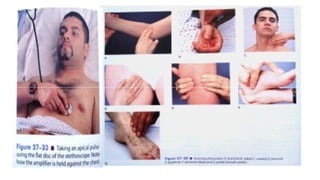
• Describe various sites & methods used to measure Pulse
• Recognize the signs of alert while taking Pulse
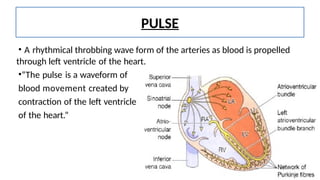
PULSE
• A rhythmical throbbing wave form of the arteries as blood is propelled
through left ventricle of the heart.
•“The pulse is a waveform of
blood movement created by
contraction of the left ventricle
of the heart.”
Physiology of Pulse
Blood flows through the body in a continues circuit. Electrical impulses
originating from the SA node travel through heart muscle to stimulate
cardiac contraction.
Approximately 60 to 70 ml (stroke volume) of blood enters the aorta
with each ventricular contraction.
With each stroke volume ejection, the wall distends, creating a pulse
wave that travels rapidly toward the distal ends of the arteries.
When a pulse wave reaches a peripheral artery, it can be felt by palpating
the artery lightly against underlying bone or muscles.
Regulation ofPulse
Pulse is regulated by the Autonomic Nervous System through the Sino-atrial
node.( Often called pace-maker.)
• Para sympathetic stimulation decreases the heart rate
• Sympathetic stimulates increase the heart rate.
The quantity of blood forced out of the left ventricle during each contraction
is called stroke volume. (70 ml for an average adult).
The volume of blood pumped by the heart during 1 minute is the Cardiac
output. Pulse rate X Stroke Volume = Cardiac out put
Cardiac output = Stroke volume × Pulse rate =70ml × 80 BPM
=5600 ml =5.6 L/min
Pulse Volume, or force, refers to the strength of the pulse
when the heart contracts. The pulse volume is also called the
pulse strength or quality, refers to the force of blood with each
beat
It can be range from absent to bounding.
• Bounding- Strong full force pulse.
• Thready / weak- Difficult to palpate, a pulse of
diminished strength.
• Absent- No palpable pulse.
Volume is influenced by the forcefulness of the
heartbeat, the
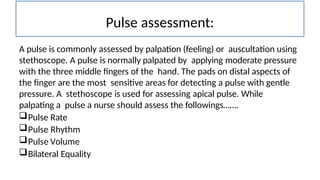
Pulse assessment:
A pulse is commonly assessed by palpation (feeling) or auscultation using
stethoscope. A pulse is normally palpated by applying moderate pressure
with the three middle fingers of the hand. The pads on distal aspects of
the finger are the most sensitive areas for detecting a pulse with gentle
pressure. A stethoscope is used for assessing apical pulse. While
palpating a pulse a nurse should assess the followings…….
Pulse Rate
Pulse Rhythm
Pulse Volume
Bilateral Equality
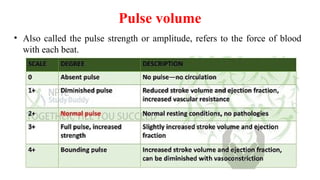
Pulse volume
• Also called the pulse strength or amplitude, refers to the force of blood
with each beat.
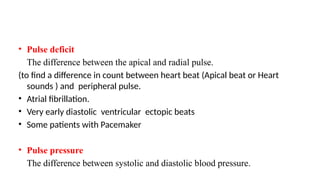
• Pulse deficit
The difference between the apical and radial pulse.
(to find a difference in count between heart beat (Apical beat or Heart
sounds ) and peripheral pulse.
• Atrial fibrillation.
• Very early diastolic ventricular ectopic beats
• Some patients with Pacemaker
• Pulse pressure
The difference between systolic and diastolic blood pressure.
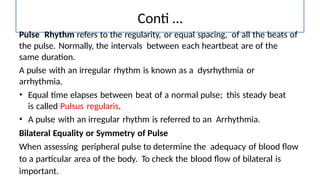
Conti …
Pulse Rhythm refers to the regularity, or equal spacing, of all the beats of
the pulse. Normally, the intervals between each heartbeat are of the
same duration.
A pulse with an irregular rhythm is known as a dysrhythmia or
arrhythmia.
• Equal time elapses between beat of a normal pulse; this steady beat
is called Pulsus regularis.
• A pulse with an irregular rhythm is referred to an Arrhythmia.
Bilateral Equality or Symmetry of Pulse
When assessing peripheral pulse to determine the adequacy of blood flow
to a particular area of the body. To check the blood flow of bilateral is
important.
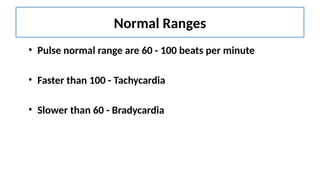
Normal Ranges
• Pulse normal range are 60 - 100 beats per minute
• Faster than 100 - Tachycardia
• Slower than 60 - Bradycardia
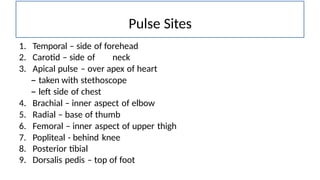
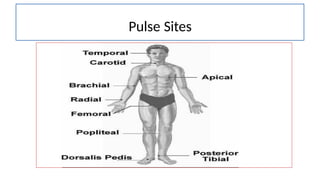
1. Temporal – side of forehead
2. Carotid – side of neck
3. Apical pulse – over apex of heart
– taken with stethoscope
– left side of chest
4. Brachial – inner aspect of elbow
5. Radial – base of thumb
6. Femoral – inner aspect of upper thigh
7. Popliteal - behind knee
8. Posterior tibial
9. Dorsalis pedis – top of foot
Pulse Sites
Pulse Sites
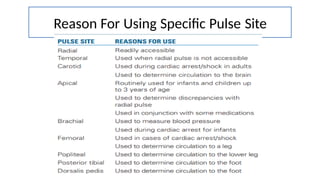
Reason For Using Specific Pulse Site
How To Find / Measure Pulse?
• At points where the artery is between finger tips and a bony area
• Called pulse points
• Felt with 2-3 fingers, but never the thumb
• Measured in beats per minute
• Count the waves for 60 seconds
• Or, count the waves for 30 seconds - multiply by 2
QUALITY OF PULSE
• Rhythm: regular or irregular
• Rate: Within the normal limits
• Strength: Strong, bounding, thready
Types of Pulse
1. Peripheral pulse is a pulse located away from the heart, for example,
in the foot or wrist. Assessed via fingers
2. The apical pulse, in contrast, is a central pulse; that is, it is located at
the apex of the heart. It is also referred to as the point of maximal
impulse (PMI).
Assessed or taken via stethoscope
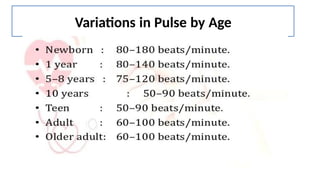
Variations in Pulse by Age
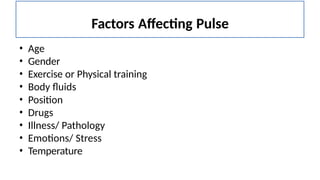
Factors Affecting Pulse
• Age
• Gender
• Exercise or Physical training
• Body fluids
• Position
• Drugs
• Illness/ Pathology
• Emotions/ Stress
• Temperature
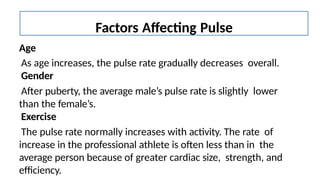
Age
As age increases, the pulse rate gradually decreases overall.
Gender
After puberty, the average male’s pulse rate is slightly lower
than the female’s.
Exercise
The pulse rate normally increases with activity. The rate of
increase in the professional athlete is often less than in the
average person because of greater cardiac size, strength, and
efficiency.
Factors Affecting Pulse
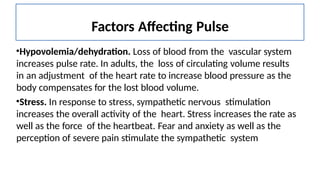
•Hypovolemia/dehydration. Loss of blood from the vascular system
increases pulse rate. In adults, the loss of circulating volume results
in an adjustment of the heart rate to increase blood pressure as the
body compensates for the lost blood volume.
•Stress. In response to stress, sympathetic nervous stimulation
increases the overall activity of the heart. Stress increases the rate as
well as the force of the heartbeat. Fear and anxiety as well as the
perception of severe pain stimulate the sympathetic system
Factors Affecting Pulse
Fever
The pulse rate increases (a) in response to the lowered blood pressure
that results from peripheral vasodilation associated with elevated body
temperature and (b) because of the increased metabolic rate.
Medications.
Some medications decrease the pulse rate, and others increase it. For
example, cardiotonics (e.g., digitalis preparations) decrease the heart
rate, whereas epinephrine increases it.
Factors Affecting Pulse
Position. When a person is sitting or standing, blood usually pools
in dependent vessels of the venous system. Pooling results in a
transient decrease in the venous blood return to the heart and a
subsequent reduction in blood pressure and increase in heart rate.
Pathology. Certain diseases such as some heart conditions or
those that impair oxygenation can alter the resting pulse rate.
Factors Affecting Pulse
When to take Pulse
• See how well the heart is working. In an emergency situation,
your pulse rate can help find out if the heart is pumping
enough blood.
• Help find the cause of symptoms, such as an irregular or rapid
heartbeat (palpitations), dizziness, fainting, chest pain, or
shortness of breath.
• Check for blood flow after an injury or when a blood vessel
may be blocked.
Continue. . . .
• Check on medicines or diseases that cause a slow heart rate.
Your doctor may ask you to check your pulse every day if you
have heart disease or if you are taking certain medicines that
can slow your heart rate, such as digoxin or beta-blockers (such
as atenolol or propranolol).
• Check your general health and fitness level. Checking your pulse
rate at rest, during exercise, or immediately after vigorous
exercise can give you important information about your overall
fitness level.
Activity Time
References
• Erb, G & Kozier, B. (2020). Fundamentals of Nursing
Concepts, Process and practice (10th edition): Addison-
Welsy.
Thank You

Unit 5 Basic Vital Sign how to check Pulse.pptx

  • 1.
    Vital Signs (Pulse) Fundamentalof Nursing Generic BSN Year 1st , Semester 1st Mr. ABDUL MAJID (RN, DCN, PRN BSN, CRNA)
  • 2.
    Objectives: By the endof my lecture students will be able to : • Define Pulse • Discuss the normal ranges for pulse • Define terms related to Pulse • List the factors affecting pulse • Describe the characteristics of pulse • Describe various sites & methods used to measure Pulse • Recognize the signs of alert while taking Pulse
  • 3.
    PULSE • A rhythmicalthrobbing wave form of the arteries as blood is propelled through left ventricle of the heart. •“The pulse is a waveform of blood movement created by contraction of the left ventricle of the heart.”
  • 4.
    Physiology of Pulse Bloodflows through the body in a continues circuit. Electrical impulses originating from the SA node travel through heart muscle to stimulate cardiac contraction. Approximately 60 to 70 ml (stroke volume) of blood enters the aorta with each ventricular contraction. With each stroke volume ejection, the wall distends, creating a pulse wave that travels rapidly toward the distal ends of the arteries. When a pulse wave reaches a peripheral artery, it can be felt by palpating the artery lightly against underlying bone or muscles.
  • 5.
    Regulation ofPulse Pulse isregulated by the Autonomic Nervous System through the Sino-atrial node.( Often called pace-maker.) • Para sympathetic stimulation decreases the heart rate • Sympathetic stimulates increase the heart rate. The quantity of blood forced out of the left ventricle during each contraction is called stroke volume. (70 ml for an average adult). The volume of blood pumped by the heart during 1 minute is the Cardiac output. Pulse rate X Stroke Volume = Cardiac out put Cardiac output = Stroke volume × Pulse rate =70ml × 80 BPM =5600 ml =5.6 L/min
  • 6.
    Pulse Volume, orforce, refers to the strength of the pulse when the heart contracts. The pulse volume is also called the pulse strength or quality, refers to the force of blood with each beat It can be range from absent to bounding. • Bounding- Strong full force pulse. • Thready / weak- Difficult to palpate, a pulse of diminished strength. • Absent- No palpable pulse. Volume is influenced by the forcefulness of the heartbeat, the
  • 7.
    Pulse assessment: A pulseis commonly assessed by palpation (feeling) or auscultation using stethoscope. A pulse is normally palpated by applying moderate pressure with the three middle fingers of the hand. The pads on distal aspects of the finger are the most sensitive areas for detecting a pulse with gentle pressure. A stethoscope is used for assessing apical pulse. While palpating a pulse a nurse should assess the followings……. Pulse Rate Pulse Rhythm Pulse Volume Bilateral Equality
  • 8.
    Pulse volume • Alsocalled the pulse strength or amplitude, refers to the force of blood with each beat.
  • 9.
    • Pulse deficit Thedifference between the apical and radial pulse. (to find a difference in count between heart beat (Apical beat or Heart sounds ) and peripheral pulse. • Atrial fibrillation. • Very early diastolic ventricular ectopic beats • Some patients with Pacemaker • Pulse pressure The difference between systolic and diastolic blood pressure.
  • 10.
    Conti … Pulse Rhythmrefers to the regularity, or equal spacing, of all the beats of the pulse. Normally, the intervals between each heartbeat are of the same duration. A pulse with an irregular rhythm is known as a dysrhythmia or arrhythmia. • Equal time elapses between beat of a normal pulse; this steady beat is called Pulsus regularis. • A pulse with an irregular rhythm is referred to an Arrhythmia. Bilateral Equality or Symmetry of Pulse When assessing peripheral pulse to determine the adequacy of blood flow to a particular area of the body. To check the blood flow of bilateral is important.
  • 11.
    Normal Ranges • Pulsenormal range are 60 - 100 beats per minute • Faster than 100 - Tachycardia • Slower than 60 - Bradycardia
  • 12.
    1. Temporal –side of forehead 2. Carotid – side of neck 3. Apical pulse – over apex of heart – taken with stethoscope – left side of chest 4. Brachial – inner aspect of elbow 5. Radial – base of thumb 6. Femoral – inner aspect of upper thigh 7. Popliteal - behind knee 8. Posterior tibial 9. Dorsalis pedis – top of foot Pulse Sites
  • 13.
  • 14.
    Reason For UsingSpecific Pulse Site
  • 16.
    How To Find/ Measure Pulse? • At points where the artery is between finger tips and a bony area • Called pulse points • Felt with 2-3 fingers, but never the thumb • Measured in beats per minute • Count the waves for 60 seconds • Or, count the waves for 30 seconds - multiply by 2
  • 17.
    QUALITY OF PULSE •Rhythm: regular or irregular • Rate: Within the normal limits • Strength: Strong, bounding, thready
  • 18.
    Types of Pulse 1.Peripheral pulse is a pulse located away from the heart, for example, in the foot or wrist. Assessed via fingers 2. The apical pulse, in contrast, is a central pulse; that is, it is located at the apex of the heart. It is also referred to as the point of maximal impulse (PMI). Assessed or taken via stethoscope
  • 19.
  • 20.
    Factors Affecting Pulse •Age • Gender • Exercise or Physical training • Body fluids • Position • Drugs • Illness/ Pathology • Emotions/ Stress • Temperature
  • 21.
    Age As age increases,the pulse rate gradually decreases overall. Gender After puberty, the average male’s pulse rate is slightly lower than the female’s. Exercise The pulse rate normally increases with activity. The rate of increase in the professional athlete is often less than in the average person because of greater cardiac size, strength, and efficiency. Factors Affecting Pulse
  • 22.
    •Hypovolemia/dehydration. Loss ofblood from the vascular system increases pulse rate. In adults, the loss of circulating volume results in an adjustment of the heart rate to increase blood pressure as the body compensates for the lost blood volume. •Stress. In response to stress, sympathetic nervous stimulation increases the overall activity of the heart. Stress increases the rate as well as the force of the heartbeat. Fear and anxiety as well as the perception of severe pain stimulate the sympathetic system Factors Affecting Pulse
  • 23.
    Fever The pulse rateincreases (a) in response to the lowered blood pressure that results from peripheral vasodilation associated with elevated body temperature and (b) because of the increased metabolic rate. Medications. Some medications decrease the pulse rate, and others increase it. For example, cardiotonics (e.g., digitalis preparations) decrease the heart rate, whereas epinephrine increases it. Factors Affecting Pulse
  • 24.
    Position. When aperson is sitting or standing, blood usually pools in dependent vessels of the venous system. Pooling results in a transient decrease in the venous blood return to the heart and a subsequent reduction in blood pressure and increase in heart rate. Pathology. Certain diseases such as some heart conditions or those that impair oxygenation can alter the resting pulse rate. Factors Affecting Pulse
  • 25.
    When to takePulse • See how well the heart is working. In an emergency situation, your pulse rate can help find out if the heart is pumping enough blood. • Help find the cause of symptoms, such as an irregular or rapid heartbeat (palpitations), dizziness, fainting, chest pain, or shortness of breath. • Check for blood flow after an injury or when a blood vessel may be blocked.
  • 26.
    Continue. . .. • Check on medicines or diseases that cause a slow heart rate. Your doctor may ask you to check your pulse every day if you have heart disease or if you are taking certain medicines that can slow your heart rate, such as digoxin or beta-blockers (such as atenolol or propranolol). • Check your general health and fitness level. Checking your pulse rate at rest, during exercise, or immediately after vigorous exercise can give you important information about your overall fitness level.
  • 27.
  • 28.
    References • Erb, G& Kozier, B. (2020). Fundamentals of Nursing Concepts, Process and practice (10th edition): Addison- Welsy.
  • 29.