Public Speaking Essentials
Presented by Taha Ghayyur
Why Public Speaking Matters?
PUBLIC SPEAKING ESSENTIALS
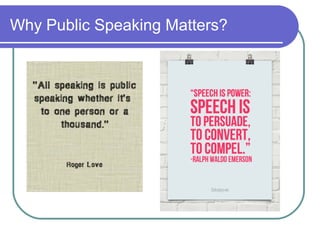
Why Public Speaking Matters?
 Enhanced self-confidence & self-esteem
 Better visibility and success at school & work
 Better communication with family, friends, co-
workers & community
 Ability to influence & motivate others
 Ability to deal with conflicts
 Top leadership skill
 Better sales person & Daee / Caller to God
 A special blessing and gift from God
 Always room to learn and improve
Types of Speeches
PUBLIC SPEAKING ESSENTIALS
Types of Speeches
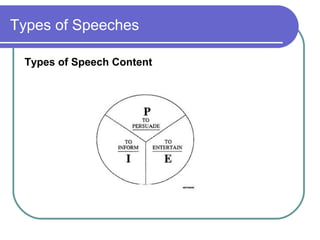
Types of Speech Content
Types of Speeches
Types of Speech Content
Persuasive - Persuasive speaking can involve
everything from arguing about politics, to religious
sermons (Khutbah), to a sales or fundraising pitch.
Informative - Informative speaking generally centers
on talking about people, events, processes, places, or
things. It could also be instructional speech about a
product or a process.
Entertaining (Special Occasion) - Special Occasion
(or ceremonial, commemorative, or epideictic) speech
usually pay tribute or praise a person, an institution, an
event, idea, or place.
Types of Speeches
Types of Speech Delivery
1.Read Word-for-Word from Manuscript (for formal /
official occasions)
2.Delivered from Memory (fully memorized and well
rehearsed speech)
3.Extemporaneous (prepared speech delivered from
brief notes; most commonly used)
4.Impromptu (no prior preparation at all on a topic
speaker is very comfortable with)
V
Dealing with Public Speaking
Anxiety
PUBLIC SPEAKING ESSENTIALS
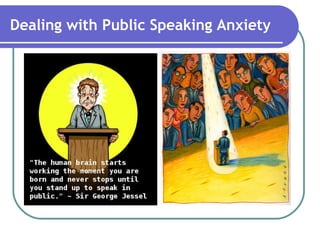
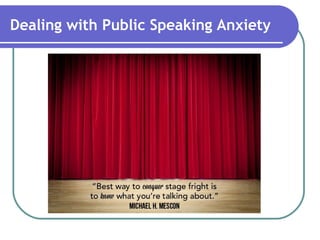
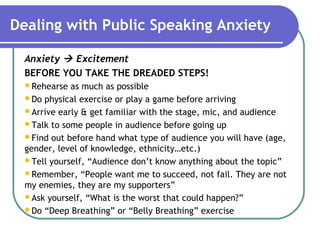
Dealing with Public Speaking Anxiety
Anxiety  Excitement
BEFORE YOU TAKE THE DREADED STEPS!
Rehearse as much as possible
Do physical exercise or play a game before arriving
Arrive early & get familiar with the stage, mic, and audience
Talk to some people in audience before going up
Find out before hand what type of audience you will have (age,
gender, level of knowledge, ethnicity…etc.)
Tell yourself, “Audience don’t know anything about the topic”
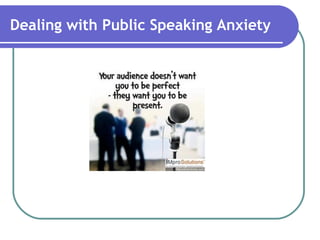
Remember, “People want me to succeed, not fail. They are not
my enemies, they are my supporters”
Ask yourself, “What is the worst that could happen?”
Do “Deep Breathing” or “Belly Breathing” exercise
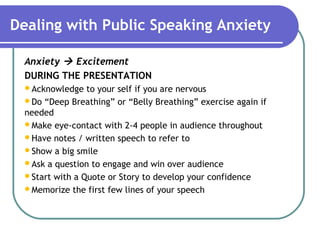
Dealing with Public Speaking Anxiety
Anxiety  Excitement
BEFORE YOU TAKE THE DREADED STEPS!
Read the Dua of Prophet Musa [Surah TaHa 20:25-28]
Dealing with Public Speaking Anxiety
Anxiety  Excitement
DURING THE PRESENTATION
Acknowledge to your self if you are nervous
Do “Deep Breathing” or “Belly Breathing” exercise again if
needed
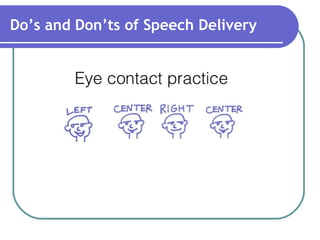
Make eye-contact with 2-4 people in audience throughout
Have notes / written speech to refer to
Show a big smile
Ask a question to engage and win over audience
Start with a Quote or Story to develop your confidence
Memorize the first few lines of your speech
Crafting & Organizing Your Speech
PUBLIC SPEAKING ESSENTIALS
Crafting & Organizing Your Speech
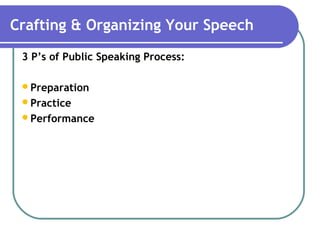
3 P’s of Public Speaking Process:
Preparation
Practice
Performance
Crafting & Organizing Your Speech
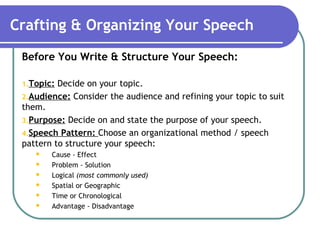
Before You Write & Structure Your Speech:
1.Topic: Decide on your topic.
2.Audience: Consider the audience and refining your topic to suit
them.
3.Purpose: Decide on and state the purpose of your speech.
4.Speech Pattern: Choose an organizational method / speech
pattern to structure your speech:
 Cause - Effect
 Problem - Solution
 Logical (most commonly used)
 Spatial or Geographic
 Time or Chronological
 Advantage - Disadvantage
Crafting & Organizing Your Speech
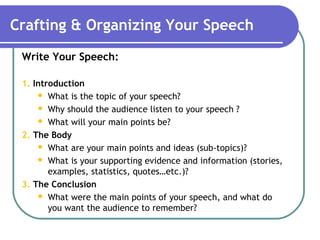
Write Your Speech:
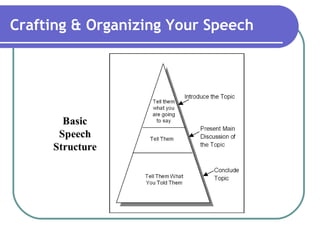
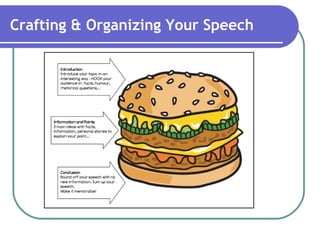
1. Introduction
 What is the topic of your speech?
 Why should the audience listen to your speech ?
 What will your main points be?
2. The Body
 What are your main points and ideas (sub-topics)?
 What is your supporting evidence and information (stories,
examples, statistics, quotes…etc.)?
3. The Conclusion
 What were the main points of your speech, and what do
you want the audience to remember?
Do’s and Don’ts of Speech Delivery
PUBLIC SPEAKING ESSENTIALS
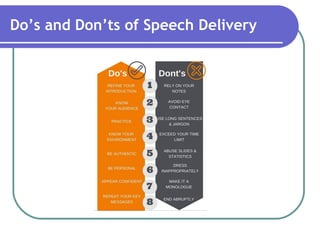
Do’s and Don’ts of Speech Delivery
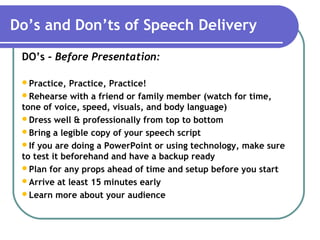
DO’s - Before Presentation:
Practice, Practice, Practice!
Rehearse with a friend or family member (watch for time,
tone of voice, speed, visuals, and body language)
Dress well & professionally from top to bottom
Bring a legible copy of your speech script
If you are doing a PowerPoint or using technology, make sure
to test it beforehand and have a backup ready
Plan for any props ahead of time and setup before you start
Arrive at least 15 minutes early
Learn more about your audience
Do’s and Don’ts of Speech Delivery
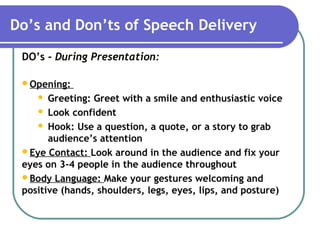
DO’s - During Presentation:
Opening:
 Greeting: Greet with a smile and enthusiastic voice
 Look confident
 Hook: Use a question, a quote, or a story to grab
audience’s attention
Eye Contact: Look around in the audience and fix your
eyes on 3-4 people in the audience throughout
Body Language: Make your gestures welcoming and
positive (hands, shoulders, legs, eyes, lips, and posture)
Do’s and Don’ts of Speech Delivery
DO’s - During Presentation:
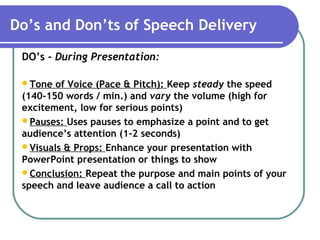
Tone of Voice (Pace & Pitch): Keep steady the speed
(140-150 words / min.) and vary the volume (high for
excitement, low for serious points)
Pauses: Uses pauses to emphasize a point and to get
audience’s attention (1-2 seconds)
Visuals & Props: Enhance your presentation with
PowerPoint presentation or things to show
Conclusion: Repeat the purpose and main points of your
speech and leave audience a call to action
Do’s and Don’ts of Speech Delivery
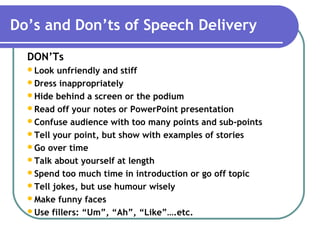
DON’Ts
Look unfriendly and stiff
Dress inappropriately
Hide behind a screen or the podium
Read off your notes or PowerPoint presentation
Confuse audience with too many points and sub-points
Tell your point, but show with examples of stories
Go over time
Talk about yourself at length
Spend too much time in introduction or go off topic
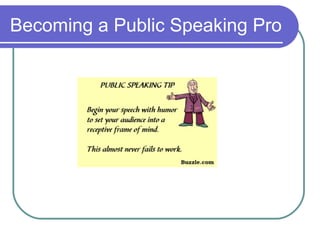
Tell jokes, but use humour wisely
Make funny faces
Use fillers: “Um”, “Ah”, “Like”….etc.
Do’s and Don’ts of Speech Delivery
Becoming a Public Speaking Pro
PUBLIC SPEAKING ESSENTIALS
Becoming a Public Speaking Pro

Public Speaking Essentials

  • 1.
  • 2.
    Why Public SpeakingMatters? PUBLIC SPEAKING ESSENTIALS
  • 3.
  • 4.
    Why Public SpeakingMatters?  Enhanced self-confidence & self-esteem  Better visibility and success at school & work  Better communication with family, friends, co- workers & community  Ability to influence & motivate others  Ability to deal with conflicts  Top leadership skill  Better sales person & Daee / Caller to God  A special blessing and gift from God  Always room to learn and improve
  • 5.
    Types of Speeches PUBLICSPEAKING ESSENTIALS
  • 6.
    Types of Speeches Typesof Speech Content
  • 7.
    Types of Speeches Typesof Speech Content Persuasive - Persuasive speaking can involve everything from arguing about politics, to religious sermons (Khutbah), to a sales or fundraising pitch. Informative - Informative speaking generally centers on talking about people, events, processes, places, or things. It could also be instructional speech about a product or a process. Entertaining (Special Occasion) - Special Occasion (or ceremonial, commemorative, or epideictic) speech usually pay tribute or praise a person, an institution, an event, idea, or place.
  • 8.
    Types of Speeches Typesof Speech Delivery 1.Read Word-for-Word from Manuscript (for formal / official occasions) 2.Delivered from Memory (fully memorized and well rehearsed speech) 3.Extemporaneous (prepared speech delivered from brief notes; most commonly used) 4.Impromptu (no prior preparation at all on a topic speaker is very comfortable with)
  • 9.
    V Dealing with PublicSpeaking Anxiety PUBLIC SPEAKING ESSENTIALS
  • 10.
    Dealing with PublicSpeaking Anxiety
  • 11.
    Dealing with PublicSpeaking Anxiety
  • 12.
    Dealing with PublicSpeaking Anxiety
  • 13.
    Dealing with PublicSpeaking Anxiety
  • 14.
    Dealing with PublicSpeaking Anxiety
  • 15.
    Dealing with PublicSpeaking Anxiety
  • 16.
    Dealing with PublicSpeaking Anxiety
  • 17.
    Dealing with PublicSpeaking Anxiety Anxiety  Excitement BEFORE YOU TAKE THE DREADED STEPS! Rehearse as much as possible Do physical exercise or play a game before arriving Arrive early & get familiar with the stage, mic, and audience Talk to some people in audience before going up Find out before hand what type of audience you will have (age, gender, level of knowledge, ethnicity…etc.) Tell yourself, “Audience don’t know anything about the topic” Remember, “People want me to succeed, not fail. They are not my enemies, they are my supporters” Ask yourself, “What is the worst that could happen?” Do “Deep Breathing” or “Belly Breathing” exercise
  • 18.
    Dealing with PublicSpeaking Anxiety Anxiety  Excitement BEFORE YOU TAKE THE DREADED STEPS! Read the Dua of Prophet Musa [Surah TaHa 20:25-28]
  • 19.
    Dealing with PublicSpeaking Anxiety Anxiety  Excitement DURING THE PRESENTATION Acknowledge to your self if you are nervous Do “Deep Breathing” or “Belly Breathing” exercise again if needed Make eye-contact with 2-4 people in audience throughout Have notes / written speech to refer to Show a big smile Ask a question to engage and win over audience Start with a Quote or Story to develop your confidence Memorize the first few lines of your speech
  • 20.
    Crafting & OrganizingYour Speech PUBLIC SPEAKING ESSENTIALS
  • 21.
    Crafting & OrganizingYour Speech 3 P’s of Public Speaking Process: Preparation Practice Performance
  • 22.
  • 23.
  • 24.
    Crafting & OrganizingYour Speech Before You Write & Structure Your Speech: 1.Topic: Decide on your topic. 2.Audience: Consider the audience and refining your topic to suit them. 3.Purpose: Decide on and state the purpose of your speech. 4.Speech Pattern: Choose an organizational method / speech pattern to structure your speech:  Cause - Effect  Problem - Solution  Logical (most commonly used)  Spatial or Geographic  Time or Chronological  Advantage - Disadvantage
  • 25.
    Crafting & OrganizingYour Speech Write Your Speech: 1. Introduction  What is the topic of your speech?  Why should the audience listen to your speech ?  What will your main points be? 2. The Body  What are your main points and ideas (sub-topics)?  What is your supporting evidence and information (stories, examples, statistics, quotes…etc.)? 3. The Conclusion  What were the main points of your speech, and what do you want the audience to remember?
  • 26.
    Do’s and Don’tsof Speech Delivery PUBLIC SPEAKING ESSENTIALS
  • 27.
    Do’s and Don’tsof Speech Delivery DO’s - Before Presentation: Practice, Practice, Practice! Rehearse with a friend or family member (watch for time, tone of voice, speed, visuals, and body language) Dress well & professionally from top to bottom Bring a legible copy of your speech script If you are doing a PowerPoint or using technology, make sure to test it beforehand and have a backup ready Plan for any props ahead of time and setup before you start Arrive at least 15 minutes early Learn more about your audience
  • 28.
    Do’s and Don’tsof Speech Delivery DO’s - During Presentation: Opening:  Greeting: Greet with a smile and enthusiastic voice  Look confident  Hook: Use a question, a quote, or a story to grab audience’s attention Eye Contact: Look around in the audience and fix your eyes on 3-4 people in the audience throughout Body Language: Make your gestures welcoming and positive (hands, shoulders, legs, eyes, lips, and posture)
  • 29.
    Do’s and Don’tsof Speech Delivery DO’s - During Presentation: Tone of Voice (Pace & Pitch): Keep steady the speed (140-150 words / min.) and vary the volume (high for excitement, low for serious points) Pauses: Uses pauses to emphasize a point and to get audience’s attention (1-2 seconds) Visuals & Props: Enhance your presentation with PowerPoint presentation or things to show Conclusion: Repeat the purpose and main points of your speech and leave audience a call to action
  • 30.
    Do’s and Don’tsof Speech Delivery DON’Ts Look unfriendly and stiff Dress inappropriately Hide behind a screen or the podium Read off your notes or PowerPoint presentation Confuse audience with too many points and sub-points Tell your point, but show with examples of stories Go over time Talk about yourself at length Spend too much time in introduction or go off topic Tell jokes, but use humour wisely Make funny faces Use fillers: “Um”, “Ah”, “Like”….etc.
  • 31.
    Do’s and Don’tsof Speech Delivery
  • 32.
    Do’s and Don’tsof Speech Delivery
  • 33.
    Do’s and Don’tsof Speech Delivery
  • 34.
    Becoming a PublicSpeaking Pro PUBLIC SPEAKING ESSENTIALS
  • 35.
    Becoming a PublicSpeaking Pro
  • 36.
    Becoming a PublicSpeaking Pro
  • 37.
    Becoming a PublicSpeaking Pro
  • 38.
    Becoming a PublicSpeaking Pro
  • 39.
    Becoming a PublicSpeaking Pro

Editor's Notes

  • #32 https://www.youtube.com/watch?v=m7SSj5Z5kTo
  • #40 https://www.youtube.com/watch?v=tShavGuo0_E