Value Invested,
Value Returned
RETENTION & RECRUITMENT
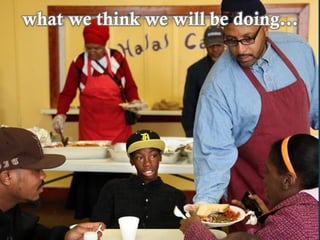
what we think we will be doing…
what the community thinks we do…
what our parents think we do….
what non-Muslims think we do…
Just kidding!
what we think we actually do…
what we actually end up doing…
What’s the Life Cycle
of a “Volunteer”?
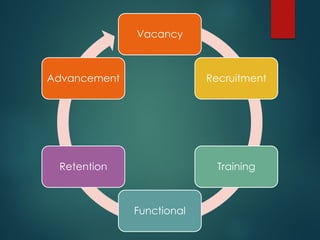
Vacancy
Recruitment
Training
Functional
Retention
Advancement
Vacancy
Recruitment
Training
Functional
Retention
Advancement
So What Should We
Discuss First?
Recruitment
Retention
Why is Retention Important?
Brainstorm:
Why do we
want to
retain team
members?
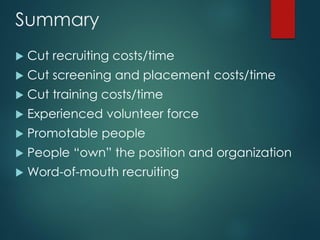
Summary
 Cut recruiting costs/time
 Cut screening and placement costs/time
 Cut training costs/time
 Experienced volunteer force
 Promotable people
 People “own” the position and organization
 Word-of-mouth recruiting
So Who’s Job is it?
Who works in HR
here?
Right or Wrong
Answer?
Brainstorm
4 Groups:
Why don’t
people stick
around?
Why do
People
Stay?
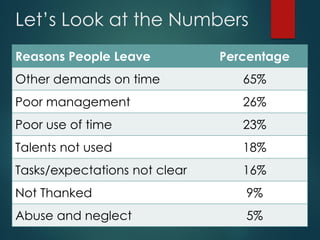
Let’s Look at the Numbers
Reasons People Leave Percentage
Other demands on time 65%
Poor management 26%
Poor use of time 23%
Talents not used 18%
Tasks/expectations not clear 16%
Not Thanked 9%
Abuse and neglect 5%
What Do Those
Numbers Mean?
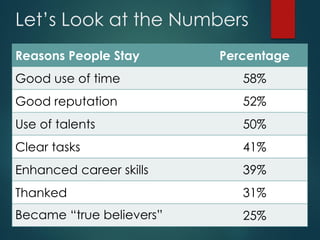
Let’s Look at the Numbers
Reasons People Stay Percentage
Good use of time 58%
Good reputation 52%
Use of talents 50%
Clear tasks 41%
Enhanced career skills 39%
Thanked 31%
Became “true believers” 25%
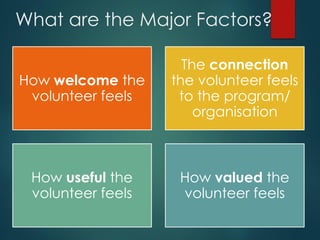
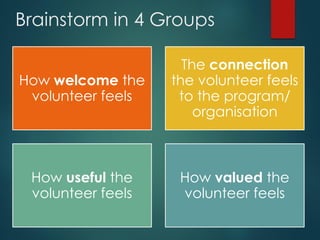
What are the Major Factors?
How welcome the
volunteer feels
The connection
the volunteer feels
to the program/
organisation
How useful the
volunteer feels
How valued the
volunteer feels
What are the Best
Practices in Each
Area?
Brainstorm in 4 Groups
How welcome the
volunteer feels
The connection
the volunteer feels
to the program/
organisation
How useful the
volunteer feels
How valued the
volunteer feels
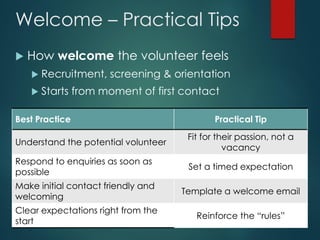
Welcome – Practical Tips
 How welcome the volunteer feels
 Recruitment, screening & orientation
 Starts from moment of first contact
Best Practice Practical Tip
Understand the potential volunteer
Fit for their passion, not a
vacancy
Respond to enquiries as soon as
possible
Set a timed expectation
Make initial contact friendly and
welcoming
Template a welcome email
Clear expectations right from the
start
Reinforce the “rules”
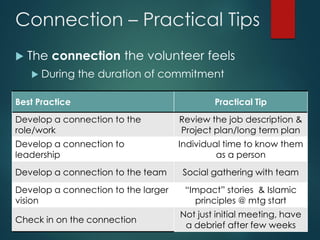
Connection – Practical Tips
 The connection the volunteer feels
 During the duration of commitment
Best Practice Practical Tip
Develop a connection to the
role/work
Review the job description &
Project plan/long term plan
Develop a connection to
leadership
Individual time to know them
as a person
Develop a connection to the team Social gathering with team
Develop a connection to the larger
vision
“Impact” stories & Islamic
principles @ mtg start
Check in on the connection
Not just initial meeting, have
a debrief after few weeks
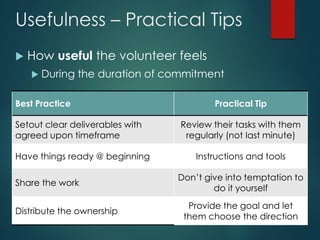
Usefulness – Practical Tips
 How useful the volunteer feels
 During the duration of commitment
Best Practice Practical Tip
Setout clear deliverables with
agreed upon timeframe
Review their tasks with them
regularly (not last minute)
Have things ready @ beginning Instructions and tools
Share the work
Don’t give into temptation to
do it yourself
Distribute the ownership
Provide the goal and let
them choose the direction
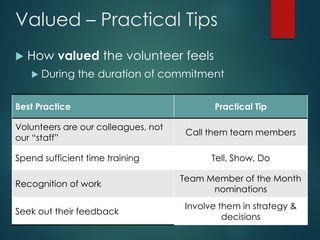
Valued – Practical Tips
 How valued the volunteer feels
 During the duration of commitment
Best Practice Practical Tip
Volunteers are our colleagues, not
our “staff”
Call them team members
Spend sufficient time training Tell, Show, Do
Recognition of work
Team Member of the Month
nominations
Seek out their feedback
Involve them in strategy &
decisions
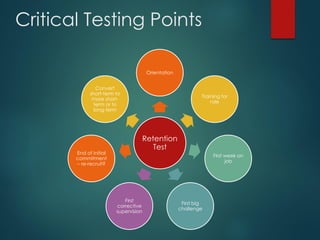
Critical Testing Points
Retention
Test
Orientation
Training for
role
First week on
job
First big
challenge
First
corrective
supervision
End of initial
commitment
– re-recruit?
Convert
short-term to
more short-
term or to
long-term
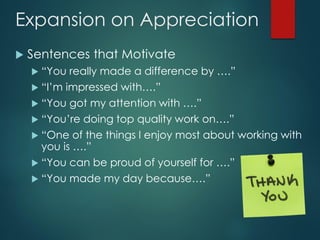
Expansion on Appreciation
 Sentences that Motivate
 “You really made a difference by ….”
 “I’m impressed with….”
 “You got my attention with ….”
 “You’re doing top quality work on….”
 “One of the things I enjoy most about working with
you is ….”
 “You can be proud of yourself for ….”
 “You made my day because….”
Let’s Come Back to
Recruitment…
Why Did we Discuss
Retention First?
Why Recruit Right
the First Time?
Let’s Do a Real Life Example
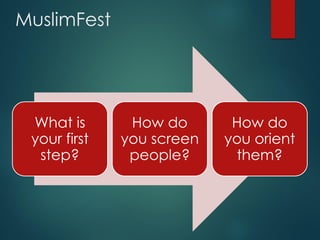
MuslimFest
What is
your first
step?
How do
you screen
people?
How do
you orient
them?
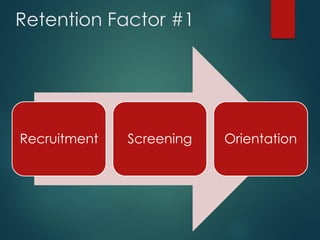
Retention Factor #1
Recruitment Screening Orientation
Recruitment
Activity
What resources do
you need right
now?
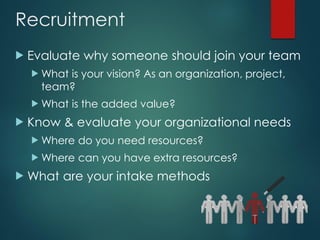
Recruitment
 Evaluate why someone should join your team
 What is your vision? As an organization, project,
team?
 What is the added value?
 Know & evaluate your organizational needs
 Where do you need resources?
 Where can you have extra resources?
 What are your intake methods
Screening Activity
What are
expectations you
have of your
volunteers?
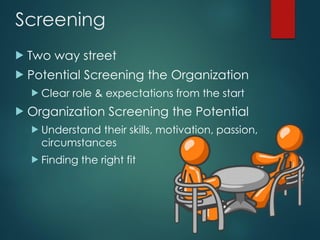
Screening
 Two way street
 Potential Screening the Organization
 Clear role & expectations from the start
 Organization Screening the Potential
 Understand their skills, motivation, passion,
circumstances
 Finding the right fit
Orientation Activity
What do you wish
you were told
when you started?
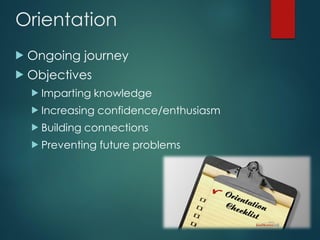
Orientation
 Ongoing journey
 Objectives
 Imparting knowledge
 Increasing confidence/enthusiasm
 Building connections
 Preventing future problems
Orientation
 Key components
 Program Vision & Benefits
 Organizational Structure – Where do they fit?
 General expectations & policies
 Specifics about the Role
 Evaluation/Performance review
 Benefits for the Volunteer
So Who’s Job is it?
Watch out for the
GOLDEN
opportunities!
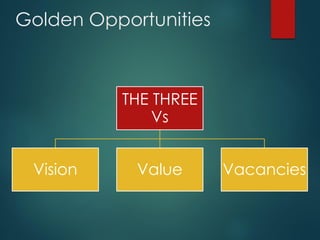
Golden Opportunities
THE THREE
Vs
Vision Value Vacancies
Better Recruitment
=
Better Retention
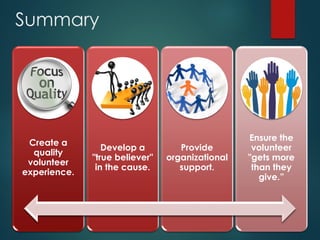
Summary
Create a
quality
volunteer
experience.
Develop a
"true believer"
in the cause.
Provide
organizational
support.
Ensure the
volunteer
"gets more
than they
give.”
Sometimes, your role
will be to spend more
time on developing the
right people, then
doing the right things.
Volunteer Retention & Recruitment