Butterflies, PowerPoint, and
      the ‘Perfect’ Presentation


                                                   Jeff Pelletier
                                       The Ohio State University
Presentation available online at http://www.slideshare.net/jeffbc94
Your Parting Gifts
 Who are we – Why are we here
 What is a presentation
 Five rules for a better presentation
 Dress and appearance
 Some tricks to use; some to avoid

 But first…your initial questions
A Little About Me
 Boston College, BA Computer Science, 1994
 The Ohio State University, MA Higher Education and
  Student Affairs, 2004
 8 years experience with US Navy
 10 years, Ohio Union Staff
 7 years, Delta Tau Delta
 8 years, Toastmasters International
 35+ conferences attended
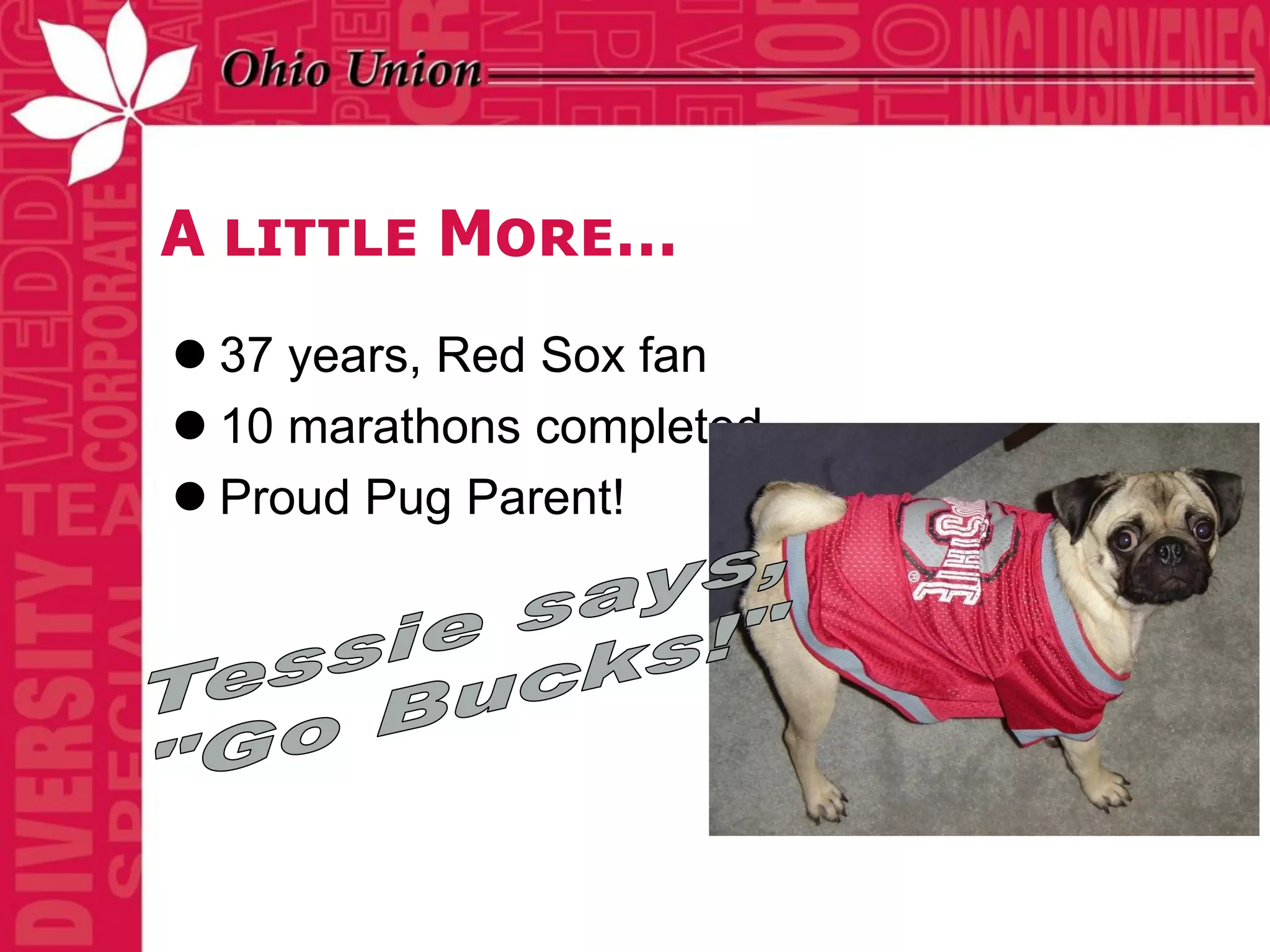
A little More…
 37 years, Red Sox fan
 10 marathons completed
 Proud Pug Parent!
What is a Presentation?
 Four types of Presentations
  –   Informative
  –   Inspirational
  –   Entertaining
  –   Persuasive
 The Military Model
Five Fundamental Principles
 Stay focused
 Keep it short, finish early
   – “Finish speaking before your audience finishes
     listening.”
 Know the purpose and make it useful
 Judicious use of media
 Practice, practice, practice
Make it Useful
 Collect information ahead of time
  – What does the audience want to hear?
  – What does the space look like?*
 Use language the audience will understand
 Avoid acronyms
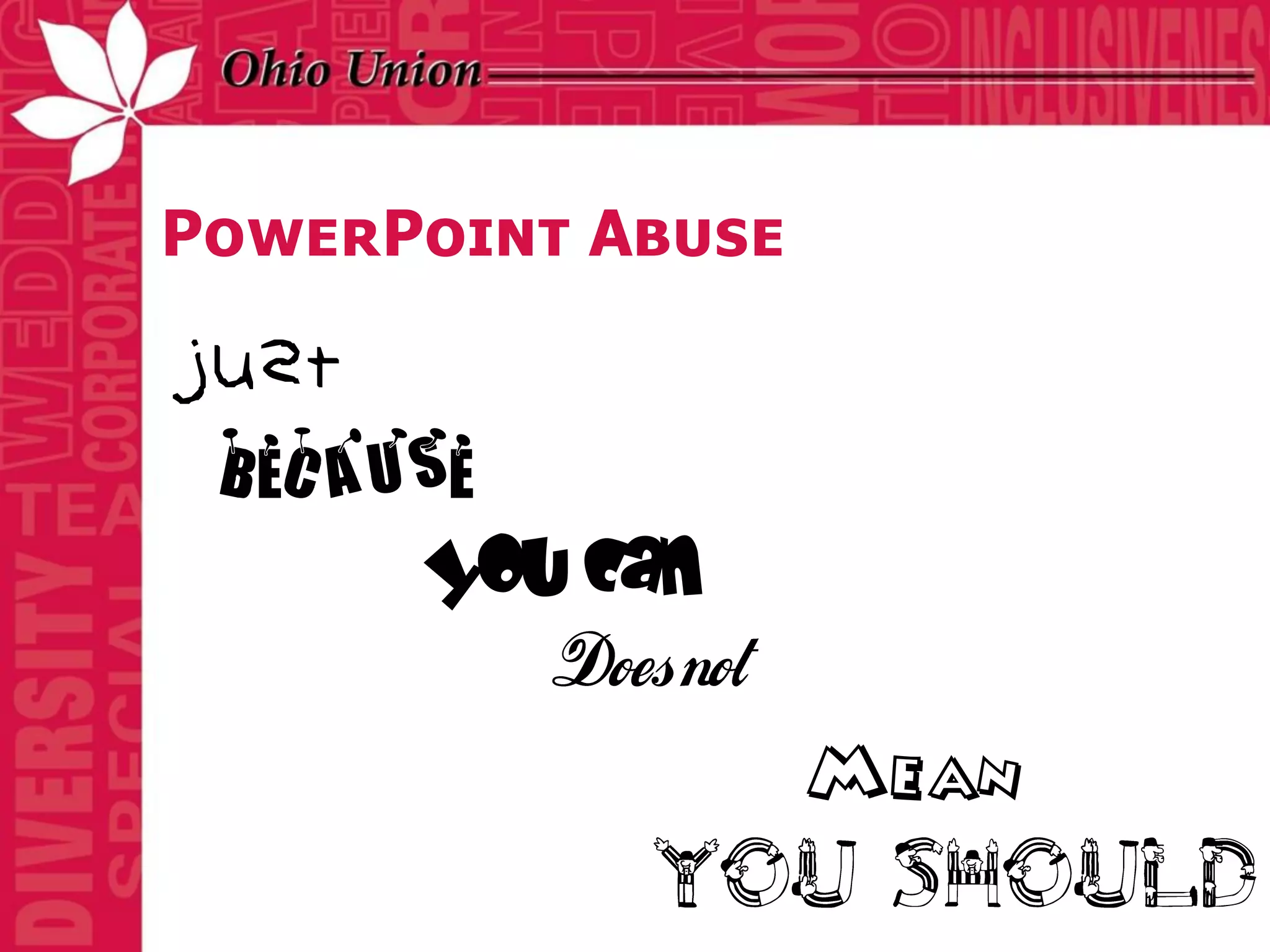
PowerPoint Abuse

Just
 Because
      you can

                   Mean
PowerPoint
 Do you need A/V?
 4 bullets, 6 words
 Reading from slides or notes – pause*
 Dark background and light fonts
 Adjust lighting if possible
 Have a backup plan
Some Tricks to Practice
 Greet audience members
 Eye contact*
 Speak slowly, clearly, accurately
 Look for a friendly face, look for head nods
 Move around the podium or stand up
 Use of nonverbals
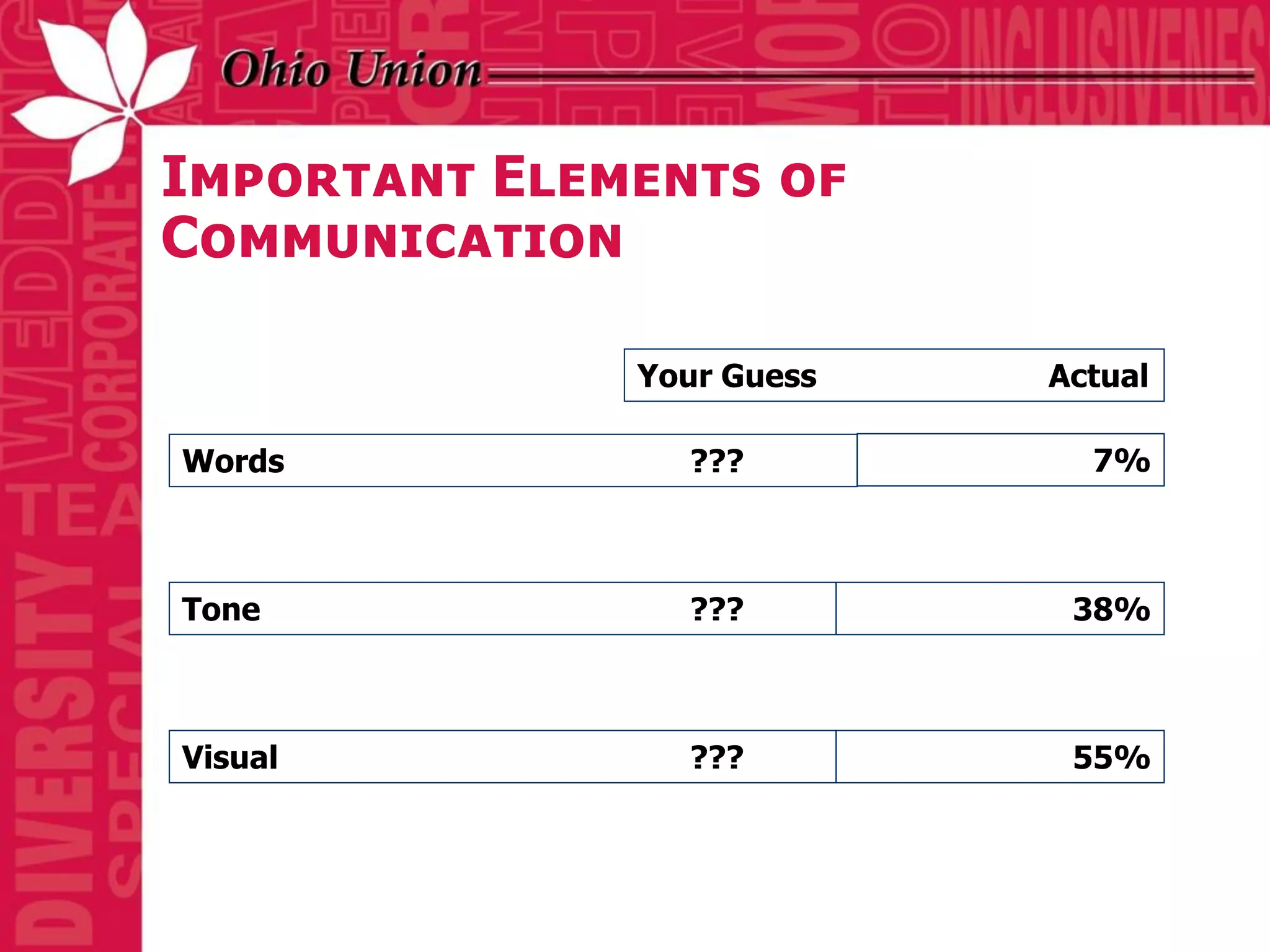
Important Elements of
Communication

              Your Guess   Actual

Words           ???          7%


Tone            ???         38%


Visual          ???         55%
Some Pitfalls to Watch For
IN your control:
 “Crutch” words - um, ah, like, you know…
 Swallowing your words
 Humor – use and misuse
 Don’t confuse your listeners*
 Don’t sell yourself short
 Relax and harness nervous energy
Some Pitfalls to Watch For
NOT in your control:
 Sleepers!
 Co-presenters
 Room abuse
 THAT audience member
Dress and Appearance
 Always ask about appropriate dress for the
  occasion
 Always dress one notch better
 The rule of 12…
 Watch out for accessories
Connect with the Audience
 Ask open ended questions
 Six degrees of separation…connect
 Give them reasons to like you
 But first…any initial questions?
 I don't know – Can I get back to you?
 Be honest and be yourself
Connect with the Audience
 Use “people words”
 Personalize statistics
 Body references
 Conversational phrases
 Name games
Written Presentations
     Jeff’s Top Ten List of Written Crazymakers
1.   CAPS LOCK
2.   Excessive punctuation!!!!!!!!!!!!!!!!!!!!!!
3.   Emoticons   ;-) 8-)
4.   Grammar and capitalization in e-mail
5.   Don’t forget subject line, attachments
Written Presentations
    Jeff’s Top Ten List of Written Crazymakers
6. Make signature line appropriate
7. Double check pertinent information (date,
    time, location)
8. Practical font and background
9. Avoid vernacular, jargon, abbreviation
10. “Webster’s defines…”
Tell 'em what you told 'em
 We established the speakers credentials
 We discussed what is a presentation
 5 Rules
 Military Briefing
 Dress and appearance
 Some tips you can use
 How to choose and present your topic
Good Luck With Future
        Presentations!
Special thanks to:
- Keith Steiner (Delta Tau Delta)
- Michael Hevel (Association of Fraternity Advisors)
- Corbin Smyth (Association of College Unions
  International)
- Kevin Johnston, Tennille-Lynn Milo (Toastmasters
  International)
- George Brymer (author, Vital Integrities)

                                                        Jeff Pelletier
                                              Pelletier.12@osu.edu
                                              614-688-INFO (4636)
     Presentation available at: http://osudelts.org.ohio-state.edu/about.php
Panels and Roundtables
 Introduce the topic at hand, and have some guiding
  thoughts/questions to get things started
 Allow time for processing questions (to ask or to
  answer)
 Okay to wander from a set agenda, provided:
   – The group is being productive
   – Not too much time on one particular issue
 Watch for dominant/quiet participants
 Consider a recorder/minute-keeper
Leading/Serving on A Panel
 Select panelists with varied experience, knowledge,
  generation, or location
 Repeat questions from audience for all to hear
 Not every question needs to be answered by all
 Time limit on presentation, and answers
 Summarize to close the session
Roundtables
 Quick introduction of participants
 Five types of questions:
   –   Overhead
   –   Direct
   –   Relay
   –   Open-ended
   –   Closed-ended/Show of Hands
 Watch for side-conversations after group has moved
  on
 End early to encourage direct follow-up
Connect IN the Audience
 It’s okay to smile
 Nodding off vs. nodding in assent
 It’s okay to laugh!
 Resist the temptation to be “that audience
  member”
 Follow-up after the session
Written Presentations
 Michael’s Top Ten List of Written Crazymakers
11. Take time to write
12. Proofread
13. Citation style
14. Inclusive language
15. Adverbs, contractions, passive voice
Being a Good Listener
 Four types of listening
  –   Engaged
  –   Thoughtful
  –   Combative
  –   Absent
 Hear – Understand – Interpret – Respond
 Don’t think about your response while listening
Turning Experience into a
Presentation
 Practice into Theory
 What does your audience want to hear?
 Why are they listening?
 What are your own abilities?
National Conferences – “The
Big Show”
 No prerequisites – just desire and material
 Start early to finish
 Regional as Rehearsal
 Offer to present on campus (HR Departments)
 Find your local Toastmasters club

Public speaking 2010

  • 1.
    Butterflies, PowerPoint, and the ‘Perfect’ Presentation Jeff Pelletier The Ohio State University Presentation available online at http://www.slideshare.net/jeffbc94
  • 2.
    Your Parting Gifts Who are we – Why are we here  What is a presentation  Five rules for a better presentation  Dress and appearance  Some tricks to use; some to avoid  But first…your initial questions
  • 3.
    A Little AboutMe  Boston College, BA Computer Science, 1994  The Ohio State University, MA Higher Education and Student Affairs, 2004  8 years experience with US Navy  10 years, Ohio Union Staff  7 years, Delta Tau Delta  8 years, Toastmasters International  35+ conferences attended
  • 4.
    A little More… 37 years, Red Sox fan  10 marathons completed  Proud Pug Parent!
  • 5.
    What is aPresentation?  Four types of Presentations – Informative – Inspirational – Entertaining – Persuasive  The Military Model
  • 6.
    Five Fundamental Principles Stay focused  Keep it short, finish early – “Finish speaking before your audience finishes listening.”  Know the purpose and make it useful  Judicious use of media  Practice, practice, practice
  • 7.
    Make it Useful Collect information ahead of time – What does the audience want to hear? – What does the space look like?*  Use language the audience will understand  Avoid acronyms
  • 8.
  • 9.
    PowerPoint  Do youneed A/V?  4 bullets, 6 words  Reading from slides or notes – pause*  Dark background and light fonts  Adjust lighting if possible  Have a backup plan
  • 10.
    Some Tricks toPractice  Greet audience members  Eye contact*  Speak slowly, clearly, accurately  Look for a friendly face, look for head nods  Move around the podium or stand up  Use of nonverbals
  • 11.
    Important Elements of Communication Your Guess Actual Words ??? 7% Tone ??? 38% Visual ??? 55%
  • 12.
    Some Pitfalls toWatch For IN your control:  “Crutch” words - um, ah, like, you know…  Swallowing your words  Humor – use and misuse  Don’t confuse your listeners*  Don’t sell yourself short  Relax and harness nervous energy
  • 13.
    Some Pitfalls toWatch For NOT in your control:  Sleepers!  Co-presenters  Room abuse  THAT audience member
  • 14.
    Dress and Appearance Always ask about appropriate dress for the occasion  Always dress one notch better  The rule of 12…  Watch out for accessories
  • 15.
    Connect with theAudience  Ask open ended questions  Six degrees of separation…connect  Give them reasons to like you  But first…any initial questions?  I don't know – Can I get back to you?  Be honest and be yourself
  • 16.
    Connect with theAudience  Use “people words”  Personalize statistics  Body references  Conversational phrases  Name games
  • 17.
    Written Presentations Jeff’s Top Ten List of Written Crazymakers 1. CAPS LOCK 2. Excessive punctuation!!!!!!!!!!!!!!!!!!!!!! 3. Emoticons   ;-) 8-) 4. Grammar and capitalization in e-mail 5. Don’t forget subject line, attachments
  • 18.
    Written Presentations Jeff’s Top Ten List of Written Crazymakers 6. Make signature line appropriate 7. Double check pertinent information (date, time, location) 8. Practical font and background 9. Avoid vernacular, jargon, abbreviation 10. “Webster’s defines…”
  • 19.
    Tell 'em whatyou told 'em  We established the speakers credentials  We discussed what is a presentation  5 Rules  Military Briefing  Dress and appearance  Some tips you can use  How to choose and present your topic
  • 20.
    Good Luck WithFuture Presentations! Special thanks to: - Keith Steiner (Delta Tau Delta) - Michael Hevel (Association of Fraternity Advisors) - Corbin Smyth (Association of College Unions International) - Kevin Johnston, Tennille-Lynn Milo (Toastmasters International) - George Brymer (author, Vital Integrities) Jeff Pelletier Pelletier.12@osu.edu 614-688-INFO (4636) Presentation available at: http://osudelts.org.ohio-state.edu/about.php
  • 21.
    Panels and Roundtables Introduce the topic at hand, and have some guiding thoughts/questions to get things started  Allow time for processing questions (to ask or to answer)  Okay to wander from a set agenda, provided: – The group is being productive – Not too much time on one particular issue  Watch for dominant/quiet participants  Consider a recorder/minute-keeper
  • 22.
    Leading/Serving on APanel  Select panelists with varied experience, knowledge, generation, or location  Repeat questions from audience for all to hear  Not every question needs to be answered by all  Time limit on presentation, and answers  Summarize to close the session
  • 23.
    Roundtables  Quick introductionof participants  Five types of questions: – Overhead – Direct – Relay – Open-ended – Closed-ended/Show of Hands  Watch for side-conversations after group has moved on  End early to encourage direct follow-up
  • 24.
    Connect IN theAudience  It’s okay to smile  Nodding off vs. nodding in assent  It’s okay to laugh!  Resist the temptation to be “that audience member”  Follow-up after the session
  • 25.
    Written Presentations Michael’sTop Ten List of Written Crazymakers 11. Take time to write 12. Proofread 13. Citation style 14. Inclusive language 15. Adverbs, contractions, passive voice
  • 26.
    Being a GoodListener  Four types of listening – Engaged – Thoughtful – Combative – Absent  Hear – Understand – Interpret – Respond  Don’t think about your response while listening
  • 27.
    Turning Experience intoa Presentation  Practice into Theory  What does your audience want to hear?  Why are they listening?  What are your own abilities?
  • 28.
    National Conferences –“The Big Show”  No prerequisites – just desire and material  Start early to finish  Regional as Rehearsal  Offer to present on campus (HR Departments)  Find your local Toastmasters club

Editor's Notes

  • #4 ACUI – 4-10 (7) ACUI Region - 3, 5-9 (6) DTD - 5-10, 8,10 (8) Toastmasters – 0, 1, 2, 5, 6 (5) Other – EMS, Promodel, ACPA, IPDS, AFA Drive-in, Stu Org drive-in, Greek advisorx2, FYE (9)
  • #5 Stand up if… This is your first ACUI Presented before/not yet You’ve ever spoken in public You’ve ever been nervous or stressed about speaking in public
  • #10 There is merit in the “low-tech” presentation True Colors Dr Bob’s handouts and overheads Try not to step in front of the projector
  • #11 Confidence will never eliminate nervousness – it will help you learn to control it Never sit on the table or behind the table – a little TOO casual
  • #12 Often the accurate answer to a usage question begins, "It depends." And what it depends on most often is where you are, who you are, who your listeners or readers are, and what your purpose in speaking or writing is. -Kenneth G. Wilson, usage writer (b. 1923)
  • #13 Hillary – actually Me – “and stuff like that” “ British Humor” – joke that falls flat (Susan Litton) “ This is going to be awful, but…”
  • #14 Don’t apologize for missing information, or if you are under the weather Do apologize for A/V issues, ambient noise or temperature
  • #15 Remove name tags that hang or might get in the way
  • #16 Customize material for your audience People don’t want to see you fail Don’t feel pressure to be a professional – do try to be a prepared presenter
  • #17 “ Our students have done over 400 hours of service” “ Many people meet their new best friend…vs. look to your left and right. You may be sitting next to your new roommate” See eye-to-eye with your group; working hand-in-hand; Don’t hold your tongue – ask questions!
  • #21 Potential Table-Topics questions: Why did you decide to attend OSU/your institution? Describe your favorite family get-together (real or potential) What will you miss most after graduation/over the summer while you are away from campus If people were to create a TV show about your life or world, what would it be about? Tell a favorite story from or about your hometown
  • #22 The trick to effective panels/roundtables is to NOT be the dominant voice in the room, but be the thread that ties thoughts together. Okay to sit in this situation – may be preferred
  • #23 The trick to effective panels/roundtables is to NOT be the dominant voice in the room, but be the thread that ties thoughts together. Okay to sit in this situation – may be preferred
  • #24 The trick to effective panels/roundtables is to NOT be the dominant voice in the room, but be the thread that ties thoughts together. Okay to sit in this situation – may be preferred