PUBLIC RELATIONS
What is Public Relations?
There are a number of definitions of the concept of public relations, as
described here.

• PR is the practice of promoting goodwill among the public for a company,
government body or person to present a favourable image.

• PR is primarily concerned with the image of the organization portrayed
to the public, often in the media.

• The British Institute of Public Relations has defined public relations as a
deliberate, planned and sustained effort to establish a relationship
between an organisation and its public.
How is PR different from
               Marketing?
While PR is aligned to marketing and communication techniques, it is not the
same concept. Both functions aim to increase the reputation and recognition of
the organisation in the public arena.

However, public relations is usually not product specific. Instead, PR may
occur as a result of a crisis and is usually seen as a long-term investment in
the goodwill and reputation of the organisation.
IMAGE IS EVERYTHING

Many celebrities, performers and actors have public relations consultants
and assistants who carefully vet information about their client. This is
usually to allow the accepted or desired public persona to continue.

Stories, events or interviews that do not support this image are stopped
or may be denied. If it is true, then many public relations consultants have
influence over the presentation of stories and may be able to influence
the type of information used in the media.
Activity
1. List the image or impressions that you identify with the following
people, organisations and products.
a. Dick Smith.
b. Elle MacPherson.
c. SS Holden Commodore.
d. Large four-wheel-drive vehicles.
e. The Salvation Army.
f. American Express credit card.
g. Porsche Motor Company.
h. Ralph Lauren.
i. Royal Children’s Hospital.
j. Snoop Dog
K. Collingwood Football Club and Hawthorn Football Club
2. Why do you have these impressions? List as many sources as possible
about where these impressions have come from.
‘Public’

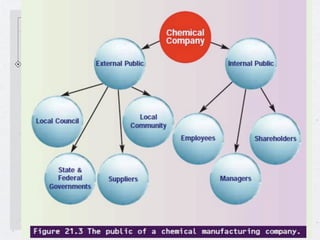
    The ‘public’ can be defined as those with a stake or interest in a particular
    organisation or business. The public may be internal or external stakeholders:


• Internal ‘public’ may include employees, shareholders and management. 
 
• External ‘public’ might include the local community, suppliers, competitors, and all
tiers of government. The ‘public’ of a large retail store will be different from that
of a small cabinetmaking business.
Create a mind map of the ‘public’ for each of the following
organisations.

a.   A gymnasium.
b.   The Carlton Football Club.
c.   A local secondary school.
d.   A supermarket.
e.   A hospital.
Research
Make a poster of the strategies and tactics you could use as a
public relations officer for a multi-national juice company

Public relations

  • 1.
  • 2.
    What is PublicRelations? There are a number of definitions of the concept of public relations, as described here. • PR is the practice of promoting goodwill among the public for a company, government body or person to present a favourable image. • PR is primarily concerned with the image of the organization portrayed to the public, often in the media. • The British Institute of Public Relations has defined public relations as a deliberate, planned and sustained effort to establish a relationship between an organisation and its public.
  • 3.
    How is PRdifferent from Marketing? While PR is aligned to marketing and communication techniques, it is not the same concept. Both functions aim to increase the reputation and recognition of the organisation in the public arena. However, public relations is usually not product specific. Instead, PR may occur as a result of a crisis and is usually seen as a long-term investment in the goodwill and reputation of the organisation.
  • 4.
    IMAGE IS EVERYTHING Manycelebrities, performers and actors have public relations consultants and assistants who carefully vet information about their client. This is usually to allow the accepted or desired public persona to continue. Stories, events or interviews that do not support this image are stopped or may be denied. If it is true, then many public relations consultants have influence over the presentation of stories and may be able to influence the type of information used in the media.
  • 5.
    Activity 1. List theimage or impressions that you identify with the following people, organisations and products. a. Dick Smith. b. Elle MacPherson. c. SS Holden Commodore. d. Large four-wheel-drive vehicles. e. The Salvation Army. f. American Express credit card. g. Porsche Motor Company. h. Ralph Lauren. i. Royal Children’s Hospital. j. Snoop Dog K. Collingwood Football Club and Hawthorn Football Club 2. Why do you have these impressions? List as many sources as possible about where these impressions have come from.
  • 6.
    ‘Public’ The ‘public’ can be defined as those with a stake or interest in a particular organisation or business. The public may be internal or external stakeholders:   • Internal ‘public’ may include employees, shareholders and management.    • External ‘public’ might include the local community, suppliers, competitors, and all tiers of government. The ‘public’ of a large retail store will be different from that of a small cabinetmaking business.
  • 8.
    Create a mindmap of the ‘public’ for each of the following organisations. a. A gymnasium. b. The Carlton Football Club. c. A local secondary school. d. A supermarket. e. A hospital.
  • 9.
    Research Make a posterof the strategies and tactics you could use as a public relations officer for a multi-national juice company

Editor's Notes