Sensation and
Perception
All our information comes into us through our senses.
SENSATION – the process of detecting, receiving,
converting and transmitting information resulting from
stimulation of sensory receptors.
PERCEPTION – the process of selecting, identifying,
organizing and interpreting sensory input into a useful
and meaningful mental representations of the world in
the light of relevant memories from past experiences.
The Human Eye
 Stimulates to vision is made up of electromagnetic radiation called radiant
energy. These light waves vary in length and are measured in millimicrons.
These also vary in intensity and complexity. Intensity or brightness is
physically represented by the amplitude of the wave, of whatever length,
that strikes the eye. Complexity refers to the mixture of wavelength hitting
the eye.
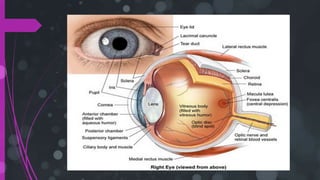
 The human eye is composed of three layers: sclerotic coat, the choroid
coat and the retina. The outer layer, the sclera, is a tough fibrous material.
It protects the eyeball and maintains its shape. A portion of this layer,
which is transparent and bulges out, is the cornea.
The Human Ear
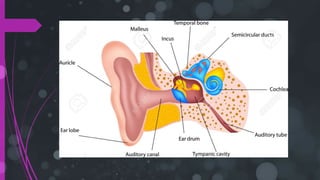
 The ear is composed of three parts: the outer ear, the middle ear, and the
inner ear. Each part has a vital function in transforming pressure I the air
into movements of the hair cells. The external auricle (called pinna or
concha) gathers sound waves and funnels them down to the tympanic
membrane (eardrum), a thin membrane at the end of the canal. In the
middle ear is a system of bones known as the malleus (hammer), the
incus (anvil), and the stapes (stirrup). These bones are hinged into a
system of levers so that the movement of the eardrum is transmitted to the
oval window, the membrane separating the cochlea from the middle ear.
 The inner ear has two labyrinths, namely: the semicircular canal, the
organs of equilibrium and the cochlea, the organ for audition.
OLFACTION
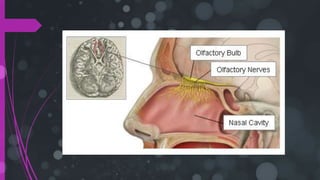
 Smell is distance awareness. It is the only sensitivity which will inform us
the presence of objects before there is actual contact with them. Olfactory
stimuli are gaseous particles which are carried to sensitive receptor cells.
The receptors of olfaction are in the two Schneiderian membranes situated
at the uppermost part of each nostril. These sensitive nerve cells are
called olfactory bulbs.
 There are six primary olfactory qualities: fragrant, spicy, fruity, resinous,
putrid, and burnt. Continued exposure to olfactory stimulation results in
adaptation in olfaction; the rate of adaptation is ore rapid than in other
sensitivities. When olfactory sensitivity is impaired, the condition is called
anosmia. Partial anosmia occurs when one has colds or catarrhal
conditions.
GUSTATION
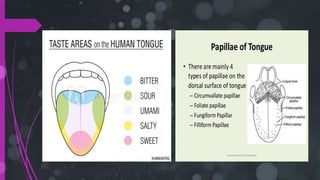
 Gustatory stimuli for taste are substances soluble in saliva.
The receptors for these are cells grouped together as taste
buds on the surface of the tongue and at the mucous
membrane in the throat and mouth. There is a small opening
in each olfactory bulb where the taste stimulus must go before
there is reception by the taste cells. Fibers of nerves surround
these cells.
 There are four kinds of elementary taste qualities: sweet,
salty, sour, and bitter.
CUTANEOUS SENSITIVITIES
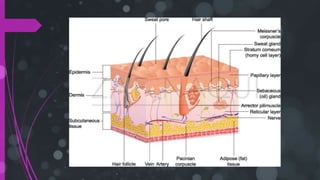
 Skin senses are groups of cutaneous sensitivities which enable us to
experience pressure, pain, cold, and warmth. Each of these experiences is
produced by different stimuli and is mediated by different sets of receptors.
The surface of the skin is not uniformly sensitive to stimulation. There are
insensitive areas, and sensitive areas have a degree of specialization.
Attention: The Selective Principle
An individual is, by nature, sensitive to only a limited range of physical
energies in the world. For example, one does not respond to radio waves
and supersonic vibrations of air particles.
PERCEPTION AND ATTENTION
 Perception refers to the combination of different sensations and the
utilization of past experiences in recognizing objects and facts when the
present stimulation arises.
 The human organism, in its attempt to satisfy its motives, is always
sensitive and responsive to the environment. Through the sense organs,
they translate or perceive the stimulation around them. But they cannot
select only those stimuli that are important or have relevance for their
needs. Adjustment proceeds when the individual can organize the
numerous stimuli affecting their receptors and put meaning to the sensory
experiences. On the basis of these experiences, organized patterns of
personal and symbolic meanings are developed.
Visual Perception
A. Perceptual constancy depends on the familiarity of the
object to the perceiver.
1. Size constancy is when perception of an object’s size remains
constant even when viewed from different distances. Example, when a
person is approaching you,
2. Shape constancy is when the perceived shape remains constant
even when retinal image of the shape changes,
3. Brightness constancy is when the perceived brightness of an object
is not determined by the actual amount of light reflected to the eyes.
4. Color constancy, like brightness constancy, depends on the
knowledge of the contextual light.
B. Perceptual contrast occurs when the same stimulus looks different in
different contexts. It is the opposite of perceptual constancy. Perceptual contrast
has size, shape, and color contrast.
Under color contrast, red appears brighter when surrounded by green than
when surrounded by other colors; blue appears brightest when surrounded by
yellow.
C. Perceptual organization on grouping
1. Similarity. Visual elements with similar color, shape, or texture are seen as
belonging together.
2. Proximity. Visual elements near each other are seen as belonging together.
3. Symmetry. Visual elements that for regular, simple, well-balanced shapes are
seen as belonging together.
4. Continuity. Visual elements that permit lines, curves, or movements to continue
in a direction already established tend to be grouped together.
5. Closure. Incomplete objects are usually filled in and seen as complete.
Development of Visual Perception
 Neonate seem to see clearly only objects located about nine to twelve
inches from their face. This due to the fact that neonates lack the muscular
ability to coordinate the movements of their two eyes and probably see
only shades of black, white, and gray.
 Perceptual system are not complete at birth. They require time to mature
and gain precision in handling large amount of complicated data.
 An infant several weeks after birth can have a clear view at a distance of
twenty feet. They prefer looking at complex patterns or at those with
striking colors. An adult can clear view up to a distance of one hundred
fifty feet.
Environmental Influences on
Perception.
1. Ordinary inevitable sensorimotor experience during infancy. Sensorimotor
experiences refer to the opportunity to move about and take information through
vision, hearing, taste, smell, and other perceptual systems.
a. Light; essential for the growth of numerous visual skills.
b. Patterned visual experiences.
c. Active movement.
2. Sensory deprivation after infancy. Donald Hebb (1904-1985), a Canadian
psychologist, made a study regarding this topic. His participants were made to stay
in a lighted cubicle, with a comfortable bed and a foam rubber pillow. He made
them wear cotton gloves and cardboard cuffs to restrict their sense of touch. The
only sound that they heard was humming of an exhaust fan. Brief excursions to the
toilet and time out for meals were their only relief from this dull routine. After two to
three days in this situation, the participants suffered temporary perceptual
distortions. Some of them saw image such as flashes of light, dots, and
geometrical patterns.
3. States of mind. Personal motives, emotions, goals, values, expectations,
needs, and other mental influences affect what people perceive.
4. Culture. Culture plays a vital role in perception. Individuals from different
races and nationalities perceive things and situations differently depending
on what they are used to.
5. Asituation.cquired knowledge. Is the information that a person brings to
a perceptual
Psychology (sensation and perception)

Psychology (sensation and perception)

  • 1.
  • 2.
    All our informationcomes into us through our senses. SENSATION – the process of detecting, receiving, converting and transmitting information resulting from stimulation of sensory receptors. PERCEPTION – the process of selecting, identifying, organizing and interpreting sensory input into a useful and meaningful mental representations of the world in the light of relevant memories from past experiences.
  • 3.
    The Human Eye Stimulates to vision is made up of electromagnetic radiation called radiant energy. These light waves vary in length and are measured in millimicrons. These also vary in intensity and complexity. Intensity or brightness is physically represented by the amplitude of the wave, of whatever length, that strikes the eye. Complexity refers to the mixture of wavelength hitting the eye.  The human eye is composed of three layers: sclerotic coat, the choroid coat and the retina. The outer layer, the sclera, is a tough fibrous material. It protects the eyeball and maintains its shape. A portion of this layer, which is transparent and bulges out, is the cornea.
  • 5.
    The Human Ear The ear is composed of three parts: the outer ear, the middle ear, and the inner ear. Each part has a vital function in transforming pressure I the air into movements of the hair cells. The external auricle (called pinna or concha) gathers sound waves and funnels them down to the tympanic membrane (eardrum), a thin membrane at the end of the canal. In the middle ear is a system of bones known as the malleus (hammer), the incus (anvil), and the stapes (stirrup). These bones are hinged into a system of levers so that the movement of the eardrum is transmitted to the oval window, the membrane separating the cochlea from the middle ear.  The inner ear has two labyrinths, namely: the semicircular canal, the organs of equilibrium and the cochlea, the organ for audition.
  • 7.
    OLFACTION  Smell isdistance awareness. It is the only sensitivity which will inform us the presence of objects before there is actual contact with them. Olfactory stimuli are gaseous particles which are carried to sensitive receptor cells. The receptors of olfaction are in the two Schneiderian membranes situated at the uppermost part of each nostril. These sensitive nerve cells are called olfactory bulbs.  There are six primary olfactory qualities: fragrant, spicy, fruity, resinous, putrid, and burnt. Continued exposure to olfactory stimulation results in adaptation in olfaction; the rate of adaptation is ore rapid than in other sensitivities. When olfactory sensitivity is impaired, the condition is called anosmia. Partial anosmia occurs when one has colds or catarrhal conditions.
  • 9.
    GUSTATION  Gustatory stimulifor taste are substances soluble in saliva. The receptors for these are cells grouped together as taste buds on the surface of the tongue and at the mucous membrane in the throat and mouth. There is a small opening in each olfactory bulb where the taste stimulus must go before there is reception by the taste cells. Fibers of nerves surround these cells.  There are four kinds of elementary taste qualities: sweet, salty, sour, and bitter.
  • 11.
    CUTANEOUS SENSITIVITIES  Skinsenses are groups of cutaneous sensitivities which enable us to experience pressure, pain, cold, and warmth. Each of these experiences is produced by different stimuli and is mediated by different sets of receptors. The surface of the skin is not uniformly sensitive to stimulation. There are insensitive areas, and sensitive areas have a degree of specialization. Attention: The Selective Principle An individual is, by nature, sensitive to only a limited range of physical energies in the world. For example, one does not respond to radio waves and supersonic vibrations of air particles.
  • 13.
    PERCEPTION AND ATTENTION Perception refers to the combination of different sensations and the utilization of past experiences in recognizing objects and facts when the present stimulation arises.  The human organism, in its attempt to satisfy its motives, is always sensitive and responsive to the environment. Through the sense organs, they translate or perceive the stimulation around them. But they cannot select only those stimuli that are important or have relevance for their needs. Adjustment proceeds when the individual can organize the numerous stimuli affecting their receptors and put meaning to the sensory experiences. On the basis of these experiences, organized patterns of personal and symbolic meanings are developed.
  • 14.
    Visual Perception A. Perceptualconstancy depends on the familiarity of the object to the perceiver. 1. Size constancy is when perception of an object’s size remains constant even when viewed from different distances. Example, when a person is approaching you, 2. Shape constancy is when the perceived shape remains constant even when retinal image of the shape changes, 3. Brightness constancy is when the perceived brightness of an object is not determined by the actual amount of light reflected to the eyes. 4. Color constancy, like brightness constancy, depends on the knowledge of the contextual light.
  • 15.
    B. Perceptual contrastoccurs when the same stimulus looks different in different contexts. It is the opposite of perceptual constancy. Perceptual contrast has size, shape, and color contrast. Under color contrast, red appears brighter when surrounded by green than when surrounded by other colors; blue appears brightest when surrounded by yellow. C. Perceptual organization on grouping 1. Similarity. Visual elements with similar color, shape, or texture are seen as belonging together. 2. Proximity. Visual elements near each other are seen as belonging together. 3. Symmetry. Visual elements that for regular, simple, well-balanced shapes are seen as belonging together. 4. Continuity. Visual elements that permit lines, curves, or movements to continue in a direction already established tend to be grouped together. 5. Closure. Incomplete objects are usually filled in and seen as complete.
  • 16.
    Development of VisualPerception  Neonate seem to see clearly only objects located about nine to twelve inches from their face. This due to the fact that neonates lack the muscular ability to coordinate the movements of their two eyes and probably see only shades of black, white, and gray.  Perceptual system are not complete at birth. They require time to mature and gain precision in handling large amount of complicated data.  An infant several weeks after birth can have a clear view at a distance of twenty feet. They prefer looking at complex patterns or at those with striking colors. An adult can clear view up to a distance of one hundred fifty feet.
  • 17.
    Environmental Influences on Perception. 1.Ordinary inevitable sensorimotor experience during infancy. Sensorimotor experiences refer to the opportunity to move about and take information through vision, hearing, taste, smell, and other perceptual systems. a. Light; essential for the growth of numerous visual skills. b. Patterned visual experiences. c. Active movement. 2. Sensory deprivation after infancy. Donald Hebb (1904-1985), a Canadian psychologist, made a study regarding this topic. His participants were made to stay in a lighted cubicle, with a comfortable bed and a foam rubber pillow. He made them wear cotton gloves and cardboard cuffs to restrict their sense of touch. The only sound that they heard was humming of an exhaust fan. Brief excursions to the toilet and time out for meals were their only relief from this dull routine. After two to three days in this situation, the participants suffered temporary perceptual distortions. Some of them saw image such as flashes of light, dots, and geometrical patterns.
  • 18.
    3. States ofmind. Personal motives, emotions, goals, values, expectations, needs, and other mental influences affect what people perceive. 4. Culture. Culture plays a vital role in perception. Individuals from different races and nationalities perceive things and situations differently depending on what they are used to. 5. Asituation.cquired knowledge. Is the information that a person brings to a perceptual