Sensation and perception
Anna Marie Abrera, RPsy
Faculty, Social Science Dept.
College of Arts, Sciences and Social Work
Philippine Christian University
anna.abrera@pcu.edu.ph
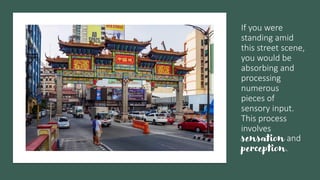
If you were
standing amid
this street scene,
you would be
absorbing and
processing
numerous
pieces of
sensory input.
This process
involves
sensation and
perception.
We rely on our sensory
systems to provide important
information about our
surroundings. We use this
information to successfully
navigate and interact with our
environment so that we can
find nourishment, seek
shelter, maintain social
relationships, and avoid
potentially dangerous
situations.
Defining sensation: What
does it mean to sense
something?
• Sensation
• The detection of physical energy
emitted or reflected by physical
objects.
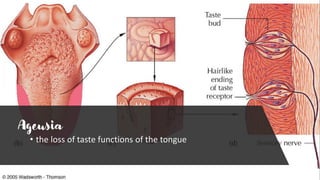
• It occurs when energy in the external
environment or the body stimulates
receptors in the sense organs.
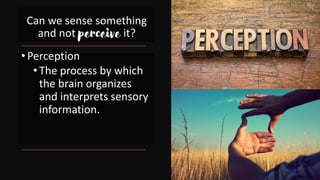
•Perception
•The process by which
the brain organizes
and interprets sensory
information.
Can we sense something
and not perceive it?
Bottom-up processing refers to the fact that perceptions are
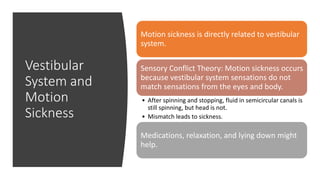
built from sensory input. On the other hand, how we interpret
those sensations is influenced by our available knowledge, our
experiences, and our thoughts., also called the top-down
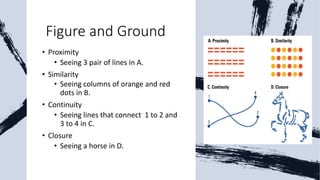
processing.
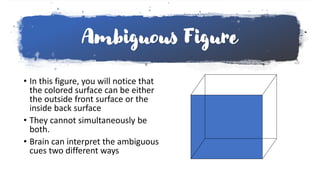
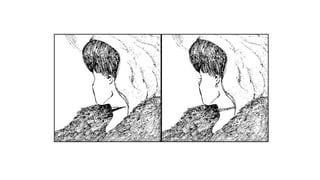
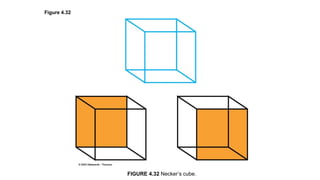
Ambiguous Figure
• In this figure, you will notice that
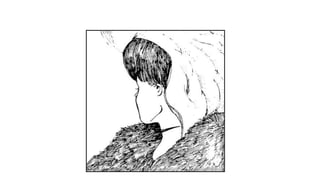
the colored surface can be either
the outside front surface or the
inside back surface
• They cannot simultaneously be
both.
• Brain can interpret the ambiguous
cues two different ways
You have probably known since elementary school that we have five
senses: vision, hearing (audition), smell (olfaction), taste (gustation),
and touch (somatosensation). It turns out that this notion of five senses

is oversimplified. We also have sensory systems that provide
information about balance (the vestibular sense), body position and
movement (proprioception and kinesthesia), pain (nociception), and
temperature (thermoception).
Principles in the Sensation
and Perception Process
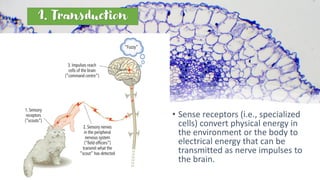
• Sense receptors (i.e., specialized
cells) convert physical energy in
the environment or the body to
electrical energy that can be
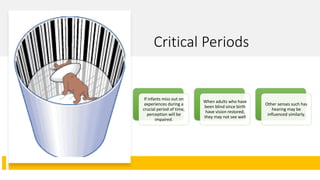
transmitted as nerve impulses to
the brain.
1. Transduction
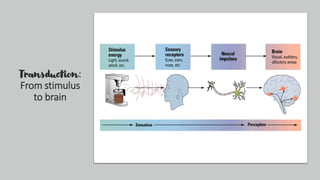
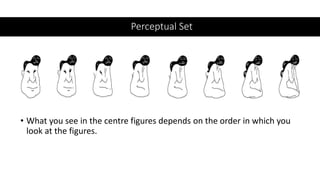
Transduction:
From stimulus
to brain
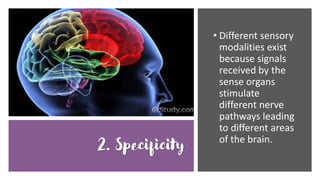
2. Specificity
• Different sensory
modalities exist
because signals
received by the
sense organs
stimulate
different nerve
pathways leading
to different areas
of the brain.
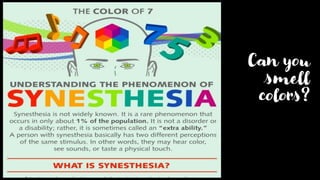
Can you
smell
colors?
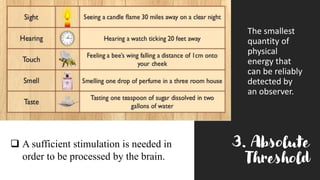
3. Absolute
Threshold
The smallest
quantity of
physical
energy that
can be reliably
detected by
an observer.
❑ A sufficient stimulation is needed in
order to be processed by the brain.
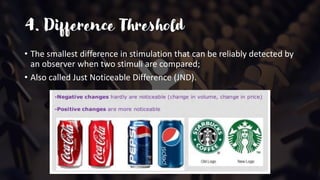
4. Difference Threshold
• The smallest difference in stimulation that can be reliably detected by
an observer when two stimuli are compared;
• Also called Just Noticeable Difference (JND).
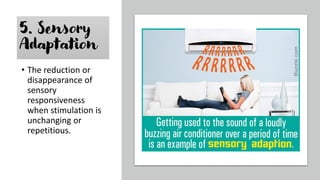
5. Sensory
Adaptation
• The reduction or
disappearance of
sensory
responsiveness
when stimulation is
unchanging or
repetitious.
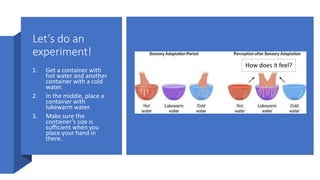
Let’s do an
experiment!
1. Get a container with
hot water and another
container with a cold
water.
2. In the middle, place a
container with
lukewarm water.
3. Make sure the
container’s size is
sufficient when you
place your hand in
there.
How does it feel?
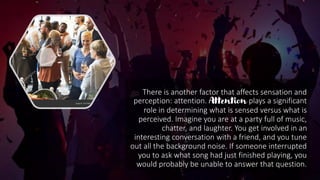
There is another factor that affects sensation and
perception: attention. Attention plays a significant
role in determining what is sensed versus what is
perceived. Imagine you are at a party full of music,
chatter, and laughter. You get involved in an
interesting conversation with a friend, and you tune
out all the background noise. If someone interrupted
you to ask what song had just finished playing, you
would probably be unable to answer that question.
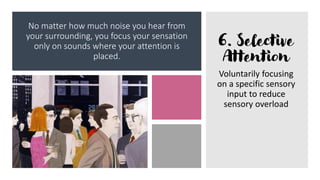
No matter how much noise you hear from
your surrounding, you focus your sensation
only on sounds where your attention is
placed.
6. Selective
Attention
Voluntarily focusing
on a specific sensory
input to reduce
sensory overload
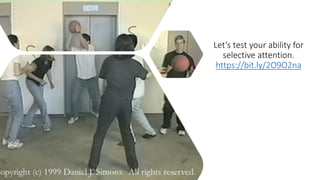
Let’s test your ability for
selective attention.
https://bit.ly/2O9O2na
Failure to notice something that is completely visible because of a lack of
attention is called inattentional blindness.
Here’s a video clip on how we also fail to notice changes due to lack of
attention to certain stimuli. This is known as change blindness.
https://bit.ly/3fjLnDm
Vision
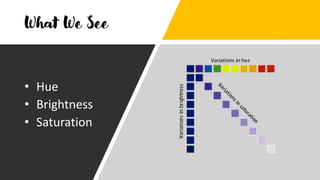
What We See
• Hue
• Brightness
• Saturation
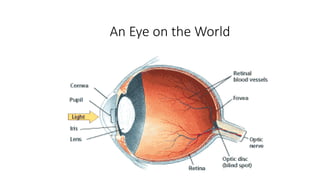
An Eye on the World
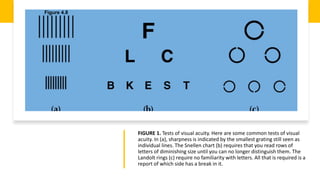
FIGURE 1. Tests of visual acuity. Here are some common tests of visual
acuity. In (a), sharpness is indicated by the smallest grating still seen as
individual lines. The Snellen chart (b) requires that you read rows of
letters of diminishing size until you can no longer distinguish them. The
Landolt rings (c) require no familiarity with letters. All that is required is a
report of which side has a break in it.
Figure 4.8
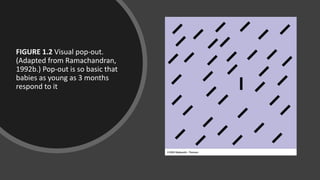
FIGURE 1.2 Visual pop-out.
(Adapted from Ramachandran,
1992b.) Pop-out is so basic that
babies as young as 3 months
respond to it
Why the
Visual System
is not a
Camera?
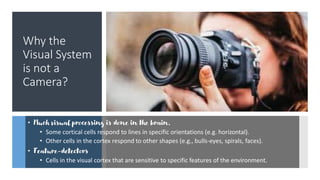
• Much visual processing is done in the brain.
• Some cortical cells respond to lines in specific orientations (e.g. horizontal).
• Other cells in the cortex respond to other shapes (e.g., bulls-eyes, spirals, faces).
• Feature-detectors
• Cells in the visual cortex that are sensitive to specific features of the environment.
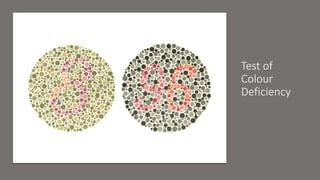
Test of
Colour
Deficiency
Hearing
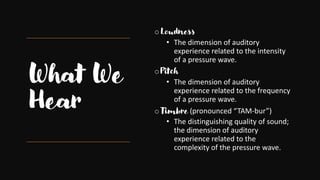
What We
Hear
oLoudness
• The dimension of auditory
experience related to the intensity
of a pressure wave.
oPitch
• The dimension of auditory
experience related to the frequency
of a pressure wave.
oTimbre (pronounced “TAM-bur”)
• The distinguishing quality of sound;
the dimension of auditory
experience related to the
complexity of the pressure wave.
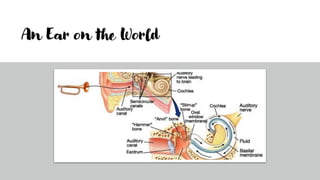
An Ear on the World
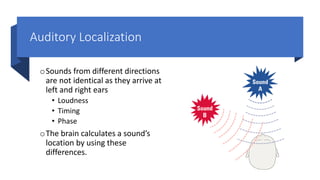
Auditory Localization
oSounds from different directions
are not identical as they arrive at
left and right ears
• Loudness
• Timing
• Phase
oThe brain calculates a sound’s
location by using these
differences.
Can you trust your ears?
• Short Video Clip
• https://bit.ly/2W1kuwm
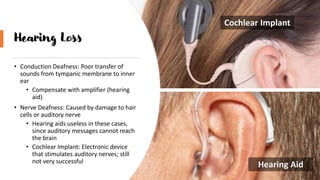
Hearing Loss
• Conduction Deafness: Poor transfer of
sounds from tympanic membrane to inner
ear
• Compensate with amplifier (hearing
aid)
• Nerve Deafness: Caused by damage to hair
cells or auditory nerve
• Hearing aids useless in these cases,
since auditory messages cannot reach
the brain
• Cochlear Implant: Electronic device
that stimulates auditory nerves; still
not very successful
Cochlear Implant
Hearing Aid
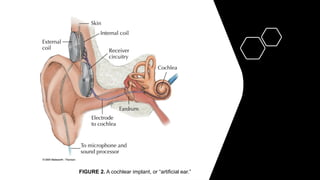
FIGURE 2. A cochlear implant, or “artificial ear.”
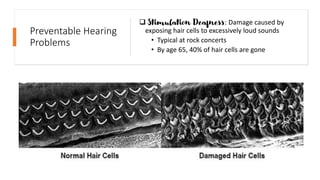
Preventable Hearing
Problems
❑ Stimulation Deafness: Damage caused by
exposing hair cells to excessively loud sounds
• Typical at rock concerts
• By age 65, 40% of hair cells are gone
Other Senses
TASTE: SAVOURY
SENSATIONS
SMELL: THE SENSE
OF SCENTS
SENSES OF THE SKIN THE MYSTERY OF
PAIN
THE ENVIRONMENT
WITHIN
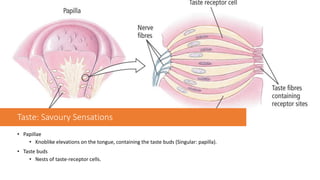
Taste: Savoury Sensations
• Papillae
• Knoblike elevations on the tongue, containing the taste buds (Singular: papilla).
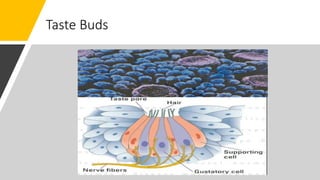
• Taste buds
• Nests of taste-receptor cells.
Taste Buds
Four Tastes
❑Four basic tastes
• Salty, sour, bitter and sweet.
❑Different people have different tastes based on:
• Genetics
• Culture
• Learning
• Food attractiveness
Ageusia
• the loss of taste functions of the tongue
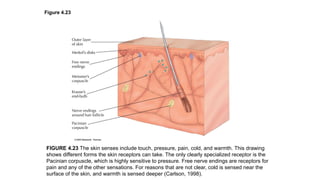
Figure 4.23
FIGURE 4.23 The skin senses include touch, pressure, pain, cold, and warmth. This drawing
shows different forms the skin receptors can take. The only clearly specialized receptor is the
Pacinian corpuscle, which is highly sensitive to pressure. Free nerve endings are receptors for
pain and any of the other sensations. For reasons that are not clear, cold is sensed near the
surface of the skin, and warmth is sensed deeper (Carlson, 1998).
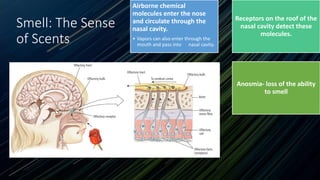
Smell: The Sense
of Scents
Airborne chemical
molecules enter the nose
and circulate through the
nasal cavity.
• Vapors can also enter through the
mouth and pass into nasal cavity.
Receptors on the roof of the
nasal cavity detect these
molecules.
Anosmia- loss of the ability
to smell
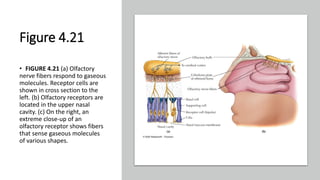
Figure 4.21
• FIGURE 4.21 (a) Olfactory
nerve fibers respond to gaseous
molecules. Receptor cells are
shown in cross section to the
left. (b) Olfactory receptors are
located in the upper nasal
cavity. (c) On the right, an
extreme close-up of an
olfactory receptor shows fibers
that sense gaseous molecules
of various shapes.
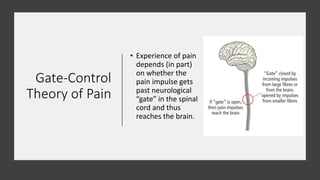
Gate-Control
Theory of Pain
• Experience of pain
depends (in part)
on whether the
pain impulse gets
past neurological
“gate” in the spinal
cord and thus
reaches the brain.
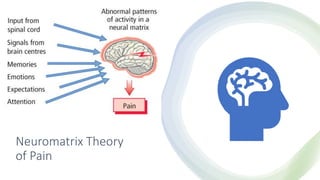
Neuromatrix Theory
of Pain
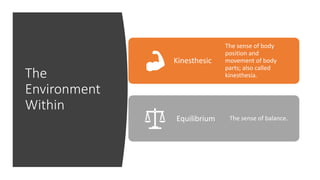
The
Environment
Within
Kinesthesic
The sense of body
position and
movement of body
parts; also called
kinesthesia.
Equilibrium The sense of balance.
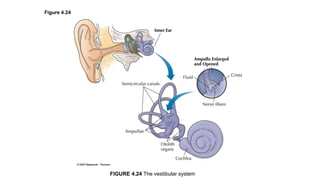
Figure 4.24
FIGURE 4.24 The vestibular system
Vestibular
System and
Motion
Sickness
Motion sickness is directly related to vestibular
system.
Sensory Conflict Theory: Motion sickness occurs
because vestibular system sensations do not
match sensations from the eyes and body.
• After spinning and stopping, fluid in semicircular canals is
still spinning, but head is not.
• Mismatch leads to sickness.
Medications, relaxation, and lying down might
help.
Perception
Form Perception
• Gestalt principles describe the
brain’s organization of sensory
building blocks into meaningful units
and patterns.
Figure and Ground
• Proximity
• Seeing 3 pair of lines in A.
• Similarity
• Seeing columns of orange and red
dots in B.
• Continuity
• Seeing lines that connect 1 to 2 and
3 to 4 in C.
• Closure
• Seeing a horse in D.
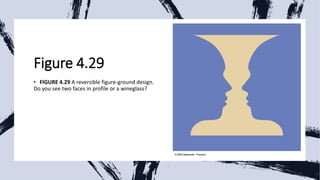
Figure 4.29
• FIGURE 4.29 A reversible figure-ground design.
Do you see two faces in profile or a wineglass?
Depth and Distance Perception
• Binocular Cues:
• Visual cues to depth or distance that require the use of
both eyes.
• Convergence: Turning inward of the eyes, which occurs
when they focus on a nearby object.
• Retinal Disparity: The slight difference in lateral separation
between two objects as seen by the left eye and the right
eye.
Visual Constancies
• The accurate perception of objects as
stable or unchanged despite changes in
the sensory patterns they produce.
• Shape constancy
• Location constancy
• Size constancy
• Brightness constancy
• Color constancy
Shape
Constancy
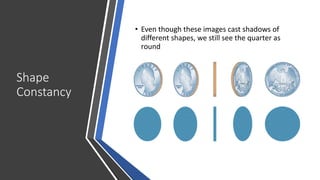
• Even though these images cast shadows of
different shapes, we still see the quarter as
round
Optical
Illusions
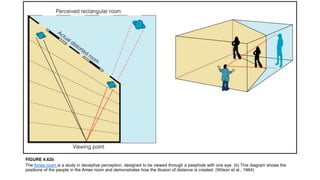
When we misjudge distance, we
misjudge size as well.
For example, the Ames room illusion
causes us to misjudge the heights of
people standing in it using a powerfully
misleading set of background cues.
FIGURE 4.62b
The Ames room is a study in deceptive perception, designed to be viewed through a peephole with one eye. (b) This diagram shows the
positions of the people in the Ames room and demonstrates how the illusion of distance is created. (Wilson et al., 1964)
Figure 4.32
FIGURE 4.32 Necker’s cube.
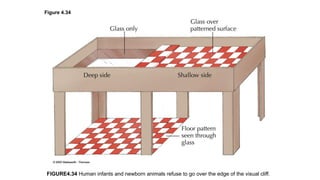
Figure 4.34
FIGURE4.34 Human infants and newborn animals refuse to go over the edge of the visual cliff.
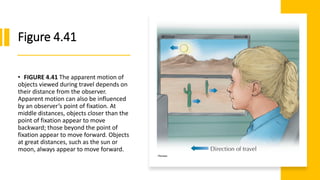
Figure 4.41
• FIGURE 4.41 The apparent motion of
objects viewed during travel depends on
their distance from the observer.
Apparent motion can also be influenced
by an observer’s point of fixation. At
middle distances, objects closer than the
point of fixation appear to move
backward; those beyond the point of
fixation appear to move forward. Objects
at great distances, such as the sun or
moon, always appear to move forward.
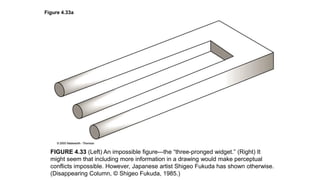
Figure 4.33a
FIGURE 4.33 (Left) An impossible figure—the “three-pronged widget.” (Right) It
might seem that including more information in a drawing would make perceptual
conflicts impossible. However, Japanese artist Shigeo Fukuda has shown otherwise.
(Disappearing Column, © Shigeo Fukuda, 1985.)
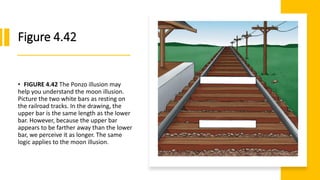
Figure 4.42
• FIGURE 4.42 The Ponzo illusion may
help you understand the moon illusion.
Picture the two white bars as resting on
the railroad tracks. In the drawing, the
upper bar is the same length as the lower
bar. However, because the upper bar
appears to be farther away than the lower
bar, we perceive it as longer. The same
logic applies to the moon illusion.
Perceptual
Learning
Change in the brain that alters
how we process sensory
information
Perceptual Reconstructions:
Mental models of external
events
Perceptual Habits: Ingrained
patterns of organization and
attention
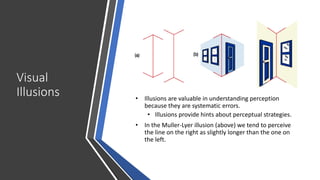
Visual
Illusions • Illusions are valuable in understanding perception
because they are systematic errors.
• Illusions provide hints about perceptual strategies.
• In the Muller-Lyer illusion (above) we tend to perceive
the line on the right as slightly longer than the one on
the left.
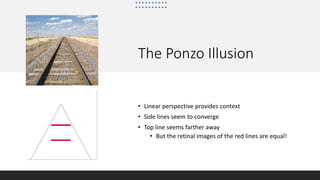
The Ponzo Illusion
• Linear perspective provides context
• Side lines seem to converge
• Top line seems farther away
• But the retinal images of the red lines are equal!
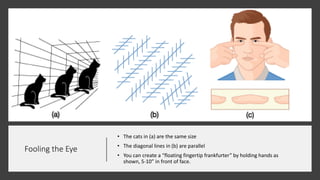
Fooling the Eye
• The cats in (a) are the same size
• The diagonal lines in (b) are parallel
• You can create a “floating fingertip frankfurter” by holding hands as
shown, 5-10” in front of face.
Perceptual Powers:
Origins and
Influences
• Inborn abilities
• Critical periods
• Psychological and cultural
Influences on perception
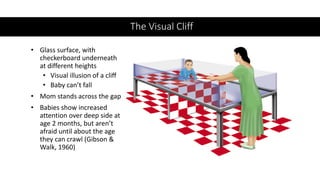
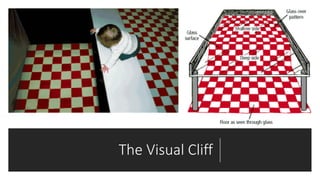
The Visual Cliff
• Glass surface, with
checkerboard underneath
at different heights
• Visual illusion of a cliff
• Baby can’t fall
• Mom stands across the gap
• Babies show increased
attention over deep side at
age 2 months, but aren’t
afraid until about the age
they can crawl (Gibson &
Walk, 1960)
The Visual Cliff
Critical Periods
If infants miss out on
experiences during a
crucial period of time,
perception will be
impaired.
When adults who have
been blind since birth
have vision restored,
they may not see well
Other senses such has
hearing may be
influenced similarly.
Errors in
Perception
• Illusion
• Hallucination
• Delusion
Psychological
and Cultural
Influences on
Perception
• We are more likely to perceive something when
we need it.
• What we believe can affect what we perceive.
• Emotions, such as fear, can influence perceptions
of sensory information.
• Expectations based on our previous experiences
influence how we perceive the world.
• Perceptual Set
• A habitual way of perceiving, based on
expectations.
• All are influenced by our culture.
Perceptual Set
• What you see in the centre figures depends on the order in which you
look at the figures.
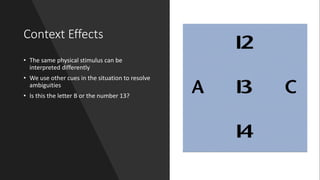
Context Effects
• The same physical stimulus can be
interpreted differently
• We use other cues in the situation to resolve
ambiguities
• Is this the letter B or the number 13?
Puzzles of
Perception
Subliminal Perception
Extrasensory Perception:
Reality or Illusion?
Subliminal Perception
• Perceiving without awareness
• visual stimuli can affect your behaviour even when you are unaware that
you saw it
• nonconscious processing also occurs in memory, thinking, and decision
making
• these effects are often small, however, and difficult to demonstrate and
work best with simple stimuli
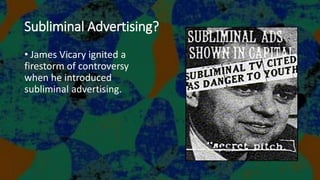
Subliminal Advertising?
• James Vicary ignited a
firestorm of controversy
when he introduced
subliminal advertising.
Subliminal
Perception
• Perception versus Persuasion
• there is no empirical research to
support popular notions that subliminal
persuasion has any effect on a person’s
behaviour
• persuasion works best when messages,
in the form of advertising or self-help
tapes, are presented above-threshold,
or at a supraliminal level
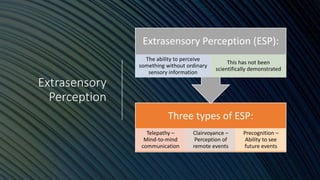
Extrasensory
Perception
Three types of ESP:
Telepathy –
Mind-to-mind
communication
Clairvoyance –
Perception of
remote events
Precognition –
Ability to see
future events
Extrasensory Perception (ESP):
The ability to perceive
something without ordinary
sensory information
This has not been
scientifically demonstrated
Parapsychology
• The study of purported psychic phenomena such as ESP and
mental telepathy.
• Persinger suggests that psychic phenomena are related to
signs of temporal lobe epilepsy in otherwise neurologically
normal individuals.
• Most ESP studies produce negative findings and are not easily
replicated.
Parapsychology
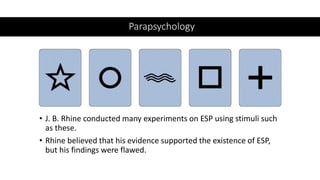
• J. B. Rhine conducted many experiments on ESP using stimuli such
as these.
• Rhine believed that his evidence supported the existence of ESP,
but his findings were flawed.

Sensation and Perception by Miss A

  • 1.
    Sensation and perception AnnaMarie Abrera, RPsy Faculty, Social Science Dept. College of Arts, Sciences and Social Work Philippine Christian University anna.abrera@pcu.edu.ph
  • 2.
    If you were standingamid this street scene, you would be absorbing and processing numerous pieces of sensory input. This process involves sensation and perception.
  • 3.
    We rely onour sensory systems to provide important information about our surroundings. We use this information to successfully navigate and interact with our environment so that we can find nourishment, seek shelter, maintain social relationships, and avoid potentially dangerous situations.
  • 4.
    Defining sensation: What doesit mean to sense something? • Sensation • The detection of physical energy emitted or reflected by physical objects. • It occurs when energy in the external environment or the body stimulates receptors in the sense organs.
  • 5.
    •Perception •The process bywhich the brain organizes and interprets sensory information. Can we sense something and not perceive it?
  • 6.
    Bottom-up processing refersto the fact that perceptions are built from sensory input. On the other hand, how we interpret those sensations is influenced by our available knowledge, our experiences, and our thoughts., also called the top-down processing.
  • 7.
    Ambiguous Figure • Inthis figure, you will notice that the colored surface can be either the outside front surface or the inside back surface • They cannot simultaneously be both. • Brain can interpret the ambiguous cues two different ways
  • 8.
    You have probablyknown since elementary school that we have five senses: vision, hearing (audition), smell (olfaction), taste (gustation), and touch (somatosensation). It turns out that this notion of five senses is oversimplified. We also have sensory systems that provide information about balance (the vestibular sense), body position and movement (proprioception and kinesthesia), pain (nociception), and temperature (thermoception).
  • 9.
    Principles in theSensation and Perception Process
  • 10.
    • Sense receptors(i.e., specialized cells) convert physical energy in the environment or the body to electrical energy that can be transmitted as nerve impulses to the brain. 1. Transduction
  • 11.
  • 12.
    2. Specificity • Differentsensory modalities exist because signals received by the sense organs stimulate different nerve pathways leading to different areas of the brain.
  • 13.
  • 14.
    3. Absolute Threshold The smallest quantityof physical energy that can be reliably detected by an observer. ❑ A sufficient stimulation is needed in order to be processed by the brain.
  • 15.
    4. Difference Threshold •The smallest difference in stimulation that can be reliably detected by an observer when two stimuli are compared; • Also called Just Noticeable Difference (JND).
  • 16.
    5. Sensory Adaptation • Thereduction or disappearance of sensory responsiveness when stimulation is unchanging or repetitious.
  • 17.
    Let’s do an experiment! 1.Get a container with hot water and another container with a cold water. 2. In the middle, place a container with lukewarm water. 3. Make sure the container’s size is sufficient when you place your hand in there. How does it feel?
  • 18.
    There is anotherfactor that affects sensation and perception: attention. Attention plays a significant role in determining what is sensed versus what is perceived. Imagine you are at a party full of music, chatter, and laughter. You get involved in an interesting conversation with a friend, and you tune out all the background noise. If someone interrupted you to ask what song had just finished playing, you would probably be unable to answer that question.
  • 19.
    No matter howmuch noise you hear from your surrounding, you focus your sensation only on sounds where your attention is placed. 6. Selective Attention Voluntarily focusing on a specific sensory input to reduce sensory overload
  • 20.
    Let’s test yourability for selective attention. https://bit.ly/2O9O2na
  • 21.
    Failure to noticesomething that is completely visible because of a lack of attention is called inattentional blindness. Here’s a video clip on how we also fail to notice changes due to lack of attention to certain stimuli. This is known as change blindness. https://bit.ly/3fjLnDm
  • 22.
  • 23.
    What We See •Hue • Brightness • Saturation
  • 24.
    An Eye onthe World
  • 25.
    FIGURE 1. Testsof visual acuity. Here are some common tests of visual acuity. In (a), sharpness is indicated by the smallest grating still seen as individual lines. The Snellen chart (b) requires that you read rows of letters of diminishing size until you can no longer distinguish them. The Landolt rings (c) require no familiarity with letters. All that is required is a report of which side has a break in it. Figure 4.8
  • 26.
    FIGURE 1.2 Visualpop-out. (Adapted from Ramachandran, 1992b.) Pop-out is so basic that babies as young as 3 months respond to it
  • 27.
    Why the Visual System isnot a Camera? • Much visual processing is done in the brain. • Some cortical cells respond to lines in specific orientations (e.g. horizontal). • Other cells in the cortex respond to other shapes (e.g., bulls-eyes, spirals, faces). • Feature-detectors • Cells in the visual cortex that are sensitive to specific features of the environment.
  • 28.
  • 29.
  • 30.
    What We Hear oLoudness • Thedimension of auditory experience related to the intensity of a pressure wave. oPitch • The dimension of auditory experience related to the frequency of a pressure wave. oTimbre (pronounced “TAM-bur”) • The distinguishing quality of sound; the dimension of auditory experience related to the complexity of the pressure wave.
  • 31.
    An Ear onthe World
  • 32.
    Auditory Localization oSounds fromdifferent directions are not identical as they arrive at left and right ears • Loudness • Timing • Phase oThe brain calculates a sound’s location by using these differences.
  • 33.
    Can you trustyour ears? • Short Video Clip • https://bit.ly/2W1kuwm
  • 34.
    Hearing Loss • ConductionDeafness: Poor transfer of sounds from tympanic membrane to inner ear • Compensate with amplifier (hearing aid) • Nerve Deafness: Caused by damage to hair cells or auditory nerve • Hearing aids useless in these cases, since auditory messages cannot reach the brain • Cochlear Implant: Electronic device that stimulates auditory nerves; still not very successful Cochlear Implant Hearing Aid
  • 35.
    FIGURE 2. Acochlear implant, or “artificial ear.”
  • 36.
    Preventable Hearing Problems ❑ StimulationDeafness: Damage caused by exposing hair cells to excessively loud sounds • Typical at rock concerts • By age 65, 40% of hair cells are gone
  • 37.
    Other Senses TASTE: SAVOURY SENSATIONS SMELL:THE SENSE OF SCENTS SENSES OF THE SKIN THE MYSTERY OF PAIN THE ENVIRONMENT WITHIN
  • 38.
    Taste: Savoury Sensations •Papillae • Knoblike elevations on the tongue, containing the taste buds (Singular: papilla). • Taste buds • Nests of taste-receptor cells.
  • 39.
  • 40.
    Four Tastes ❑Four basictastes • Salty, sour, bitter and sweet. ❑Different people have different tastes based on: • Genetics • Culture • Learning • Food attractiveness
  • 41.
    Ageusia • the lossof taste functions of the tongue
  • 42.
    Figure 4.23 FIGURE 4.23The skin senses include touch, pressure, pain, cold, and warmth. This drawing shows different forms the skin receptors can take. The only clearly specialized receptor is the Pacinian corpuscle, which is highly sensitive to pressure. Free nerve endings are receptors for pain and any of the other sensations. For reasons that are not clear, cold is sensed near the surface of the skin, and warmth is sensed deeper (Carlson, 1998).
  • 43.
    Smell: The Sense ofScents Airborne chemical molecules enter the nose and circulate through the nasal cavity. • Vapors can also enter through the mouth and pass into nasal cavity. Receptors on the roof of the nasal cavity detect these molecules. Anosmia- loss of the ability to smell
  • 44.
    Figure 4.21 • FIGURE4.21 (a) Olfactory nerve fibers respond to gaseous molecules. Receptor cells are shown in cross section to the left. (b) Olfactory receptors are located in the upper nasal cavity. (c) On the right, an extreme close-up of an olfactory receptor shows fibers that sense gaseous molecules of various shapes.
  • 45.
    Gate-Control Theory of Pain •Experience of pain depends (in part) on whether the pain impulse gets past neurological “gate” in the spinal cord and thus reaches the brain.
  • 46.
  • 47.
    The Environment Within Kinesthesic The sense ofbody position and movement of body parts; also called kinesthesia. Equilibrium The sense of balance.
  • 48.
    Figure 4.24 FIGURE 4.24The vestibular system
  • 49.
    Vestibular System and Motion Sickness Motion sicknessis directly related to vestibular system. Sensory Conflict Theory: Motion sickness occurs because vestibular system sensations do not match sensations from the eyes and body. • After spinning and stopping, fluid in semicircular canals is still spinning, but head is not. • Mismatch leads to sickness. Medications, relaxation, and lying down might help.
  • 50.
  • 51.
    Form Perception • Gestaltprinciples describe the brain’s organization of sensory building blocks into meaningful units and patterns.
  • 52.
    Figure and Ground •Proximity • Seeing 3 pair of lines in A. • Similarity • Seeing columns of orange and red dots in B. • Continuity • Seeing lines that connect 1 to 2 and 3 to 4 in C. • Closure • Seeing a horse in D.
  • 55.
    Figure 4.29 • FIGURE4.29 A reversible figure-ground design. Do you see two faces in profile or a wineglass?
  • 58.
    Depth and DistancePerception • Binocular Cues: • Visual cues to depth or distance that require the use of both eyes. • Convergence: Turning inward of the eyes, which occurs when they focus on a nearby object. • Retinal Disparity: The slight difference in lateral separation between two objects as seen by the left eye and the right eye.
  • 59.
    Visual Constancies • Theaccurate perception of objects as stable or unchanged despite changes in the sensory patterns they produce. • Shape constancy • Location constancy • Size constancy • Brightness constancy • Color constancy
  • 60.
    Shape Constancy • Even thoughthese images cast shadows of different shapes, we still see the quarter as round
  • 61.
    Optical Illusions When we misjudgedistance, we misjudge size as well. For example, the Ames room illusion causes us to misjudge the heights of people standing in it using a powerfully misleading set of background cues.
  • 62.
    FIGURE 4.62b The Amesroom is a study in deceptive perception, designed to be viewed through a peephole with one eye. (b) This diagram shows the positions of the people in the Ames room and demonstrates how the illusion of distance is created. (Wilson et al., 1964)
  • 63.
    Figure 4.32 FIGURE 4.32Necker’s cube.
  • 64.
    Figure 4.34 FIGURE4.34 Humaninfants and newborn animals refuse to go over the edge of the visual cliff.
  • 65.
    Figure 4.41 • FIGURE4.41 The apparent motion of objects viewed during travel depends on their distance from the observer. Apparent motion can also be influenced by an observer’s point of fixation. At middle distances, objects closer than the point of fixation appear to move backward; those beyond the point of fixation appear to move forward. Objects at great distances, such as the sun or moon, always appear to move forward.
  • 66.
    Figure 4.33a FIGURE 4.33(Left) An impossible figure—the “three-pronged widget.” (Right) It might seem that including more information in a drawing would make perceptual conflicts impossible. However, Japanese artist Shigeo Fukuda has shown otherwise. (Disappearing Column, © Shigeo Fukuda, 1985.)
  • 67.
    Figure 4.42 • FIGURE4.42 The Ponzo illusion may help you understand the moon illusion. Picture the two white bars as resting on the railroad tracks. In the drawing, the upper bar is the same length as the lower bar. However, because the upper bar appears to be farther away than the lower bar, we perceive it as longer. The same logic applies to the moon illusion.
  • 68.
    Perceptual Learning Change in thebrain that alters how we process sensory information Perceptual Reconstructions: Mental models of external events Perceptual Habits: Ingrained patterns of organization and attention
  • 69.
    Visual Illusions • Illusionsare valuable in understanding perception because they are systematic errors. • Illusions provide hints about perceptual strategies. • In the Muller-Lyer illusion (above) we tend to perceive the line on the right as slightly longer than the one on the left.
  • 70.
    The Ponzo Illusion •Linear perspective provides context • Side lines seem to converge • Top line seems farther away • But the retinal images of the red lines are equal!
  • 71.
    Fooling the Eye •The cats in (a) are the same size • The diagonal lines in (b) are parallel • You can create a “floating fingertip frankfurter” by holding hands as shown, 5-10” in front of face.
  • 72.
    Perceptual Powers: Origins and Influences •Inborn abilities • Critical periods • Psychological and cultural Influences on perception
  • 73.
    The Visual Cliff •Glass surface, with checkerboard underneath at different heights • Visual illusion of a cliff • Baby can’t fall • Mom stands across the gap • Babies show increased attention over deep side at age 2 months, but aren’t afraid until about the age they can crawl (Gibson & Walk, 1960)
  • 74.
  • 75.
    Critical Periods If infantsmiss out on experiences during a crucial period of time, perception will be impaired. When adults who have been blind since birth have vision restored, they may not see well Other senses such has hearing may be influenced similarly.
  • 76.
    Errors in Perception • Illusion •Hallucination • Delusion
  • 77.
    Psychological and Cultural Influences on Perception •We are more likely to perceive something when we need it. • What we believe can affect what we perceive. • Emotions, such as fear, can influence perceptions of sensory information. • Expectations based on our previous experiences influence how we perceive the world. • Perceptual Set • A habitual way of perceiving, based on expectations. • All are influenced by our culture.
  • 78.
    Perceptual Set • Whatyou see in the centre figures depends on the order in which you look at the figures.
  • 79.
    Context Effects • Thesame physical stimulus can be interpreted differently • We use other cues in the situation to resolve ambiguities • Is this the letter B or the number 13?
  • 80.
  • 81.
    Subliminal Perception • Perceivingwithout awareness • visual stimuli can affect your behaviour even when you are unaware that you saw it • nonconscious processing also occurs in memory, thinking, and decision making • these effects are often small, however, and difficult to demonstrate and work best with simple stimuli
  • 82.
    Subliminal Advertising? • JamesVicary ignited a firestorm of controversy when he introduced subliminal advertising.
  • 83.
    Subliminal Perception • Perception versusPersuasion • there is no empirical research to support popular notions that subliminal persuasion has any effect on a person’s behaviour • persuasion works best when messages, in the form of advertising or self-help tapes, are presented above-threshold, or at a supraliminal level
  • 84.
    Extrasensory Perception Three types ofESP: Telepathy – Mind-to-mind communication Clairvoyance – Perception of remote events Precognition – Ability to see future events Extrasensory Perception (ESP): The ability to perceive something without ordinary sensory information This has not been scientifically demonstrated
  • 85.
    Parapsychology • The studyof purported psychic phenomena such as ESP and mental telepathy. • Persinger suggests that psychic phenomena are related to signs of temporal lobe epilepsy in otherwise neurologically normal individuals. • Most ESP studies produce negative findings and are not easily replicated.
  • 86.
    Parapsychology • J. B.Rhine conducted many experiments on ESP using stimuli such as these. • Rhine believed that his evidence supported the existence of ESP, but his findings were flawed.