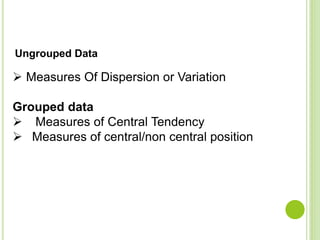
Ungrouped Data
 Measures Of Dispersion or Variation
Grouped data
 Measures of Central Tendency
 Measures of central/non central position
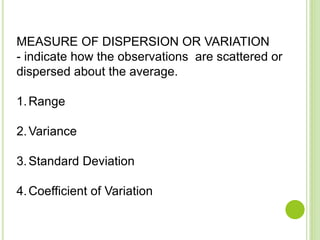
MEASURE OF DISPERSION OR VARIATION
- indicate how the observations are scattered or
dispersed about the average.
1.Range
2.Variance
3.Standard Deviation
4.Coefficient of Variation
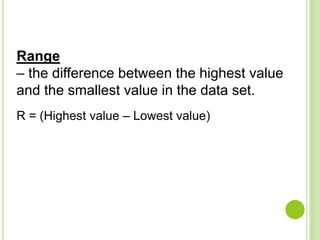
Range
– the difference between the highest value
and the smallest value in the data set.
R = (Highest value – Lowest value)
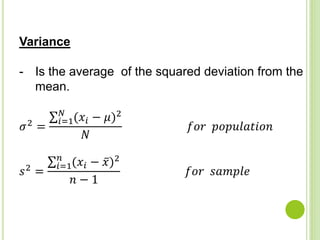
Variance
- Is the average of the squared deviation from the
mean.
𝜎2 =
𝑖=1
𝑁
(𝑥𝑖 − 𝜇)2
𝑁
𝑓𝑜𝑟 𝑝𝑜𝑝𝑢𝑙𝑎𝑡𝑖𝑜𝑛
𝑠2 =
𝑖=1
𝑛
(𝑥𝑖 − 𝑥)2
𝑛 − 1
𝑓𝑜𝑟 𝑠𝑎𝑚𝑝𝑙𝑒
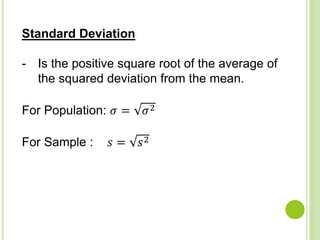
Standard Deviation
- Is the positive square root of the average of
the squared deviation from the mean.
For Population: 𝜎 = 𝜎2
For Sample : 𝑠 = 𝑠2
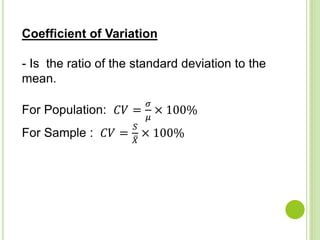
Coefficient of Variation
- Is the ratio of the standard deviation to the
mean.
For Population: 𝐶𝑉 =
𝜎
𝜇
× 100%
For Sample : 𝐶𝑉 =
𝑆
𝑋
× 100%
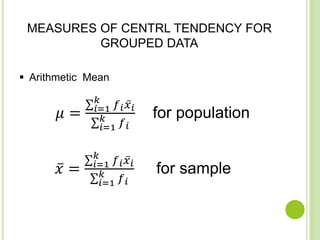
MEASURES OF CENTRL TENDENCY FOR
GROUPED DATA
 Arithmetic Mean
𝜇 = 𝑖=1
𝑘
𝑓 𝑖 𝑥 𝑖
𝑖=1
𝑘
𝑓 𝑖
for population
𝑥 = 𝑖=1
𝑘
𝑓 𝑖 𝑥 𝑖
𝑖=1
𝑘 𝑓 𝑖
for sample
MEASURES OF CENTRL TENDENCY FOR GROUPED DATA
 Median ( 𝜇, 𝑥 )
𝜇 = 𝐿𝐶𝐵 𝑚 + 𝑐 [
𝑛
2
− 𝐹 𝑚−1
𝑓𝑚
]
𝑥 =𝐿𝐶𝐵 𝑚 + 𝑐 [
𝑛
2
−𝐹 𝑚−1
𝑓 𝑚
]
Where :
𝐿𝐶𝐵 𝑚 = is the lower class boundary of the median class
𝑐 = class width
𝐹 𝑚−1 = cumulative frequency before the cumulative frequency of the
median class.
𝑓𝑚 = frequency of the median class
n = number of observation
MEASURES OF CENTRL TENDENCY FOR GROUPED DATA
 Mode ( 𝜇, 𝑥 )
𝜇 = 𝐿𝐶𝐵 𝑚𝑜 + 𝑐 [
𝑓 𝑚0 − 𝑓1
2𝑓𝑚𝑜 − 𝑓1 − 𝑓2
]
𝑥 = 𝐿𝐶𝐵 𝑚𝑜 + 𝑐 [
𝑓 𝑚0 − 𝑓1
2𝑓𝑚𝑜 − 𝑓1 − 𝑓2
]
where
𝐿𝐶𝐵 𝑚𝑜= is the lower class boundary of the
modal class
c = the class width
𝑓 𝑚0 = frequency of the modal class
𝑓1 = frequency before the modal class
𝑓2 = frequency after the modal class.
statistic midterm

statistic midterm

  • 2.
    Ungrouped Data  MeasuresOf Dispersion or Variation Grouped data  Measures of Central Tendency  Measures of central/non central position
  • 3.
    MEASURE OF DISPERSIONOR VARIATION - indicate how the observations are scattered or dispersed about the average. 1.Range 2.Variance 3.Standard Deviation 4.Coefficient of Variation
  • 4.
    Range – the differencebetween the highest value and the smallest value in the data set. R = (Highest value – Lowest value)
  • 5.
    Variance - Is theaverage of the squared deviation from the mean. 𝜎2 = 𝑖=1 𝑁 (𝑥𝑖 − 𝜇)2 𝑁 𝑓𝑜𝑟 𝑝𝑜𝑝𝑢𝑙𝑎𝑡𝑖𝑜𝑛 𝑠2 = 𝑖=1 𝑛 (𝑥𝑖 − 𝑥)2 𝑛 − 1 𝑓𝑜𝑟 𝑠𝑎𝑚𝑝𝑙𝑒
  • 6.
    Standard Deviation - Isthe positive square root of the average of the squared deviation from the mean. For Population: 𝜎 = 𝜎2 For Sample : 𝑠 = 𝑠2
  • 7.
    Coefficient of Variation -Is the ratio of the standard deviation to the mean. For Population: 𝐶𝑉 = 𝜎 𝜇 × 100% For Sample : 𝐶𝑉 = 𝑆 𝑋 × 100%
  • 8.
    MEASURES OF CENTRLTENDENCY FOR GROUPED DATA  Arithmetic Mean 𝜇 = 𝑖=1 𝑘 𝑓 𝑖 𝑥 𝑖 𝑖=1 𝑘 𝑓 𝑖 for population 𝑥 = 𝑖=1 𝑘 𝑓 𝑖 𝑥 𝑖 𝑖=1 𝑘 𝑓 𝑖 for sample
  • 9.
    MEASURES OF CENTRLTENDENCY FOR GROUPED DATA  Median ( 𝜇, 𝑥 ) 𝜇 = 𝐿𝐶𝐵 𝑚 + 𝑐 [ 𝑛 2 − 𝐹 𝑚−1 𝑓𝑚 ] 𝑥 =𝐿𝐶𝐵 𝑚 + 𝑐 [ 𝑛 2 −𝐹 𝑚−1 𝑓 𝑚 ] Where : 𝐿𝐶𝐵 𝑚 = is the lower class boundary of the median class 𝑐 = class width 𝐹 𝑚−1 = cumulative frequency before the cumulative frequency of the median class. 𝑓𝑚 = frequency of the median class n = number of observation
  • 10.
    MEASURES OF CENTRLTENDENCY FOR GROUPED DATA  Mode ( 𝜇, 𝑥 ) 𝜇 = 𝐿𝐶𝐵 𝑚𝑜 + 𝑐 [ 𝑓 𝑚0 − 𝑓1 2𝑓𝑚𝑜 − 𝑓1 − 𝑓2 ] 𝑥 = 𝐿𝐶𝐵 𝑚𝑜 + 𝑐 [ 𝑓 𝑚0 − 𝑓1 2𝑓𝑚𝑜 − 𝑓1 − 𝑓2 ] where 𝐿𝐶𝐵 𝑚𝑜= is the lower class boundary of the modal class c = the class width 𝑓 𝑚0 = frequency of the modal class 𝑓1 = frequency before the modal class 𝑓2 = frequency after the modal class.