• A psychiatricemergency is defined as -
“any disturbance in thoughts,
feelings or actions for which
immediate therapeutic interventions
are necessary”.
• Patients may cause harm to
themselves or others or suffer immense,
acute distress which is intolerable.
Introduction
3.
General principles
• Theprinciples underlying many
psychiatric emergencies remain the
same.
• The emergent task at hand - triage,
evaluation, formulation, and
disposition, keeping safety for the
patient, others, and oneself
• Always err on the side of caution
4.
• Ensuring thesafety of the patient, others
and oneself is the challenge.
• The management of a psychiatric
emergency is a team effort in which both
medical professionals and hospital staff
have crucial roles.
•Appropriate management of psychiatric
emergencies saves lives.
5.
1. Suicidal patient,
2.Violent patient,
3. Substance withdrawal,
4. Severe anxiety/ panic attack,
5. Drug toxicity/ intoxication,
6. Drug induced Parkinsonism.
Examples
6.
•Defined as:- terminationof one’s life
intentionally.
•3rd leading cause of death between 15-24
yr.
•Suicidal patient is one- who attempted, tried
to attempt or frequently thought of attempting
suicide.
•Emergent intervention is required- as
suicide can be prevented.
•Prevalence of suicide- 10-15% in
depression, 10% in schizophrenia, number
rises when alcoholism is comorbid.
SUICIDE
7.
•Rate is 11.2per lac in 2011, India
•One person commit suicide every 40 sec.
globally
•Poisoning ,hanging, self immolation, slitting
of wrist & overdose of sleeping pills are
some common means.
•“Risk assessment is the integral part of
evaluation and management”.
8.
1. A persontalks about death, threatens of
committing/ discussing suicide.
2. Discuss different methods of suicide.
3. A person mentions suicide ideation.
4. A person attempts an act of deliberate self harm.
5. A person is seen making good bye gestures or
communications, writing of will/ other acts suggestive
of suicidal plan.
6. A person has suffered recent major loss of life or
property.
7. Hopelessness.
8. Severe agitation/ anxiety.
:-
Warning signs of suicide
9.
1.Such patients haveeither-
frequently thought of/
contemplated suicide/have
planned the act/ have
attempted the act.
2. Such patients are
brought by family members.
Presentation
10.
Risk factors
1. Femalegender,
2. Elderly age group,
3. Depression/ psychiatric illness
4. Poor social support,
5. Single status,
6. Alcohol abuse,
7. Chronic physical illnesses,
8. Family history.
11.
• Integral partof management of such
patients.
• Establishes severity of situation and
likelihood of future death by suicide.
Suicide risk assessment
12.
Types of suiciderisk
1. Low suicide risk:- less severe psychiatric illnesses,
better social support, fewer attempts, have employed less
lethal means of suicide such as superficial cut marks on
wrist.
2. Moderate suicidal risk:- presence of psychiatric
disorder, multiple attempts, attempts in last few days, low-
moderate lethality attempts like pills, alcoholism.
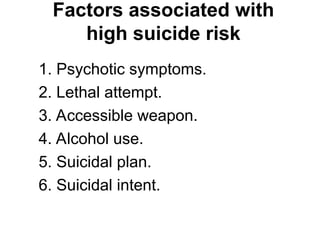
3. High suicide risk:- severe psychiatric illness, attempt
in last few hours, lethal attempts like hanging/ gunshot/
pesticide, poor social support.
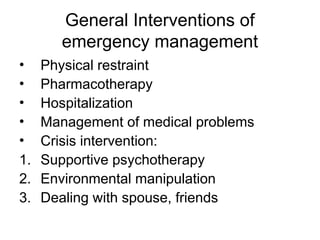
General Interventions of
emergencymanagement
• Physical restraint
• Pharmacotherapy
• Hospitalization
• Management of medical problems
• Crisis intervention:
1. Supportive psychotherapy
2. Environmental manipulation
3. Dealing with spouse, friends
15.
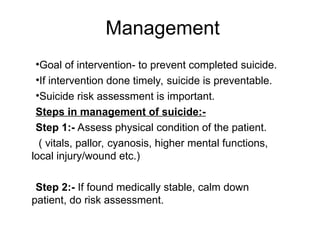
•Goal of intervention-to prevent completed suicide.
•If intervention done timely, suicide is preventable.
•Suicide risk assessment is important.
Steps in management of suicide:-
Step 1:- Assess physical condition of the patient.
( vitals, pallor, cyanosis, higher mental functions,
local injury/wound etc.)
Step 2:- If found medically stable, calm down
patient, do risk assessment.
Management
16.
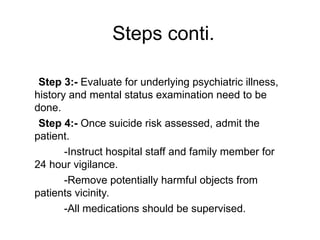
Step 3:- Evaluatefor underlying psychiatric illness,
history and mental status examination need to be
done.
Step 4:- Once suicide risk assessed, admit the
patient.
-Instruct hospital staff and family member for
24 hour vigilance.
-Remove potentially harmful objects from
patients vicinity.
-All medications should be supervised.
Steps conti.
17.
1. Early recognitionof suicide risk factors.
2. Early diagnosis and prompt treatment of
mental disorders like schizophrenia,
depression, bipolar disorder and substance
abuse.
3. Identify warning signs- talks, threats,
thoughts or previous attempts of deliberate
self harm.
4. Directly asking patients about - death
wishes, suicidal ideations, intentions.
5. 24 hour strict vigilance is advised till
underlying psychiatric illness responds to
Prevention
18.
1. All suicidalpatients require psychiatric
evaluations once medically stable.
2. Hospitalization in psychiatry ward
recommended for all patients who have made
lethal attempts of deliberate self harm/ who
exhibit high risk of suicide.
3. Early psychiatric intervention can prevent
suicide.
When to refer a suicidal patient
:-
- Ictal andpost-ictal states.
- Head injuries.
- Frontal & temporal lobe
pathologies
- Dyselectrolemias.
- Delirium & dementia.
- Renal & hepatic failure.
- Endocrine disorders.
Medical conditions presenting with
violence
21.
1. Ensure thesafety of others including oneself.
2. Restrain or seclusion may be required. ( care to
be taken not to violate human rights of any patient by
forceful restraint/ injection unless as last resort).
3. To rule out organicity and look for treatable
medical cause.
4. Medication oral or parentral to control agitation.
5. Psychiatric assessment by history and MSE to
establish underlying diagnosis.
6. Treat underlying psychiatric disorder.
“Management of a violent patients require
patience, vigilance, team effort and
preparedness”.
Management
22.
1. Don’t approacha violent patients alone, staff
should be present.
2. Ensure removal of potentially harmful objects
from patients vicinity.
3. Assess for the possibility of possession of
weapon by patient.
4. Ensure suitable escape route in case of
uncontrollable violence.
Special precautions
23.
5. Don’t intimidate,argue or pose any threat to the
patient.
6. Approach patient in calm and non threatening
manner.
7. Maintain at least 3-6 feet distance from patient.
8. If patient agrees to speak with you, sit him down
and listen him, let him know you are there to help
him and he need not to fear.
Special precautions (conti.)
24.
1. LORAZEPAM- 2-4mgOral/ IM ; effective
particularly in non-psychotic patients.
2. OLANZAPINE- 10mg Oral/IM; indicated
in psychosis.
3. HALOPERIDOL (5-10mg) +
PROMETHAZINE (25-50mg) IM; rapid
control of psychotic agitation.
Medications
25.
- All suspectedcases of organicity should be
investigated and referred to concerned
speciality.
- All stabilised patients should be sent for
psychiatric evaluation and management.
- Medical conditions should be examined and
stabilised before a psychiatric referral.
- Very severe cases need inpatient
management.
When to refer a violent patient
26.
SUBSTANCE WITHDRAWAL:-
1. Complicatedalcohol withdrawal ( seizure
or delirium tremens).
20% untreated cases of DT dies.
Management with benzodiazepines and
thiamine oral or injectable.
2. Opioid dependence with distressing
withdrawal symptoms.
OTHER PSYCHIATRIC EMERGENCIES
27.
- Characterised asdiscrete episodes of
severe anxiety associated with autonomic
symptoms like breathlessness, palpitations,
heaviness of head, sense of impending
doom.
- often perceived as heart attack by patients.
- Benzodiazepines are indicated.
PANIC ATTACKS
28.
- Occulogyric crisis,extrapyramidal
symptoms.
- Usually develops in patients on
antipsychotic agents (typical ones).
- IM/IV Promethazine 25-50mg is the
treatment of choice and review the
treatment
DRUG INDUCED
ACUTE DYSTONIA




![PERI-PROSTHETIC FRACTURE NAIL-PLATE CONSTRUCT [NPC].pptx](https://cdn.slidesharecdn.com/ss_thumbnails/drarunkumardrmohamedashrafperiprostheticfrasturenail-plateconstructnpc-260209164459-7e9d15a1-thumbnail.jpg?width=640&height=640&fit=bounds)


