Chapter Three
3.2 The Internet
3.2.1 Overview of the Internet
3.2.1.1 Introduction to the
Internet
At the end of this topic, students
should be able to:
- Explain about the Internet
1
What to cover?
• Definition of Internet
• Advantages and disadvantages of Internet
• Intranet & extranet
2
The Internet
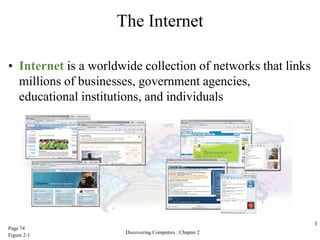
• Internet is a worldwide collection of networks that links
millions of businesses, government agencies,
educational institutions, and individuals
Discovering Computers : Chapter 2
3
Page 74
Figure 2-1
Evolution of the Internet
Discovering Computers : Chapter 2
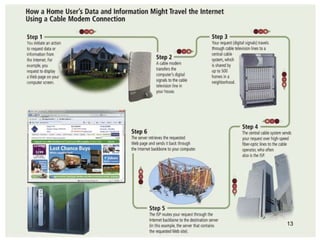
4
Pages 75 - 76
•1969 - ARPANET becomes functional
•1984 - ARPANET has more than 1,000 individual computers linked
as hosts
•1986 - NSF connects NSFnet to ARPANET and becomes known as
the Internet
•1995 - NSFNet terminates its network on the Internet and resumes
status as research network
•1996 - Internet2 is founded
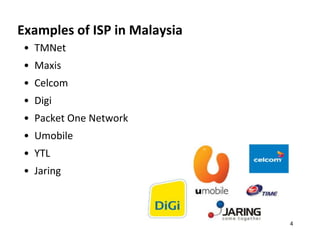
•Today - More than 550 million hosts connect to the Internet
5
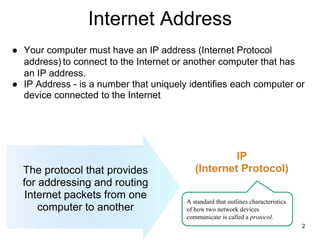
• Vast amounts of data can be stored and processed
quickly and efficiently
• Information is available 24 hours a day through
access on the Internet or home computer files or
office/ workshop servers and computer facilities
Advantages of Internet
1. Accessibility
6
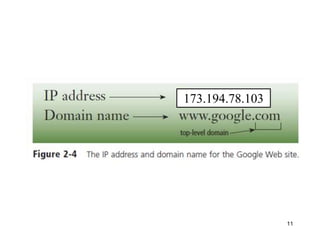
• Decreases in storage costs and increases in
Internet connection speeds persuade more users
to use cloud storage for their data.
• Web application hosts often store users’ data and
information on their servers, which sometimes is
called cloud storage.
• Cloud storage also provides users with the
convenience of accessing their files from almost
anywhere.
2. Storage
Advantages of Internet
7
• You don’t need to leave home to shop – you can
shop online and deal with bank transactions and
book holidays – an advantage if your are disabled
and cannot easily get out.
• You can work from home and use video
conferencing/ forum or chat to people across the
other side of the world. ( all of which saves money
and time)
3. Online activity
Advantages of Internet
8
• Information is readily available, however
confidential information may be accessed unless
properly password controlled
• In many instances, where personal and
confidential records were not protected properly,
individuals have found their privacy violated and
identities stolen.
Disadvantages of Internet
1. Violation of Privacy
9
• Adults, teens, and children around the world are
using Internet to share publicly their photos,
videos, journals, music, and other personal
information. Some of these unsuspecting,
innocent computer users have fallen victim to
crimes committed by dangerous strangers.
• Protect yourself and your dependents from these
criminals by being cautious in e-mail messages
and on Web sites.
2. Public Safety
Disadvantages of Internet
10
• Prolonged or improper computer use to access to
the Internet can lead to injuries or disorders of
the hands, wrists, elbows, eyes, neck, and back.
• Computer users can protect themselves from
these health risks through proper workplace
design, good posture while at the computer, and
appropriately spaced work breaks.
• Two behavioral health risks are computer
addiction and technology overload
3. Health Risks
Disadvantages of Internet
Networks
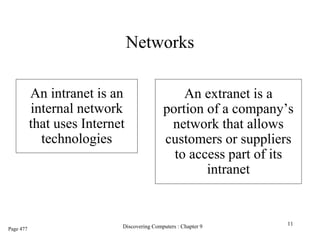
An intranet is an
internal network
that uses Internet
technologies
An extranet is a
portion of a company’s
network that allows
customers or suppliers
to access part of its
intranet
Discovering Computers : Chapter 9 11
Page 477
Intranet vs Extranet
Discovering Computers : Chapter 9 12
Page 477
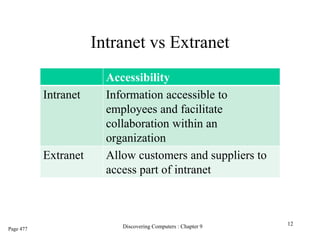
Accessibility
Intranet Information accessible to
employees and facilitate
collaboration within an
organization
Extranet Allow customers and suppliers to
access part of intranet
Chapter Three
3.2 The Internet
3.2.1 Overview of the Internet
3.2.1.2 The Internet Connection
At the end of this topic, students
should be able to:
- Describe different types of Internet
connection
1
1. Dial-up Connection
2. Broadband Internet Connection
2
Types of Internet Connection
o PC has to dial via a phone line to connect
o Conventional dial-up
▪ Slower, but cheaper
▪ Ties up phone lines
▪ Relatively secure from hackers
3
Dial-up Connection
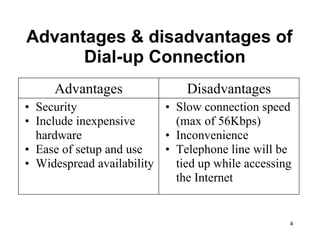
Advantages Disadvantages
• Security
• Include inexpensive
hardware
• Ease of setup and use
• Widespread availability
• Slow connection speed
(max of 56Kbps)
• Inconvenience
• Telephone line will be
tied up while accessing
the Internet
4
Advantages & disadvantages of
Dial-up Connection
• Also refer to Direct Connection or always-on
connections.
• PC is continually connected to the Internet
• Used in the home and office
• Many home and small business users connect
to the Internet via high-speed broadband
Internet service
• Because you are always connected, it is important
to protect your computer from hackers
5
2. Broadband Internet Connection
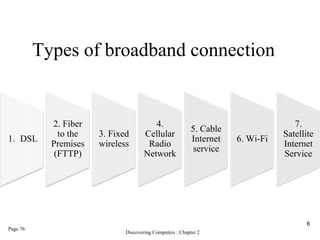
Types of broadband connection
Discovering Computers : Chapter 2
6
Page 76
1. DSL
2. Fiber
to the
Premises
(FTTP)
3. Fixed
wireless
4.
Cellular
Radio
Network
5. Cable
Internet
service
6. Wi-Fi
7.
Satellite
Internet
Service
7
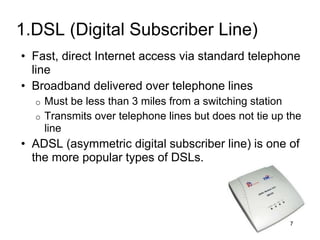
• Fast, direct Internet access via standard telephone
line
• Broadband delivered over telephone lines
o Must be less than 3 miles from a switching station
o Transmits over telephone lines but does not tie up the
line
• ADSL (asymmetric digital subscriber line) is one of
the more popular types of DSLs.
1.DSL (Digital Subscriber Line)
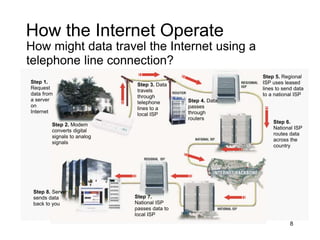
How the Internet Operate
How might data travel the Internet using a
telephone line connection?
Step 1.
Request
data from
a server
on
Internet
Step 5. Regional
ISP uses leased
lines to send data
to a national ISP
Step 6.
National ISP
routes data
across the
country
Step 8. Server
sends data
back to you
Step 2. Modem
converts digital
signals to analog
signals
Step 3. Data
travels
through
telephone
lines to a
local ISP
Step 4. Data
passes
through
routers
Step 7.
National ISP
passes data to
local ISP
8
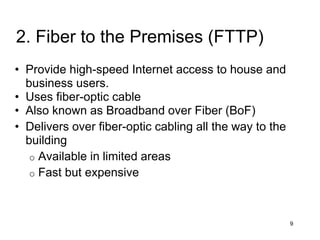
• Provide high-speed Internet access to house and
business users.
• Uses fiber-optic cable
• Also known as Broadband over Fiber (BoF)
• Delivers over fiber-optic cabling all the way to the
building
o Available in limited areas
o Fast but expensive
9
2. Fiber to the Premises (FTTP)
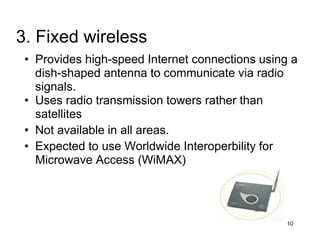
• Provides high-speed Internet connections using a
dish-shaped antenna to communicate via radio
signals.
• Uses radio transmission towers rather than
satellites
• Not available in all areas.
• Expected to use Worldwide Interoperbility for
Microwave Access (WiMAX)
10
3. Fixed wireless
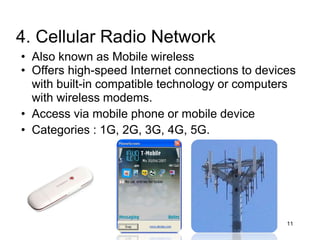
• Also known as Mobile wireless
• Offers high-speed Internet connections to devices
with built-in compatible technology or computers
with wireless modems.
• Access via mobile phone or mobile device
• Categories : 1G, 2G, 3G, 4G, 5G.
11
4. Cellular Radio Network
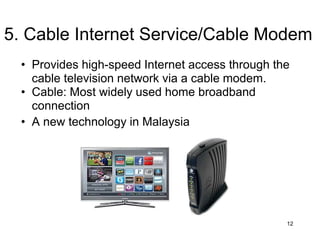
• Provides high-speed Internet access through the
cable television network via a cable modem.
• Cable: Most widely used home broadband
connection
• A new technology in Malaysia
12
5. Cable Internet Service/Cable Modem
13
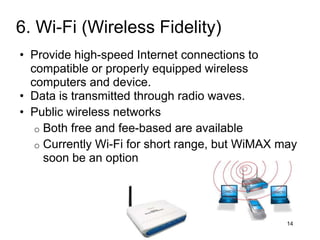
• Provide high-speed Internet connections to
compatible or properly equipped wireless
computers and device.
• Data is transmitted through radio waves.
• Public wireless networks
o Both free and fee-based are available
o Currently Wi-Fi for short range, but WiMAX may
soon be an option
14
6. Wi-Fi (Wireless Fidelity)
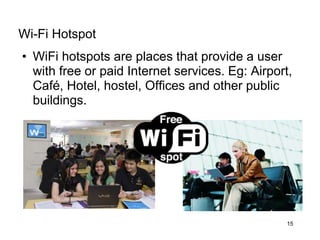
• WiFi hotspots are places that provide a user
with free or paid Internet services. Eg: Airport,
Café, Hotel, hostel, Offices and other public
buildings.
Wi-Fi Hotspot
15
• Provides high-speed Internet connections via
satellite.
• Broadband option for rural areas
o Slower and more expensive than cable or DSL
o Available in many areas other broadband
options are not
• A satellite dish communicates with a satellite
modem.
16
7. Satellite Internet service
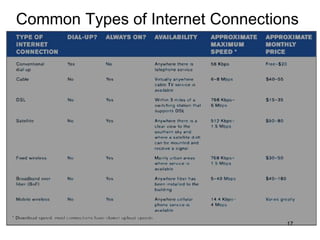
Common Types of Internet Connections
17
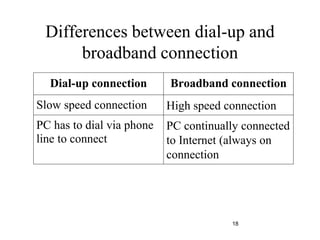
Differences between dial-up and
broadband connection
18
Dial-up connection Broadband connection
Slow speed connection High speed connection
PC has to dial via phone
line to connect
PC continually connected
to Internet (always on
connection
Chapter Three
3.2 The Internet
3.2.1 Overview of the Internet
3.2.1.3 Internet Service
Provider
At the end of this topic, students should
be able to:
1. Explain the Internet Service Provider.
2. List examples of Internet Service
Provider in Malaysia
1
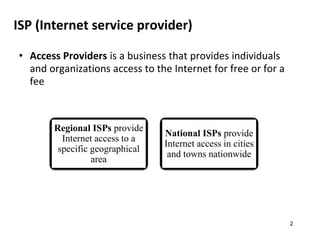
ISP (Internet service provider)
2
Regional ISPs provide
Internet access to a
specific geographical
area
National ISPs provide
Internet access in cities
and towns nationwide
• Access Providers is a business that provides individuals
and organizations access to the Internet for free or for a
fee
Responsibilities of an ISP
• Providing and maintaining a connection to the Internet
• Support the hardware and software needed to service that
connection
• To protect their site and network from external threats
such as viruses, hacker attacks and other illegal activities
• Provide 24-hour customer service and technical support
3
Examples of ISP in Malaysia
4
• TMNet
• Maxis
• Celcom
• Digi
• Packet One Network
• Umobile
• YTL
• Jaring
Chapter Three
3.2 The Internet
3.2.1 Overview of the Internet
3.2.1.4 The Internet Address
At the end of this topic, students should
be able to:
1. Identify the structure of IP address
2. Describe the purpose of an IP address
and its relationship to a domain name
1
Internet Address
The protocol that provides
for addressing and routing
Internet packets from one
computer to another
IP
(Internet Protocol)
2
A standard that outlines characteristics
of how two network devices
communicate is called a protocol.
● Your computer must have an IP address (Internet Protocol
address) to connect to the Internet or another computer that has
an IP address.
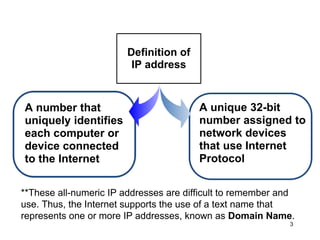
● IP Address - is a number that uniquely identifies each computer or
device connected to the Internet
A number that
uniquely identifies
each computer or
device connected
to the Internet
Definition of
IP address
A unique 32-bit
number assigned to
network devices
that use Internet
Protocol
3
**These all-numeric IP addresses are difficult to remember and
use. Thus, the Internet supports the use of a text name that
represents one or more IP addresses, known as Domain Name.
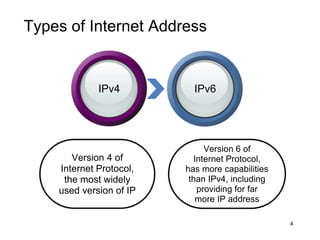
Version 4 of
Internet Protocol,
the most widely
used version of IP
Version 6 of
Internet Protocol,
has more capabilities
than IPv4, including
providing for far
more IP address
IPv4 IPv6
4
Types of Internet Address
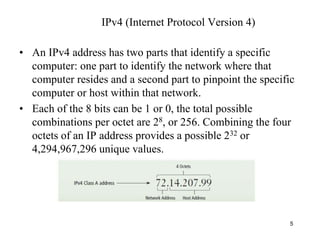
• An IPv4 address has two parts that identify a specific
computer: one part to identify the network where that
computer resides and a second part to pinpoint the specific
computer or host within that network.
• Each of the 8 bits can be 1 or 0, the total possible
combinations per octet are 28, or 256. Combining the four
octets of an IP address provides a possible 232 or
4,294,967,296 unique values.
5
IPv4 (Internet Protocol Version 4)
6
• IP address has four group of numbers, separated by
periods
• First portion of each IP address identifies the network
• Last portion identifies the specific computer
• The number in each group is between 0 and 255
IPV4
7
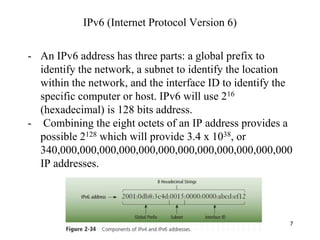
- An IPv6 address has three parts: a global prefix to
identify the network, a subnet to identify the location
within the network, and the interface ID to identify the
specific computer or host. IPv6 will use 216
(hexadecimal) is 128 bits address.
- Combining the eight octets of an IP address provides a
possible 2128 which will provide 3.4 x 1038, or
340,000,000,000,000,000,000,000,000,000,000,000,000
IP addresses.
IPv6 (Internet Protocol Version 6)
8
• A new version of IP address consists of eight group of
hexadecimal numbers separated by colons :
• Uses 128 bits addresses
IPV6
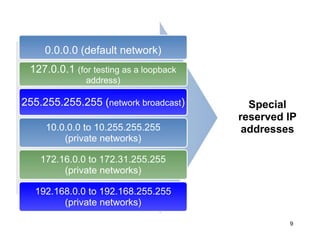
0.0.0.0 (default network)
127.0.0.1 (for testing as a loopback
address)
255.255.255.255 (network broadcast) Special
reserved IP
addresses10.0.0.0 to 10.255.255.255
(private networks)
172.16.0.0 to 172.31.255.255
(private networks)
192.168.0.0 to 192.168.255.255
(private networks)
9
Domain name
• The text version of an IP address
• The text in the domain name up to the first period identifies the
type of Internet server.
• Every domain name contains a top-level domain (TLD), which is
the last section of the domain name. It is used usually to identify
the type of organization associated with the domain.
• You register for a domain name from a registrar, which is an
organization that sells and manages domain names.
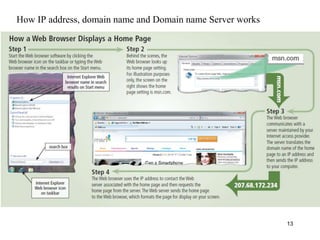
Domain Name System (DNS)
• Method that the Internet uses to store domain names and their
corresponding IP addresses.
• translates the domain name into its associated IP address.
Domain Name System (DNS) Server
A server on the internet that usually is associated with an ISP.
10
11
173.194.78.103
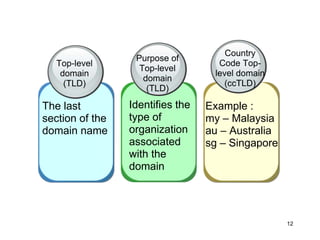
Top-level
domain
(TLD)
The last
section of the
domain name
Example :
my – Malaysia
au – Australia
sg – Singapore
Purpose of
Top-level
domain
(TLD)
Country
Code Top-
level domain
(ccTLD)
12
Identifies the
type of
organization
associated
with the
domain
13
How IP address, domain name and Domain name Server works
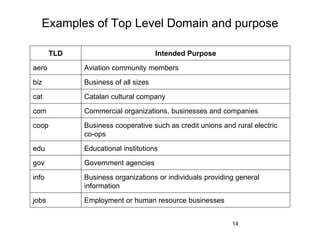
Examples of Top Level Domain and purpose
14
TLD Intended Purpose
aero Aviation community members
biz Business of all sizes
cat Catalan cultural company
com Commercial organizations, businesses and companies
coop Business cooperative such as credit unions and rural electric
co-ops
edu Educational institutions
gov Government agencies
info Business organizations or individuals providing general
information
jobs Employment or human resource businesses
Examples of Top Level Domain and purpose
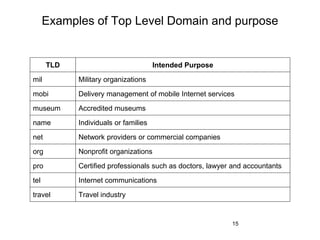
15
TLD Intended Purpose
mil Military organizations
mobi Delivery management of mobile Internet services
museum Accredited museums
name Individuals or families
net Network providers or commercial companies
org Nonprofit organizations
pro Certified professionals such as doctors, lawyer and accountants
tel Internet communications
travel Travel industry
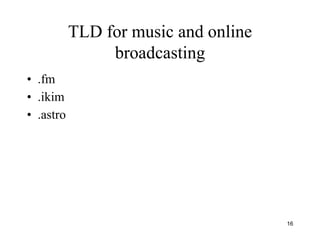
TLD for music and online
broadcasting
• .fm
• .ikim
• .astro
16

PST SC015 Chapter 3 Internet Technology (II) 2017/2018

  • 1.
    Chapter Three 3.2 TheInternet 3.2.1 Overview of the Internet 3.2.1.1 Introduction to the Internet At the end of this topic, students should be able to: - Explain about the Internet 1
  • 2.
    What to cover? •Definition of Internet • Advantages and disadvantages of Internet • Intranet & extranet 2
  • 3.
    The Internet • Internetis a worldwide collection of networks that links millions of businesses, government agencies, educational institutions, and individuals Discovering Computers : Chapter 2 3 Page 74 Figure 2-1
  • 4.
    Evolution of theInternet Discovering Computers : Chapter 2 4 Pages 75 - 76 •1969 - ARPANET becomes functional •1984 - ARPANET has more than 1,000 individual computers linked as hosts •1986 - NSF connects NSFnet to ARPANET and becomes known as the Internet •1995 - NSFNet terminates its network on the Internet and resumes status as research network •1996 - Internet2 is founded •Today - More than 550 million hosts connect to the Internet
  • 5.
    5 • Vast amountsof data can be stored and processed quickly and efficiently • Information is available 24 hours a day through access on the Internet or home computer files or office/ workshop servers and computer facilities Advantages of Internet 1. Accessibility
  • 6.
    6 • Decreases instorage costs and increases in Internet connection speeds persuade more users to use cloud storage for their data. • Web application hosts often store users’ data and information on their servers, which sometimes is called cloud storage. • Cloud storage also provides users with the convenience of accessing their files from almost anywhere. 2. Storage Advantages of Internet
  • 7.
    7 • You don’tneed to leave home to shop – you can shop online and deal with bank transactions and book holidays – an advantage if your are disabled and cannot easily get out. • You can work from home and use video conferencing/ forum or chat to people across the other side of the world. ( all of which saves money and time) 3. Online activity Advantages of Internet
  • 8.
    8 • Information isreadily available, however confidential information may be accessed unless properly password controlled • In many instances, where personal and confidential records were not protected properly, individuals have found their privacy violated and identities stolen. Disadvantages of Internet 1. Violation of Privacy
  • 9.
    9 • Adults, teens,and children around the world are using Internet to share publicly their photos, videos, journals, music, and other personal information. Some of these unsuspecting, innocent computer users have fallen victim to crimes committed by dangerous strangers. • Protect yourself and your dependents from these criminals by being cautious in e-mail messages and on Web sites. 2. Public Safety Disadvantages of Internet
  • 10.
    10 • Prolonged orimproper computer use to access to the Internet can lead to injuries or disorders of the hands, wrists, elbows, eyes, neck, and back. • Computer users can protect themselves from these health risks through proper workplace design, good posture while at the computer, and appropriately spaced work breaks. • Two behavioral health risks are computer addiction and technology overload 3. Health Risks Disadvantages of Internet
  • 11.
    Networks An intranet isan internal network that uses Internet technologies An extranet is a portion of a company’s network that allows customers or suppliers to access part of its intranet Discovering Computers : Chapter 9 11 Page 477
  • 12.
    Intranet vs Extranet DiscoveringComputers : Chapter 9 12 Page 477 Accessibility Intranet Information accessible to employees and facilitate collaboration within an organization Extranet Allow customers and suppliers to access part of intranet
  • 13.
    Chapter Three 3.2 TheInternet 3.2.1 Overview of the Internet 3.2.1.2 The Internet Connection At the end of this topic, students should be able to: - Describe different types of Internet connection 1
  • 14.
    1. Dial-up Connection 2.Broadband Internet Connection 2 Types of Internet Connection
  • 15.
    o PC hasto dial via a phone line to connect o Conventional dial-up ▪ Slower, but cheaper ▪ Ties up phone lines ▪ Relatively secure from hackers 3 Dial-up Connection
  • 16.
    Advantages Disadvantages • Security •Include inexpensive hardware • Ease of setup and use • Widespread availability • Slow connection speed (max of 56Kbps) • Inconvenience • Telephone line will be tied up while accessing the Internet 4 Advantages & disadvantages of Dial-up Connection
  • 17.
    • Also referto Direct Connection or always-on connections. • PC is continually connected to the Internet • Used in the home and office • Many home and small business users connect to the Internet via high-speed broadband Internet service • Because you are always connected, it is important to protect your computer from hackers 5 2. Broadband Internet Connection
  • 18.
    Types of broadbandconnection Discovering Computers : Chapter 2 6 Page 76 1. DSL 2. Fiber to the Premises (FTTP) 3. Fixed wireless 4. Cellular Radio Network 5. Cable Internet service 6. Wi-Fi 7. Satellite Internet Service
  • 19.
    7 • Fast, directInternet access via standard telephone line • Broadband delivered over telephone lines o Must be less than 3 miles from a switching station o Transmits over telephone lines but does not tie up the line • ADSL (asymmetric digital subscriber line) is one of the more popular types of DSLs. 1.DSL (Digital Subscriber Line)
  • 20.
    How the InternetOperate How might data travel the Internet using a telephone line connection? Step 1. Request data from a server on Internet Step 5. Regional ISP uses leased lines to send data to a national ISP Step 6. National ISP routes data across the country Step 8. Server sends data back to you Step 2. Modem converts digital signals to analog signals Step 3. Data travels through telephone lines to a local ISP Step 4. Data passes through routers Step 7. National ISP passes data to local ISP 8
  • 21.
    • Provide high-speedInternet access to house and business users. • Uses fiber-optic cable • Also known as Broadband over Fiber (BoF) • Delivers over fiber-optic cabling all the way to the building o Available in limited areas o Fast but expensive 9 2. Fiber to the Premises (FTTP)
  • 22.
    • Provides high-speedInternet connections using a dish-shaped antenna to communicate via radio signals. • Uses radio transmission towers rather than satellites • Not available in all areas. • Expected to use Worldwide Interoperbility for Microwave Access (WiMAX) 10 3. Fixed wireless
  • 23.
    • Also knownas Mobile wireless • Offers high-speed Internet connections to devices with built-in compatible technology or computers with wireless modems. • Access via mobile phone or mobile device • Categories : 1G, 2G, 3G, 4G, 5G. 11 4. Cellular Radio Network
  • 24.
    • Provides high-speedInternet access through the cable television network via a cable modem. • Cable: Most widely used home broadband connection • A new technology in Malaysia 12 5. Cable Internet Service/Cable Modem
  • 25.
  • 26.
    • Provide high-speedInternet connections to compatible or properly equipped wireless computers and device. • Data is transmitted through radio waves. • Public wireless networks o Both free and fee-based are available o Currently Wi-Fi for short range, but WiMAX may soon be an option 14 6. Wi-Fi (Wireless Fidelity)
  • 27.
    • WiFi hotspotsare places that provide a user with free or paid Internet services. Eg: Airport, Café, Hotel, hostel, Offices and other public buildings. Wi-Fi Hotspot 15
  • 28.
    • Provides high-speedInternet connections via satellite. • Broadband option for rural areas o Slower and more expensive than cable or DSL o Available in many areas other broadband options are not • A satellite dish communicates with a satellite modem. 16 7. Satellite Internet service
  • 29.
    Common Types ofInternet Connections 17
  • 30.
    Differences between dial-upand broadband connection 18 Dial-up connection Broadband connection Slow speed connection High speed connection PC has to dial via phone line to connect PC continually connected to Internet (always on connection
  • 31.
    Chapter Three 3.2 TheInternet 3.2.1 Overview of the Internet 3.2.1.3 Internet Service Provider At the end of this topic, students should be able to: 1. Explain the Internet Service Provider. 2. List examples of Internet Service Provider in Malaysia 1
  • 32.
    ISP (Internet serviceprovider) 2 Regional ISPs provide Internet access to a specific geographical area National ISPs provide Internet access in cities and towns nationwide • Access Providers is a business that provides individuals and organizations access to the Internet for free or for a fee
  • 33.
    Responsibilities of anISP • Providing and maintaining a connection to the Internet • Support the hardware and software needed to service that connection • To protect their site and network from external threats such as viruses, hacker attacks and other illegal activities • Provide 24-hour customer service and technical support 3
  • 34.
    Examples of ISPin Malaysia 4 • TMNet • Maxis • Celcom • Digi • Packet One Network • Umobile • YTL • Jaring
  • 35.
    Chapter Three 3.2 TheInternet 3.2.1 Overview of the Internet 3.2.1.4 The Internet Address At the end of this topic, students should be able to: 1. Identify the structure of IP address 2. Describe the purpose of an IP address and its relationship to a domain name 1
  • 36.
    Internet Address The protocolthat provides for addressing and routing Internet packets from one computer to another IP (Internet Protocol) 2 A standard that outlines characteristics of how two network devices communicate is called a protocol. ● Your computer must have an IP address (Internet Protocol address) to connect to the Internet or another computer that has an IP address. ● IP Address - is a number that uniquely identifies each computer or device connected to the Internet
  • 37.
    A number that uniquelyidentifies each computer or device connected to the Internet Definition of IP address A unique 32-bit number assigned to network devices that use Internet Protocol 3 **These all-numeric IP addresses are difficult to remember and use. Thus, the Internet supports the use of a text name that represents one or more IP addresses, known as Domain Name.
  • 38.
    Version 4 of InternetProtocol, the most widely used version of IP Version 6 of Internet Protocol, has more capabilities than IPv4, including providing for far more IP address IPv4 IPv6 4 Types of Internet Address
  • 39.
    • An IPv4address has two parts that identify a specific computer: one part to identify the network where that computer resides and a second part to pinpoint the specific computer or host within that network. • Each of the 8 bits can be 1 or 0, the total possible combinations per octet are 28, or 256. Combining the four octets of an IP address provides a possible 232 or 4,294,967,296 unique values. 5 IPv4 (Internet Protocol Version 4)
  • 40.
    6 • IP addresshas four group of numbers, separated by periods • First portion of each IP address identifies the network • Last portion identifies the specific computer • The number in each group is between 0 and 255 IPV4
  • 41.
    7 - An IPv6address has three parts: a global prefix to identify the network, a subnet to identify the location within the network, and the interface ID to identify the specific computer or host. IPv6 will use 216 (hexadecimal) is 128 bits address. - Combining the eight octets of an IP address provides a possible 2128 which will provide 3.4 x 1038, or 340,000,000,000,000,000,000,000,000,000,000,000,000 IP addresses. IPv6 (Internet Protocol Version 6)
  • 42.
    8 • A newversion of IP address consists of eight group of hexadecimal numbers separated by colons : • Uses 128 bits addresses IPV6
  • 43.
    0.0.0.0 (default network) 127.0.0.1(for testing as a loopback address) 255.255.255.255 (network broadcast) Special reserved IP addresses10.0.0.0 to 10.255.255.255 (private networks) 172.16.0.0 to 172.31.255.255 (private networks) 192.168.0.0 to 192.168.255.255 (private networks) 9
  • 44.
    Domain name • Thetext version of an IP address • The text in the domain name up to the first period identifies the type of Internet server. • Every domain name contains a top-level domain (TLD), which is the last section of the domain name. It is used usually to identify the type of organization associated with the domain. • You register for a domain name from a registrar, which is an organization that sells and manages domain names. Domain Name System (DNS) • Method that the Internet uses to store domain names and their corresponding IP addresses. • translates the domain name into its associated IP address. Domain Name System (DNS) Server A server on the internet that usually is associated with an ISP. 10
  • 45.
  • 46.
    Top-level domain (TLD) The last section ofthe domain name Example : my – Malaysia au – Australia sg – Singapore Purpose of Top-level domain (TLD) Country Code Top- level domain (ccTLD) 12 Identifies the type of organization associated with the domain
  • 47.
    13 How IP address,domain name and Domain name Server works
  • 48.
    Examples of TopLevel Domain and purpose 14 TLD Intended Purpose aero Aviation community members biz Business of all sizes cat Catalan cultural company com Commercial organizations, businesses and companies coop Business cooperative such as credit unions and rural electric co-ops edu Educational institutions gov Government agencies info Business organizations or individuals providing general information jobs Employment or human resource businesses
  • 49.
    Examples of TopLevel Domain and purpose 15 TLD Intended Purpose mil Military organizations mobi Delivery management of mobile Internet services museum Accredited museums name Individuals or families net Network providers or commercial companies org Nonprofit organizations pro Certified professionals such as doctors, lawyer and accountants tel Internet communications travel Travel industry
  • 50.
    TLD for musicand online broadcasting • .fm • .ikim • .astro 16