At the end of this topic, students
should be able to:
Identify the coding system used in data
processing
Differentiate the coding system
a)
b)
1
Computer System
2.3 Information Coding Schemes
Chapter
PDT - 2017/2018
Information Coding Schemes
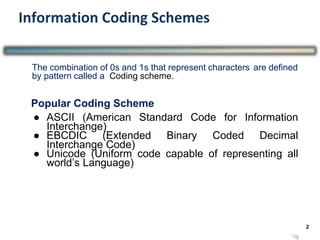
The combination of 0s and 1s that represent characters are defined
by pattern called a Coding scheme.
Popular Coding Scheme
● ASCII (American Standard Code for Information
Interchange)
● EBCDIC (Extended Binary Coded Decimal
Interchange Code)
● Unicode (Uniform code capable of representing all
world’s Language)
2
Information Coding Schemes
2
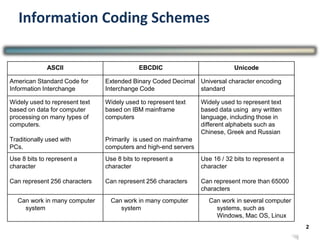
ASCII EBCDIC Unicode
American Standard Code for
Information Interchange
Extended Binary Coded Decimal
Interchange Code
Universal character encoding
standard
Widely used to represent text
based on data for computer
processing on many types of
computers.
Traditionally used with
PCs.
Widely used to represent text
based on IBM mainframe
computers
Primarily is used on mainframe
computers and high-end servers
Widely used to represent text
based data using any written
language, including those in
different alphabets such as
Chinese, Greek and Russian
Use 8 bits to represent a
character
Can represent 256 characters
Use 8 bits to represent a
character
Can represent 256 characters
Use 16 / 32 bits to represent a
character
Can represent more than 65000
characters
Can work in many computer
system
Can work in many computer
system
Can work in several computer
systems, such as
Windows, Mac OS, Linux

PDT DC015 Chapter 2 Computer System 2017/2018 (e)

  • 1.
    At the endof this topic, students should be able to: Identify the coding system used in data processing Differentiate the coding system a) b) 1 Computer System 2.3 Information Coding Schemes Chapter PDT - 2017/2018
  • 2.
    Information Coding Schemes Thecombination of 0s and 1s that represent characters are defined by pattern called a Coding scheme. Popular Coding Scheme ● ASCII (American Standard Code for Information Interchange) ● EBCDIC (Extended Binary Coded Decimal Interchange Code) ● Unicode (Uniform code capable of representing all world’s Language) 2
  • 3.
    Information Coding Schemes 2 ASCIIEBCDIC Unicode American Standard Code for Information Interchange Extended Binary Coded Decimal Interchange Code Universal character encoding standard Widely used to represent text based on data for computer processing on many types of computers. Traditionally used with PCs. Widely used to represent text based on IBM mainframe computers Primarily is used on mainframe computers and high-end servers Widely used to represent text based data using any written language, including those in different alphabets such as Chinese, Greek and Russian Use 8 bits to represent a character Can represent 256 characters Use 8 bits to represent a character Can represent 256 characters Use 16 / 32 bits to represent a character Can represent more than 65000 characters Can work in many computer system Can work in many computer system Can work in several computer systems, such as Windows, Mac OS, Linux