PSORIASIS
Saleh Al-Khalid
Supervised by: Dr. Hanan Alotaibi
OUTLINE
• Definition
• Epidemiology
• Causes and Risk Factors
• Clinical Presentation
• Types
• Diagnosis
• Treatment
• Prognosis
OUTLINE
• Definition
• Epidemiology
• Causes and Risk Factors
• Clinical Presentation
• Types
• Diagnosis
• Treatment
• Prognosis
DEFINITION
Psoriasis is a common chronic, disfiguring,
inflammatory skin disease most commonly
characterized by well-demarcated,
erythematous plaques with silver scale and
associated with a variety of comorbidities.
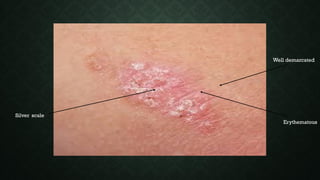
Well demarcated
Erythematous
Silver scale
OUTLINE
• Definition
• Epidemiology
• Causes and Risk Factors
• Clinical Presentation
• Types
• Diagnosis
• Treatment
• Prognosis
EPIDEMIOLOGY
• A systematic worldwide review found the prevalence of
psoriasis ranged:
• 0.5 to 11.4 percent in adults
• 0 to 1.4 percent in children
• Psoriasis is common in Saudi Arabia as elsewhere:
percentage of occurrence in the eastern Saudi Arabia is
5.3%
EPIDEMIOLOGY
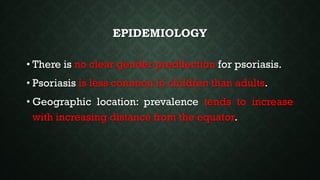
• There is no clear gender predilection for psoriasis.
• Psoriasis is less common in children than adults.
• Geographic location: prevalence tends to increase
with increasing distance from the equator.
EPIDEMIOLOGY
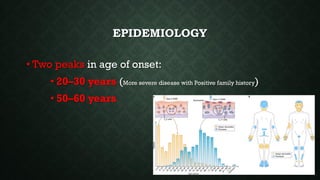
• Two peaks in age of onset:
• 20–30 years (More severe disease with Positive family history)
• 50–60 years
EPIDEMIOLOGY
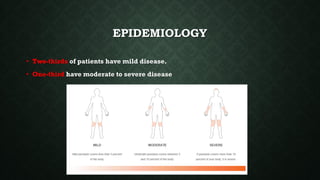
• Two-thirds of patients have mild disease.
• One-third have moderate to severe disease
OUTLINE
• Definition
• Epidemiology
• Causes and Risk Factors
• Clinical Presentation
• Types
• Diagnosis
• Treatment
• Prognosis
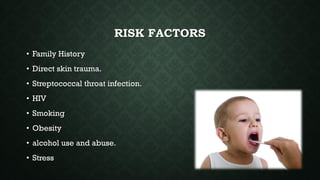
RISK FACTORS
• Family History
• Direct skin trauma.
• Streptococcal throat infection.
• HIV
• Smoking
• Obesity
• alcohol use and abuse.
• Stress
RISK FACTORS
• Vitamin D deficiency
• Certain medications:
• Lithium, Beta blockers, Antimalarial drugs ,Iodides, Rapid taper of
systemic corticosteroids
• Endocrine factors: Hypocalcemia, Pregnancy
• Weather: worse in winter and improve during summer
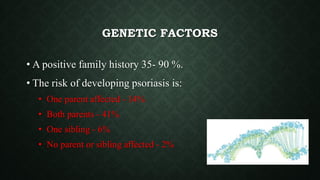
GENETIC FACTORS
• A positive family history 35- 90 %.
• The risk of developing psoriasis is:
• One parent affected - 14%
• Both parents - 41%
• One sibling - 6%
• No parent or sibling affected - 2%
OUTLINE
• Definition
• Epidemiology
• Causes and Risk Factors
• Clinical Presentation
• Types
• Diagnosis
• Treatment
• Prognosis
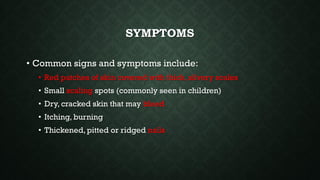
SYMPTOMS
• Common signs and symptoms include:
• Red patches of skin covered with thick, silvery scales
• Small scaling spots (commonly seen in children)
• Dry, cracked skin that may bleed
• Itching, burning
• Thickened, pitted or ridged nails
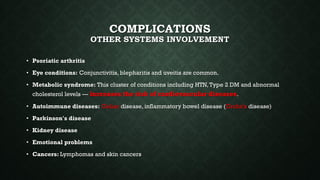
COMPLICATIONS
OTHER SYSTEMS INVOLVEMENT
• Psoriatic arthritis
• Eye conditions: Conjunctivitis, blepharitis and uveitis are common.
• Metabolic syndrome: This cluster of conditions including HTN,Type 2 DM and abnormal
cholesterol levels — increases the risk of cardiovascular diseases.
• Autoimmune diseases: Celiac disease, inflammatory bowel disease (Crohn's disease)
• Parkinson's disease
• Kidney disease
• Emotional problems
• Cancers: Lymphomas and skin cancers
OUTLINE
• Definition
• Epidemiology
• Causes and Risk Factors
• Clinical Presentation
• Types
• Diagnosis
• Treatment
• Prognosis
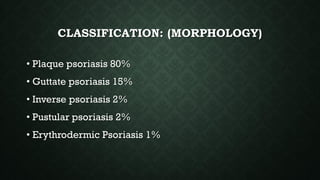
CLASSIFICATION: (MORPHOLOGY)
• Plaque psoriasis 80%
• Guttate psoriasis 15%
• Inverse psoriasis 2%
• Pustular psoriasis 2%
• Erythrodermic Psoriasis 1%
CLASSIFICATION: (MORPHOLOGY)
• Plaque psoriasis 80%
• Guttate psoriasis 15%
• inverse psoriasis 2%
• Pustular psoriasis 2%
• Erythrodermic Psoriasis 1%
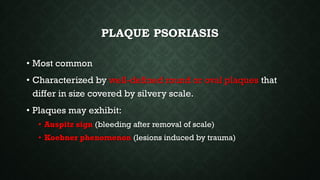
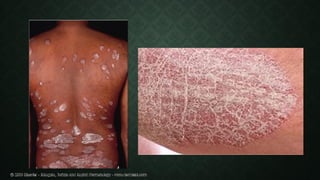
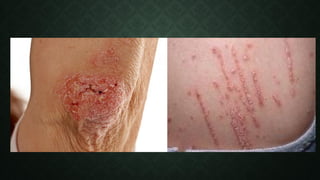
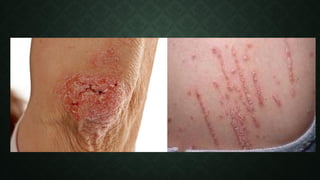
PLAQUE PSORIASIS
• Most common
• Characterized by well-defined round or oval plaques that
differ in size covered by silvery scale.
• Plaques may exhibit:
• Auspitz sign (bleeding after removal of scale)
• Koebner phenomenon (lesions induced by trauma)
CLASSIFICATION: (MORPHOLOGY)
• Plaque psoriasis 80%
• Guttate psoriasis 15%
• inverse psoriasis 2%
• Pustular psoriasis 2%
• Erythrodermic Psoriasis 1%
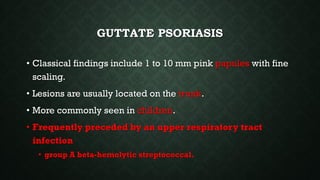
GUTTATE PSORIASIS
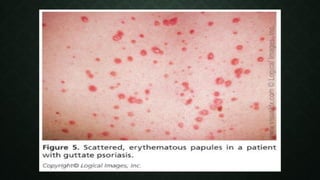
• Classical findings include 1 to 10 mm pink papules with fine
scaling.
• Lesions are usually located on the trunk.
• More commonly seen in children.
• Frequently preceded by an upper respiratory tract
infection
• group A beta-hemolytic streptococcal.
CLASSIFICATION: (MORPHOLOGY)
• Plaque psoriasis 80%
• Guttate psoriasis 15%
• Inverse psoriasis 2%
• Pustular psoriasis 2%
• Erythrodermic Psoriasis 1%
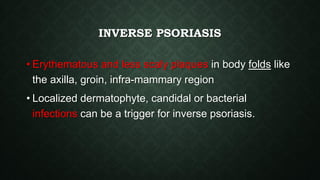
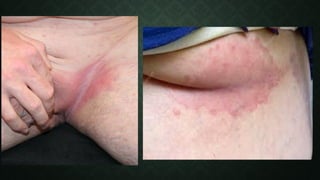
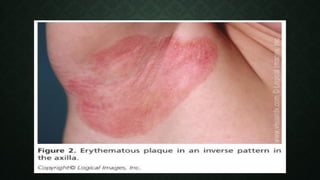
INVERSE PSORIASIS
• Erythematous and less scaly plaques in body folds like
the axilla, groin, infra-mammary region
• Localized dermatophyte, candidal or bacterial
infections can be a trigger for inverse psoriasis.
CLASSIFICATION: (MORPHOLOGY)
• Plaque psoriasis 80%
• Guttate psoriasis 15%
• inverse psoriasis 2%
• Pustular psoriasis 2%
• Erythrodermic Psoriasis 1%
PUSTULAR PSORIASIS
• Present as: Sterile pustules in top of erythema.
• Triggering factors include:
• Pregnancy
• Rapid tapering of corticosteroids (or other systemic therapies)
• Hypocalcemia
• Infections
PUSTULAR PSORIASIS
•Four distinct patterns:
• Von Zumbusch pattern
• Annular pattern
• Exanthematic type
• Localized pattern
VON ZUMBUSCH PATTERN
• Generalized eruption with
erythema and pustulation.
• The skin is painful.
• Fever and ill Patient.
• Associated with hypocalcemia,
sepsis, and dehydration.
ANNULAR PATTERN
• Annular erythematous
scaly lesions with
postulation.
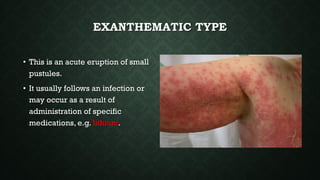
EXANTHEMATIC TYPE
• This is an acute eruption of small
pustules.
• It usually follows an infection or
may occur as a result of
administration of specific
medications, e.g. lithium.
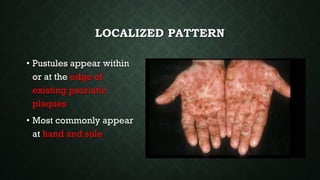
LOCALIZED PATTERN
• Pustules appear within
or at the edge of
existing psoriatic
plaques
• Most commonly appear
at hand and sole
CLASSIFICATION: (MORPHOLOGY)
• Plaque psoriasis 80%
• Guttate psoriasis 15%
• inverse psoriasis 2%
• Pustular psoriasis 2%
• Erythrodermic Psoriasis 1%
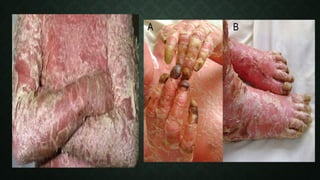
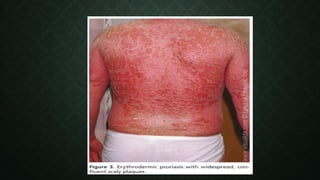
ERYTHRODERMIC PSORIASIS
• Life–Threatening Form of Psoriasis
• Patients may become febrile, and dehydrated
• May evolve from plaque psoriasis or appear as eruptive
phenomenon
• Complications:
• Cardiac failure
• Sepsis
• Malabsorption
• Anemia
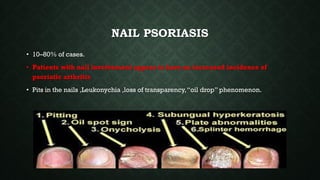
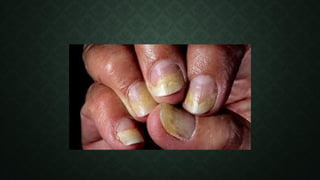
NAIL PSORIASIS
• 10–80% of cases.
• Patients with nail involvement appear to have an increased incidence of
psoriatic arthritis
• Pits in the nails ,Leukonychia ,loss of transparency,“oil drop” phenomenon.
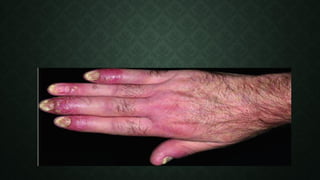
PSORIATIC ARTHRITIS
• Sometimes the joint symptoms are the first or only manifestation of
psoriasis or at times only nail changes are seen.
• Symptoms range from mild to severe, and psoriatic arthritis can affect
any joint.
• It can cause stiffness and progressive joint damage that in the most
serious cases may lead to permanent deformity.
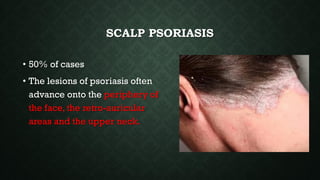
SCALP PSORIASIS
• 50% of cases
• The lesions of psoriasis often
advance onto the periphery of
the face, the retro-auricular
areas and the upper neck.
OUTLINE
• Definition
• Epidemiology
• Causes and Risk Factors
• Clinical Presentation
• Types
• Diagnosis
• Treatment
• Prognosis
DIAGNOSIS
• In most cases, diagnosis of psoriasis is fairly
straightforward.
• Medical history and Physical exam.
• Skin biopsy. Rarely
HISTORY
• Important history points to ask when suspecting psoriasis:
• Family history (1/3 of psoriasis patients have a positive family history)
• Medications (Systemic corticosteroid withdrawal, Beta blockers,
Lithium, Antimalaria, and Interferons)
• Recent illnesses / Past medical history (Infections URTI, Joint
complains…)
• Social history (Smoking, Alcohol consumption, and High BMI)
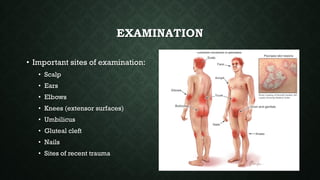
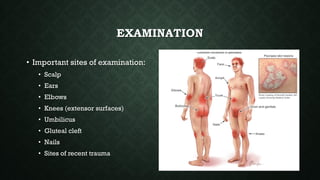
EXAMINATION
• Important sites of examination:
• Scalp
• Ears
• Elbows
• Knees (extensor surfaces)
• Umbilicus
• Gluteal cleft
• Nails
• Sites of recent trauma
INVESTIGATION
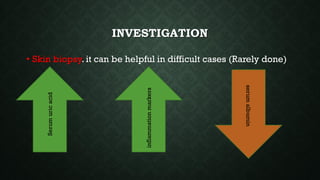
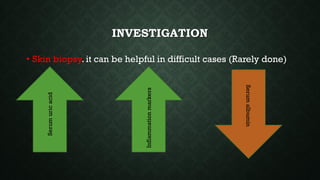
• Skin biopsy. it can be helpful in difficult cases (Rarely done)
Serum
uric
acid
inflammation
markers
serum
albumin
OUTLINE
• Definition
• Epidemiology
• Causes and Risk Factors
• Clinical Presentation
• Types
• Diagnosis
• Treatment
• Prognosis
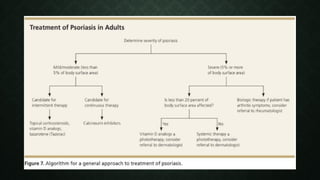
MANAGEMENT
• Psoriasis is a lifelong disease and can affect all aspects
of a patient’s quality of life (QOL).
• Remember to address both the physical, psychosocial
and comorbidities aspects of psoriasis.
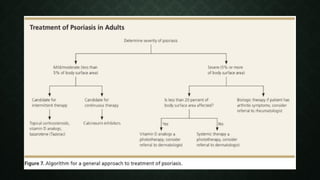
MANAGEMENT
• Patients with localized plaque psoriasis can be managed by
a primary care provider and it is managed by topical
treatment:
• 1-Eliminate trigger factors
• 2-Emollients
• 3-Topical therapies
• Psoriasis of all other types should be evaluated by a
dermatologist.
EMOLLIENTS
• Alleviate pruritus
• Reduce scale
• Enhance penetration of topical therapy
• Hydrate dry and cracked skin
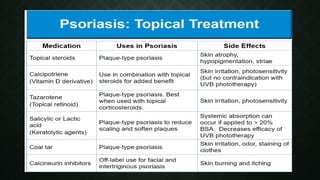
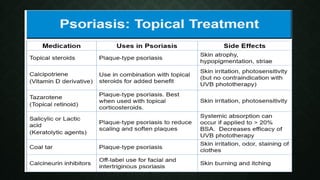
TOPICAL THERAPIES
• Topical corticosteroids
• Vitamin D analogs
• Retinoids
• Coal tars
• Salicylic acid
• Calcineurin inhibitors
• First line agents: high potency topical steroid + calcipotriene
(vitamin D analog)
CALCIPOTRIOL/BETAMETHASONE
OINTMENT
• Provides rapid, effective psoriasis control
• Once-daily treatment.
• Most common adverse events include pruritus, rash and
burning sensation
CORTICOSTEROIDS
• It has an:
• anti-inflammatory
• Anti-proliferative
• Immunomodulatory
• Adverse effects associated with long-term use include:
• Skin atrophy
• Hypopigmentation
• Striae
• Rapid relapse on stopping therapy
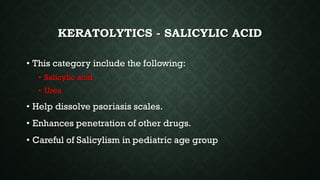
KERATOLYTICS
• This category include the following:
• Salicylic acid
• Urea
• Help dissolve psoriasis scales.
• Enhances penetration of other drugs.
TAZAROTENE (SYNTHETIC RETINOID)
• For Chronic plaque psoriasis cases
• Once daily
• Commonly causes local irritation
• pregnancy category X
COAL TAR
• It helps to reduce inflammation and pruritus.
• May cause local skin irritation.
• Use limited by distinctive smell and ability to stain clothing
and skin.
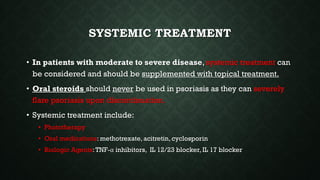
SYSTEMIC TREATMENT
• In patients with moderate to severe disease, systemic treatment can
be considered and should be supplemented with topical treatment
• Oral steroids should never be used in psoriasis as they can severely
flare psoriasis upon discontinuation
• Systemic treatment include:
• Phototherapy
• Oral medications: methotrexate, acitretin
• Biologic Agents:TNF-α inhibitors, IL 12/23 blocker, IL 17 blocker
REFERRAL
• Confirmation of the diagnosis.
• The response to treatment is inadequate.
• There is significant impact on quality of life.
• The patient has widespread severe disease.
• In cases of psoriatic arthritis, referral and/or collaboration with a
rheumatologist is indicated.
OUTLINE
• Definition
• Epidemiology
• Causes and Risk Factors
• Clinical Presentation
• Types
• Diagnosis
• Treatment
• Prognosis
PROGNOSIS
• Chronic plaque psoriasis is in most cases a lifelong disease.
• Guttate psoriasis is often a self-limited disease, lasting from 12 to 16
weeks without treatment.
• 1/3 to 2/3 of these patients later develop the chronic plaque psoriasis
• Erythrodermic and generalized pustular psoriasis have a poorer
prognosis.
• Life–Threatening Forms of Psoriasis
DISEASE IMPACT
• Psoriasis causes significant psycho-social morbidity.
• Problems with work, activities of daily living, and
socialization.
• Depression
• Spend money in expensive treatment choices.
MCQ
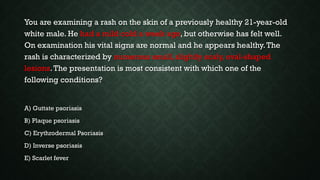
You are examining a rash on the skin of a previously healthy 21-year-old
white male. He had a mild cold a week ago, but otherwise has felt well.
On examination his vital signs are normal and he appears healthy.The
rash is characterized by numerous small, slightly scaly, oval-shaped
lesions.The presentation is most consistent with which one of the
following conditions?
A) Guttate psoriasis
B) Plaque psoriasis
C) Erythrodermal Psoriasis
D) Inverse psoriasis
E) Scarlet fever
•A) Guttate psoriasis
EXPLANATION
The answer is A:The condition of guttate psoriasis is characterized by numerous
small, oval (teardrop-shaped) lesions that develop after an acute upper respiratory
tract infection.
These lesions are often not as scaly or as erythematous as the classic lesions of plaque-
type psoriasis, which are usually located on extensor surfaces.
Usually, guttate psoriasis must be differentiated from pityriasis rosea, another
condition characterized by the sudden outbreak of red scaly lesions, which also often
follows a mild upper respiratory tract infection.
REFERENCE
• UpToDate
• Mayo clonic
• AAFP
• National Psoriasis Foundation
• Amarican Academy of Dermatology
THANKS
CAN STRESS BE
DISFIGURING
Saleh Al-Khalid
Supervised by: Dr. Asma’a Alrefae
OUTLINE
• Case Scenario
• 8 Roles of family physician in psoriasis
• Management Options
CASE SCENARIO
• A 52-year-old male smoker presented with a mildly pruritic rash that
began three months earlier on his back and spread to his scalp, trunk,
and extremities, including the palms and soles. He had a history of
alcoholic cirrhosis. He had no recent new exposures, including
medications.
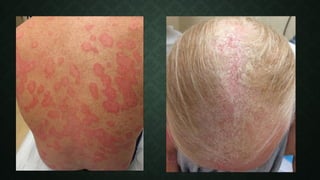
• Physical examination revealed numerous well-circumscribed,
erythematous, non-blanching plaques with adherent white scale
involving approximately 70% of his body. His palms and soles
displayed thick scale with fissures, and he had oil spots and
onycholysis affecting several fingernails.
WHAT IS THE DIAGNOSIS?
A. Plaque psoriasis
B. Guttate psoriasis
C. inverse psoriasis
D. Pustular psoriasis
E. Erythrodermic Psoriasis
A. Plaque psoriasis
8 ROLES OF FAMILY PHYSICIAN IN
PSORIASIS
1. Be convinced about Clinical diagnosis of psoriasis by knowing important hx and ex.
2. Holistic approach
3. Include impacted comorbidities in the psoriasis management.
4. Patient education about the chronicity of disease and reassure about contagious, about
risk factor avoidance, proper sun exposure, proper skin moisturizing are very effective.
5. Aware about all details of treatment modalities.
6. Referral: Dermatology or Rheumatology
7. EBM
8. Cost effective : stop unjustified investigation as it is clinical diagnosis ( ESR, ANA, etc.)
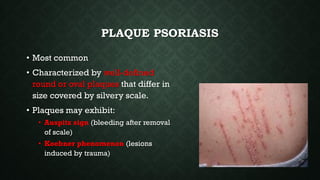
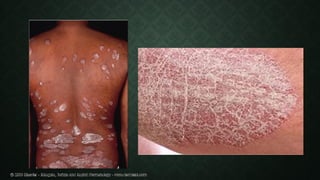
PLAQUE PSORIASIS
• Most common
• Characterized by well-defined
round or oval plaques that differ in
size covered by silvery scale.
• Plaques may exhibit:
• Auspitz sign (bleeding after removal
of scale)
• Koebner phenomenon (lesions
induced by trauma)
8 ROLES OF FAMILY PHYSICIAN IN
PSORIASIS
1. Be convinced about Clinical diagnosis of psoriasis by knowing
important hx and ex.
2. Holistic approach
3. Include impacted comorbidities in the psoriasis management.
4. Patient education about the chronicity of disease and reassure about contagious, about
risk factor avoidance, proper sun exposure, proper skin moisturizing are very effective.
5. Aware about all details of treatment modalities.
6. Referral: Dermatology or Rheumatology
7. EBM
8. Cost effective : stop unjustified investigation as it is clinical diagnosis ( ESR, ANA, etc.)
DIAGNOSIS
Clinical diagnosis
• In most cases, diagnosis of psoriasis is fairly
straightforward.
• Medical history and Physical exam.
• Skin biopsy. Rarely
HISTORY
• Important history points to ask when suspecting psoriasis:
• Family history (1/3 of psoriasis patients have a positive family history)
• Medications (Systemic corticosteroid withdrawal, Beta blockers,
Lithium, Antimalaria, and Interferons)
• Recent illnesses / Past medical history (Infections URTI, Joint
complains…)
• Social history (Smoking, Alcohol consumption, and High BMI)
EXAMINATION
• Important sites of examination:
• Scalp
• Ears
• Elbows
• Knees (extensor surfaces)
• Umbilicus
• Gluteal cleft
• Nails
• Sites of recent trauma
8 ROLES OF FAMILY PHYSICIAN IN
PSORIASIS
1. Be convinced about Clinical diagnosis of psoriasis by knowing important hx and ex.
2. Holistic approach
3. Include impacted comorbidities in the psoriasis management.
4. Patient education about the chronicity of disease and reassure about contagious, about
risk factor avoidance, proper sun exposure, proper skin moisturizing are very effective.
5. Aware about all details of treatment modalities.
6. Referral: Dermatology or Rheumatology
7. EBM
8. Cost effective : stop unjustified investigation as it is clinical diagnosis ( ESR, ANA, etc.)
Once you diagnose patient with psoriasis
please screen and provide management for
Depression or Anxiety or stress either as a
cause or impact
8 ROLES OF FAMILY PHYSICIAN IN
PSORIASIS
1. Be convinced about Clinical diagnosis of psoriasis by knowing important hx and ex.
2. Holistic approach
3. Include impacted comorbidities in the psoriasis management.
4. Patient education about the chronicity of disease and reassure about
contagious, about risk factor avoidance, proper sun exposure, proper
skin moisturizing are very effective.
5. Aware about all details of treatment modalities.
6. Referral: Dermatology or Rheumatology
7. EBM
8. Cost effective : stop unjustified investigation as it is clinical diagnosis ( ESR, ANA, etc.)
OTHER THAN SKIN
• Psoriatic arthritis
• Eye conditions: Conjunctivitis, blepharitis and uveitis are common.
• Metabolic syndrome: This cluster of conditions including HTN,Type 2 DM and abnormal
cholesterol levels — increases the risk of cardiovascular diseases.
• Autoimmune diseases: Celiac disease, inflammatory bowel disease (Crohn's disease)
• Parkinson's disease
• Kidney disease
• Emotional problems
• Cancers: Lymphomas x3 and skin cancers SCC x14
INVESTIGATION
• Skin biopsy. it can be helpful in difficult cases (Rarely done)
Serum
uric
acid
Inflammation
markers
Serum
albumin
8 ROLES OF FAMILY PHYSICIAN IN
PSORIASIS
1. Be convinced about Clinical diagnosis of psoriasis by knowing important hx and ex.
2. Holistic approach
3. Include impacted comorbidities in the psoriasis management.
4. Patient education about the chronicity of disease and reassure
about contagious, about risk factor avoidance, proper sun
exposure, proper skin moisturizing are very effective.
5. Aware about all details of treatment modalities.
6. Referral: Dermatology or Rheumatology
7. EBM
8. Cost effective : stop unjustified investigation as it is clinical diagnosis ( ESR, ANA, etc.)
Causes and Risk Factors
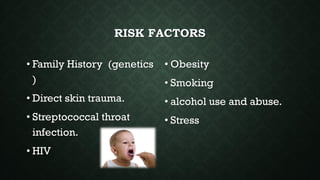
RISK FACTORS
• Family History (genetics
)
• Direct skin trauma.
• Streptococcal throat
infection.
• HIV
• Obesity
• Smoking
• alcohol use and abuse.
• Stress
RISK FACTORS
• Vitamin D deficiency
• Certain medications:
Lithium, Beta blockers,
Antimalarial drugs
,Iodides, Rapid taper of
systemic
corticosteroids
• Endocrine factors:
Hypocalcemia, and
pregnancy state
• Weather: worse in
winter and improve
during summer
GENETIC FACTORS
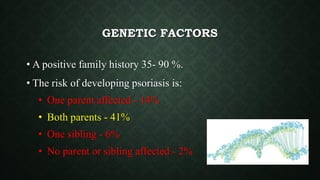
• A positive family history 35- 90 %.
• The risk of developing psoriasis is:
• One parent affected - 14%
• Both parents - 41%
• One sibling - 6%
• No parent or sibling affected - 2%
8 ROLES OF FAMILY PHYSICIAN IN
PSORIASIS
1. Be convinced about Clinical diagnosis of psoriasis by knowing important hx and ex.
2. Holistic approach
3. Include impacted comorbidities in the psoriasis management.
4. Patient education about the chronicity of disease and reassure about contagious, about
risk factor avoidance, proper sun exposure, proper skin moisturizing are very effective.
5. Aware about all details of treatment modalities.
6. Referral: Dermatology or Rheumatology
7. EBM
8. Cost effective : stop unjustified investigation as it is clinical diagnosis ( ESR, ANA, etc.)
OUTLINE OF MANAGMENT
- Topical
- Systemic
- Intra-lesion injection
- Phototherapy
- Biological
• Non pharmacological
MANAGEMENT
• Psoriasis is a lifelong disease and can affect all aspects
of a patient’s quality of life (QOL).
• Remember to address both the physical, psychosocial
and social aspects of psoriasis.
MANAGEMENT
• Patients with localized plaque psoriasis can be managed by
a primary care provider and it is managed by topical
treatment:
• 1-Eliminate trigger factors
• 2-Emollients
• 3-Topical therapies
• Psoriasis of all other types should be evaluated by a
dermatologist.
WHAT MAKES PSORIASIS WORSE?
• Obesity
• Infections
• Medication.
• Lithium
• beta blockers
• ACE-I
• Ibuprofen
• Winter weather
• Xerosis (dry skin)
• Sunburn
• Smoking / alcohol
• Stress
PROPER SUNLIGHT EXPOSURE?
• Sunlight can help psoriasis, but be careful not to stay in the
sun too long.
• You should use sunscreen on the parts of your skin that aren't
affected by psoriasis, especially face.
EMOLLIENTS
• Alleviate pruritus
• Reduce scale
• Enhance penetration of topical therapy
• Hydrate dry and cracked skin
TOPICAL THERAPIES
• Corticosteroids ( topical)
• Vitamin D analogs ( calcipotriene)
• Retinoids
• Coal tars
• Anthraline
• Salicylic acid
• Calcineurin inhibitors
•First line agents:
high potency topical
steroid +
calcipotriene (vitamin
D analog)
CALCIPOTRIOL/BETAMETHASONE
OINTMENT
• Provides rapid, effective psoriasis control
• Once-daily treatment.
• Most common adverse events include pruritus, rash and
burning sensation
ULTRA-POTENT CORTICOSTEROID
• It has an:
• anti-inflammatory
• Anti-proliferative
• Immuno-modulatory
• Adverse effects associated with long-term use include:
• Skin atrophy
• Hypopigmentation
• Striae
• Rapid relapse on stopping therapy
POTENCY
• Low-potency: are used in delicate skin areas, such as the face,
genitals or flexures.
• Increased risk for cutaneous atrophy
• Mid-potency: are used for lesions on the chest, back and
extremities.
• High-potency: are usually used on lesions on the palms and
soles.
FORM
• Ointments are the best choice for dry, scaly, hyperkeratotic
plaques.
• Lotions and gels are best suited for the treatment of the
scalp.
• Creams can be used on all areas.
TACHYPHYLAXIS
• Is define as: rapid decrease in response to repeated doses
over a short time period.
• Managed by Free- period of steroid
IS IT SAFE TO USE TOPICAL
CORTICOSTEROIDS FOR LONG TIME ?
• Long-term use of steroid creams can damage your
skin and cause side effects that don't go away, like
making skin thin and bruised.
FOR HOW LONG TOPICAL STEROIDS CAN
BE USED?
For 2 weeks maximum
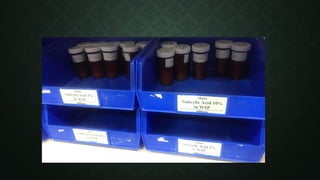
KERATOLYTICS - SALICYLIC ACID
• This category include the following:
• Salicylic acid
• Urea
• Help dissolve psoriasis scales.
• Enhances penetration of other drugs.
• Careful of Salicylism in pediatric age group
TAZAROTENE (SYNTHETIC RETINOID)
• For Chronic plaque psoriasis cases
• Once daily
• Commonly causes local irritation
• Pregnancy category X
COAL TAR
• It helps to reduce inflammation and pruritus.
• May cause local skin irritation.
• Use limited by distinctive smell and ability to stain clothing
and skin.
• It may exacerbate Asthma.
ANTHRALIN
SYSTEMIC TREATMENT
• In patients with moderate to severe disease, systemic treatment can
be considered and should be supplemented with topical treatment.
• Oral steroids should never be used in psoriasis as they can severely
flare psoriasis upon discontinuation.
• Systemic treatment include:
• Phototherapy
• Oral medications: methotrexate, acitretin, cyclosporin
• Biologic Agents:TNF-α inhibitors, IL 12/23 blocker, IL 17 blocker
WHEN WE CAN EXPECT THE IMPROVEMENT
AFTER STARTING THERAPY?
•Scales foes away Immediately.
•Normal skin thickness takes 2-6 weeks.
•Redness may last several months.
8 ROLES OF FAMILY PHYSICIAN IN
PSORIASIS
1. Be convinced about Clinical diagnosis of psoriasis by knowing important hx and ex.
2. Holistic approach
3. Include impacted comorbidities in the psoriasis management.
4. Patient education about the chronicity of disease and reassure about contagious, about
risk factor avoidance, proper sun exposure, proper skin moisturizing are very effective.
5. Aware about all details of treatment modalities.
6. Referral: Dermatology or Rheumatology
7. EBM
8. Cost effective : stop unjustified investigation as it is clinical diagnosis ( ESR, ANA, etc.)
REFERRAL
• Un availability of medication as in our PHC
• Confirmation of the diagnosis.
• The response to treatment is inadequate.
• There is significant impact on quality of life.
• The patient has widespread severe disease.
• In cases of psoriatic arthritis, referral and/or collaboration with a
rheumatologist is indicated.
SUMMERY
1- Avoidance For all triggers is crucial as dryness, smoking,
stress, alcohol ….
2- Proper sun exposure.
3- Remember the psychosocial impact of psoriatic patient
such as social embarrassment, mood disturbance ,,,etc.)
4- Referral when indicated.
REFERENCE
• UpToDate
• Mayo clonic
• AAFP
• National Psoriasis Foundation
• Amarican Academy of Dermatology
THANKS

Psoriasis.pdf

  • 1.
  • 2.
    OUTLINE • Definition • Epidemiology •Causes and Risk Factors • Clinical Presentation • Types • Diagnosis • Treatment • Prognosis
  • 3.
    OUTLINE • Definition • Epidemiology •Causes and Risk Factors • Clinical Presentation • Types • Diagnosis • Treatment • Prognosis
  • 4.
    DEFINITION Psoriasis is acommon chronic, disfiguring, inflammatory skin disease most commonly characterized by well-demarcated, erythematous plaques with silver scale and associated with a variety of comorbidities.
  • 5.
  • 6.
    OUTLINE • Definition • Epidemiology •Causes and Risk Factors • Clinical Presentation • Types • Diagnosis • Treatment • Prognosis
  • 7.
    EPIDEMIOLOGY • A systematicworldwide review found the prevalence of psoriasis ranged: • 0.5 to 11.4 percent in adults • 0 to 1.4 percent in children • Psoriasis is common in Saudi Arabia as elsewhere: percentage of occurrence in the eastern Saudi Arabia is 5.3%
  • 8.
    EPIDEMIOLOGY • There isno clear gender predilection for psoriasis. • Psoriasis is less common in children than adults. • Geographic location: prevalence tends to increase with increasing distance from the equator.
  • 9.
    EPIDEMIOLOGY • Two peaksin age of onset: • 20–30 years (More severe disease with Positive family history) • 50–60 years
  • 10.
    EPIDEMIOLOGY • Two-thirds ofpatients have mild disease. • One-third have moderate to severe disease
  • 11.
    OUTLINE • Definition • Epidemiology •Causes and Risk Factors • Clinical Presentation • Types • Diagnosis • Treatment • Prognosis
  • 12.
    RISK FACTORS • FamilyHistory • Direct skin trauma. • Streptococcal throat infection. • HIV • Smoking • Obesity • alcohol use and abuse. • Stress
  • 13.
    RISK FACTORS • VitaminD deficiency • Certain medications: • Lithium, Beta blockers, Antimalarial drugs ,Iodides, Rapid taper of systemic corticosteroids • Endocrine factors: Hypocalcemia, Pregnancy • Weather: worse in winter and improve during summer
  • 14.
    GENETIC FACTORS • Apositive family history 35- 90 %. • The risk of developing psoriasis is: • One parent affected - 14% • Both parents - 41% • One sibling - 6% • No parent or sibling affected - 2%
  • 15.
    OUTLINE • Definition • Epidemiology •Causes and Risk Factors • Clinical Presentation • Types • Diagnosis • Treatment • Prognosis
  • 16.
    SYMPTOMS • Common signsand symptoms include: • Red patches of skin covered with thick, silvery scales • Small scaling spots (commonly seen in children) • Dry, cracked skin that may bleed • Itching, burning • Thickened, pitted or ridged nails
  • 17.
    COMPLICATIONS OTHER SYSTEMS INVOLVEMENT •Psoriatic arthritis • Eye conditions: Conjunctivitis, blepharitis and uveitis are common. • Metabolic syndrome: This cluster of conditions including HTN,Type 2 DM and abnormal cholesterol levels — increases the risk of cardiovascular diseases. • Autoimmune diseases: Celiac disease, inflammatory bowel disease (Crohn's disease) • Parkinson's disease • Kidney disease • Emotional problems • Cancers: Lymphomas and skin cancers
  • 18.
    OUTLINE • Definition • Epidemiology •Causes and Risk Factors • Clinical Presentation • Types • Diagnosis • Treatment • Prognosis
  • 19.
    CLASSIFICATION: (MORPHOLOGY) • Plaquepsoriasis 80% • Guttate psoriasis 15% • Inverse psoriasis 2% • Pustular psoriasis 2% • Erythrodermic Psoriasis 1%
  • 20.
    CLASSIFICATION: (MORPHOLOGY) • Plaquepsoriasis 80% • Guttate psoriasis 15% • inverse psoriasis 2% • Pustular psoriasis 2% • Erythrodermic Psoriasis 1%
  • 21.
    PLAQUE PSORIASIS • Mostcommon • Characterized by well-defined round or oval plaques that differ in size covered by silvery scale. • Plaques may exhibit: • Auspitz sign (bleeding after removal of scale) • Koebner phenomenon (lesions induced by trauma)
  • 24.
    CLASSIFICATION: (MORPHOLOGY) • Plaquepsoriasis 80% • Guttate psoriasis 15% • inverse psoriasis 2% • Pustular psoriasis 2% • Erythrodermic Psoriasis 1%
  • 25.
    GUTTATE PSORIASIS • Classicalfindings include 1 to 10 mm pink papules with fine scaling. • Lesions are usually located on the trunk. • More commonly seen in children. • Frequently preceded by an upper respiratory tract infection • group A beta-hemolytic streptococcal.
  • 27.
    CLASSIFICATION: (MORPHOLOGY) • Plaquepsoriasis 80% • Guttate psoriasis 15% • Inverse psoriasis 2% • Pustular psoriasis 2% • Erythrodermic Psoriasis 1%
  • 28.
    INVERSE PSORIASIS • Erythematousand less scaly plaques in body folds like the axilla, groin, infra-mammary region • Localized dermatophyte, candidal or bacterial infections can be a trigger for inverse psoriasis.
  • 31.
    CLASSIFICATION: (MORPHOLOGY) • Plaquepsoriasis 80% • Guttate psoriasis 15% • inverse psoriasis 2% • Pustular psoriasis 2% • Erythrodermic Psoriasis 1%
  • 32.
    PUSTULAR PSORIASIS • Presentas: Sterile pustules in top of erythema. • Triggering factors include: • Pregnancy • Rapid tapering of corticosteroids (or other systemic therapies) • Hypocalcemia • Infections
  • 33.
    PUSTULAR PSORIASIS •Four distinctpatterns: • Von Zumbusch pattern • Annular pattern • Exanthematic type • Localized pattern
  • 34.
    VON ZUMBUSCH PATTERN •Generalized eruption with erythema and pustulation. • The skin is painful. • Fever and ill Patient. • Associated with hypocalcemia, sepsis, and dehydration.
  • 35.
    ANNULAR PATTERN • Annularerythematous scaly lesions with postulation.
  • 36.
    EXANTHEMATIC TYPE • Thisis an acute eruption of small pustules. • It usually follows an infection or may occur as a result of administration of specific medications, e.g. lithium.
  • 37.
    LOCALIZED PATTERN • Pustulesappear within or at the edge of existing psoriatic plaques • Most commonly appear at hand and sole
  • 38.
    CLASSIFICATION: (MORPHOLOGY) • Plaquepsoriasis 80% • Guttate psoriasis 15% • inverse psoriasis 2% • Pustular psoriasis 2% • Erythrodermic Psoriasis 1%
  • 39.
    ERYTHRODERMIC PSORIASIS • Life–ThreateningForm of Psoriasis • Patients may become febrile, and dehydrated • May evolve from plaque psoriasis or appear as eruptive phenomenon • Complications: • Cardiac failure • Sepsis • Malabsorption • Anemia
  • 42.
    NAIL PSORIASIS • 10–80%of cases. • Patients with nail involvement appear to have an increased incidence of psoriatic arthritis • Pits in the nails ,Leukonychia ,loss of transparency,“oil drop” phenomenon.
  • 44.
    PSORIATIC ARTHRITIS • Sometimesthe joint symptoms are the first or only manifestation of psoriasis or at times only nail changes are seen. • Symptoms range from mild to severe, and psoriatic arthritis can affect any joint. • It can cause stiffness and progressive joint damage that in the most serious cases may lead to permanent deformity.
  • 46.
    SCALP PSORIASIS • 50%of cases • The lesions of psoriasis often advance onto the periphery of the face, the retro-auricular areas and the upper neck.
  • 47.
    OUTLINE • Definition • Epidemiology •Causes and Risk Factors • Clinical Presentation • Types • Diagnosis • Treatment • Prognosis
  • 48.
    DIAGNOSIS • In mostcases, diagnosis of psoriasis is fairly straightforward. • Medical history and Physical exam. • Skin biopsy. Rarely
  • 49.
    HISTORY • Important historypoints to ask when suspecting psoriasis: • Family history (1/3 of psoriasis patients have a positive family history) • Medications (Systemic corticosteroid withdrawal, Beta blockers, Lithium, Antimalaria, and Interferons) • Recent illnesses / Past medical history (Infections URTI, Joint complains…) • Social history (Smoking, Alcohol consumption, and High BMI)
  • 50.
    EXAMINATION • Important sitesof examination: • Scalp • Ears • Elbows • Knees (extensor surfaces) • Umbilicus • Gluteal cleft • Nails • Sites of recent trauma
  • 51.
    INVESTIGATION • Skin biopsy.it can be helpful in difficult cases (Rarely done) Serum uric acid inflammation markers serum albumin
  • 52.
    OUTLINE • Definition • Epidemiology •Causes and Risk Factors • Clinical Presentation • Types • Diagnosis • Treatment • Prognosis
  • 53.
    MANAGEMENT • Psoriasis isa lifelong disease and can affect all aspects of a patient’s quality of life (QOL). • Remember to address both the physical, psychosocial and comorbidities aspects of psoriasis.
  • 54.
    MANAGEMENT • Patients withlocalized plaque psoriasis can be managed by a primary care provider and it is managed by topical treatment: • 1-Eliminate trigger factors • 2-Emollients • 3-Topical therapies • Psoriasis of all other types should be evaluated by a dermatologist.
  • 55.
    EMOLLIENTS • Alleviate pruritus •Reduce scale • Enhance penetration of topical therapy • Hydrate dry and cracked skin
  • 56.
    TOPICAL THERAPIES • Topicalcorticosteroids • Vitamin D analogs • Retinoids • Coal tars • Salicylic acid • Calcineurin inhibitors • First line agents: high potency topical steroid + calcipotriene (vitamin D analog)
  • 57.
    CALCIPOTRIOL/BETAMETHASONE OINTMENT • Provides rapid,effective psoriasis control • Once-daily treatment. • Most common adverse events include pruritus, rash and burning sensation
  • 58.
    CORTICOSTEROIDS • It hasan: • anti-inflammatory • Anti-proliferative • Immunomodulatory • Adverse effects associated with long-term use include: • Skin atrophy • Hypopigmentation • Striae • Rapid relapse on stopping therapy
  • 59.
    KERATOLYTICS • This categoryinclude the following: • Salicylic acid • Urea • Help dissolve psoriasis scales. • Enhances penetration of other drugs.
  • 60.
    TAZAROTENE (SYNTHETIC RETINOID) •For Chronic plaque psoriasis cases • Once daily • Commonly causes local irritation • pregnancy category X
  • 61.
    COAL TAR • Ithelps to reduce inflammation and pruritus. • May cause local skin irritation. • Use limited by distinctive smell and ability to stain clothing and skin.
  • 64.
    SYSTEMIC TREATMENT • Inpatients with moderate to severe disease, systemic treatment can be considered and should be supplemented with topical treatment • Oral steroids should never be used in psoriasis as they can severely flare psoriasis upon discontinuation • Systemic treatment include: • Phototherapy • Oral medications: methotrexate, acitretin • Biologic Agents:TNF-α inhibitors, IL 12/23 blocker, IL 17 blocker
  • 65.
    REFERRAL • Confirmation ofthe diagnosis. • The response to treatment is inadequate. • There is significant impact on quality of life. • The patient has widespread severe disease. • In cases of psoriatic arthritis, referral and/or collaboration with a rheumatologist is indicated.
  • 66.
    OUTLINE • Definition • Epidemiology •Causes and Risk Factors • Clinical Presentation • Types • Diagnosis • Treatment • Prognosis
  • 67.
    PROGNOSIS • Chronic plaquepsoriasis is in most cases a lifelong disease. • Guttate psoriasis is often a self-limited disease, lasting from 12 to 16 weeks without treatment. • 1/3 to 2/3 of these patients later develop the chronic plaque psoriasis • Erythrodermic and generalized pustular psoriasis have a poorer prognosis. • Life–Threatening Forms of Psoriasis
  • 68.
    DISEASE IMPACT • Psoriasiscauses significant psycho-social morbidity. • Problems with work, activities of daily living, and socialization. • Depression • Spend money in expensive treatment choices.
  • 69.
  • 70.
    You are examininga rash on the skin of a previously healthy 21-year-old white male. He had a mild cold a week ago, but otherwise has felt well. On examination his vital signs are normal and he appears healthy.The rash is characterized by numerous small, slightly scaly, oval-shaped lesions.The presentation is most consistent with which one of the following conditions? A) Guttate psoriasis B) Plaque psoriasis C) Erythrodermal Psoriasis D) Inverse psoriasis E) Scarlet fever
  • 71.
  • 72.
    EXPLANATION The answer isA:The condition of guttate psoriasis is characterized by numerous small, oval (teardrop-shaped) lesions that develop after an acute upper respiratory tract infection. These lesions are often not as scaly or as erythematous as the classic lesions of plaque- type psoriasis, which are usually located on extensor surfaces. Usually, guttate psoriasis must be differentiated from pityriasis rosea, another condition characterized by the sudden outbreak of red scaly lesions, which also often follows a mild upper respiratory tract infection.
  • 74.
    REFERENCE • UpToDate • Mayoclonic • AAFP • National Psoriasis Foundation • Amarican Academy of Dermatology
  • 75.
  • 76.
    CAN STRESS BE DISFIGURING SalehAl-Khalid Supervised by: Dr. Asma’a Alrefae
  • 77.
    OUTLINE • Case Scenario •8 Roles of family physician in psoriasis • Management Options
  • 78.
    CASE SCENARIO • A52-year-old male smoker presented with a mildly pruritic rash that began three months earlier on his back and spread to his scalp, trunk, and extremities, including the palms and soles. He had a history of alcoholic cirrhosis. He had no recent new exposures, including medications. • Physical examination revealed numerous well-circumscribed, erythematous, non-blanching plaques with adherent white scale involving approximately 70% of his body. His palms and soles displayed thick scale with fissures, and he had oil spots and onycholysis affecting several fingernails.
  • 80.
    WHAT IS THEDIAGNOSIS? A. Plaque psoriasis B. Guttate psoriasis C. inverse psoriasis D. Pustular psoriasis E. Erythrodermic Psoriasis A. Plaque psoriasis
  • 81.
    8 ROLES OFFAMILY PHYSICIAN IN PSORIASIS 1. Be convinced about Clinical diagnosis of psoriasis by knowing important hx and ex. 2. Holistic approach 3. Include impacted comorbidities in the psoriasis management. 4. Patient education about the chronicity of disease and reassure about contagious, about risk factor avoidance, proper sun exposure, proper skin moisturizing are very effective. 5. Aware about all details of treatment modalities. 6. Referral: Dermatology or Rheumatology 7. EBM 8. Cost effective : stop unjustified investigation as it is clinical diagnosis ( ESR, ANA, etc.)
  • 82.
    PLAQUE PSORIASIS • Mostcommon • Characterized by well-defined round or oval plaques that differ in size covered by silvery scale. • Plaques may exhibit: • Auspitz sign (bleeding after removal of scale) • Koebner phenomenon (lesions induced by trauma)
  • 85.
    8 ROLES OFFAMILY PHYSICIAN IN PSORIASIS 1. Be convinced about Clinical diagnosis of psoriasis by knowing important hx and ex. 2. Holistic approach 3. Include impacted comorbidities in the psoriasis management. 4. Patient education about the chronicity of disease and reassure about contagious, about risk factor avoidance, proper sun exposure, proper skin moisturizing are very effective. 5. Aware about all details of treatment modalities. 6. Referral: Dermatology or Rheumatology 7. EBM 8. Cost effective : stop unjustified investigation as it is clinical diagnosis ( ESR, ANA, etc.)
  • 86.
    DIAGNOSIS Clinical diagnosis • Inmost cases, diagnosis of psoriasis is fairly straightforward. • Medical history and Physical exam. • Skin biopsy. Rarely
  • 87.
    HISTORY • Important historypoints to ask when suspecting psoriasis: • Family history (1/3 of psoriasis patients have a positive family history) • Medications (Systemic corticosteroid withdrawal, Beta blockers, Lithium, Antimalaria, and Interferons) • Recent illnesses / Past medical history (Infections URTI, Joint complains…) • Social history (Smoking, Alcohol consumption, and High BMI)
  • 88.
    EXAMINATION • Important sitesof examination: • Scalp • Ears • Elbows • Knees (extensor surfaces) • Umbilicus • Gluteal cleft • Nails • Sites of recent trauma
  • 89.
    8 ROLES OFFAMILY PHYSICIAN IN PSORIASIS 1. Be convinced about Clinical diagnosis of psoriasis by knowing important hx and ex. 2. Holistic approach 3. Include impacted comorbidities in the psoriasis management. 4. Patient education about the chronicity of disease and reassure about contagious, about risk factor avoidance, proper sun exposure, proper skin moisturizing are very effective. 5. Aware about all details of treatment modalities. 6. Referral: Dermatology or Rheumatology 7. EBM 8. Cost effective : stop unjustified investigation as it is clinical diagnosis ( ESR, ANA, etc.)
  • 90.
    Once you diagnosepatient with psoriasis please screen and provide management for Depression or Anxiety or stress either as a cause or impact
  • 91.
    8 ROLES OFFAMILY PHYSICIAN IN PSORIASIS 1. Be convinced about Clinical diagnosis of psoriasis by knowing important hx and ex. 2. Holistic approach 3. Include impacted comorbidities in the psoriasis management. 4. Patient education about the chronicity of disease and reassure about contagious, about risk factor avoidance, proper sun exposure, proper skin moisturizing are very effective. 5. Aware about all details of treatment modalities. 6. Referral: Dermatology or Rheumatology 7. EBM 8. Cost effective : stop unjustified investigation as it is clinical diagnosis ( ESR, ANA, etc.)
  • 92.
    OTHER THAN SKIN •Psoriatic arthritis • Eye conditions: Conjunctivitis, blepharitis and uveitis are common. • Metabolic syndrome: This cluster of conditions including HTN,Type 2 DM and abnormal cholesterol levels — increases the risk of cardiovascular diseases. • Autoimmune diseases: Celiac disease, inflammatory bowel disease (Crohn's disease) • Parkinson's disease • Kidney disease • Emotional problems • Cancers: Lymphomas x3 and skin cancers SCC x14
  • 93.
    INVESTIGATION • Skin biopsy.it can be helpful in difficult cases (Rarely done) Serum uric acid Inflammation markers Serum albumin
  • 94.
    8 ROLES OFFAMILY PHYSICIAN IN PSORIASIS 1. Be convinced about Clinical diagnosis of psoriasis by knowing important hx and ex. 2. Holistic approach 3. Include impacted comorbidities in the psoriasis management. 4. Patient education about the chronicity of disease and reassure about contagious, about risk factor avoidance, proper sun exposure, proper skin moisturizing are very effective. 5. Aware about all details of treatment modalities. 6. Referral: Dermatology or Rheumatology 7. EBM 8. Cost effective : stop unjustified investigation as it is clinical diagnosis ( ESR, ANA, etc.)
  • 95.
  • 96.
    RISK FACTORS • FamilyHistory (genetics ) • Direct skin trauma. • Streptococcal throat infection. • HIV • Obesity • Smoking • alcohol use and abuse. • Stress
  • 97.
    RISK FACTORS • VitaminD deficiency • Certain medications: Lithium, Beta blockers, Antimalarial drugs ,Iodides, Rapid taper of systemic corticosteroids • Endocrine factors: Hypocalcemia, and pregnancy state • Weather: worse in winter and improve during summer
  • 98.
    GENETIC FACTORS • Apositive family history 35- 90 %. • The risk of developing psoriasis is: • One parent affected - 14% • Both parents - 41% • One sibling - 6% • No parent or sibling affected - 2%
  • 99.
    8 ROLES OFFAMILY PHYSICIAN IN PSORIASIS 1. Be convinced about Clinical diagnosis of psoriasis by knowing important hx and ex. 2. Holistic approach 3. Include impacted comorbidities in the psoriasis management. 4. Patient education about the chronicity of disease and reassure about contagious, about risk factor avoidance, proper sun exposure, proper skin moisturizing are very effective. 5. Aware about all details of treatment modalities. 6. Referral: Dermatology or Rheumatology 7. EBM 8. Cost effective : stop unjustified investigation as it is clinical diagnosis ( ESR, ANA, etc.)
  • 100.
    OUTLINE OF MANAGMENT -Topical - Systemic - Intra-lesion injection - Phototherapy - Biological • Non pharmacological
  • 101.
    MANAGEMENT • Psoriasis isa lifelong disease and can affect all aspects of a patient’s quality of life (QOL). • Remember to address both the physical, psychosocial and social aspects of psoriasis.
  • 102.
    MANAGEMENT • Patients withlocalized plaque psoriasis can be managed by a primary care provider and it is managed by topical treatment: • 1-Eliminate trigger factors • 2-Emollients • 3-Topical therapies • Psoriasis of all other types should be evaluated by a dermatologist.
  • 103.
    WHAT MAKES PSORIASISWORSE? • Obesity • Infections • Medication. • Lithium • beta blockers • ACE-I • Ibuprofen • Winter weather • Xerosis (dry skin) • Sunburn • Smoking / alcohol • Stress
  • 104.
    PROPER SUNLIGHT EXPOSURE? •Sunlight can help psoriasis, but be careful not to stay in the sun too long. • You should use sunscreen on the parts of your skin that aren't affected by psoriasis, especially face.
  • 105.
    EMOLLIENTS • Alleviate pruritus •Reduce scale • Enhance penetration of topical therapy • Hydrate dry and cracked skin
  • 106.
    TOPICAL THERAPIES • Corticosteroids( topical) • Vitamin D analogs ( calcipotriene) • Retinoids • Coal tars • Anthraline • Salicylic acid • Calcineurin inhibitors •First line agents: high potency topical steroid + calcipotriene (vitamin D analog)
  • 107.
    CALCIPOTRIOL/BETAMETHASONE OINTMENT • Provides rapid,effective psoriasis control • Once-daily treatment. • Most common adverse events include pruritus, rash and burning sensation
  • 108.
    ULTRA-POTENT CORTICOSTEROID • Ithas an: • anti-inflammatory • Anti-proliferative • Immuno-modulatory • Adverse effects associated with long-term use include: • Skin atrophy • Hypopigmentation • Striae • Rapid relapse on stopping therapy
  • 109.
    POTENCY • Low-potency: areused in delicate skin areas, such as the face, genitals or flexures. • Increased risk for cutaneous atrophy • Mid-potency: are used for lesions on the chest, back and extremities. • High-potency: are usually used on lesions on the palms and soles.
  • 110.
    FORM • Ointments arethe best choice for dry, scaly, hyperkeratotic plaques. • Lotions and gels are best suited for the treatment of the scalp. • Creams can be used on all areas.
  • 111.
    TACHYPHYLAXIS • Is defineas: rapid decrease in response to repeated doses over a short time period. • Managed by Free- period of steroid
  • 112.
    IS IT SAFETO USE TOPICAL CORTICOSTEROIDS FOR LONG TIME ? • Long-term use of steroid creams can damage your skin and cause side effects that don't go away, like making skin thin and bruised.
  • 113.
    FOR HOW LONGTOPICAL STEROIDS CAN BE USED? For 2 weeks maximum
  • 114.
    KERATOLYTICS - SALICYLICACID • This category include the following: • Salicylic acid • Urea • Help dissolve psoriasis scales. • Enhances penetration of other drugs. • Careful of Salicylism in pediatric age group
  • 116.
    TAZAROTENE (SYNTHETIC RETINOID) •For Chronic plaque psoriasis cases • Once daily • Commonly causes local irritation • Pregnancy category X
  • 117.
    COAL TAR • Ithelps to reduce inflammation and pruritus. • May cause local skin irritation. • Use limited by distinctive smell and ability to stain clothing and skin. • It may exacerbate Asthma.
  • 118.
  • 121.
    SYSTEMIC TREATMENT • Inpatients with moderate to severe disease, systemic treatment can be considered and should be supplemented with topical treatment. • Oral steroids should never be used in psoriasis as they can severely flare psoriasis upon discontinuation. • Systemic treatment include: • Phototherapy • Oral medications: methotrexate, acitretin, cyclosporin • Biologic Agents:TNF-α inhibitors, IL 12/23 blocker, IL 17 blocker
  • 122.
    WHEN WE CANEXPECT THE IMPROVEMENT AFTER STARTING THERAPY? •Scales foes away Immediately. •Normal skin thickness takes 2-6 weeks. •Redness may last several months.
  • 123.
    8 ROLES OFFAMILY PHYSICIAN IN PSORIASIS 1. Be convinced about Clinical diagnosis of psoriasis by knowing important hx and ex. 2. Holistic approach 3. Include impacted comorbidities in the psoriasis management. 4. Patient education about the chronicity of disease and reassure about contagious, about risk factor avoidance, proper sun exposure, proper skin moisturizing are very effective. 5. Aware about all details of treatment modalities. 6. Referral: Dermatology or Rheumatology 7. EBM 8. Cost effective : stop unjustified investigation as it is clinical diagnosis ( ESR, ANA, etc.)
  • 124.
    REFERRAL • Un availabilityof medication as in our PHC • Confirmation of the diagnosis. • The response to treatment is inadequate. • There is significant impact on quality of life. • The patient has widespread severe disease. • In cases of psoriatic arthritis, referral and/or collaboration with a rheumatologist is indicated.
  • 125.
    SUMMERY 1- Avoidance Forall triggers is crucial as dryness, smoking, stress, alcohol …. 2- Proper sun exposure. 3- Remember the psychosocial impact of psoriatic patient such as social embarrassment, mood disturbance ,,,etc.) 4- Referral when indicated.
  • 126.
    REFERENCE • UpToDate • Mayoclonic • AAFP • National Psoriasis Foundation • Amarican Academy of Dermatology
  • 127.