In the name of
TRUTH
PSORIASIS
The Non Infectious, Chronic, Inflammatory, common
“Itching Condition”

Afzalipoor university of medical sciences
dermatology department
What is psoriasis?
• Named for the Greek word psōra meaning "itch“
• It is characterized by well defined Erythematous
plaques and inflamed lesions with
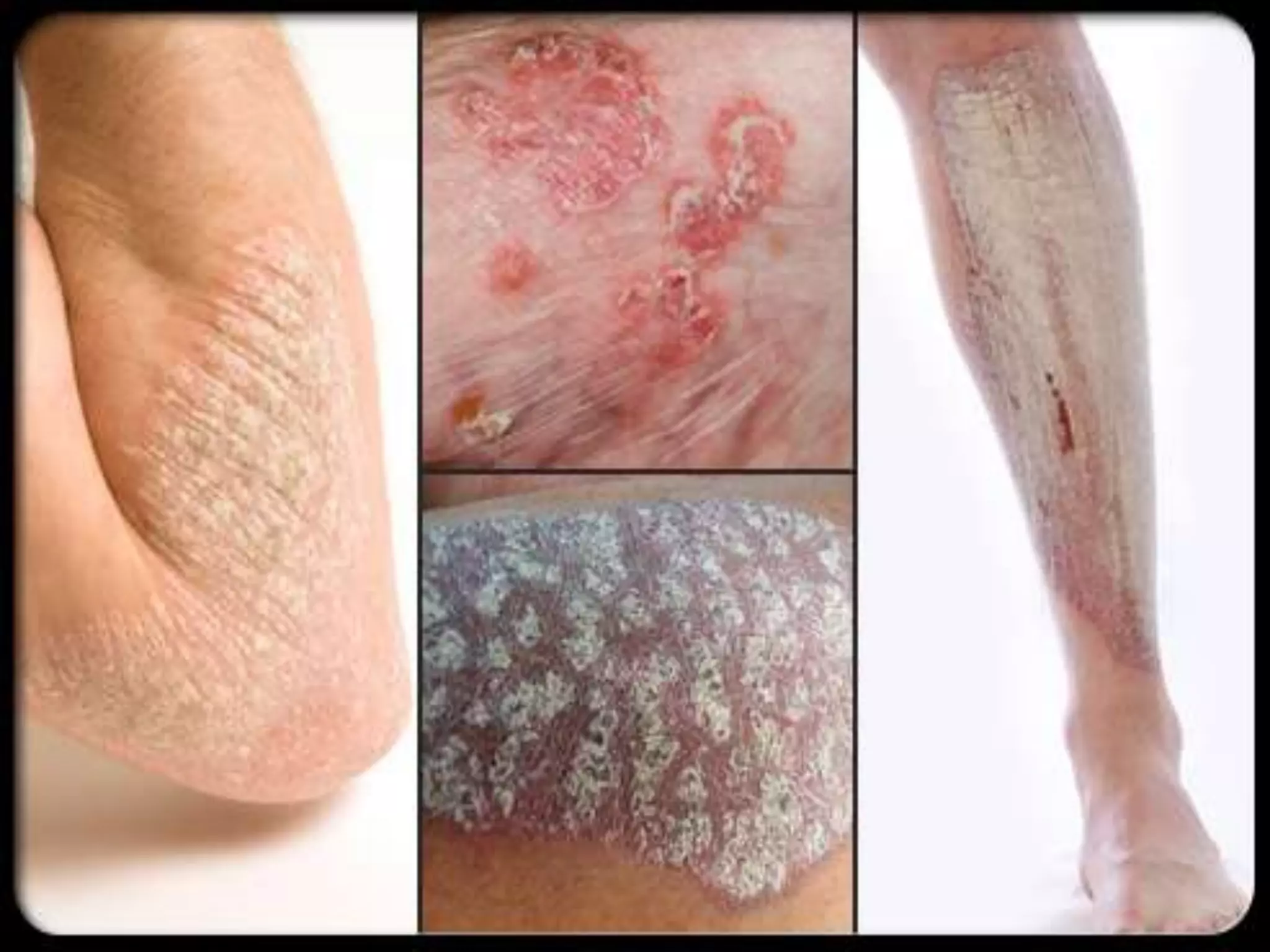
large, adherent, silvery-white scales( red, scaly skin
plaques.)
What is psoriasis?
• Named for the Greek word psōra meaning "itch“
• It is characterized by well defined Erythematous plaques
and inflamed lesions with large, adherent, silvery-white
scales( red, scaly skin patches.)
• Psoriasis is an T-cell mediated, non contagious skin
disorder. It is a mistake of immune system that makes
faulty signal which leads to overproduction of skin cell.
• no known cause.
• controllable but not curable.
• Psoriasis commonly affects the skin of the
elbows, knees, and scalp.
Epidemiology
• Prevalence: 1-3%
• M=F
• Although psoriasis can be seen in people of
any age, from babies to seniors, most
commonly patients are first diagnosed in their
early adult years.
• picked age of incidence is late second decade
of life and late 40s.
What Causes Psoriasis?
• The exact cause of psoriasis remains
unknown. There may be a combination of risk
factors, including genetic predisposition and
environmental factors. It is common for
psoriasis to be found in members of the same
family.
Difference Between normal Skin
Psoriasis Skin
Common Trigger Factors For Psoriasis
•
•
•
•
•
•
•
•
•

Infections (e.g. streptococcal, viral(HIV), candida)
Skin trauma (Koebner phenomenon)
Psychological stress
Drugs (e.g. lithium, beta
blockers, antimalarial, stopping usage of
corticosteroids)
Sunburn
winter
Metabolic factors (e.g. calcium deficiency)
Hormonal factors (e.g. pregnancy)
Smoking & Taking AlcoholDrinking
symptomes
Scaling

94

Itching

79

Skin redness

71

Tightness of skin

31

Bleeding

29

Burning sensation

21

Fatigue

19

Other

5

0

20

40

60

80

100
types
•
•
•
•
•
•

Plaque (Most Popular)
Guttate
Flexural (Inverse)
Pustular
Erythrodermic
Others Like Nail, Palm, Scalp
1-Plaque Psoriasis(psoriasis vulgaris)
• Most common type
• Features pink, well-defined plaques with
silvery scale
• Lesions may be single or numerous
• Classically affects elbows, knees, trunk and
scalps.(nail?)
• Characteristic features: dark red(uncontroled lesions)
– Auspitz sign
2-Guttate Psoriasis
• Numerous and small lesions – ~ 1 cm diameter
• Monomorphic, pink plaque. Usually there is a fine
scale on the droplike lesion that is much finer than
the scales in plaque psoriasis
• Commonly found on trunk and proximal limbs
• Often preceded by an pharyngitis streptococcal
infection, viral infection and stopping usage of
systemic corticosteroids(less common).
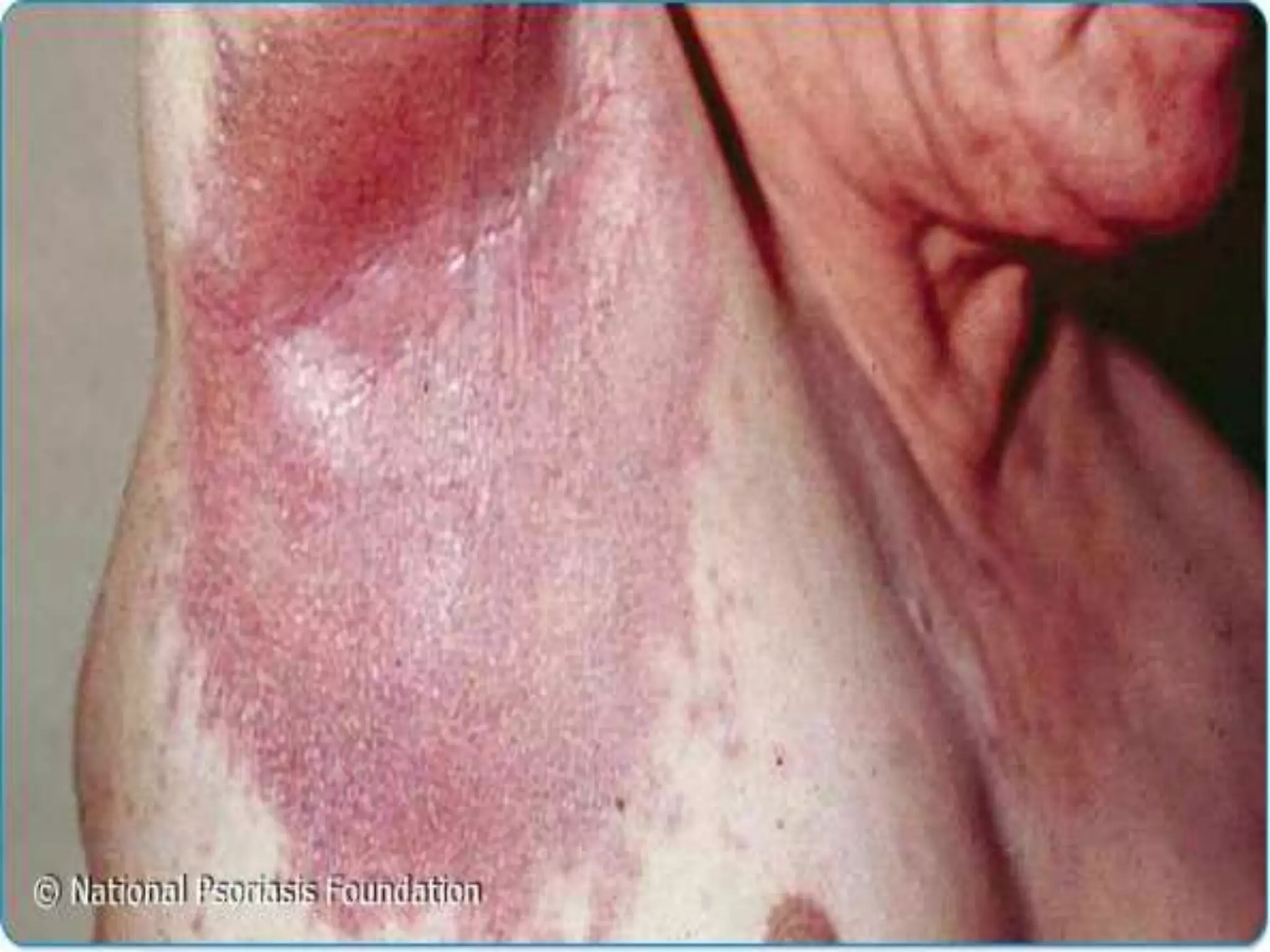
3-Flexural Psoriasis(inverse)
• bright red, smooth (not scaly) patches found in the
folds of the skin.
• The most common areas are gluteal cleft, axillae and
submammary regions.
• May cause diagnostic difficulty when genital or
perianal region is affected in isolation
• Associated with candida infection.
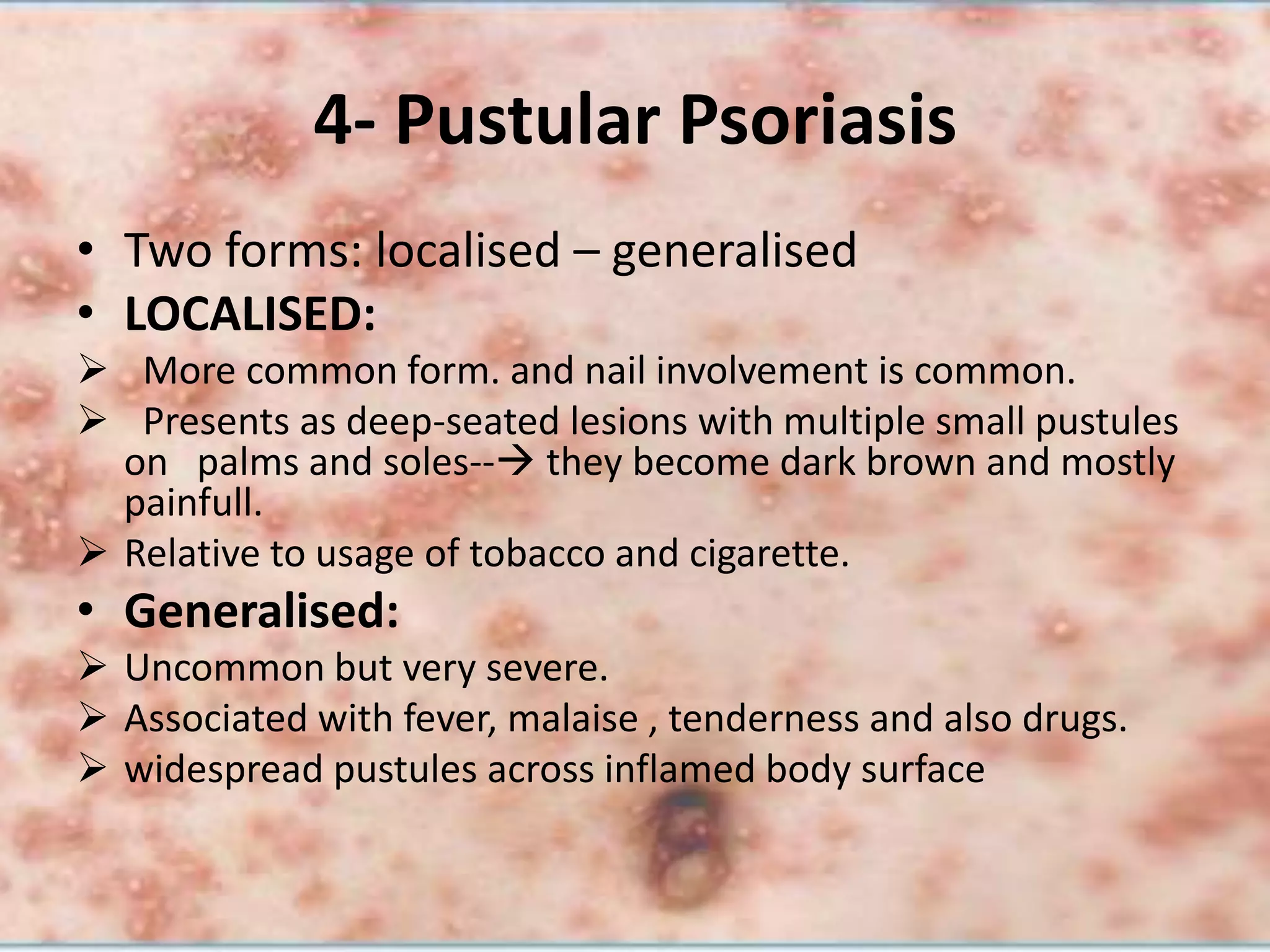
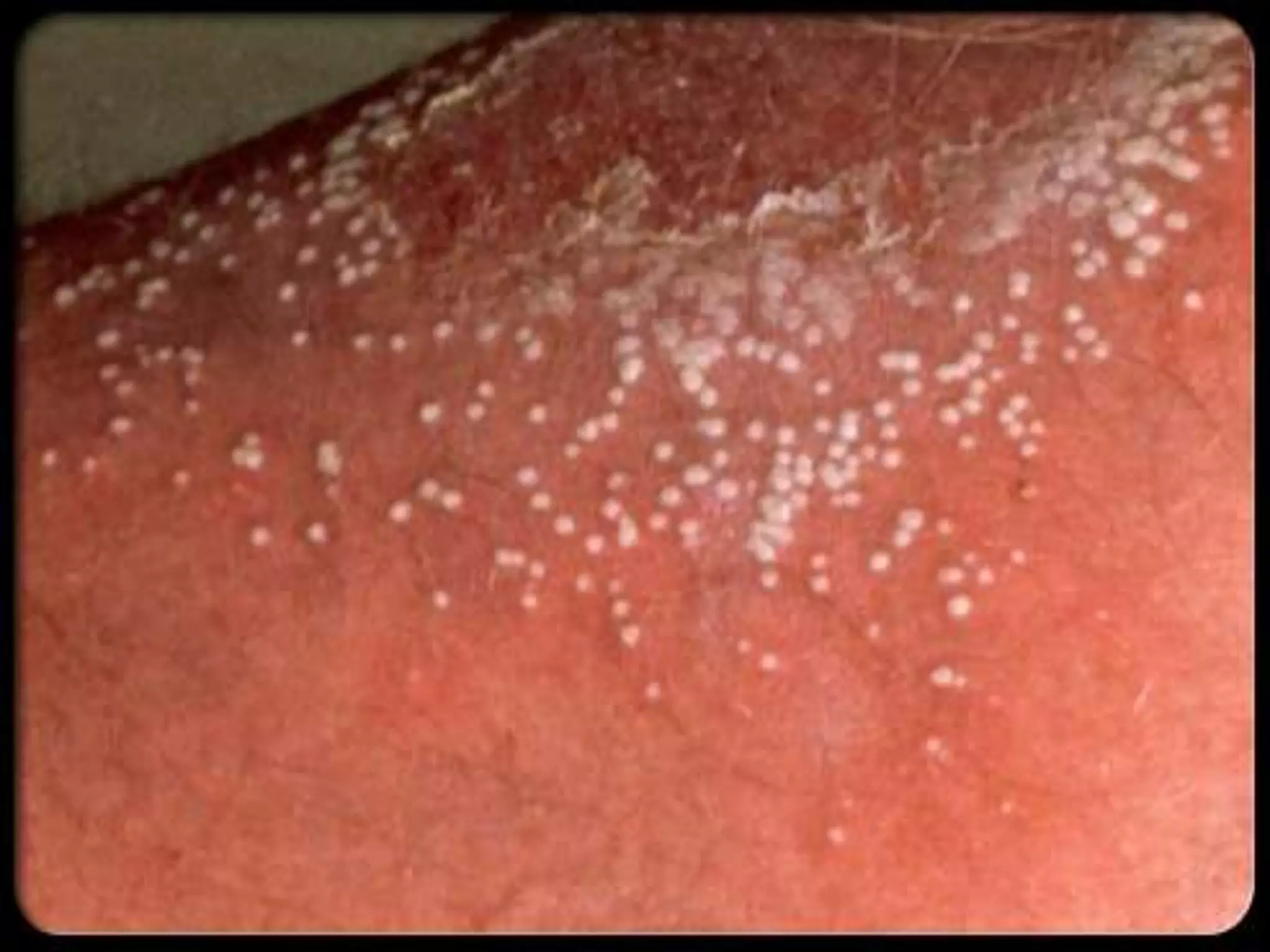
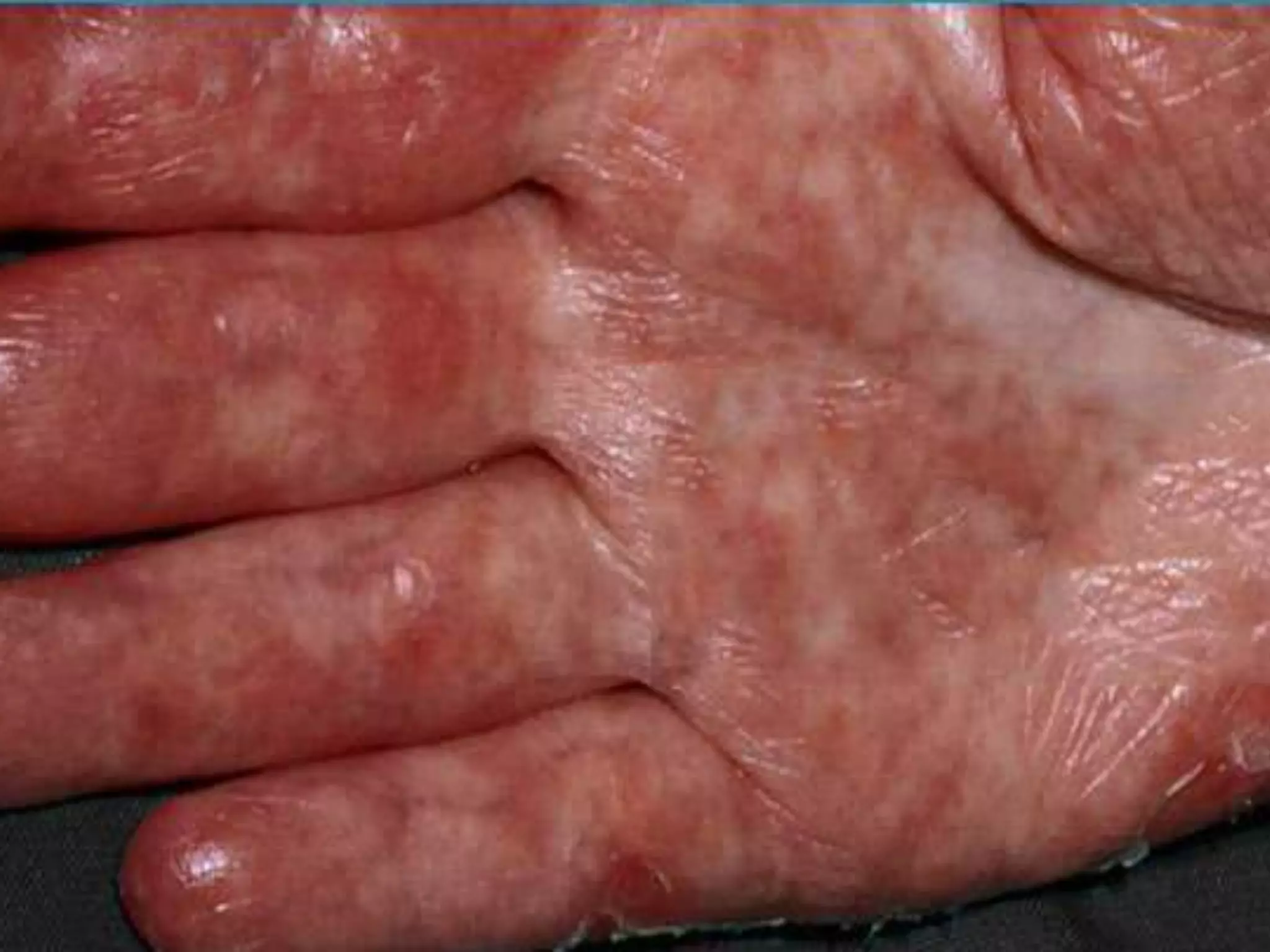
4- Pustular Psoriasis
• Two forms: localised – generalised
• LOCALISED:
 More common form. and nail involvement is common.
 Presents as deep-seated lesions with multiple small pustules
on palms and soles-- they become dark brown and mostly
painfull.
 Relative to usage of tobacco and cigarette.

• Generalised:
 Uncommon but very severe.
 Associated with fever, malaise , tenderness and also drugs.
 widespread pustules across inflamed body surface
5- Erythrodermic psoriasis
• the least common but severe.
• Generalised erythema covering entire skin surface
• May evolve slowly from chronic plaque psoriasis or
appear as eruptive phenomenon.
• Patients may become febrile, hypo/hyperthermic and
dehydrated plus shaking and skin pain.
• Can be associated with drugs.
• Complications include cardiac
failure, infections, malabsorption and anaemia.
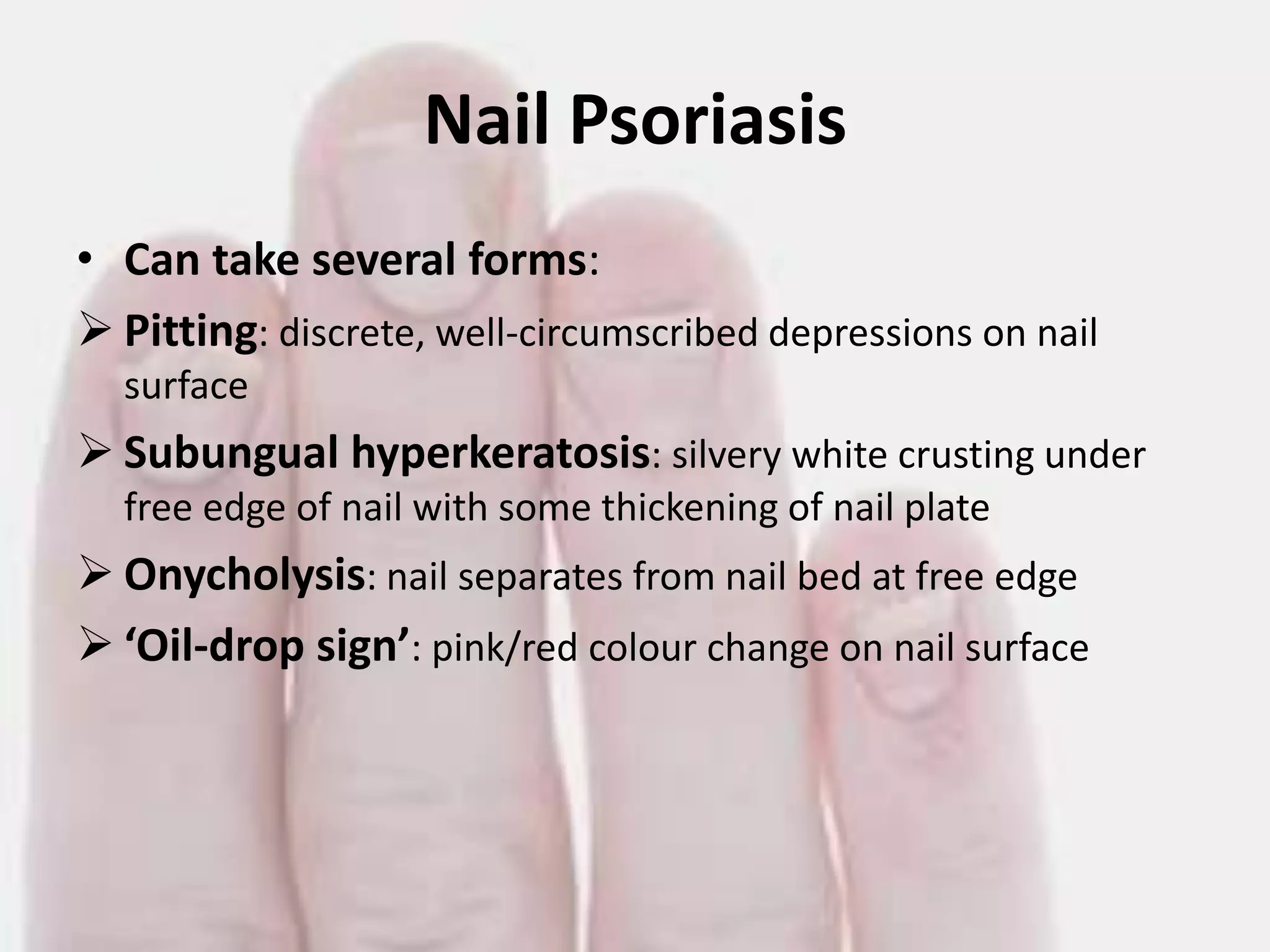
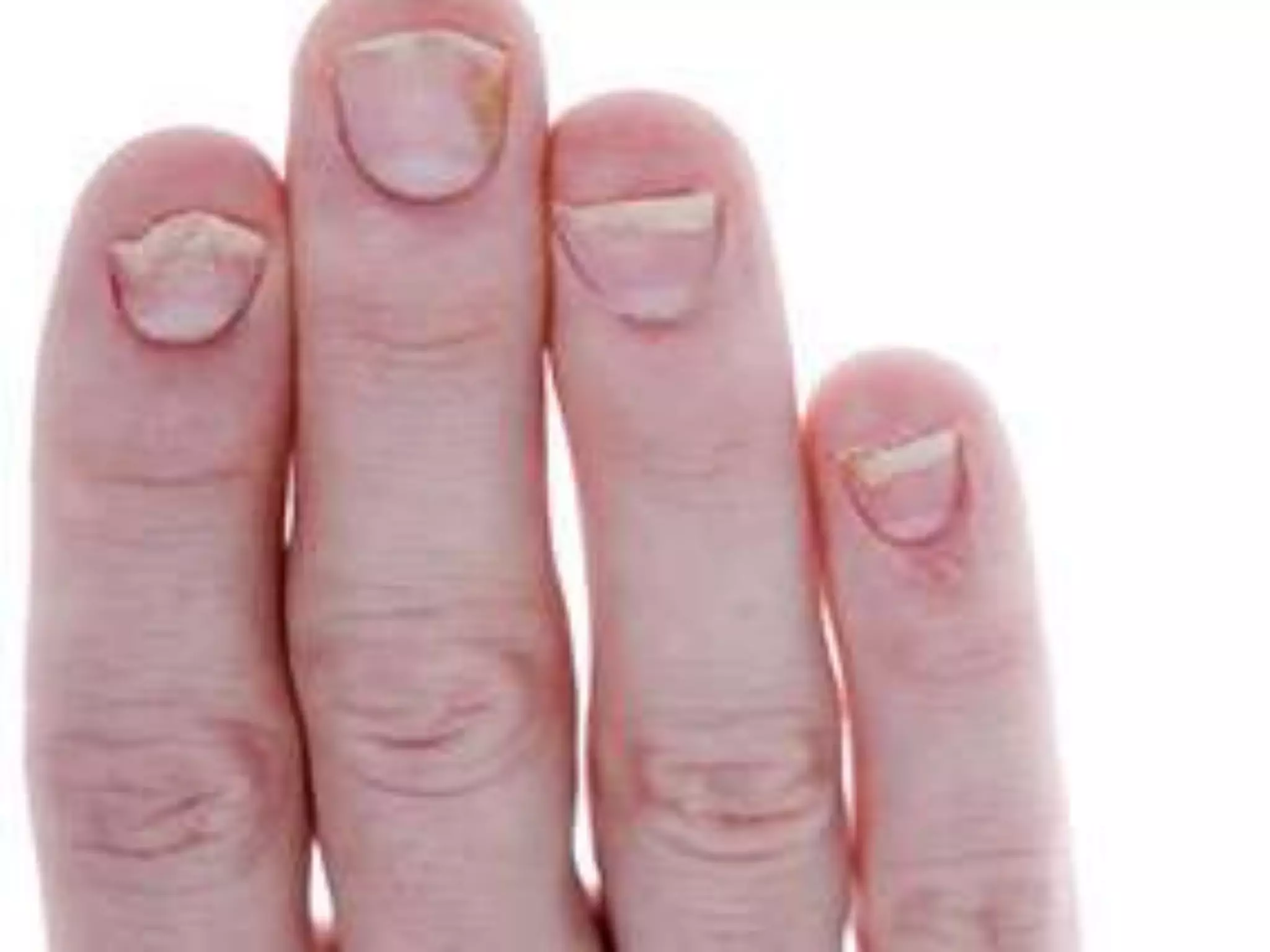
Nail Psoriasis
• Can take several forms:
 Pitting: discrete, well-circumscribed depressions on nail
surface

 Subungual hyperkeratosis: silvery white crusting under
free edge of nail with some thickening of nail plate

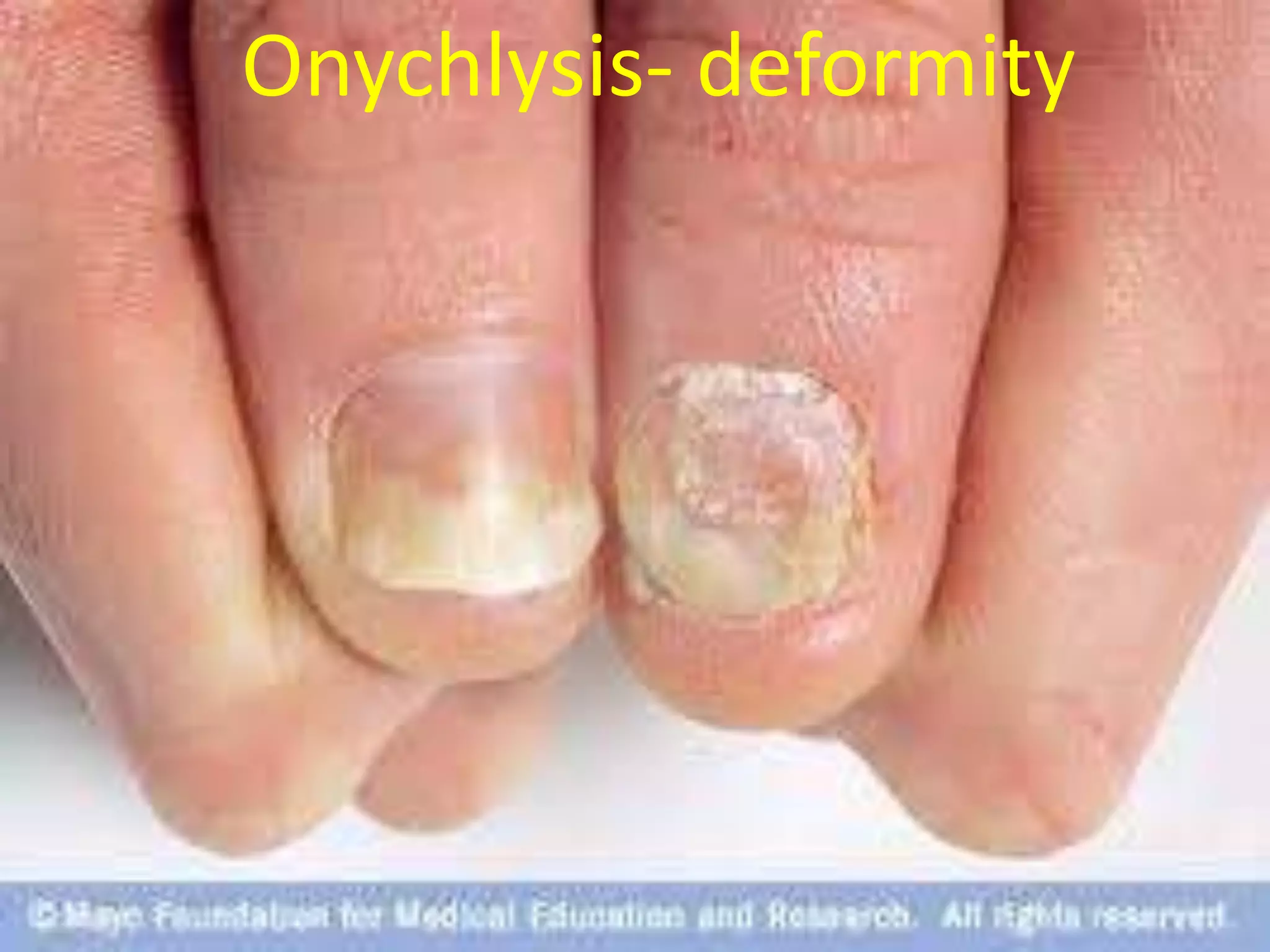
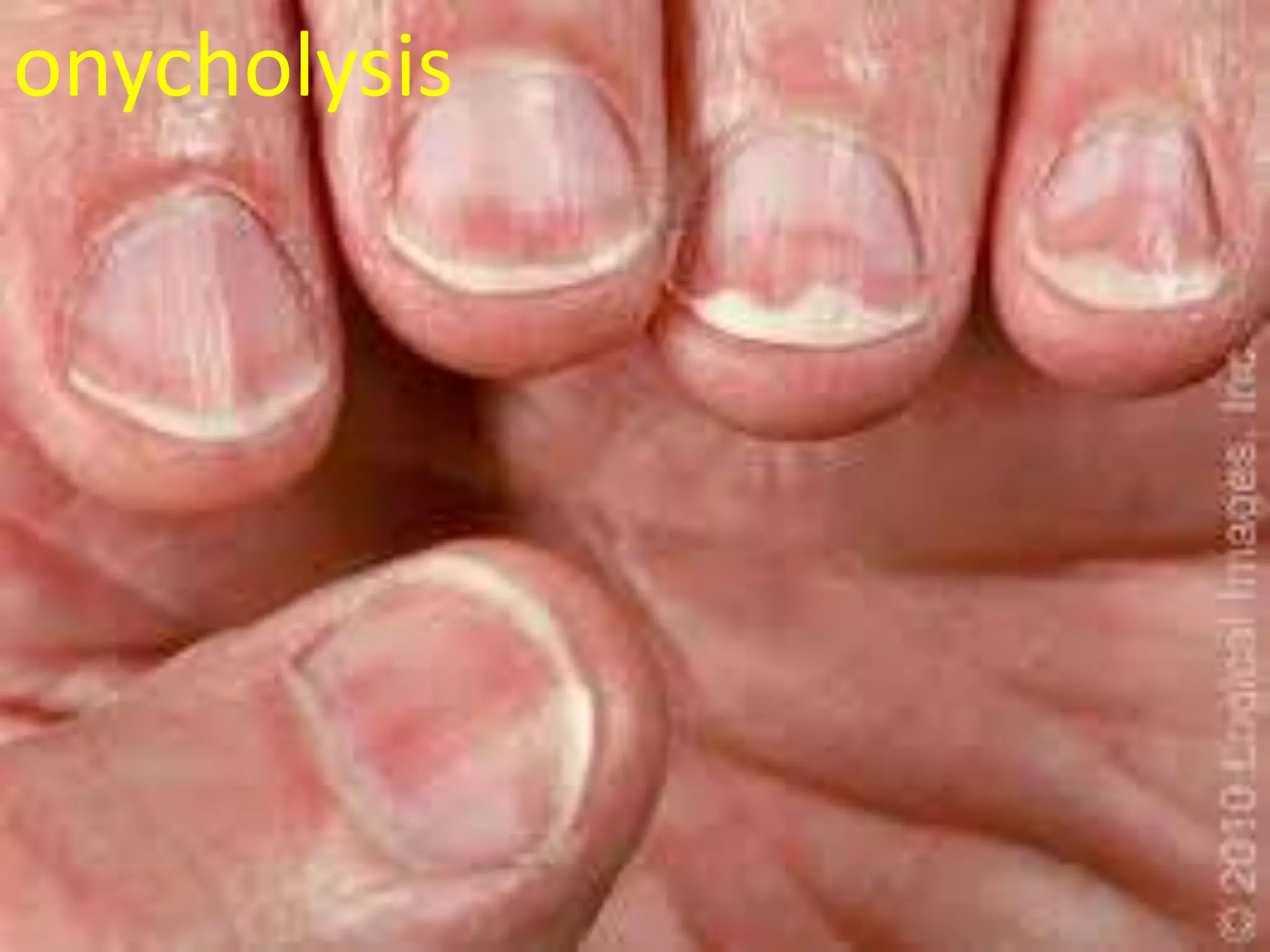
 Onycholysis: nail separates from nail bed at free edge
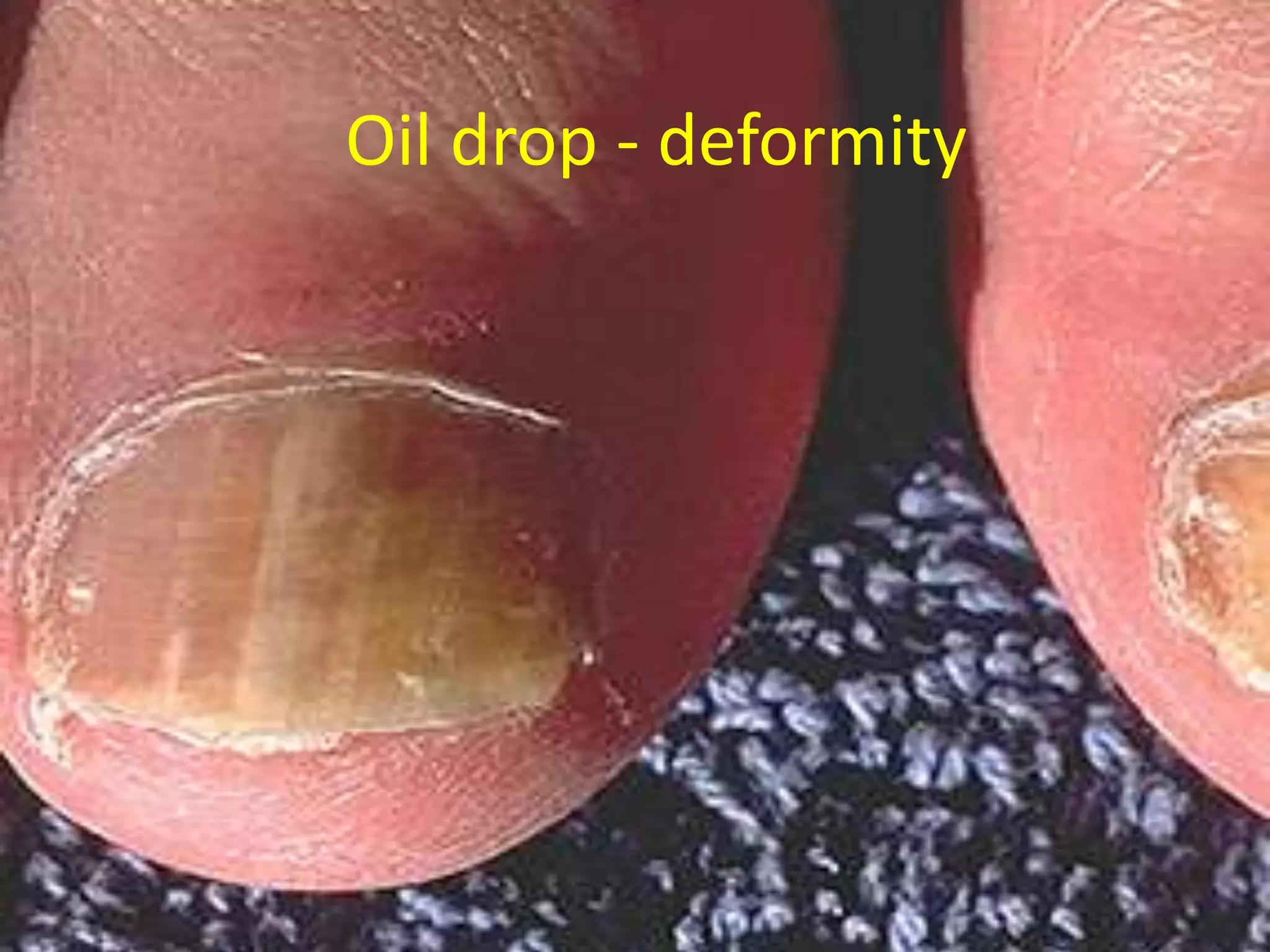
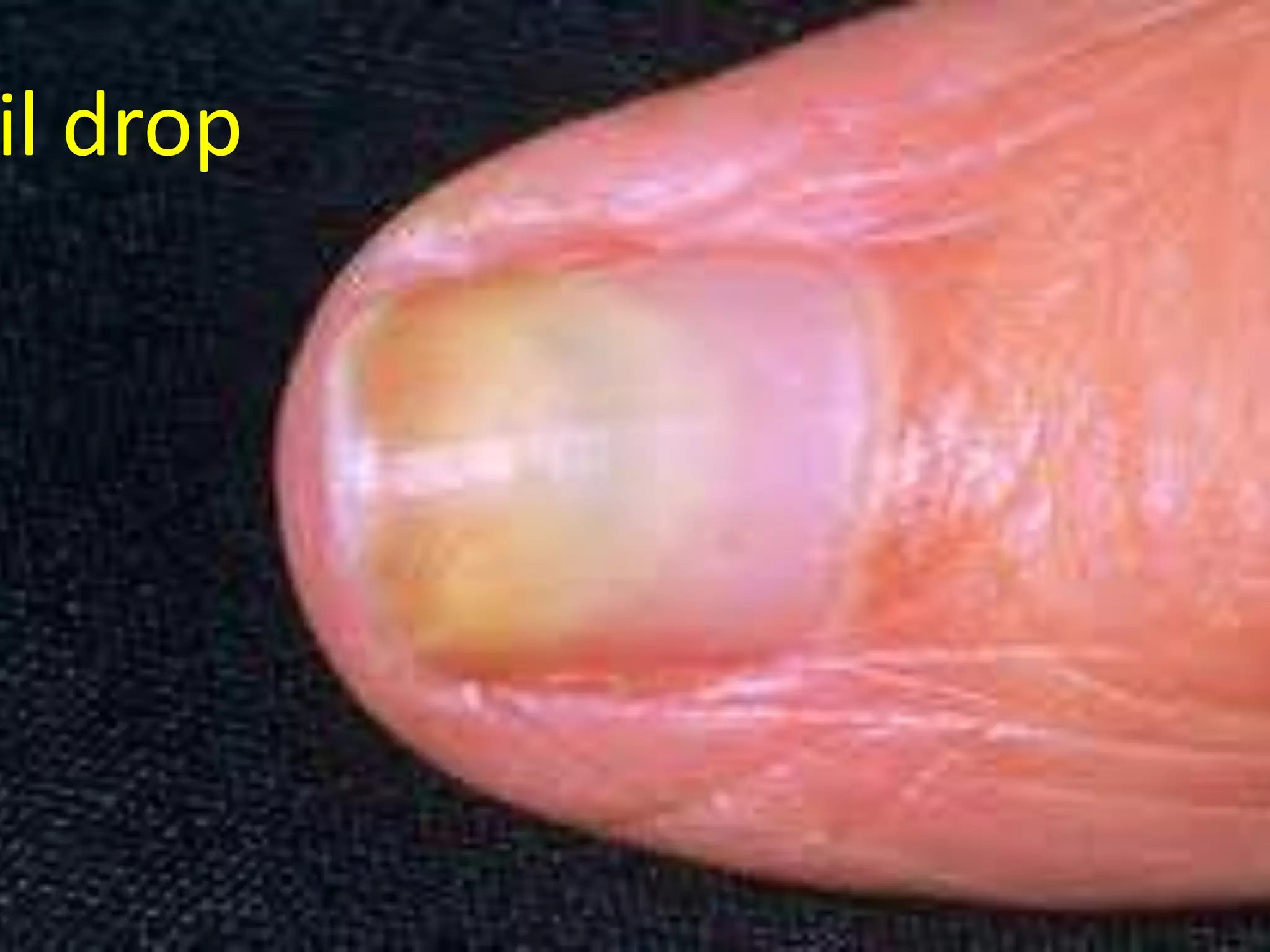
 ‘Oil-drop sign’: pink/red colour change on nail surface
pitting
Oil drop - deformity
il drop
Onychlysis- deformity
onycholysis
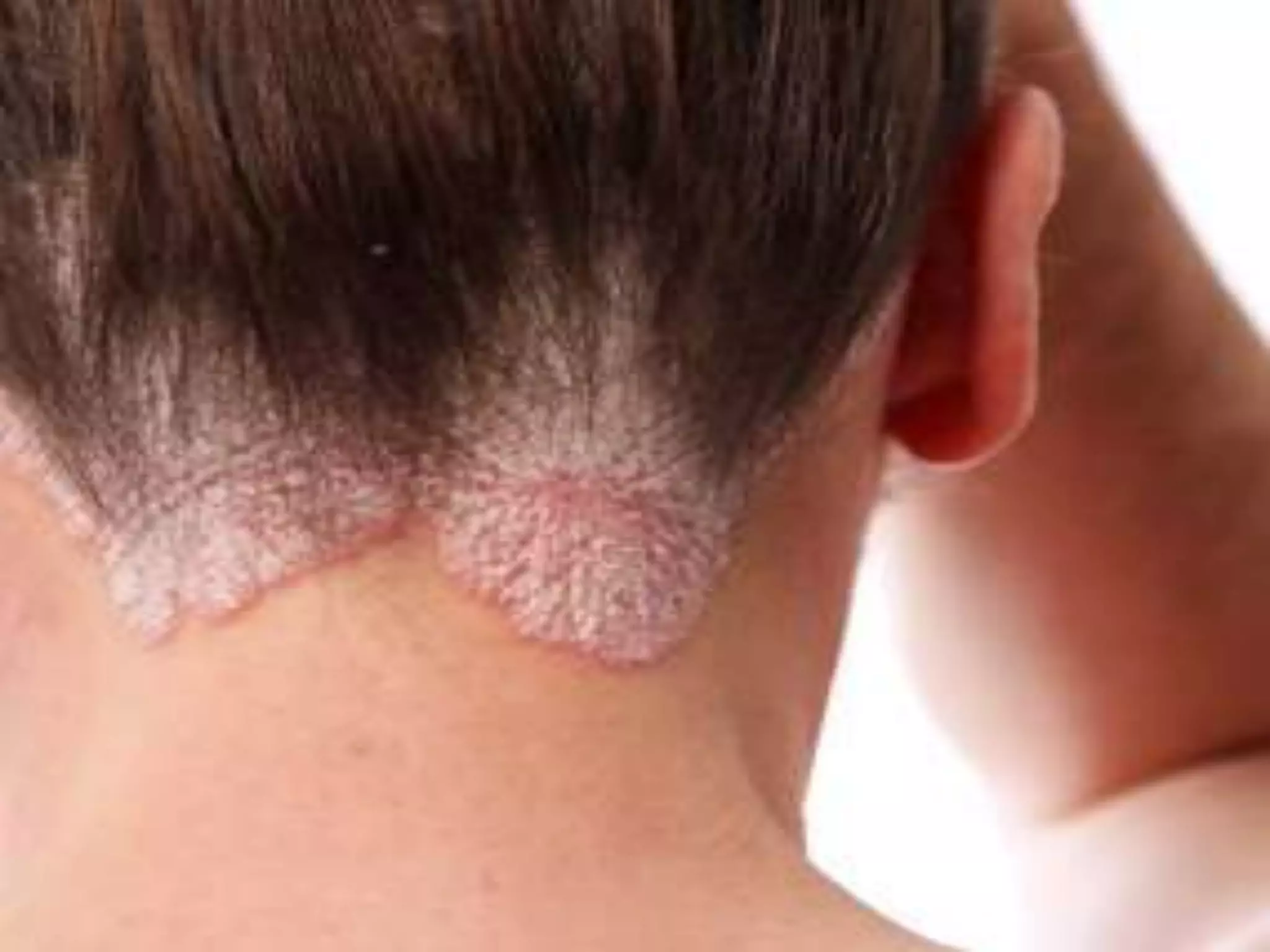
Scalp Psoriasis
• The scalp may have fine, dry, scaly skin or have
heavily crusted plaque areas (thick hyperkeratotic
plaques)
• May extend beyond hairline
• Sometimes psoriasis of the scalp is confused with
seborrheic dermatitis. A key difference is that in
seborrheic dermatitis, the scales are greasy
looking, not dry.
Psoriatic Arthritis
• RF Negative.
• Psoriatic arthritis is a specific condition in which a
person has both psoriasis and arthritis. Psoriatic
arthritis is an autoimmune disease.
1. Symmetric oligoarticular 70%
2. Spondylitis 20%
3. Distal interphalangeal 10%
4. Mutilan 5%
Laboratory findings:
• Acantosis
• Hyperkeratosis
• hypergranulosis
• Monro microabccess
+ HIV assessment/ anti streptolysin O/
KOH test
Differential diagnosis
•
•
•
•

Dermatitis seborrheic
Dyshidrotic eczema(hands and feet)
Tinea
Pityriasis rosea
Treatments:
• Topical therapy
• Phototherapy
• Systemic therapy
topical
•
•
•
•
•
•
•

Coal tar
Corticosteroids (I-V)
Calcipotrience
Anthralin(drithocreme)
Tazarotene(tazorac)
Salicylic acid
Bath solution
phototherapy
• UVB photo therapy
• PUVA (ultraviolet A) (psoralen+UVA)
systemic
•
•
•
•

Methotrexate
Cyclosporine
Acitretin
Biologic drugs(immune moderator)
 Etanercept
 Adalimumab
 Infliximab
 Alefacept
 ustekinumab
Psoriasis

Psoriasis

  • 1.
    In the nameof TRUTH
  • 2.
    PSORIASIS The Non Infectious,Chronic, Inflammatory, common “Itching Condition” Afzalipoor university of medical sciences dermatology department
  • 3.
    What is psoriasis? •Named for the Greek word psōra meaning "itch“ • It is characterized by well defined Erythematous plaques and inflamed lesions with large, adherent, silvery-white scales( red, scaly skin plaques.)
  • 8.
    What is psoriasis? •Named for the Greek word psōra meaning "itch“ • It is characterized by well defined Erythematous plaques and inflamed lesions with large, adherent, silvery-white scales( red, scaly skin patches.) • Psoriasis is an T-cell mediated, non contagious skin disorder. It is a mistake of immune system that makes faulty signal which leads to overproduction of skin cell. • no known cause. • controllable but not curable. • Psoriasis commonly affects the skin of the elbows, knees, and scalp.
  • 9.
    Epidemiology • Prevalence: 1-3% •M=F • Although psoriasis can be seen in people of any age, from babies to seniors, most commonly patients are first diagnosed in their early adult years. • picked age of incidence is late second decade of life and late 40s.
  • 10.
    What Causes Psoriasis? •The exact cause of psoriasis remains unknown. There may be a combination of risk factors, including genetic predisposition and environmental factors. It is common for psoriasis to be found in members of the same family.
  • 11.
    Difference Between normalSkin Psoriasis Skin
  • 12.
    Common Trigger FactorsFor Psoriasis • • • • • • • • • Infections (e.g. streptococcal, viral(HIV), candida) Skin trauma (Koebner phenomenon) Psychological stress Drugs (e.g. lithium, beta blockers, antimalarial, stopping usage of corticosteroids) Sunburn winter Metabolic factors (e.g. calcium deficiency) Hormonal factors (e.g. pregnancy) Smoking & Taking AlcoholDrinking
  • 13.
    symptomes Scaling 94 Itching 79 Skin redness 71 Tightness ofskin 31 Bleeding 29 Burning sensation 21 Fatigue 19 Other 5 0 20 40 60 80 100
  • 14.
    types • • • • • • Plaque (Most Popular) Guttate Flexural(Inverse) Pustular Erythrodermic Others Like Nail, Palm, Scalp
  • 15.
    1-Plaque Psoriasis(psoriasis vulgaris) •Most common type • Features pink, well-defined plaques with silvery scale • Lesions may be single or numerous • Classically affects elbows, knees, trunk and scalps.(nail?) • Characteristic features: dark red(uncontroled lesions) – Auspitz sign
  • 18.
    2-Guttate Psoriasis • Numerousand small lesions – ~ 1 cm diameter • Monomorphic, pink plaque. Usually there is a fine scale on the droplike lesion that is much finer than the scales in plaque psoriasis • Commonly found on trunk and proximal limbs • Often preceded by an pharyngitis streptococcal infection, viral infection and stopping usage of systemic corticosteroids(less common).
  • 21.
    3-Flexural Psoriasis(inverse) • brightred, smooth (not scaly) patches found in the folds of the skin. • The most common areas are gluteal cleft, axillae and submammary regions. • May cause diagnostic difficulty when genital or perianal region is affected in isolation • Associated with candida infection.
  • 24.
    4- Pustular Psoriasis •Two forms: localised – generalised • LOCALISED:  More common form. and nail involvement is common.  Presents as deep-seated lesions with multiple small pustules on palms and soles-- they become dark brown and mostly painfull.  Relative to usage of tobacco and cigarette. • Generalised:  Uncommon but very severe.  Associated with fever, malaise , tenderness and also drugs.  widespread pustules across inflamed body surface
  • 27.
    5- Erythrodermic psoriasis •the least common but severe. • Generalised erythema covering entire skin surface • May evolve slowly from chronic plaque psoriasis or appear as eruptive phenomenon. • Patients may become febrile, hypo/hyperthermic and dehydrated plus shaking and skin pain. • Can be associated with drugs. • Complications include cardiac failure, infections, malabsorption and anaemia.
  • 29.
    Nail Psoriasis • Cantake several forms:  Pitting: discrete, well-circumscribed depressions on nail surface  Subungual hyperkeratosis: silvery white crusting under free edge of nail with some thickening of nail plate  Onycholysis: nail separates from nail bed at free edge  ‘Oil-drop sign’: pink/red colour change on nail surface
  • 30.
  • 31.
    Oil drop -deformity
  • 32.
  • 33.
  • 34.
  • 36.
    Scalp Psoriasis • Thescalp may have fine, dry, scaly skin or have heavily crusted plaque areas (thick hyperkeratotic plaques) • May extend beyond hairline • Sometimes psoriasis of the scalp is confused with seborrheic dermatitis. A key difference is that in seborrheic dermatitis, the scales are greasy looking, not dry.
  • 38.
    Psoriatic Arthritis • RFNegative. • Psoriatic arthritis is a specific condition in which a person has both psoriasis and arthritis. Psoriatic arthritis is an autoimmune disease. 1. Symmetric oligoarticular 70% 2. Spondylitis 20% 3. Distal interphalangeal 10% 4. Mutilan 5%
  • 39.
    Laboratory findings: • Acantosis •Hyperkeratosis • hypergranulosis • Monro microabccess + HIV assessment/ anti streptolysin O/ KOH test
  • 40.
  • 41.
    Treatments: • Topical therapy •Phototherapy • Systemic therapy
  • 42.
  • 43.
    phototherapy • UVB phototherapy • PUVA (ultraviolet A) (psoralen+UVA)
  • 44.
    systemic • • • • Methotrexate Cyclosporine Acitretin Biologic drugs(immune moderator) Etanercept  Adalimumab  Infliximab  Alefacept  ustekinumab