


























Environmentalism(s) Dr. Christopher S. Rice


Egocentrism
Homocentrism
Ecocentrism
Problems with Eco-centrism: May actually be homocentric at its root – assigning values of species, etc. Fuzziness between facts and values, is and ought. Assumption of moral progress. Feminist critique – glosses over issues of race, gender, class, species difference.
Deep Ecology
 
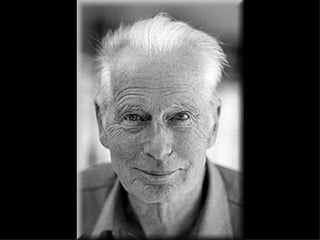
Ecosophy T
Ecosophy A philosophy of ecological harmony or equilibrium.
Ecosophy T
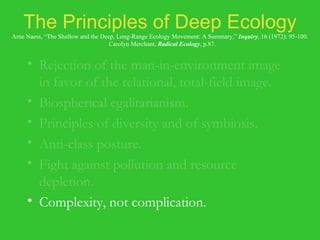
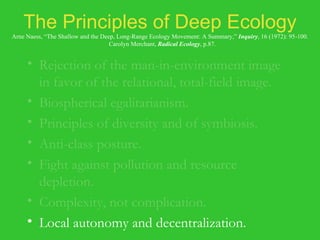
The Principles of Deep Ecology Arne Naess, “The Shallow and the Deep, Long-Range Ecology Movement: A Summary,”  Inquiry , 16 (1972): 95-100.   Carolyn Merchant,  Radical Ecology , p.87. Rejection of the man-in-environment image in favor of the relational, total-field image. Biospherical egalitarianism. Principles of diversity and of symbiosis. Anti-class posture. Fight against pollution and resource depletion. Complexity, not complication. Local autonomy and decentralization.


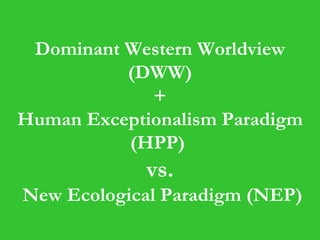
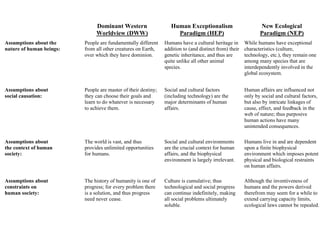
Dominant Western Worldview (DWW) + Human Exceptionalism Paradigm   (HPP)  vs.  New Ecological Paradigm (NEP)
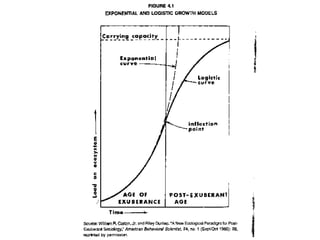
Source:  William R. Catton, Jr. and Riley Dunlap.  “A New Ecological Paradigm for Post-Exuberant Sociology,”  American Behavioral Scientist , 24, no. 1 (Sept./Oct. 1980): 34.  Also  Carolyn Merchant,  Radical Ecology , pp. 90-91.
Human Nature
Principle of Biospheric Equality
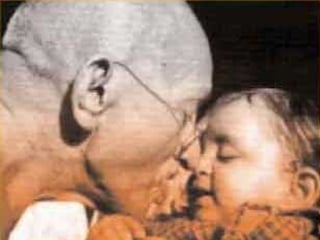
We are an event, not an ego
 
The Self
Dialectical Idealism
 
 
Christian Tradition
Eco-science
Chaos Theory
Social Ecology
Progressivism + Environmentalism
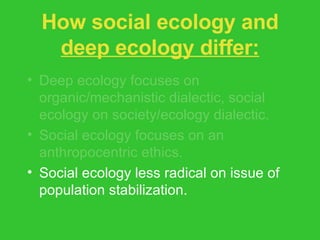
How social ecology and  deep ecology differ: Deep ecology focuses on organic/mechanistic dialectic, social ecology on society/ecology dialectic. Social ecology focuses on an anthropocentric ethics. Social ecology less radical on issue of population stabilization.
Anarchist Social Ecology
 
It’s all about the  hierarchy , baby!
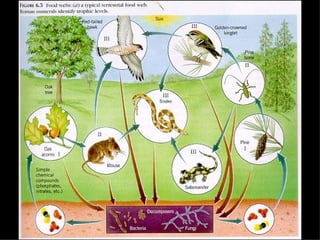
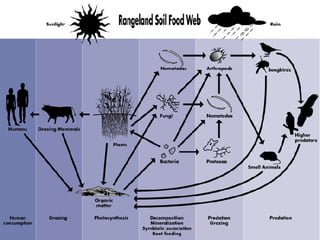
Food WEB vs. Food CHAIN
 
 
“ An immanent dialectic within phenomena” Humans are transformed by their relations with nature, even as they transform nature by their interactions with it. Nature is not just the passive receptor of human action, but the active transformer of human labor. Nature interacts with humanity to yield the actualization of their common potentialities in the natural and social worlds.
Ending social domination
Ecology vs. Environmentalism
Bioregionalism
 
Ecosystem A distinct human and natural community including the social as well as the organic factors that interrelate with each other to provide the basis for an ecologically rounded and balanced community.
Socialist Ecology
economic transformation to ecological socialism
First Contradiction of Capitalism
Second Contradiction of Capitalism
Ecology is the basis of  3 conditions of production The external physical conditions. The personal conditions of laborers. The social conditions of production.
Resultant changes in Marxism Where First Contradiction lead to  overproduction , Second Contradiction leads to  underproduction . Traditionally, labor and socialist movements are agents of transformation. In EM, ecological social movements are the agents of change. State socialism rejected in favor of localization and appropriate technologies and systems.
Cyber-Greens
 
“ Email burns oil and shits filth into your air” ~ Bruce Sterling, Viridiandesign.org
They're all about creating irresistible consumer demand for cool objects that will yield a global atmosphere upgrade. It's the Net vs. the 20th-century fossil order in a fight that the cybergreens are winning. Why? Because they're not about spiritual potential, human decency, small is beautiful, peace, justice or anything else unattainable. The cybergreens are about stuff people want, such as health, sex, glamour, hot products, awesome bandwidth, tech innovation and tons of money.  We're gonna glam, spend and consume our way into planetary survival . ~ Bruce Sterling
Greening your Geek

PS 240 Environmentalism Fall 2007

  • 1.
  • 2.
  • 3.
  • 4.
  • 5.
  • 6.
  • 7.
  • 8.
  • 9.
  • 10.
    Problems with Eco-centrism:May actually be homocentric at its root – assigning values of species, etc. Fuzziness between facts and values, is and ought. Assumption of moral progress. Feminist critique – glosses over issues of race, gender, class, species difference.
  • 11.
    Problems with Eco-centrism:May actually be homocentric at its root – assigning values of species, etc. Fuzziness between facts and values, is and ought. Assumption of moral progress. Feminist critique – glosses over issues of race, gender, class, species difference.
  • 12.
    Problems with Eco-centrism:May actually be homocentric at its root – assigning values of species, etc. Fuzziness between facts and values, is and ought. Assumption of moral progress. Feminist critique – glosses over issues of race, gender, class, species difference.
  • 13.
    Problems with Eco-centrism:May actually be homocentric at its root – assigning values of species, etc. Fuzziness between facts and values, is and ought. Assumption of moral progress. Feminist critique – glosses over issues of race, gender, class, species difference.
  • 14.
  • 15.
  • 16.
  • 17.
    Ecosophy A philosophyof ecological harmony or equilibrium.
  • 18.
  • 19.
    The Principles ofDeep Ecology Arne Naess, “The Shallow and the Deep, Long-Range Ecology Movement: A Summary,” Inquiry , 16 (1972): 95-100. Carolyn Merchant, Radical Ecology , p.87. Rejection of the man-in-environment image in favor of the relational, total-field image. Biospherical egalitarianism. Principles of diversity and of symbiosis. Anti-class posture. Fight against pollution and resource depletion. Complexity, not complication. Local autonomy and decentralization.
  • 20.
    The Principles ofDeep Ecology Arne Naess, “The Shallow and the Deep, Long-Range Ecology Movement: A Summary,” Inquiry , 16 (1972): 95-100. Carolyn Merchant, Radical Ecology , p.87. Rejection of the man-in-environment image in favor of the relational, total-field image. Biospherical egalitarianism. Principles of diversity and of symbiosis. Anti-class posture. Fight against pollution and resource depletion. Complexity, not complication. Local autonomy and decentralization.
  • 21.
    The Principles ofDeep Ecology Arne Naess, “The Shallow and the Deep, Long-Range Ecology Movement: A Summary,” Inquiry , 16 (1972): 95-100. Carolyn Merchant, Radical Ecology , p.87. Rejection of the man-in-environment image in favor of the relational, total-field image. Biospherical egalitarianism. Principles of diversity and of symbiosis. Anti-class posture. Fight against pollution and resource depletion. Complexity, not complication. Local autonomy and decentralization.
  • 22.
    The Principles ofDeep Ecology Arne Naess, “The Shallow and the Deep, Long-Range Ecology Movement: A Summary,” Inquiry , 16 (1972): 95-100. Carolyn Merchant, Radical Ecology , p.87. Rejection of the man-in-environment image in favor of the relational, total-field image. Biospherical egalitarianism. Principles of diversity and of symbiosis. Anti-class posture. Fight against pollution and resource depletion. Complexity, not complication. Local autonomy and decentralization.
  • 23.
    The Principles ofDeep Ecology Arne Naess, “The Shallow and the Deep, Long-Range Ecology Movement: A Summary,” Inquiry , 16 (1972): 95-100. Carolyn Merchant, Radical Ecology , p.87. Rejection of the man-in-environment image in favor of the relational, total-field image. Biospherical egalitarianism. Principles of diversity and of symbiosis. Anti-class posture. Fight against pollution and resource depletion. Complexity, not complication. Local autonomy and decentralization.
  • 24.
    The Principles ofDeep Ecology Arne Naess, “The Shallow and the Deep, Long-Range Ecology Movement: A Summary,” Inquiry , 16 (1972): 95-100. Carolyn Merchant, Radical Ecology , p.87. Rejection of the man-in-environment image in favor of the relational, total-field image. Biospherical egalitarianism. Principles of diversity and of symbiosis. Anti-class posture. Fight against pollution and resource depletion. Complexity, not complication. Local autonomy and decentralization.
  • 25.
    The Principles ofDeep Ecology Arne Naess, “The Shallow and the Deep, Long-Range Ecology Movement: A Summary,” Inquiry , 16 (1972): 95-100. Carolyn Merchant, Radical Ecology , p.87. Rejection of the man-in-environment image in favor of the relational, total-field image. Biospherical egalitarianism. Principles of diversity and of symbiosis. Anti-class posture. Fight against pollution and resource depletion. Complexity, not complication. Local autonomy and decentralization.
  • 26.
  • 27.
  • 28.
  • 29.
    Dominant Western Worldview(DWW) + Human Exceptionalism Paradigm (HPP) vs. New Ecological Paradigm (NEP)
  • 30.
    Source: WilliamR. Catton, Jr. and Riley Dunlap. “A New Ecological Paradigm for Post-Exuberant Sociology,” American Behavioral Scientist , 24, no. 1 (Sept./Oct. 1980): 34. Also Carolyn Merchant, Radical Ecology , pp. 90-91.
  • 31.
  • 32.
  • 33.
    We are anevent, not an ego
  • 34.
  • 35.
  • 36.
  • 37.
  • 38.
  • 39.
  • 40.
  • 41.
  • 42.
  • 43.
  • 44.
    How social ecologyand deep ecology differ: Deep ecology focuses on organic/mechanistic dialectic, social ecology on society/ecology dialectic. Social ecology focuses on an anthropocentric ethics. Social ecology less radical on issue of population stabilization.
  • 45.
    How social ecologyand deep ecology differ: Deep ecology focuses on organic/mechanistic dialectic, social ecology on society/ecology dialectic. Social ecology focuses on an anthropocentric ethics. Social ecology less radical on issue of population stabilization.
  • 46.
    How social ecologyand deep ecology differ: Deep ecology focuses on organic/mechanistic dialectic, social ecology on society/ecology dialectic. Social ecology focuses on an anthropocentric ethics. Social ecology less radical on issue of population stabilization.
  • 47.
  • 48.
  • 49.
    It’s all aboutthe hierarchy , baby!
  • 50.
    Food WEB vs.Food CHAIN
  • 51.
  • 52.
  • 53.
    “ An immanentdialectic within phenomena” Humans are transformed by their relations with nature, even as they transform nature by their interactions with it. Nature is not just the passive receptor of human action, but the active transformer of human labor. Nature interacts with humanity to yield the actualization of their common potentialities in the natural and social worlds.
  • 54.
    “ An immanentdialectic within phenomena” Humans are transformed by their relations with nature, even as they transform nature by their interactions with it. Nature is not just the passive receptor of human action, but the active transformer of human labor. Nature interacts with humanity to yield the actualization of their common potentialities in the natural and social worlds.
  • 55.
    “ An immanentdialectic within phenomena” Humans are transformed by their relations with nature, even as they transform nature by their interactions with it. Nature is not just the passive receptor of human action, but the active transformer of human labor. Nature interacts with humanity to yield the actualization of their common potentialities in the natural and social worlds.
  • 56.
  • 57.
  • 58.
  • 59.
  • 60.
    Ecosystem A distincthuman and natural community including the social as well as the organic factors that interrelate with each other to provide the basis for an ecologically rounded and balanced community.
  • 61.
  • 62.
    economic transformation toecological socialism
  • 63.
  • 64.
  • 65.
    Ecology is thebasis of 3 conditions of production The external physical conditions. The personal conditions of laborers. The social conditions of production.
  • 66.
    Ecology is thebasis of 3 conditions of production The external physical conditions. The personal conditions of laborers. The social conditions of production.
  • 67.
    Ecology is thebasis of 3 conditions of production The external physical conditions. The personal conditions of laborers. The social conditions of production.
  • 68.
    Resultant changes inMarxism Where First Contradiction lead to overproduction , Second Contradiction leads to underproduction . Traditionally, labor and socialist movements are agents of transformation. In EM, ecological social movements are the agents of change. State socialism rejected in favor of localization and appropriate technologies and systems.
  • 69.
    Resultant changes inMarxism Where First Contradiction lead to overproduction , Second Contradiction leads to underproduction . Traditionally, labor and socialist movements are agents of transformation. In EM, ecological social movements are the agents of change. State socialism rejected in favor of localization and appropriate technologies and systems.
  • 70.
    Resultant changes inMarxism Where First Contradiction lead to overproduction , Second Contradiction leads to underproduction . Traditionally, labor and socialist movements are agents of transformation. In EM, ecological social movements are the agents of change. State socialism rejected in favor of localization and appropriate technologies and systems.
  • 71.
  • 72.
  • 73.
    “ Email burnsoil and shits filth into your air” ~ Bruce Sterling, Viridiandesign.org
  • 74.
    They're all aboutcreating irresistible consumer demand for cool objects that will yield a global atmosphere upgrade. It's the Net vs. the 20th-century fossil order in a fight that the cybergreens are winning. Why? Because they're not about spiritual potential, human decency, small is beautiful, peace, justice or anything else unattainable. The cybergreens are about stuff people want, such as health, sex, glamour, hot products, awesome bandwidth, tech innovation and tons of money. We're gonna glam, spend and consume our way into planetary survival . ~ Bruce Sterling
  • 75.