ENVIRONMENTALISM
A belief in and concern for the importance and influence of
environment within a society.
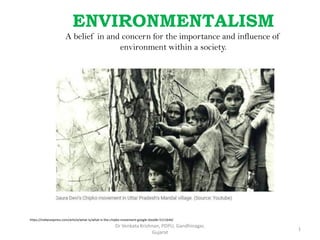
https://indianexpress.com/article/what-is/what-is-the-chipko-movement-google-doodle-5111644/
1
Dr Venkata Krishnan, PDPU, Gandhinagar,
Gujarat
Objectives & Sources
• To enable the students to identify the relationship between environmental
issues & political thought
• To encourage the students to take subjects related to environmentalism as
topic of their research
• To guide students for competitive examinations like UPSC/NET etc
2
Dr Venkata Krishnan, PDPU, Gandhinagar,
Gujarat
3
Dr Venkata Krishnan, PDPU, Gandhinagar,
Gujarat
ENVIRONMENTALISM
• Not a new phenomenon
• Legislations... 19th century
• Distinct issue 1970s
• Reasons for Rise of Environmentalism
-Severe problems related to Air pollution, Pesticide in
Agriculture, Depletion of Non-renewable resources, Climate
Change etc
Air pollution now biggest health risk in India, says report -
https://www.thehindu.com/news/cities/Delhi/air-pollution-now-biggest-health-risk-in-india-says-
report/article32912916.ece
4
Dr Venkata Krishnan, PDPU, Gandhinagar,
Gujarat
Conferences
• The 1972 United Nations Conference on the Environment in Stockholm was the first world
conference to make the environment a major issue. One of the major results of the
Stockholm conference was the creation of the United Nations Environment Programme (UNEP).
• The United Nations Conference on Environment and Development (UNCED), also known as the
'Earth Summit', was held in Rio de Janeiro, Brazil, 1992.
• The 2002 World Summit on Sustainable Development in Johannesburg adopted a Political
Declaration and Implementation Plan which included provisions covering a set of activities and
measures to be taken in order to achieve development that takes into account respect for the
environment.
• In 2012 -Rio de Janeiro, United Nations Conference on Sustainable Development in Rio (also
known as Rio+20) resulted in a document containing clear and practical steps for the
implementation of sustainable development.
• In 2015, the United Nations Summit on Sustainable Development gave birth to Agenda 2030 and
its seventeen sustainable development goals [ New York]
https://www.un.org/en/conferences/environment
5
Dr Venkata Krishnan, PDPU, Gandhinagar,
Gujarat
• Philosophy of Nature...Ancient subject
• Aristotle, Hobbes, Rousseau, Mill...sketched and appreciated diverse
pictures of nature...Mostly in this tradition – nature untouched by
humanity is utterly without value
• Industrial Revolution time attitude towards nature changed...love of
nature has grown...even 2 movements each progressing with equal
rapidity
• The insight humanity has potential to profoundly affect nature – GP
Marsh, Man and Nature 1864
• After WWII eloquently expressed...A. Leopold, R. Carson (Silent Spring)...
• Individual acts on immediate self interest, but, together we produce...
outcomes that are worse for all of us – realisation...solution mutual
coercion mutually agreed upon (Hardin)
• So, 1960s &70s writings brought...to political theory & philosophy
6
Dr Venkata Krishnan, PDPU, Gandhinagar,
Gujarat
Ideologically Environmental Thoughts
REFORMIST: ENVIRONMENTALISM
• Sustainable growth
• Ecological modernisation
• Use of renewable energy
• Production of environmental
goods
• Environmental damage not cost
free
– Increase in temperature, decrease
in output
•Anthropocentric view
•Environmental solution coexist
with existing political structures
RADICAL : ECOLOGICAL
• Economic growth incompatible
with environmental protection
• The limits to growth-The
message of this book still
holds today
• Eco-centric
•Intrinsic value to both humans &
non-humans
• Socio-political changes
required
•Authoritarian state to protect
environment, because people are
not prudent
7
Dr Venkata Krishnan, PDPU, Gandhinagar,
Gujarat
A distinct ideology?
There are works which connect environment but, Green Political Parties – distinct
one...New political system required
1980s Green’s entered legislature in Germany
The German Green Party slogan of the 1980s —“We are neither right nor
left, but ahead”—this appeal ...the new social movements ...tends to cut
across traditional class, party politics, and socioeconomic affiliations to
politicize aspects of everyday life traditionally seen as outside politics.
ENVIRONMENTALISM :
Democracy, Justice, Liberalism
Green political theorist explored relationship between
environmental movement & political process
8
Dr Venkata Krishnan, PDPU, Gandhinagar,
Gujarat
ENVIRONMENTALISM & DEMOCRACY
• What is the relationship between Environmentalism & Democracy?
Value: People’s view about how world ought to be
Interest: What is good for the people either in the long term or in the short term
Preference: What people currently want
People often act politically on preferences (emotion) rather than on
interest/values (reason)
However, Deliberative Democracy... Participatory Democracy
ENVIRONMENTALISM & CITIZENSHIP
Notion of virtue- Green Virtue...Humility & Moderation
9
Dr Venkata Krishnan, PDPU, Gandhinagar,
Gujarat
Environmentalism &
Liberalism
• Liberalism talks about neutral state...
• Liberalism allows each to do as they pleasure...
– However such things are against environmentalism
So certain difficult questions are emerging...
misunderstanding of liberalism...liberal commitment to
toleration and diversity itself...help to resolve
incompatibility...if at all
10
Dr Venkata Krishnan, PDPU, Gandhinagar,
Gujarat
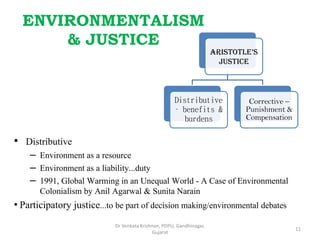
ENVIRONMENTALISM
& JUSTICE
Aristotle’s
Justice
Distributive
– benefits &
burdens
Corrective –
Punishment &
Compensation
• Distributive
– Environment as a resource
– Environment as a liability...duty
– 1991, Global Warming in an Unequal World - A Case of Environmental
Colonialism by Anil Agarwal & Sunita Narain
• Participatory justice...to be part of decision making/environmental debates
11
Dr Venkata Krishnan, PDPU, Gandhinagar,
Gujarat
The idea that developing countries like India and
China must share the blame for heating up the
earth and destabilizing its climate, as espoused in a
recent study published in the United States by the
WRI in collaboration with the UN, is an excellent
example of environmental colonialism. The report
of the WRI is based less on science and more on
politically motivated and mathematical jugglery. Its
main intention seems to be to blame developing
countries for global warming and perpetuate the
current global inequality in the use of the earth’s
environment and its resources.
12
Dr Venkata Krishnan, PDPU, Gandhinagar,
Gujarat
India & Environmentalism
• When started?
• What is West’s Environmentalism and East’s
Environmentalism?
• What are the 2 phases?
• What criticism against Environmentalists?
• Indian Green Parties
13
Dr Venkata Krishnan, PDPU, Gandhinagar,
Gujarat
India & Environmentalism
THE RISE AND FALL OF INDIAN ENVIRONMENTALISM by
Ramachandra Guha,, Hindustan Times, 2008
THE PAST & PRESENT OF INDIAN ENVIRONMENTALISM by
Ramachandra Guha, The Hindu, 2013
On the 27th of March 1973 — exactly 40 (47) years ago — a group of peasants
in a remote Himalayan village stopped a group of loggers from felling a patch
of trees. Thus was born the Chipko movement, and through it the modern
Indian environmental movement itself.
Pastoralists saw their grazing grounds taken over by factories and engineering
colleges...
In the West, the environmental movement had arisen chiefly out of a desire to
protect endangered animal species and natural habitats. In India, however, it
arose out of the imperative of human survival. This was an environmentalism
of the poor, which married the concern of social justice on the one hand with
sustainability on the other. It argued that present patterns of resource use
disadvantaged local communities and devastated the natural environment.14
Dr Venkata Krishnan, PDPU, Gandhinagar,
Gujarat
India & Environmentalism
• Environmental movements were dismissed by their critics as agents of
Western imperialism
• Meanwhile, journalists and scholars had begun more systematically
studying the impact of environmental degradation on
social life across India.
• Elements of an environmental consciousness had, finally, begun to
permeate the middle class.
• In 1991 the Indian economy started to liberalise.
Unfortunately, the votaries of liberalisation mounted an even
more savage attack on environmentalists than did the proponents of
state socialism.
• Meanwhile, the environment continued to deteriorate.
• India today is an environmental basket-case; marked by polluted skies,
dead rivers, falling water-tables, ever-increasing amounts of untreated
wastes, disappearing forests.
15
Dr Venkata Krishnan, PDPU, Gandhinagar,
Gujarat
• The author focuses on the problems inherent in
environmentalist critiques of the Indian state, and the
inability of their authors to provide a useful analytical
approach for reforming state institutions engaged in
environmental regulation and natural-resource
management. The inherent weaknesses (and
reactionary populism) of Indian environmental debates
are discussed, together with the inability of those
involved to articulate strategies for moving towards
sustainable urban and regional development within the
recent policy phase of deregulation and market
expansion in India.
• https://doi.org/10.1068%2Fa292129
16
Dr Venkata Krishnan, PDPU, Gandhinagar,
Gujarat
17
Dr Venkata Krishnan, PDPU, Gandhinagar,
Gujarat
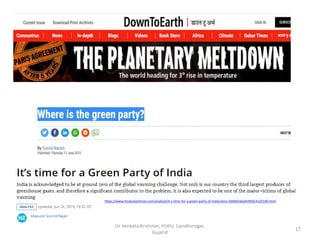
https://www.hindustantimes.com/analysis/it-s-time-for-a-green-party-of-india/story-DljkBjA3eqXVMGCA1ZCtdO.html
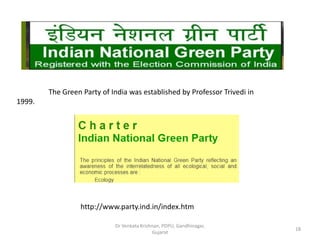
The Green Party of India was established by Professor Trivedi in
1999.
http://www.party.ind.in/index.htm
18
Dr Venkata Krishnan, PDPU, Gandhinagar,
Gujarat
https://indiagreensparty.org/
19
Dr Venkata Krishnan, PDPU, Gandhinagar,
Gujarat
20
Dr Venkata Krishnan, PDPU, Gandhinagar,
Gujarat
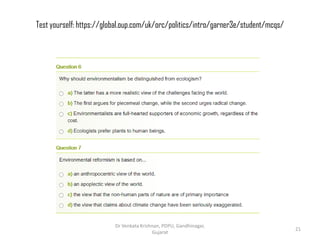
Test yourself: https://global.oup.com/uk/orc/politics/intro/garner3e/student/mcqs/
21
Dr Venkata Krishnan, PDPU, Gandhinagar,
Gujarat
A major contributory factor to this continuing process of
degradation has been the apathy and corruption of our political
class
A major contributory factor to this continuing process
of degradation has been not only the apathy and
moral degradation, but superciliousness of common
public...
22
Dr Venkata Krishnan, PDPU, Gandhinagar,
Gujarat
Further Reading
• http://edugreen.teri.res.in/explore/forestry/chipko.htm
• https://www.unive.it/pag/fileadmin/user_upload/dipartiment
i/DSLCC/documenti/DEP/numeri/n20/13_20_-
Rao_Ecofeminism.pdf
• https://www.unep.org/
• https://www.clubofrome.org/publication/the-limits-to-
growth/
• http://ramachandraguha.in/archives/the-rise-and-fall-
of-indian-environmentalism.html
• https://www.thehindu.com/opinion/lead/the-past-
present-of-indian-environmentalism/article4551665.ece
• https://opentextbc.ca/introductiontosociology/chapter
/chapter21-social-movements-and-social-change/
23
Dr Venkata Krishnan, PDPU, Gandhinagar,
Gujarat
https://www.cima.ned.org/publication/wisdom-of-the-crowd-
deliberative-democracy/
24
Dr Venkata Krishnan, PDPU, Gandhinagar,
Gujarat
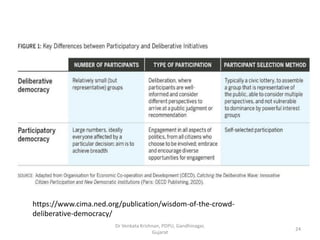
Deliberative Democracy
https://www.oxfordreference.com/view/10.1093/oi/authority.20110803095708535
A critical response to traditional models of democracy. Although deliberative
democracy encompasses a broad spectrum of ideas, the motivational aim of
deliberative theory is to legitimize political decisions by creating procedures
that allow democratic decisions to be a result of mutual understanding,
publicly expressed reason, and broadened political inclusion. This position is
contrasted with democratic models that have traditionally relied on ideas of
competing elites, vote aggregation, and private interest maximization.
Whereas traditional models focus on aggregative outcomes (by elites or
individuals), deliberative theory focuses on broadening the deliberative input
from all participants, on creating a sense of public reason, and on creating
procedures that can be seen as acceptable by all stakeholders involved. By
doing so, deliberative democrats seek to transform current systems of
governance, which are often associated with social exclusion, power
asymmetries, and mutual distrust. Deliberative theorists maintain that
political decisions are best created (and thus can be seen as more legitimate)
through a process of public reason formation, which will decrease the
democratic deficits that are currently experienced in most democracies.
25
Dr Venkata Krishnan, PDPU, Gandhinagar,
Gujarat
Participatory Democracy
https://www.oxfordreference.com/view/10.1093/oi/authority.20110803100308454
The 20th-century reincarnation of the ancient Greek ideal of government by
the people (demos). Participatory democracy is direct democracy, in the
sense that all citizens are actively involved in all important decisions. The
youth and student movements of the 1960s, in Europe and America, adopted
direct democracy with enthusiasm. In practice, this meant that all debates
and decisions took place in face-to-face meetings of the whole group. Direct
democracy was especially important in the American New Left, the French
and British student movements, the early women's movements, and the anti-
nuclear and peace movements of the 1960s and 1970s. It was also a feature
of the ecological and community movements that survived into the 1980s and
1990s. The difficulty with participatory democracy is a practical one—that it
complicates and slows down the decision-making process. Its strength is that
it binds individuals to the group through their active involvement in all
decisions. By general agreement, participatory democracy can be effective
only in groups with 500 or fewer active members.
26
Dr Venkata Krishnan, PDPU, Gandhinagar,
Gujarat

Environmentalism

  • 1.
    ENVIRONMENTALISM A belief inand concern for the importance and influence of environment within a society. https://indianexpress.com/article/what-is/what-is-the-chipko-movement-google-doodle-5111644/ 1 Dr Venkata Krishnan, PDPU, Gandhinagar, Gujarat
  • 2.
    Objectives & Sources •To enable the students to identify the relationship between environmental issues & political thought • To encourage the students to take subjects related to environmentalism as topic of their research • To guide students for competitive examinations like UPSC/NET etc 2 Dr Venkata Krishnan, PDPU, Gandhinagar, Gujarat
  • 3.
    3 Dr Venkata Krishnan,PDPU, Gandhinagar, Gujarat
  • 4.
    ENVIRONMENTALISM • Not anew phenomenon • Legislations... 19th century • Distinct issue 1970s • Reasons for Rise of Environmentalism -Severe problems related to Air pollution, Pesticide in Agriculture, Depletion of Non-renewable resources, Climate Change etc Air pollution now biggest health risk in India, says report - https://www.thehindu.com/news/cities/Delhi/air-pollution-now-biggest-health-risk-in-india-says- report/article32912916.ece 4 Dr Venkata Krishnan, PDPU, Gandhinagar, Gujarat
  • 5.
    Conferences • The 1972United Nations Conference on the Environment in Stockholm was the first world conference to make the environment a major issue. One of the major results of the Stockholm conference was the creation of the United Nations Environment Programme (UNEP). • The United Nations Conference on Environment and Development (UNCED), also known as the 'Earth Summit', was held in Rio de Janeiro, Brazil, 1992. • The 2002 World Summit on Sustainable Development in Johannesburg adopted a Political Declaration and Implementation Plan which included provisions covering a set of activities and measures to be taken in order to achieve development that takes into account respect for the environment. • In 2012 -Rio de Janeiro, United Nations Conference on Sustainable Development in Rio (also known as Rio+20) resulted in a document containing clear and practical steps for the implementation of sustainable development. • In 2015, the United Nations Summit on Sustainable Development gave birth to Agenda 2030 and its seventeen sustainable development goals [ New York] https://www.un.org/en/conferences/environment 5 Dr Venkata Krishnan, PDPU, Gandhinagar, Gujarat
  • 6.
    • Philosophy ofNature...Ancient subject • Aristotle, Hobbes, Rousseau, Mill...sketched and appreciated diverse pictures of nature...Mostly in this tradition – nature untouched by humanity is utterly without value • Industrial Revolution time attitude towards nature changed...love of nature has grown...even 2 movements each progressing with equal rapidity • The insight humanity has potential to profoundly affect nature – GP Marsh, Man and Nature 1864 • After WWII eloquently expressed...A. Leopold, R. Carson (Silent Spring)... • Individual acts on immediate self interest, but, together we produce... outcomes that are worse for all of us – realisation...solution mutual coercion mutually agreed upon (Hardin) • So, 1960s &70s writings brought...to political theory & philosophy 6 Dr Venkata Krishnan, PDPU, Gandhinagar, Gujarat
  • 7.
    Ideologically Environmental Thoughts REFORMIST:ENVIRONMENTALISM • Sustainable growth • Ecological modernisation • Use of renewable energy • Production of environmental goods • Environmental damage not cost free – Increase in temperature, decrease in output •Anthropocentric view •Environmental solution coexist with existing political structures RADICAL : ECOLOGICAL • Economic growth incompatible with environmental protection • The limits to growth-The message of this book still holds today • Eco-centric •Intrinsic value to both humans & non-humans • Socio-political changes required •Authoritarian state to protect environment, because people are not prudent 7 Dr Venkata Krishnan, PDPU, Gandhinagar, Gujarat
  • 8.
    A distinct ideology? Thereare works which connect environment but, Green Political Parties – distinct one...New political system required 1980s Green’s entered legislature in Germany The German Green Party slogan of the 1980s —“We are neither right nor left, but ahead”—this appeal ...the new social movements ...tends to cut across traditional class, party politics, and socioeconomic affiliations to politicize aspects of everyday life traditionally seen as outside politics. ENVIRONMENTALISM : Democracy, Justice, Liberalism Green political theorist explored relationship between environmental movement & political process 8 Dr Venkata Krishnan, PDPU, Gandhinagar, Gujarat
  • 9.
    ENVIRONMENTALISM & DEMOCRACY •What is the relationship between Environmentalism & Democracy? Value: People’s view about how world ought to be Interest: What is good for the people either in the long term or in the short term Preference: What people currently want People often act politically on preferences (emotion) rather than on interest/values (reason) However, Deliberative Democracy... Participatory Democracy ENVIRONMENTALISM & CITIZENSHIP Notion of virtue- Green Virtue...Humility & Moderation 9 Dr Venkata Krishnan, PDPU, Gandhinagar, Gujarat
  • 10.
    Environmentalism & Liberalism • Liberalismtalks about neutral state... • Liberalism allows each to do as they pleasure... – However such things are against environmentalism So certain difficult questions are emerging... misunderstanding of liberalism...liberal commitment to toleration and diversity itself...help to resolve incompatibility...if at all 10 Dr Venkata Krishnan, PDPU, Gandhinagar, Gujarat
  • 11.
    ENVIRONMENTALISM & JUSTICE Aristotle’s Justice Distributive – benefits& burdens Corrective – Punishment & Compensation • Distributive – Environment as a resource – Environment as a liability...duty – 1991, Global Warming in an Unequal World - A Case of Environmental Colonialism by Anil Agarwal & Sunita Narain • Participatory justice...to be part of decision making/environmental debates 11 Dr Venkata Krishnan, PDPU, Gandhinagar, Gujarat
  • 12.
    The idea thatdeveloping countries like India and China must share the blame for heating up the earth and destabilizing its climate, as espoused in a recent study published in the United States by the WRI in collaboration with the UN, is an excellent example of environmental colonialism. The report of the WRI is based less on science and more on politically motivated and mathematical jugglery. Its main intention seems to be to blame developing countries for global warming and perpetuate the current global inequality in the use of the earth’s environment and its resources. 12 Dr Venkata Krishnan, PDPU, Gandhinagar, Gujarat
  • 13.
    India & Environmentalism •When started? • What is West’s Environmentalism and East’s Environmentalism? • What are the 2 phases? • What criticism against Environmentalists? • Indian Green Parties 13 Dr Venkata Krishnan, PDPU, Gandhinagar, Gujarat
  • 14.
    India & Environmentalism THERISE AND FALL OF INDIAN ENVIRONMENTALISM by Ramachandra Guha,, Hindustan Times, 2008 THE PAST & PRESENT OF INDIAN ENVIRONMENTALISM by Ramachandra Guha, The Hindu, 2013 On the 27th of March 1973 — exactly 40 (47) years ago — a group of peasants in a remote Himalayan village stopped a group of loggers from felling a patch of trees. Thus was born the Chipko movement, and through it the modern Indian environmental movement itself. Pastoralists saw their grazing grounds taken over by factories and engineering colleges... In the West, the environmental movement had arisen chiefly out of a desire to protect endangered animal species and natural habitats. In India, however, it arose out of the imperative of human survival. This was an environmentalism of the poor, which married the concern of social justice on the one hand with sustainability on the other. It argued that present patterns of resource use disadvantaged local communities and devastated the natural environment.14 Dr Venkata Krishnan, PDPU, Gandhinagar, Gujarat
  • 15.
    India & Environmentalism •Environmental movements were dismissed by their critics as agents of Western imperialism • Meanwhile, journalists and scholars had begun more systematically studying the impact of environmental degradation on social life across India. • Elements of an environmental consciousness had, finally, begun to permeate the middle class. • In 1991 the Indian economy started to liberalise. Unfortunately, the votaries of liberalisation mounted an even more savage attack on environmentalists than did the proponents of state socialism. • Meanwhile, the environment continued to deteriorate. • India today is an environmental basket-case; marked by polluted skies, dead rivers, falling water-tables, ever-increasing amounts of untreated wastes, disappearing forests. 15 Dr Venkata Krishnan, PDPU, Gandhinagar, Gujarat
  • 16.
    • The authorfocuses on the problems inherent in environmentalist critiques of the Indian state, and the inability of their authors to provide a useful analytical approach for reforming state institutions engaged in environmental regulation and natural-resource management. The inherent weaknesses (and reactionary populism) of Indian environmental debates are discussed, together with the inability of those involved to articulate strategies for moving towards sustainable urban and regional development within the recent policy phase of deregulation and market expansion in India. • https://doi.org/10.1068%2Fa292129 16 Dr Venkata Krishnan, PDPU, Gandhinagar, Gujarat
  • 17.
    17 Dr Venkata Krishnan,PDPU, Gandhinagar, Gujarat https://www.hindustantimes.com/analysis/it-s-time-for-a-green-party-of-india/story-DljkBjA3eqXVMGCA1ZCtdO.html
  • 18.
    The Green Partyof India was established by Professor Trivedi in 1999. http://www.party.ind.in/index.htm 18 Dr Venkata Krishnan, PDPU, Gandhinagar, Gujarat
  • 19.
  • 20.
    20 Dr Venkata Krishnan,PDPU, Gandhinagar, Gujarat
  • 21.
  • 22.
    A major contributoryfactor to this continuing process of degradation has been the apathy and corruption of our political class A major contributory factor to this continuing process of degradation has been not only the apathy and moral degradation, but superciliousness of common public... 22 Dr Venkata Krishnan, PDPU, Gandhinagar, Gujarat
  • 23.
    Further Reading • http://edugreen.teri.res.in/explore/forestry/chipko.htm •https://www.unive.it/pag/fileadmin/user_upload/dipartiment i/DSLCC/documenti/DEP/numeri/n20/13_20_- Rao_Ecofeminism.pdf • https://www.unep.org/ • https://www.clubofrome.org/publication/the-limits-to- growth/ • http://ramachandraguha.in/archives/the-rise-and-fall- of-indian-environmentalism.html • https://www.thehindu.com/opinion/lead/the-past- present-of-indian-environmentalism/article4551665.ece • https://opentextbc.ca/introductiontosociology/chapter /chapter21-social-movements-and-social-change/ 23 Dr Venkata Krishnan, PDPU, Gandhinagar, Gujarat
  • 24.
  • 25.
    Deliberative Democracy https://www.oxfordreference.com/view/10.1093/oi/authority.20110803095708535 A criticalresponse to traditional models of democracy. Although deliberative democracy encompasses a broad spectrum of ideas, the motivational aim of deliberative theory is to legitimize political decisions by creating procedures that allow democratic decisions to be a result of mutual understanding, publicly expressed reason, and broadened political inclusion. This position is contrasted with democratic models that have traditionally relied on ideas of competing elites, vote aggregation, and private interest maximization. Whereas traditional models focus on aggregative outcomes (by elites or individuals), deliberative theory focuses on broadening the deliberative input from all participants, on creating a sense of public reason, and on creating procedures that can be seen as acceptable by all stakeholders involved. By doing so, deliberative democrats seek to transform current systems of governance, which are often associated with social exclusion, power asymmetries, and mutual distrust. Deliberative theorists maintain that political decisions are best created (and thus can be seen as more legitimate) through a process of public reason formation, which will decrease the democratic deficits that are currently experienced in most democracies. 25 Dr Venkata Krishnan, PDPU, Gandhinagar, Gujarat
  • 26.
    Participatory Democracy https://www.oxfordreference.com/view/10.1093/oi/authority.20110803100308454 The 20th-centuryreincarnation of the ancient Greek ideal of government by the people (demos). Participatory democracy is direct democracy, in the sense that all citizens are actively involved in all important decisions. The youth and student movements of the 1960s, in Europe and America, adopted direct democracy with enthusiasm. In practice, this meant that all debates and decisions took place in face-to-face meetings of the whole group. Direct democracy was especially important in the American New Left, the French and British student movements, the early women's movements, and the anti- nuclear and peace movements of the 1960s and 1970s. It was also a feature of the ecological and community movements that survived into the 1980s and 1990s. The difficulty with participatory democracy is a practical one—that it complicates and slows down the decision-making process. Its strength is that it binds individuals to the group through their active involvement in all decisions. By general agreement, participatory democracy can be effective only in groups with 500 or fewer active members. 26 Dr Venkata Krishnan, PDPU, Gandhinagar, Gujarat