ITERATIVE
ENHANCEMENT
MODEL
Submitted to :
Ma’am Priyanka
soghani
Efforts by:
Harshita Virwani
Harsh Kanwar
Diksha Murariya
Divya Sharma
(BCA Sem - 5)
DEFINATION OF ITERATIVE MODEL:
• An iterative life cycle model does not attempt to
start with a full specification of requirements.
• Instead, development begins by specifying and
implementing just part of the software, which
can then be reviewed in order to identify further
requirements.
• This process is then repeated, producing a new
version of the software for each cycle of the
model.
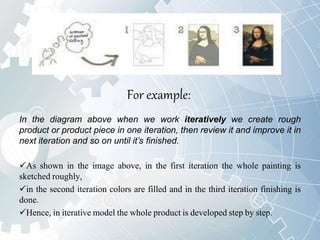
For example:
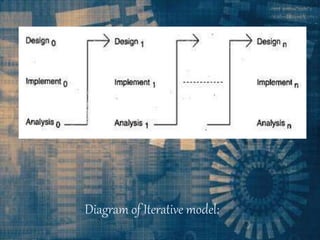
In the diagram above when we work iteratively we create rough
product or product piece in one iteration, then review it and improve it in
next iteration and so on until it’s finished.
As shown in the image above, in the first iteration the whole painting is
sketched roughly,
in the second iteration colors are filled and in the third iteration finishing is
done.
Hence, in iterative model the whole product is developed step by step.
Diagram of Iterative model:
When to use iterative model
• When the requirements of the complete
system are clearly defined and understood.
• When the project is big.
• When the Major requirements must be
defined; however, some details can evolve
with time.
Models
• Different projects may interpret
these phases differently.
• Each particular style is called a
“Software Life-Cycle Model”`
• Create a high-level design of the application
before we actually begin to build the product
and define the design solution for the entire
product
• Building and improving the product step by
step
• We can get the reliable user feedback
• Less time is spent on documenting and more
time is given for designing.
ADVANTAGES
DISADVANTAGES
• Each phase of an iteration is rigid with no
overlaps
• Costly system architecture or design issues
may arise because not all requirements are
gathered up front for the entire lifecycle
If (unclear == true )
then ask us;

Iterative enhancement model

  • 1.
    ITERATIVE ENHANCEMENT MODEL Submitted to : Ma’amPriyanka soghani Efforts by: Harshita Virwani Harsh Kanwar Diksha Murariya Divya Sharma (BCA Sem - 5)
  • 2.
    DEFINATION OF ITERATIVEMODEL: • An iterative life cycle model does not attempt to start with a full specification of requirements. • Instead, development begins by specifying and implementing just part of the software, which can then be reviewed in order to identify further requirements. • This process is then repeated, producing a new version of the software for each cycle of the model.
  • 3.
    For example: In thediagram above when we work iteratively we create rough product or product piece in one iteration, then review it and improve it in next iteration and so on until it’s finished. As shown in the image above, in the first iteration the whole painting is sketched roughly, in the second iteration colors are filled and in the third iteration finishing is done. Hence, in iterative model the whole product is developed step by step.
  • 4.
  • 5.
    When to useiterative model • When the requirements of the complete system are clearly defined and understood. • When the project is big. • When the Major requirements must be defined; however, some details can evolve with time.
  • 6.
    Models • Different projectsmay interpret these phases differently. • Each particular style is called a “Software Life-Cycle Model”`
  • 7.
    • Create ahigh-level design of the application before we actually begin to build the product and define the design solution for the entire product • Building and improving the product step by step • We can get the reliable user feedback • Less time is spent on documenting and more time is given for designing. ADVANTAGES
  • 8.
    DISADVANTAGES • Each phaseof an iteration is rigid with no overlaps • Costly system architecture or design issues may arise because not all requirements are gathered up front for the entire lifecycle
  • 9.
    If (unclear ==true ) then ask us;