McCall Software Quality Model in Software Quality Assurance
The document discusses software quality, particularly through McCall's quality model which aims to bridge the gap between users and developers by outlining quality characteristics. It identifies three major perspectives: product operations, product revision, and product transition, each encompassing specific traits like correctness, maintainability, and portability. Additionally, it explains the hierarchical relationship between quality factors, criteria, and metrics used for assessment.
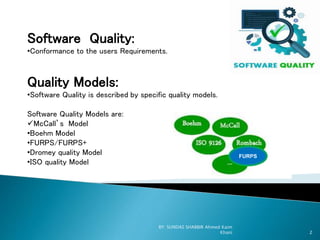
Overview of software quality, highlighting its conformance to user requirements and various quality models like McCall’s, Boehm, and ISO.
Introduction to McCall's Model which aims to connect users and developers, detailing its 11 quality factors categorized into three major perspectives.
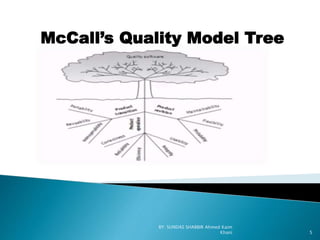
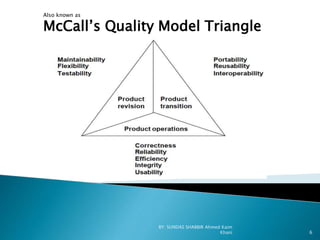
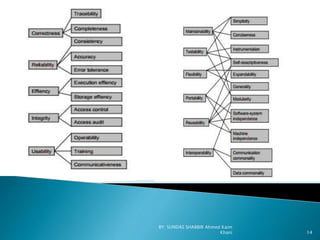
Visual representation of McCall's Model, demonstrating its qualities in a triangular and hierarchical manner with three types of characteristics.
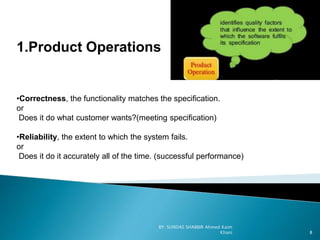
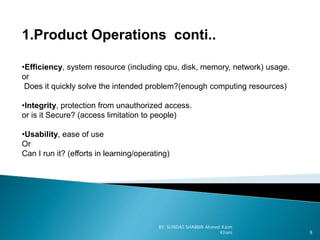
Detailed description of product operation qualities such as correctness, reliability, efficiency, integrity, and usability, focusing on user satisfaction.
Focus on product revision qualities including maintainability, flexibility, and testability, assessing how well software can adapt to changes.
Explanation of product transition qualities like portability, reusability, and interoperability, emphasizing the capabilities of software across different environments.
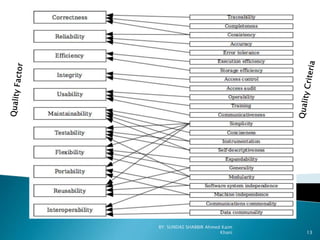
Connection between quality factors and criteria, illustrating how improvements in one area influence others to achieve overall software quality.
Software Quality:
•Conformance tothe users Requirements.
Quality Models:
•Software Quality is described by specific quality models.
Software Quality Models are:
McCall’s Model
•Boehm Model
•FURPS/FURPS+
•Dromey quality Model
•ISO quality Model
FURPS
BY: SUNDAS SHABBIR Ahmed Kaim
Khani 2
3.
Introduction:
Jim McCall producedthis model for the US Air Force
and the intention was to bridge the gap between users and developers.
McCall Model Developed in 1967-7,
•One of the first , Oldest software quality model.
•Started with volume of 55 quality characteristics ,called them “factors”
•Quality Factors was compressed into 11 main factors.
•McCall Tried to map
user view
developer’s priorities.
BY: SUNDAS SHABBIR Ahmed Kaim
Khani 3
4.
McCall Quality Model:
Three3 major perspectives.
1. Product Revision (ability to under go Changes)
Maintainability, Flexibility, Testability.
2.Product Transition (adaptability to new environments).
Portability, Reusability, Interoperability.
3.Product Operations( basic Operational characteristic).
Correctness, Reliability, Efficiency, Integrity, Usability
BY: SUNDAS SHABBIR Ahmed Kaim
Khani 4
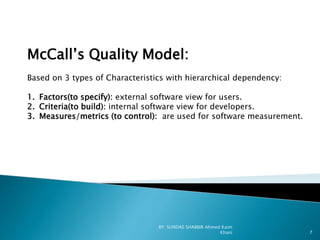
McCall’s Quality Model:
Basedon 3 types of Characteristics with hierarchical dependency:
1. Factors(to specify): external software view for users.
2. Criteria(to build): internal software view for developers.
3. Measures/metrics (to control): are used for software measurement.
BY: SUNDAS SHABBIR Ahmed Kaim
Khani 7
8.
1.Product Operations
•Correctness, thefunctionality matches the specification.
or
Does it do what customer wants?(meeting specification)
•Reliability, the extent to which the system fails.
or
Does it do it accurately all of the time. (successful performance)
BY: SUNDAS SHABBIR Ahmed Kaim
Khani 8
9.
1.Product Operations conti..
•Efficiency,system resource (including cpu, disk, memory, network) usage.
or
Does it quickly solve the intended problem?(enough computing resources)
•Integrity, protection from unauthorized access.
or is it Secure? (access limitation to people)
•Usability, ease of use
Or
Can I run it? (efforts in learning/operating)
BY: SUNDAS SHABBIR Ahmed Kaim
Khani 9
10.
2.Product revision
•Maintainability, theability to find and fix a defect.
Or Can it be fixed?(fixing bugs and errors)
•Flexibility, the ability to make changes required as dictated by the business.
Or Can it be changed?(modifying an operational program)
•Testability, the ability to Validate the software requirements.
Or Can it be tested? (ensuring performance)
BY: SUNDAS SHABBIR Ahmed Kaim
Khani 10
11.
3. Product transition
•Portability,the ability to transfer the software from one environment to another.
Or Can it be used on another machine?(Platform dependence).
•Reusability, the ease of using existing software components in a different context.
Or Can part of it be reused? (generic coding).
•Interoperability, the extent, or ease, to which software components work together.
Or Can it interface with other system (coupling system)
BY: SUNDAS SHABBIR Ahmed Kaim
Khani 11
12.
Relationship between QualityFactors and Quality Criteria
•Each quality factor is positively influenced by the set of quality criteria,
And the same quality criterion impacts a number of quality factors.
Some quality factors positively impact others.
•An effort to improve the correctness of a system will increase its reliability.
BY: SUNDAS SHABBIR Ahmed Kaim
Khani 12