Protecting Today’s Investments For
Tomorrow’s Innovations
ABOUHANA
ABOUHANA
The world grows enough food
to feed its population.
ABOUHANA
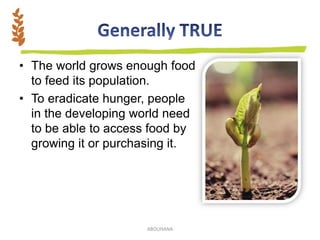
• The world grows enough food
to feed its population.
• To eradicate hunger, people
in the developing world need
to be able to access food by
growing it or purchasing it.
ABOUHANA
The global population will increase
by 42 percent between now and 2050.
ABOUHANA
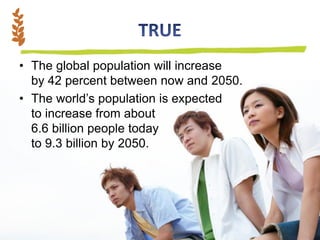
• The global population will increase
by 42 percent between now and 2050.
• The world’s population is expected
to increase from about
6.6 billion people today
to 9.3 billion by 2050.
ABOUHANA
Agriculture must increase food
production by 42 percent to keep pace.
ABOUHANA
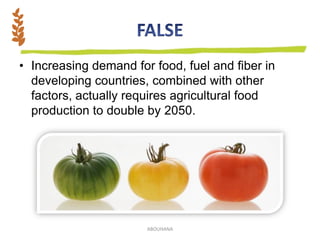
• Increasing demand for food, fuel and fiber in
developing countries, combined with other
factors, actually requires agricultural food
production to double by 2050.
ABOUHANA
Global agriculture uses
50 percent of our fresh water.
ABOUHANA
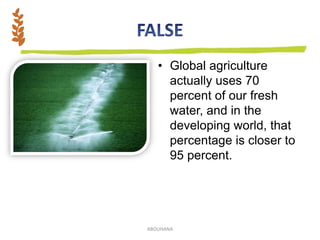
• Global agriculture
actually uses 70
percent of our fresh
water, and in the
developing world, that
percentage is closer to
95 percent.
ABOUHANA
Irrigation increases the yield of
most crops by 50 percent.
ABOUHANA
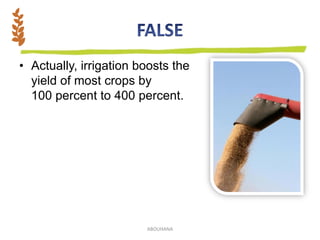
• Actually, irrigation boosts the
yield of most crops by
100 percent to 400 percent.
ABOUHANA
Agriculture uses 55 percent
of habitable land.
ABOUHANA
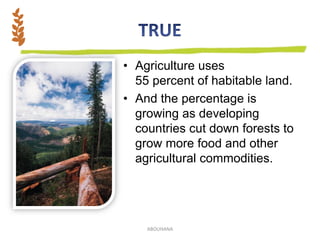
• Agriculture uses
55 percent of habitable land.
• And the percentage is
growing as developing
countries cut down forests to
grow more food and other
agricultural commodities.
ABOUHANA
Agriculture contributes 70 percent
of global greenhouse gas emissions.
ABOUHANA
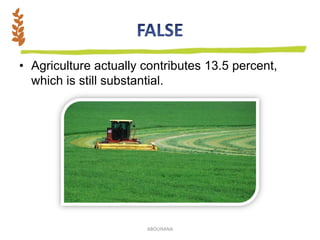
• Agriculture actually contributes 13.5 percent,
which is still substantial.
ABOUHANA
• Identifying agricultural challenges in protecting
the environment
• Tracing how scientific advancements impact the
world
• Understanding how each of us
will contribute to the future
health of our planet
ABOUHANA

Protecting the environment

  • 1.
    Protecting Today’s InvestmentsFor Tomorrow’s Innovations ABOUHANA
  • 2.
  • 3.
    The world growsenough food to feed its population. ABOUHANA
  • 4.
    • The worldgrows enough food to feed its population. • To eradicate hunger, people in the developing world need to be able to access food by growing it or purchasing it. ABOUHANA
  • 5.
    The global populationwill increase by 42 percent between now and 2050. ABOUHANA
  • 6.
    • The globalpopulation will increase by 42 percent between now and 2050. • The world’s population is expected to increase from about 6.6 billion people today to 9.3 billion by 2050. ABOUHANA
  • 7.
    Agriculture must increasefood production by 42 percent to keep pace. ABOUHANA
  • 8.
    • Increasing demandfor food, fuel and fiber in developing countries, combined with other factors, actually requires agricultural food production to double by 2050. ABOUHANA
  • 9.
    Global agriculture uses 50percent of our fresh water. ABOUHANA
  • 10.
    • Global agriculture actuallyuses 70 percent of our fresh water, and in the developing world, that percentage is closer to 95 percent. ABOUHANA
  • 11.
    Irrigation increases theyield of most crops by 50 percent. ABOUHANA
  • 12.
    • Actually, irrigationboosts the yield of most crops by 100 percent to 400 percent. ABOUHANA
  • 13.
    Agriculture uses 55percent of habitable land. ABOUHANA
  • 14.
    • Agriculture uses 55percent of habitable land. • And the percentage is growing as developing countries cut down forests to grow more food and other agricultural commodities. ABOUHANA
  • 15.
    Agriculture contributes 70percent of global greenhouse gas emissions. ABOUHANA
  • 16.
    • Agriculture actuallycontributes 13.5 percent, which is still substantial. ABOUHANA
  • 17.
    • Identifying agriculturalchallenges in protecting the environment • Tracing how scientific advancements impact the world • Understanding how each of us will contribute to the future health of our planet ABOUHANA