OUR ACTIONS ARE OUR FUTURE
A ZERO HUNGER WORLD BY
2030 IS POSSIBLE
By
TARIQ SARWAR AWAN
WORLD FOOD DAY-16th October, 2018
Presentation Delivered at University of Sargodha
2
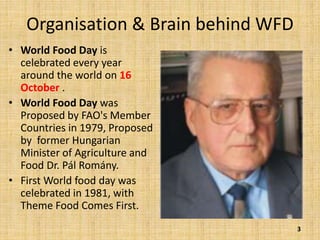
Organisation & Brain behind WFD
• World Food Day is
celebrated every year
around the world on 16
October .
• World Food Day was
Proposed by FAO's Member
Countries in 1979, Proposed
by former Hungarian
Minister of Agriculture and
Food Dr. PƔl RomƔny.
• First World food day was
celebrated in 1981, with
Theme Food Comes First.
3
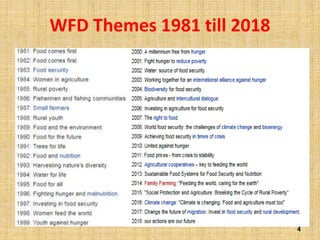
WFD Themes 1981 till 2018
4
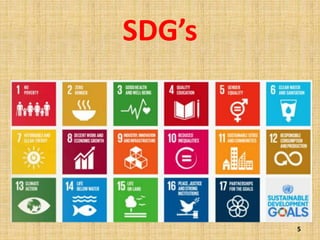
SDG’s
5
6
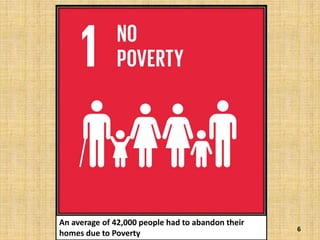
An average of 42,000 people had to abandon their
homes due to Poverty
7
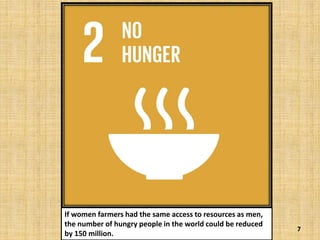
If women farmers had the same access to resources as men,
the number of hungry people in the world could be reduced
by 150 million.
8
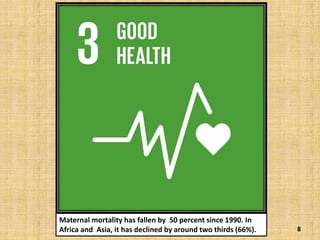
Maternal mortality has fallen by 50 percent since 1990. In
Africa and Asia, it has declined by around two thirds (66%).
9
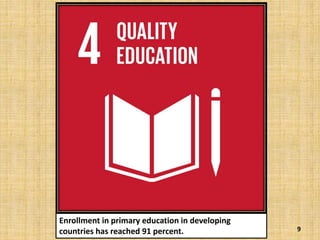
Enrollment in primary education in developing
countries has reached 91 percent.
10
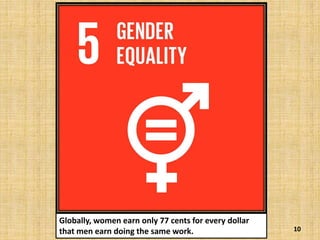
Globally, women earn only 77 cents for every dollar
that men earn doing the same work.
11
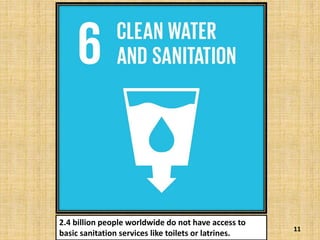
2.4 billion people worldwide do not have access to
basic sanitation services like toilets or latrines.
12
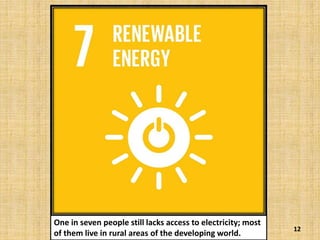
One in seven people still lacks access to electricity; most
of them live in rural areas of the developing world.
13
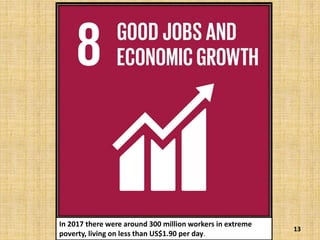
In 2017 there were around 300 million workers in extreme
poverty, living on less than US$1.90 per day.
14
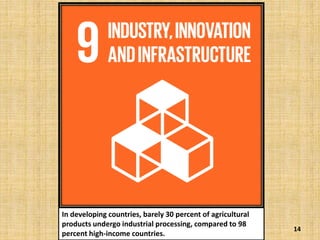
In developing countries, barely 30 percent of agricultural
products undergo industrial processing, compared to 98
percent high-income countries.
15
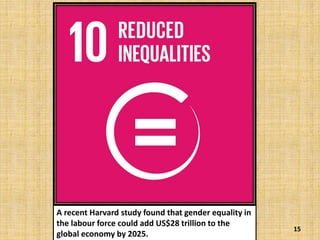
A recent Harvard study found that gender equality in
the labour force could add US$28 trillion to the
global economy by 2025.
16
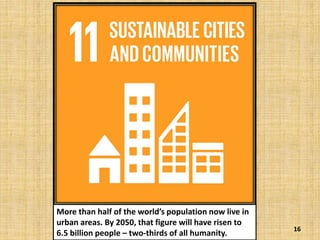
More than half of the world’s population now live in
urban areas. By 2050, that figure will have risen to
6.5 billion people – two-thirds of all humanity.
17
Less than 3 per cent of the world’s water is
drinkable, of which 2.5 % is frozen in the Antarctica,
Arctic and glaciers. Humanity therefore rely on 0.5 %
18
Since 1970, the number of natural disasters worldwide
has increased to around 400 times a year.
19
Globally, the market value of marine and coastal
resources and industries is estimated at US$3 trillion
per year, about 5 percent of global GDP.
20
Around 1.6 billion people depend on forests for their
livelihoods. Worldwide, 2.6 billion people depend
directly on agriculture to earn a living.
21
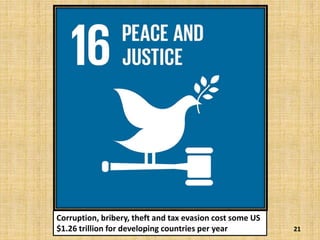
Corruption, bribery, theft and tax evasion cost some US
$1.26 trillion for developing countries per year
22
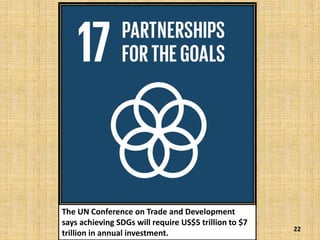
The UN Conference on Trade and Development
says achieving SDGs will require US$5 trillion to $7
trillion in annual investment.
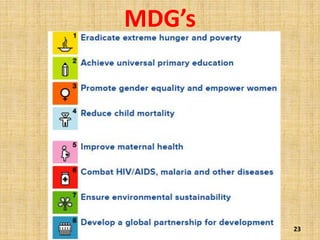
MDG’s
23
Our Actions are our Future.
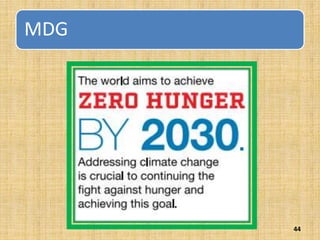
A Zero Hunger world by 2030 is possible
• After a period of decline, world hunger is on the
rise again
• According to the latest FAO 2018 State of Food
Security and Nutrition in the World report.
• Conflicts,
• extreme weather events linked to climate
change,
• economic slowdown and
• rapidly increasing overweight and obesity levels
are reversing progress made in the fight against
hunger and malnutrition.
24
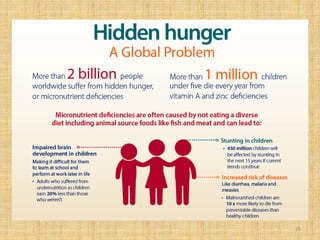
25
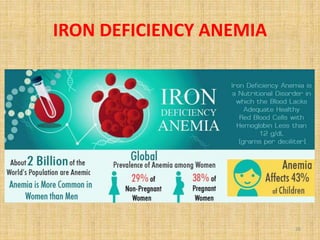
IRON DEFICIENCY ANEMIA
26
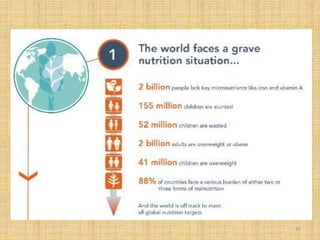
27
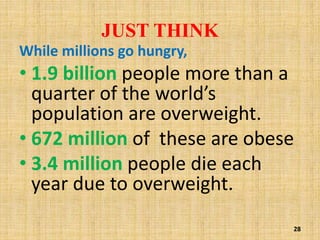
JUST THINK
While millions go hungry,
• 1.9 billion people more than a
quarter of the world’s
population are overweight.
• 672 million of these are obese
• 3.4 million people die each
year due to overweight.
28
HUNGER
• Some 795 million people in the
world do not have enough food
to lead a healthy active life. and
Around 780 million of those
people live in developing
regions.
29
ENOUGH FOOD WE HAVE
• The world produces enough food
to feed all 7 billion people, but
due to uneven distribution
around 1 billion remain
undernourished and 2 billion
suffer from hidden hunger.
30
FOOD WASTED GLOBALLY
• 1.3 billion tons of food are wasted every year,
This amounts to US$1 trillion of wasted or
lost food as the World food production for
human consumption is 3.9 billion tons.
• Just one quarter of all wasted food could
feed the 795 million undernourished people
around the world who suffer from hunger
31
Uncooked Food % Losses
• Global quantitative food losses and
waste per year are roughly
• 30% for cereals,
• 40-50% for root crops and fruits and
vegetables,
• 20% for oil seeds, meat and dairy
• 35% for fish.
32
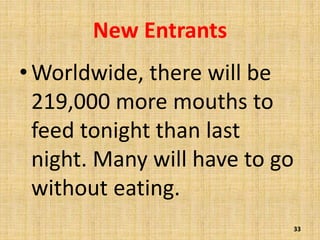
New Entrants
•Worldwide, there will be
219,000 more mouths to
feed tonight than last
night. Many will have to go
without eating.
33
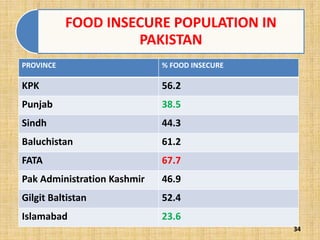
FOOD INSECURE POPULATION IN
PAKISTAN
PROVINCE % FOOD INSECURE
KPK 56.2
Punjab 38.5
Sindh 44.3
Baluchistan 61.2
FATA 67.7
Pak Administration Kashmir 46.9
Gilgit Baltistan 52.4
Islamabad 23.6
34
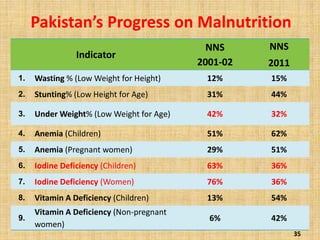
Pakistan’s Progress on Malnutrition
Indicator
NNS
2001-02
NNS
2011
1. Wasting % (Low Weight for Height) 12% 15%
2. Stunting% (Low Height for Age) 31% 44%
3. Under Weight% (Low Weight for Age) 42% 32%
4. Anemia (Children) 51% 62%
5. Anemia (Pregnant women) 29% 51%
6. Iodine Deficiency (Children) 63% 36%
7. Iodine Deficiency (Women) 76% 36%
8. Vitamin A Deficiency (Children) 13% 54%
9.
Vitamin A Deficiency (Non-pregnant
women)
6% 42%
35
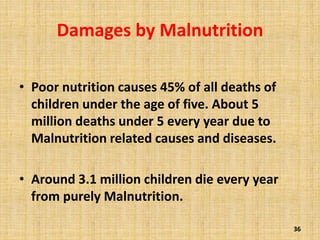
Damages by Malnutrition
• Poor nutrition causes 45% of all deaths of
children under the age of five. About 5
million deaths under 5 every year due to
Malnutrition related causes and diseases.
• Around 3.1 million children die every year
from purely Malnutrition.
36
Children damage
• Vitamin A deficiency affects 140 million
children and is the leading cause of child
blindness across developing countries.
• Some 20 million children are born mentally
impaired because their mothers had an
iodine deficiency during pregnancy.
37
Hungry Schooling
• Sixty-six million primary
school-age children attend
classes hungry across the
developing world, with 23
million in Africa alone.
38
Where the Hunger is Worst ?
• Asia have 525.6 million Hungry People.
• Sub-Saharan Africa 214 Million Hungry
People.
• Latin America and Caribbean 37 million
Hungry People.
39
Woman
• 60 % of the World’s Hungry are woman.
• 50 % of the World pregnant woman in
developing countries lack proper maternal
care resulting in 3,15,000 deaths every year.
40
Children
• Every 10 seconds a child dies from hunger
related diseases.
• 22,000 children die every day due to
conditions of poverty and improper care and
facilities.
• Each day nearly 1,000 children die due to
Preventable water and sanitation related
diarrheal diseases.
41
What Poor gets ?
• About 896 million people in developing
countries live on US $ 1.90 a day or less.
• 50 % of the Hungry people globally are from
farming families.
• 663 million people lack access to clean water.
• 2.4 billion people don’t have adequate
sanitation.
42
Poor deserves Food…..
• A European or North American consumer
wastes almost 100 kilograms of food
annually, which is more than his or her
weight (70 kilograms) or A European or North
American consumer wastes 15 times more
food than a typical African consumer
• Food waste in Europe alone could feed 200
million hungry people
43
MDG
44
ESTIMATES
• according to an estimate,
• over 60% of the world’s people are Iron
deficient,
• over 30% are deficient in Zinc,
• 30% are deficient in Iodine, and
• about 15% lack sufficient selenium in their
systems.
45
ZINC DEFICIENCY results in:
Due to Zinc deficiency
• Impairments to physical growth,
• The immune system
• Learning ability,
• An increased risk of infections,
• Damage to a person’s DNA
• Development of cancer.
• Pakistan is among countries whose populations
are at a 75% risk of zinc deficiency.
46
IODINE DEFICIENCY gives rise to
• Goiter (Abnormal Enlargement of Thyroid
Glands) and Cretinism(Iodine Deficiency
Syndrome) , which results in retardation in
physiological development and other health
problems.
• Iodine deficiency in many parts of the world has
been compensated to some extent by the
introduction of salt fortified with iodine
including PAKISTAN.
47
IRON DEFICIENCY
• Iron is needed to
• form hemoglobin,
• 20% more productivity.
• as anemia is a common disease in
underdeveloped or developing countries of
South East Asia – including Pakistan – where
humans do not consume enough of it.
• The absorption of iron is very low in the body –
normally 5-10% of ingested iron is actually
absorbed – so it requires substantial intake.
48
Improvement in last 20 years
• In past twenty Years children dying under age
of 5 are cut to half, it means more than ten
thousand children saved every day.
• Extreme poverty rates are cut to half.
• In MDG, 40 countries have already achieved
First target, to have the population of people
less affected by hunger.
49
Great Success
• 10 countries have achieved greatest success in
reducing the Total no. of Hungry people.
• Armenia
• Azerbaijan
• Brazil
• Cuba
• Georgia
• Ghana
• Kuwait
• Saint Vincent
• Thailand
• Venezuella
50
Cost of Global Economy
• The cost of Global Economy because of
Malnutrition is Equivalent to 3.5 trillion $, and
1 Trillion $ equals to 133,250,000,000,000
Pakistani Rupee or 3.5 equals to (46,637 Arabb Pak
Rupees) .
• Poor Nutrition causes half of World’s Deaths.
• Hunger Kills more people every year than AIDS,
Malaria, and TB combined
51
8 Reasons Why Zero Hunger Changes the World-1
• 1) Zero hunger could save the lives of 3.1
million children a year
• 2) Well-nourished mothers have healthier
babies with stronger immune systems
• 3) Ending child under nutrition could increase
a developing country's GDP by 16.5 percent2
• 4) A dollar invested in hunger prevention
could return between $15 and $139 in
benefits.
52
8 Reasons Why Zero Hunger Changes the World-2
• 5) Proper nutrition early in life could mean 46
percent more in lifetime earnings
• 6) Eliminating iron deficiency in a population
could boost workplace productivity by 20
percent
• 7) Ending nutrition-related child mortality
could increase a workforce by 9.4 percent
• 8) Zero hunger can help build a safer, more
prosperous world for everyone
53
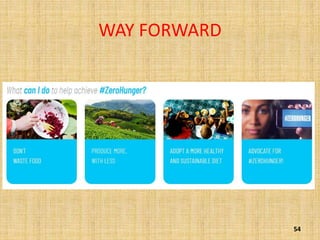
WAY FORWARD
54
NATION NEEDS US
LETS JOIN HANDS, WE ALL DO SOMETHING FOR
PAKISTAN,
WE ALL DO SOME THING FOR THIS WORLD WITH
1/3RD WASTED AND UNEVEN DISTRIBUTED FOOD
55

A ZERO HUNGER WORLD BY 2030

  • 1.
    OUR ACTIONS AREOUR FUTURE A ZERO HUNGER WORLD BY 2030 IS POSSIBLE By TARIQ SARWAR AWAN WORLD FOOD DAY-16th October, 2018 Presentation Delivered at University of Sargodha
  • 2.
  • 3.
    Organisation & Brainbehind WFD • World Food Day is celebrated every year around the world on 16 October . • World Food Day was Proposed by FAO's Member Countries in 1979, Proposed by former Hungarian Minister of Agriculture and Food Dr. PĆ”l RomĆ”ny. • First World food day was celebrated in 1981, with Theme Food Comes First. 3
  • 4.
    WFD Themes 1981till 2018 4
  • 5.
  • 6.
    6 An average of42,000 people had to abandon their homes due to Poverty
  • 7.
    7 If women farmershad the same access to resources as men, the number of hungry people in the world could be reduced by 150 million.
  • 8.
    8 Maternal mortality hasfallen by 50 percent since 1990. In Africa and Asia, it has declined by around two thirds (66%).
  • 9.
    9 Enrollment in primaryeducation in developing countries has reached 91 percent.
  • 10.
    10 Globally, women earnonly 77 cents for every dollar that men earn doing the same work.
  • 11.
    11 2.4 billion peopleworldwide do not have access to basic sanitation services like toilets or latrines.
  • 12.
    12 One in sevenpeople still lacks access to electricity; most of them live in rural areas of the developing world.
  • 13.
    13 In 2017 therewere around 300 million workers in extreme poverty, living on less than US$1.90 per day.
  • 14.
    14 In developing countries,barely 30 percent of agricultural products undergo industrial processing, compared to 98 percent high-income countries.
  • 15.
    15 A recent Harvardstudy found that gender equality in the labour force could add US$28 trillion to the global economy by 2025.
  • 16.
    16 More than halfof the world’s population now live in urban areas. By 2050, that figure will have risen to 6.5 billion people – two-thirds of all humanity.
  • 17.
    17 Less than 3per cent of the world’s water is drinkable, of which 2.5 % is frozen in the Antarctica, Arctic and glaciers. Humanity therefore rely on 0.5 %
  • 18.
    18 Since 1970, thenumber of natural disasters worldwide has increased to around 400 times a year.
  • 19.
    19 Globally, the marketvalue of marine and coastal resources and industries is estimated at US$3 trillion per year, about 5 percent of global GDP.
  • 20.
    20 Around 1.6 billionpeople depend on forests for their livelihoods. Worldwide, 2.6 billion people depend directly on agriculture to earn a living.
  • 21.
    21 Corruption, bribery, theftand tax evasion cost some US $1.26 trillion for developing countries per year
  • 22.
    22 The UN Conferenceon Trade and Development says achieving SDGs will require US$5 trillion to $7 trillion in annual investment.
  • 23.
  • 24.
    Our Actions areour Future. A Zero Hunger world by 2030 is possible • After a period of decline, world hunger is on the rise again • According to the latest FAO 2018 State of Food Security and Nutrition in the World report. • Conflicts, • extreme weather events linked to climate change, • economic slowdown and • rapidly increasing overweight and obesity levels are reversing progress made in the fight against hunger and malnutrition. 24
  • 25.
  • 26.
  • 27.
  • 28.
    JUST THINK While millionsgo hungry, • 1.9 billion people more than a quarter of the world’s population are overweight. • 672 million of these are obese • 3.4 million people die each year due to overweight. 28
  • 29.
    HUNGER • Some 795million people in the world do not have enough food to lead a healthy active life. and Around 780 million of those people live in developing regions. 29
  • 30.
    ENOUGH FOOD WEHAVE • The world produces enough food to feed all 7 billion people, but due to uneven distribution around 1 billion remain undernourished and 2 billion suffer from hidden hunger. 30
  • 31.
    FOOD WASTED GLOBALLY •1.3 billion tons of food are wasted every year, This amounts to US$1 trillion of wasted or lost food as the World food production for human consumption is 3.9 billion tons. • Just one quarter of all wasted food could feed the 795 million undernourished people around the world who suffer from hunger 31
  • 32.
    Uncooked Food %Losses • Global quantitative food losses and waste per year are roughly • 30% for cereals, • 40-50% for root crops and fruits and vegetables, • 20% for oil seeds, meat and dairy • 35% for fish. 32
  • 33.
    New Entrants •Worldwide, therewill be 219,000 more mouths to feed tonight than last night. Many will have to go without eating. 33
  • 34.
    FOOD INSECURE POPULATIONIN PAKISTAN PROVINCE % FOOD INSECURE KPK 56.2 Punjab 38.5 Sindh 44.3 Baluchistan 61.2 FATA 67.7 Pak Administration Kashmir 46.9 Gilgit Baltistan 52.4 Islamabad 23.6 34
  • 35.
    Pakistan’s Progress onMalnutrition Indicator NNS 2001-02 NNS 2011 1. Wasting % (Low Weight for Height) 12% 15% 2. Stunting% (Low Height for Age) 31% 44% 3. Under Weight% (Low Weight for Age) 42% 32% 4. Anemia (Children) 51% 62% 5. Anemia (Pregnant women) 29% 51% 6. Iodine Deficiency (Children) 63% 36% 7. Iodine Deficiency (Women) 76% 36% 8. Vitamin A Deficiency (Children) 13% 54% 9. Vitamin A Deficiency (Non-pregnant women) 6% 42% 35
  • 36.
    Damages by Malnutrition •Poor nutrition causes 45% of all deaths of children under the age of five. About 5 million deaths under 5 every year due to Malnutrition related causes and diseases. • Around 3.1 million children die every year from purely Malnutrition. 36
  • 37.
    Children damage • VitaminA deficiency affects 140 million children and is the leading cause of child blindness across developing countries. • Some 20 million children are born mentally impaired because their mothers had an iodine deficiency during pregnancy. 37
  • 38.
    Hungry Schooling • Sixty-sixmillion primary school-age children attend classes hungry across the developing world, with 23 million in Africa alone. 38
  • 39.
    Where the Hungeris Worst ? • Asia have 525.6 million Hungry People. • Sub-Saharan Africa 214 Million Hungry People. • Latin America and Caribbean 37 million Hungry People. 39
  • 40.
    Woman • 60 %of the World’s Hungry are woman. • 50 % of the World pregnant woman in developing countries lack proper maternal care resulting in 3,15,000 deaths every year. 40
  • 41.
    Children • Every 10seconds a child dies from hunger related diseases. • 22,000 children die every day due to conditions of poverty and improper care and facilities. • Each day nearly 1,000 children die due to Preventable water and sanitation related diarrheal diseases. 41
  • 42.
    What Poor gets? • About 896 million people in developing countries live on US $ 1.90 a day or less. • 50 % of the Hungry people globally are from farming families. • 663 million people lack access to clean water. • 2.4 billion people don’t have adequate sanitation. 42
  • 43.
    Poor deserves Food….. •A European or North American consumer wastes almost 100 kilograms of food annually, which is more than his or her weight (70 kilograms) or A European or North American consumer wastes 15 times more food than a typical African consumer • Food waste in Europe alone could feed 200 million hungry people 43
  • 44.
  • 45.
    ESTIMATES • according toan estimate, • over 60% of the world’s people are Iron deficient, • over 30% are deficient in Zinc, • 30% are deficient in Iodine, and • about 15% lack sufficient selenium in their systems. 45
  • 46.
    ZINC DEFICIENCY resultsin: Due to Zinc deficiency • Impairments to physical growth, • The immune system • Learning ability, • An increased risk of infections, • Damage to a person’s DNA • Development of cancer. • Pakistan is among countries whose populations are at a 75% risk of zinc deficiency. 46
  • 47.
    IODINE DEFICIENCY givesrise to • Goiter (Abnormal Enlargement of Thyroid Glands) and Cretinism(Iodine Deficiency Syndrome) , which results in retardation in physiological development and other health problems. • Iodine deficiency in many parts of the world has been compensated to some extent by the introduction of salt fortified with iodine including PAKISTAN. 47
  • 48.
    IRON DEFICIENCY • Ironis needed to • form hemoglobin, • 20% more productivity. • as anemia is a common disease in underdeveloped or developing countries of South East Asia – including Pakistan – where humans do not consume enough of it. • The absorption of iron is very low in the body – normally 5-10% of ingested iron is actually absorbed – so it requires substantial intake. 48
  • 49.
    Improvement in last20 years • In past twenty Years children dying under age of 5 are cut to half, it means more than ten thousand children saved every day. • Extreme poverty rates are cut to half. • In MDG, 40 countries have already achieved First target, to have the population of people less affected by hunger. 49
  • 50.
    Great Success • 10countries have achieved greatest success in reducing the Total no. of Hungry people. • Armenia • Azerbaijan • Brazil • Cuba • Georgia • Ghana • Kuwait • Saint Vincent • Thailand • Venezuella 50
  • 51.
    Cost of GlobalEconomy • The cost of Global Economy because of Malnutrition is Equivalent to 3.5 trillion $, and 1 Trillion $ equals to 133,250,000,000,000 Pakistani Rupee or 3.5 equals to (46,637 Arabb Pak Rupees) . • Poor Nutrition causes half of World’s Deaths. • Hunger Kills more people every year than AIDS, Malaria, and TB combined 51
  • 52.
    8 Reasons WhyZero Hunger Changes the World-1 • 1) Zero hunger could save the lives of 3.1 million children a year • 2) Well-nourished mothers have healthier babies with stronger immune systems • 3) Ending child under nutrition could increase a developing country's GDP by 16.5 percent2 • 4) A dollar invested in hunger prevention could return between $15 and $139 in benefits. 52
  • 53.
    8 Reasons WhyZero Hunger Changes the World-2 • 5) Proper nutrition early in life could mean 46 percent more in lifetime earnings • 6) Eliminating iron deficiency in a population could boost workplace productivity by 20 percent • 7) Ending nutrition-related child mortality could increase a workforce by 9.4 percent • 8) Zero hunger can help build a safer, more prosperous world for everyone 53
  • 54.
  • 55.
    NATION NEEDS US LETSJOIN HANDS, WE ALL DO SOMETHING FOR PAKISTAN, WE ALL DO SOME THING FOR THIS WORLD WITH 1/3RD WASTED AND UNEVEN DISTRIBUTED FOOD 55