Improving Human Resource Management Capability in an
Institution through Implementation of a Computerized
HRMS.- Lessons from the Conference
Adel Abouhana
CASE - X
Background
 Efficient and effective Human Resource Management in Higher
institution is critical to ensuring sustained Quality and
Competitiveness of any institution.
 Effective Implementation of an appropriate Computerized Human
Resource Management System is critical to enhancing the
organization's Human Resource management capability and
service delivery
Background
 Effective implementation of such a major “Enterprise Administrative
System” is a very complex undertaking environment has some added
complexities.
 The tradition has been for the focus to be on technical
implementation issues.
Background
 The functional user, usually administrative or Management personnel,
now plays a key role in implementing contemporary systems.
 There are many lessons to be learnt from the perspective of
functional Human Resources Personnel in the implementation process
The Human Resource Management System
 The Acquisition and Implementation of a Computerized HRMS
was not like buying Microsoft Office at the Computer Store
and installing it.-
 It started with a vision.
Vision of Human Resource Function -1
 HR focus shift from Administrative to Strategic, Facilitative,
Consultative and Developmental
 Improved HR Operational efficiency and effectiveness in HR, in
support of Al Waseeta Mission and Objectives.
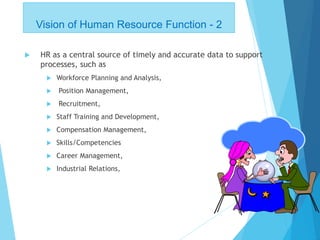
Vision of Human Resource Function - 2
 HR as a central source of timely and accurate data to support
processes, such as
 Workforce Planning and Analysis,
 Position Management,
 Recruitment,
 Staff Training and Development,
 Compensation Management,
 Skills/Competencies
 Career Management,
 Industrial Relations,
Vision of Human Resource Function - 3
 HR Processes which
put information at the line
management level
make data accessible to individual
customers for the specified purpose of
inquiry or change
are automated
allow for re-engineering areas of
functionality
Our HR Direction. -1
 A highly efficient HR Service Al waseeta and subsidiaries by
 developing a and implementing improved and efficient processes
and procedures based on functions and customer needs and not on
hierarchy
 facilitating informed and timely decision-making
Our HR Direction. -2
 Auditing processes and practices for continuous
improvement
 Developing plans and programs HR development
using sound data analysis techniques
Our HR Direction. -3
 Regarding process improvement as ongoing, taking account of
changing needs and new technology, as it emerges
 Using appropriate technology - electronic mail, intranet, internet,
document management - in order to improve communication and data
access across the orgnization.
Our Focus - Process Improvement
 Structured approach
 Positive impact on quality of services
 Meet or exceed customer’s expectations
 Add value -- Staff, Al Waseeta , Subsidiaries, Public
Our Challenges - External
 Financial constraints
 Rapidly changing technology
 Increasing competition
 Customers (subsidiaries and QP) being more demanding and requiring higher
levels of accountability and performance.
Challenges- Internal
 Customer dissatisfaction with unavailable, incorrect and inconsistent
information
 Redundancy of activities-lengthy processes
 Structure and decision-making on organizational hierarchy rather than
on process and function
 Decision-making authority either too centralized or
 too bureaucratic
Challenges- Internal
 “Common & consistent practices” are not part
of the culture
 Highly autonomous organizational units
 Old systems should accommodate all differences
 No incentives for consolidation of systems &
practices
STANDARDS
Challenges- Internal
 Strong Culture of Tradition and Custom and
practice.
 Hierarchy of Approvals
 Redundancy of information
 Organizational units reluctant to change
Challenges Identified -1
 No Executive Commitment to Radical Change
 Inadequacy of Resources
 The process to change Ordinances, Regulations and Collective
Agreements
 Laws, Custom and Practice.
Challenges -2
 Multiple locations and cultures
 Multiple health plans
 Multiple vacation plans
 Wide variety of job groups & pay practices
 To be checked
Challenges -3
 High comfort level
 Success
 History
 Value
 Concern
 Scorn
 Inertia Laziness
 Lack of
objectivity
 Genuine concern
 Political reasons
Resistance to Change
How Did We Get There?
 Piece-meal and Hierarchical /Departmental approach to
development of processes and procedures. This resulted in:
 Separate Personnel Administration Systems evolving
based on QP policy and internal situations
 Utilizing individual talent to administer current
situation
 Various sub-systems were developed to support
specific functions, based on group/ organizational
differentiation within the Organization
How Did We Get There
 Original assumptions that are no longer valid
Options Considered
 Radical Re-engineering of work processes based on
functionality and current available technology
 phased process change
Opportunities for Change
 Company Governance and Strategic Plans and Operating plans have
all identified current process weaknesses and the need for change.
 Availability of successful HRMS technology which is process-
oriented
Re-Engineering - Definition
“...the fundamental rethinking and radical redesign of business
processes to achieve dramatic improvements in critical,
contemporary measures of performance, such as cost,
quality, service, and speed.”
Hammer & Champy
PeopleSoft at X INC
HRMS at X
 Not Sure if:
 Before system was purchased a review and analysis was done
to determine the Human Resource information and process
requirements.
 HRMS was acquired by Al waseeta at inseption ? and
implementation has been on-going in phases since.
PeopleSoft HRMS at X
 A RFP was prepared and responses from vendors were judged by a
multi-disciplinary team on the following
 The general fit of the system -un-customised to fill the defined needs
 Security of Data
 User-friendliness-query and report writing
 Cost and Maintenance
 Customer Support and Training
HRMS at X
 Highlights of the System
 Not Comprehensive functionality
 Not Process-oriented
 Not User driven
 Client-Server moving towards n-tier architecture
 Security at several levels
 Windows at client end
 Easy interface with Microsoft Office
 User-friendly Query and Reporting Capability - ?”?
HRMS at X
 Implementation Team both Technical and Functional.
 Users play a major role in implementation process
 Increasing capabilities of new Versions - Resource issues
Functionality
Position
Management
Succession
Planning
Base Benefits
Administration
Salary
Administration
Health and
Safety
Training
Administration
Career Planning
Reporting
Query
Payroll
Position/
Fund Acctg
Industrial
Relations
HR Audit
Administer
Personnel
Competency
Management
Recruitment
Process Objectives
 Release of personnel from routine-non value added tasks to
Developmental areas such as planning, training and staff
development, on-going process review
 Better monitoring of performance through review of reports
 Framework in place for the future
Process Objectives
 Decision-making-:
 De-centralised : At the Department level
 Limit required approvals
 Electronic signatures and Authority
 Quicker decision-making
 Timely, consistent, accurate and “just-enough”
information.
 Improved efficiency:-
 Elimination of manual processes
 Removal of redundant processes and process steps,
Process Difficulties
 Multiple forms with redundant data
 Dual data entry, inconsistent information
 Poor communications
 Much activity and no value-added
 Expensive
 Error Prone
HRMS at X
 Before system was purchased … ? a comprehensive review
and analysis was done to determine the Human Resource
information and process needs.
HRMS at X
 A RFP was prepared and responses from vendors were judged by a
multi-disciplinary team on the following
 The general fit of the system uncustomised to fill the defined needs
 User-friendliness-query and report writing
 Security of Data
 Cost and Maintenance
 Customer Support and Training
Needed HRMS at X
 Main Highlights of the System
Comprehensive covering most strategic and
operational requirements current and future
User Friendly
Windows at client end
Easy interface with Microsoft office
Simple Query and Reporting Capability
Security
Needed HRMS at X
 Implementation Team both Technical and Functional.
 Users play a major role in implementation process
 Increasing capabilities of new Versions - Resource issues
Process Review and
Implementation Strategies -1
 Increase emphasis on process -- clearly identify X - reengineer, standardize
where possible.
 Design processes that can perform well across organizational boundaries.
 Replace obsolete systems .
 Re-engineer systems that will not be replaced.
Process Review and Implementation
Strategies -2
 Single point of entry for employee data.
 Ad hoc query, report and analysis capabilities.
 Employee data immediately available to supervisors.
 Promote uniformity.
 Reduce paperwork.
 Process improvement as ongoing, taking account of
changing needs and advantages of new technology, as it
emerges.
Process Review and
Implementation Strategies -3
 Minimum Customization
 Common standards within each campus and across campuses for data,
reports, policies and processes.
 User focus
 Team approach (Functional/Technical)
 Provide information for Data based decision making at all levels.
Process Review and
Implementation Strategies -4
 Responsibility for an action should reside closest to the place
most affected.
 emphasis on effective post-action audits
 build controls into the System where possible.
 Integrate the use of E-mail into processes, both for messages
and to convey documents.
Process Review and
Implementation Strategies -6
 Focus on common standards within each campus and across
campuses for data, reports, policies and processes.
 Shorten the cycle time for processing transactions by at least 60%.
Achieve this by reducing: the number of steps, manual effort, the
number of handoffs, the number of authorizations and by
eliminating wasteful and non-value-adding activities.
 Issues - reasons for implementation delays
 Lack of senior management commitment
 Lack of adequate implementation budget
 Lack of dedicated full-time project team
 project management
 technical team
 functional user involvement
 Lack of adequate technical infrastructure
 Executive Sponsor
 University Registrar’s relentless efforts, direct involvement
 Implementation Budget
 Dedicated project management
 Presented realistic implementation budget
 Establishment of University team (across the campuses)
 Functional Analysts
 Systems Analysts
 Project Coordinators
 Database Administrators
 Adequate technical environment
 Proper database servers on each campus
 Replace/acquire client machines
 Address network infrastructure issues
 Mona implementation
 focus for initial implementation
 addressed technical, human resources issues
 standardize processes across HR departments - business
process review
 public relations drive
 newsletters
 presentations (deans, department heads, unions)
 Cave Hill
 lack of HR functional user involvement/ ownership
 leveraged from lessons learnt at Mona
 results of BPR exercise
 user procedures
 St Augustine
 total lack of interest until payroll and Y2K became an issue
Lessons - Opportunities
 Project management and Planning
 Training and Development
 Business Process Review and Re-engineering
 Involved functional users at ALL stages - one reason for
success
 Obtained functional user buy-in early
 Ensured that dedicated functional users were part of
core team
 identify and obtain best talent
 full-time dedicated users to the project is very important
but almost never attainable.
 Payroll
 Decision to use HRS- workshop at Alwaseeta involving
Payroll & Benefits representatives from all departments .
 prior to PS, each campus operated independently
 Pro - Integrated HR/Payroll system
 Con - Required customization - Taxes, payment
methods
 On-site Functional Training
 Introduction to HR
 Introduction to Benefits
 Payroll I and II
 Urgent customizations
 National Id Number
 Net pay distribution methods
 Calculation of taxes
 Tax reporting
 General Ledger Interface
 Annual Step Increase
 Implementation
 Vanilla testing
 Standardize across campuses
 Salary plan, earning codes – Initial “M” for Mona , “C” for
Cave Hill and “S” for St. Augustine
 Attempt to standardize pay cheques & payslips
 What to standardize and what not to?
 Decision not to standardize Paygroups, Earnings Programs &
Benefit Programs.
 Testing of customizations
 End user training
 Parallel run
Lessons Learnt
 Underestimated and Undercommited Resources
 Human
 Physical
 Financial
 Unrealistic Expectations
 Unclear decision making framework
 Suspicion and skepticism
 University approach
 Communication
 Don’t Compromise
 If we had to do it over again?
 First phase should include core HR and Payroll
What is Required?
 Pro-active and process driven approach to
Implementation
 Well defined strategy and plan for change
and change management
 Synergistic team with accountability
ownership, and LEADERSHIP!
What else is Required
 Networking, benchmarking and external advice
 Careful attention to security control
 Early focus on Data conversion
 Phased approach
 Address integration issues early e.g with Finance and Student
Administration Systems
 Plan for retaining highly trained project staff
What else is Required?
 Ongoing Communication to all players
 Management and User Commitment and support
at all levels
 Dedicated resources to the Process -Human,
Financial, Physical and Organizational
 Follow Through
The Reality
 It is an uphill effort
 It is an art form to balance:
 National and organization cultures
 Logistics due organization size and geographic
spread
 Customer Expectation
The Reality
 It requires a thorough business process review, and Fit/Gap Analysis.
 The project never gets finished
 YOU NEVER HAVE ALL THAT’S REQUIRED,BUT NEED TO GET THE JOB
DONE!
 WELCOME TO THE REAL WORLD!!!

Adel abouhana HRMS implementation

  • 1.
    Improving Human ResourceManagement Capability in an Institution through Implementation of a Computerized HRMS.- Lessons from the Conference Adel Abouhana CASE - X
  • 2.
    Background  Efficient andeffective Human Resource Management in Higher institution is critical to ensuring sustained Quality and Competitiveness of any institution.  Effective Implementation of an appropriate Computerized Human Resource Management System is critical to enhancing the organization's Human Resource management capability and service delivery
  • 3.
    Background  Effective implementationof such a major “Enterprise Administrative System” is a very complex undertaking environment has some added complexities.  The tradition has been for the focus to be on technical implementation issues.
  • 4.
    Background  The functionaluser, usually administrative or Management personnel, now plays a key role in implementing contemporary systems.  There are many lessons to be learnt from the perspective of functional Human Resources Personnel in the implementation process
  • 5.
    The Human ResourceManagement System  The Acquisition and Implementation of a Computerized HRMS was not like buying Microsoft Office at the Computer Store and installing it.-  It started with a vision.
  • 6.
    Vision of HumanResource Function -1  HR focus shift from Administrative to Strategic, Facilitative, Consultative and Developmental  Improved HR Operational efficiency and effectiveness in HR, in support of Al Waseeta Mission and Objectives.
  • 7.
    Vision of HumanResource Function - 2  HR as a central source of timely and accurate data to support processes, such as  Workforce Planning and Analysis,  Position Management,  Recruitment,  Staff Training and Development,  Compensation Management,  Skills/Competencies  Career Management,  Industrial Relations,
  • 8.
    Vision of HumanResource Function - 3  HR Processes which put information at the line management level make data accessible to individual customers for the specified purpose of inquiry or change are automated allow for re-engineering areas of functionality
  • 9.
    Our HR Direction.-1  A highly efficient HR Service Al waseeta and subsidiaries by  developing a and implementing improved and efficient processes and procedures based on functions and customer needs and not on hierarchy  facilitating informed and timely decision-making
  • 10.
    Our HR Direction.-2  Auditing processes and practices for continuous improvement  Developing plans and programs HR development using sound data analysis techniques
  • 11.
    Our HR Direction.-3  Regarding process improvement as ongoing, taking account of changing needs and new technology, as it emerges  Using appropriate technology - electronic mail, intranet, internet, document management - in order to improve communication and data access across the orgnization.
  • 12.
    Our Focus -Process Improvement  Structured approach  Positive impact on quality of services  Meet or exceed customer’s expectations  Add value -- Staff, Al Waseeta , Subsidiaries, Public
  • 13.
    Our Challenges -External  Financial constraints  Rapidly changing technology  Increasing competition  Customers (subsidiaries and QP) being more demanding and requiring higher levels of accountability and performance.
  • 14.
    Challenges- Internal  Customerdissatisfaction with unavailable, incorrect and inconsistent information  Redundancy of activities-lengthy processes  Structure and decision-making on organizational hierarchy rather than on process and function  Decision-making authority either too centralized or  too bureaucratic
  • 15.
    Challenges- Internal  “Common& consistent practices” are not part of the culture  Highly autonomous organizational units  Old systems should accommodate all differences  No incentives for consolidation of systems & practices STANDARDS
  • 16.
    Challenges- Internal  StrongCulture of Tradition and Custom and practice.  Hierarchy of Approvals  Redundancy of information  Organizational units reluctant to change
  • 17.
    Challenges Identified -1 No Executive Commitment to Radical Change  Inadequacy of Resources  The process to change Ordinances, Regulations and Collective Agreements  Laws, Custom and Practice.
  • 18.
    Challenges -2  Multiplelocations and cultures  Multiple health plans  Multiple vacation plans  Wide variety of job groups & pay practices  To be checked
  • 19.
    Challenges -3  Highcomfort level  Success  History  Value  Concern  Scorn  Inertia Laziness  Lack of objectivity  Genuine concern  Political reasons Resistance to Change
  • 20.
    How Did WeGet There?  Piece-meal and Hierarchical /Departmental approach to development of processes and procedures. This resulted in:  Separate Personnel Administration Systems evolving based on QP policy and internal situations  Utilizing individual talent to administer current situation  Various sub-systems were developed to support specific functions, based on group/ organizational differentiation within the Organization
  • 21.
    How Did WeGet There  Original assumptions that are no longer valid
  • 22.
    Options Considered  RadicalRe-engineering of work processes based on functionality and current available technology  phased process change
  • 23.
    Opportunities for Change Company Governance and Strategic Plans and Operating plans have all identified current process weaknesses and the need for change.  Availability of successful HRMS technology which is process- oriented
  • 24.
    Re-Engineering - Definition “...thefundamental rethinking and radical redesign of business processes to achieve dramatic improvements in critical, contemporary measures of performance, such as cost, quality, service, and speed.” Hammer & Champy
  • 25.
  • 26.
    HRMS at X Not Sure if:  Before system was purchased a review and analysis was done to determine the Human Resource information and process requirements.  HRMS was acquired by Al waseeta at inseption ? and implementation has been on-going in phases since.
  • 27.
    PeopleSoft HRMS atX  A RFP was prepared and responses from vendors were judged by a multi-disciplinary team on the following  The general fit of the system -un-customised to fill the defined needs  Security of Data  User-friendliness-query and report writing  Cost and Maintenance  Customer Support and Training
  • 28.
    HRMS at X Highlights of the System  Not Comprehensive functionality  Not Process-oriented  Not User driven  Client-Server moving towards n-tier architecture  Security at several levels  Windows at client end  Easy interface with Microsoft Office  User-friendly Query and Reporting Capability - ?”?
  • 29.
    HRMS at X Implementation Team both Technical and Functional.  Users play a major role in implementation process  Increasing capabilities of new Versions - Resource issues
  • 30.
    Functionality Position Management Succession Planning Base Benefits Administration Salary Administration Health and Safety Training Administration CareerPlanning Reporting Query Payroll Position/ Fund Acctg Industrial Relations HR Audit Administer Personnel Competency Management Recruitment
  • 31.
    Process Objectives  Releaseof personnel from routine-non value added tasks to Developmental areas such as planning, training and staff development, on-going process review  Better monitoring of performance through review of reports  Framework in place for the future
  • 32.
    Process Objectives  Decision-making-: De-centralised : At the Department level  Limit required approvals  Electronic signatures and Authority  Quicker decision-making  Timely, consistent, accurate and “just-enough” information.  Improved efficiency:-  Elimination of manual processes  Removal of redundant processes and process steps,
  • 33.
    Process Difficulties  Multipleforms with redundant data  Dual data entry, inconsistent information  Poor communications  Much activity and no value-added  Expensive  Error Prone
  • 34.
    HRMS at X Before system was purchased … ? a comprehensive review and analysis was done to determine the Human Resource information and process needs.
  • 35.
    HRMS at X A RFP was prepared and responses from vendors were judged by a multi-disciplinary team on the following  The general fit of the system uncustomised to fill the defined needs  User-friendliness-query and report writing  Security of Data  Cost and Maintenance  Customer Support and Training
  • 36.
    Needed HRMS atX  Main Highlights of the System Comprehensive covering most strategic and operational requirements current and future User Friendly Windows at client end Easy interface with Microsoft office Simple Query and Reporting Capability Security
  • 37.
    Needed HRMS atX  Implementation Team both Technical and Functional.  Users play a major role in implementation process  Increasing capabilities of new Versions - Resource issues
  • 38.
    Process Review and ImplementationStrategies -1  Increase emphasis on process -- clearly identify X - reengineer, standardize where possible.  Design processes that can perform well across organizational boundaries.  Replace obsolete systems .  Re-engineer systems that will not be replaced.
  • 39.
    Process Review andImplementation Strategies -2  Single point of entry for employee data.  Ad hoc query, report and analysis capabilities.  Employee data immediately available to supervisors.  Promote uniformity.  Reduce paperwork.  Process improvement as ongoing, taking account of changing needs and advantages of new technology, as it emerges.
  • 40.
    Process Review and ImplementationStrategies -3  Minimum Customization  Common standards within each campus and across campuses for data, reports, policies and processes.  User focus  Team approach (Functional/Technical)  Provide information for Data based decision making at all levels.
  • 41.
    Process Review and ImplementationStrategies -4  Responsibility for an action should reside closest to the place most affected.  emphasis on effective post-action audits  build controls into the System where possible.  Integrate the use of E-mail into processes, both for messages and to convey documents.
  • 42.
    Process Review and ImplementationStrategies -6  Focus on common standards within each campus and across campuses for data, reports, policies and processes.  Shorten the cycle time for processing transactions by at least 60%. Achieve this by reducing: the number of steps, manual effort, the number of handoffs, the number of authorizations and by eliminating wasteful and non-value-adding activities.
  • 43.
     Issues -reasons for implementation delays  Lack of senior management commitment  Lack of adequate implementation budget  Lack of dedicated full-time project team  project management  technical team  functional user involvement  Lack of adequate technical infrastructure
  • 44.
     Executive Sponsor University Registrar’s relentless efforts, direct involvement  Implementation Budget  Dedicated project management  Presented realistic implementation budget
  • 45.
     Establishment ofUniversity team (across the campuses)  Functional Analysts  Systems Analysts  Project Coordinators  Database Administrators  Adequate technical environment  Proper database servers on each campus  Replace/acquire client machines  Address network infrastructure issues
  • 46.
     Mona implementation focus for initial implementation  addressed technical, human resources issues  standardize processes across HR departments - business process review  public relations drive  newsletters  presentations (deans, department heads, unions)
  • 47.
     Cave Hill lack of HR functional user involvement/ ownership  leveraged from lessons learnt at Mona  results of BPR exercise  user procedures  St Augustine  total lack of interest until payroll and Y2K became an issue
  • 48.
    Lessons - Opportunities Project management and Planning  Training and Development  Business Process Review and Re-engineering
  • 49.
     Involved functionalusers at ALL stages - one reason for success  Obtained functional user buy-in early  Ensured that dedicated functional users were part of core team  identify and obtain best talent  full-time dedicated users to the project is very important but almost never attainable.
  • 50.
     Payroll  Decisionto use HRS- workshop at Alwaseeta involving Payroll & Benefits representatives from all departments .  prior to PS, each campus operated independently  Pro - Integrated HR/Payroll system  Con - Required customization - Taxes, payment methods  On-site Functional Training  Introduction to HR  Introduction to Benefits  Payroll I and II
  • 51.
     Urgent customizations National Id Number  Net pay distribution methods  Calculation of taxes  Tax reporting  General Ledger Interface  Annual Step Increase
  • 52.
     Implementation  Vanillatesting  Standardize across campuses  Salary plan, earning codes – Initial “M” for Mona , “C” for Cave Hill and “S” for St. Augustine  Attempt to standardize pay cheques & payslips  What to standardize and what not to?  Decision not to standardize Paygroups, Earnings Programs & Benefit Programs.  Testing of customizations  End user training  Parallel run
  • 53.
    Lessons Learnt  Underestimatedand Undercommited Resources  Human  Physical  Financial  Unrealistic Expectations  Unclear decision making framework  Suspicion and skepticism
  • 54.
     University approach Communication  Don’t Compromise  If we had to do it over again?  First phase should include core HR and Payroll
  • 55.
    What is Required? Pro-active and process driven approach to Implementation  Well defined strategy and plan for change and change management  Synergistic team with accountability ownership, and LEADERSHIP!
  • 56.
    What else isRequired  Networking, benchmarking and external advice  Careful attention to security control  Early focus on Data conversion  Phased approach  Address integration issues early e.g with Finance and Student Administration Systems  Plan for retaining highly trained project staff
  • 57.
    What else isRequired?  Ongoing Communication to all players  Management and User Commitment and support at all levels  Dedicated resources to the Process -Human, Financial, Physical and Organizational  Follow Through
  • 58.
    The Reality  Itis an uphill effort  It is an art form to balance:  National and organization cultures  Logistics due organization size and geographic spread  Customer Expectation
  • 59.
    The Reality  Itrequires a thorough business process review, and Fit/Gap Analysis.  The project never gets finished  YOU NEVER HAVE ALL THAT’S REQUIRED,BUT NEED TO GET THE JOB DONE!  WELCOME TO THE REAL WORLD!!!