Commercial Contract Management1
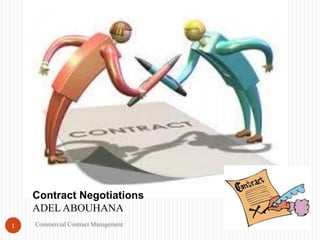
Contract Negotiations
ADEL ABOUHANA
Commercial Contract Management2
Contract Negotiations
Skills, Tools, and Best
Practices
An Interactive Adventure
into the Art & Science of the Deal!
Commercial Contract Management3
Contract Negotiations – An NCMA
National Education Seminar (NES) & CD-ROM
Key Topics of Discussion:
 The Need for Contract Negotiation Skills
* Q&A - Exercise
 Contract Negotiation Competencies – The Skills
to Win
* Self-Assessment Survey
 The Contract Negotiation Process
* Buyer & Seller – Checklist of Best Practices
Commercial Contract Management4
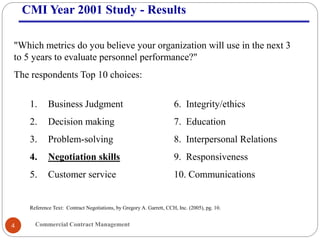
CMI Year 2001 Study - Results
"Which metrics do you believe your organization will use in the next 3
to 5 years to evaluate personnel performance?"
The respondents Top 10 choices:
1. Business Judgment 6. Integrity/ethics
2. Decision making 7. Education
3. Problem-solving 8. Interpersonal Relations
4. Negotiation skills 9. Responsiveness
5. Customer service 10. Communications
Reference Text: Contract Negotiations, by Gregory A. Garrett, CCH, Inc. (2005), pg. 10.
Commercial Contract Management5
Contract Negotiation Skills Gap
Key Facts
• Many of the Master Contract Negotiators in both the
public and private business sectors, have retired,
or retiring, or are retirement eligible by 2015**
• Significant increase in the complexity of contracts and
related projects ***
** Survey by Garrett Consulting Services, 2010
*** Center for Business Practices (CBP) study, 2009
Commercial Contract Management6
Exercise – Q & A
1. How important are contract negotiation skills to ensure
business success?
2. How well do you negotiate?
3. Does your organization have the number and level of skilled
master contract negotiators needed?
Reference Text: Contract Negotiations, by Gregory A. Garrett, CCH, Inc. (2005), pg. 12.
Commercial Contract Management7
Contract Negotiation Competencies
The Skills to Win!
Contract Negotiations –
An NCMA NES & CD-ROM
Commercial Contract Management8
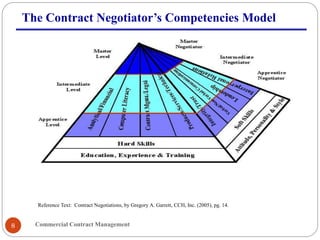
The Contract Negotiator’s Competencies Model
Reference Text: Contract Negotiations, by Gregory A. Garrett, CCH, Inc. (2005), pg. 14.
Commercial Contract Management9
Skills to Win: Self-Assessment Survey
• Complete the 20 question – Skills to Win:
Self-Assessment Survey (1 = Low Skills to 5 = High
Skills)
• Summarize and add-up your score on the survey
worksheet (pg. 3)
• Compare your result to the Self-Assessment Survey
Scoring table
Reference Text: Contract Negotiations, by Gregory A. Garrett, CCH, Inc. (2005), pgs. 15-16.
Commercial Contract Management10
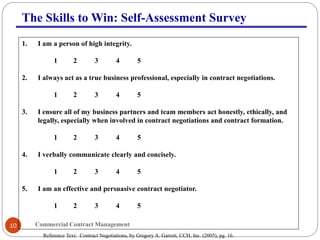
The Skills to Win: Self-Assessment Survey
1. I am a person of high integrity.
1 2 3 4 5
2. I always act as a true business professional, especially in contract negotiations.
1 2 3 4 5
3. I ensure all of my business partners and team members act honestly, ethically, and
legally, especially when involved in contract negotiations and contract formation.
1 2 3 4 5
4. I verbally communicate clearly and concisely.
1 2 3 4 5
5. I am an effective and persuasive contract negotiator.
1 2 3 4 5
Reference Text: Contract Negotiations, by Gregory A. Garrett, CCH, Inc. (2005), pg. 16.
Commercial Contract Management11
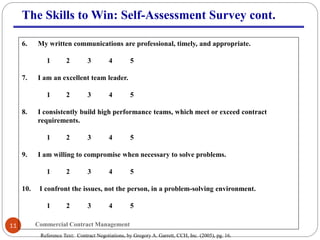
The Skills to Win: Self-Assessment Survey cont.
6. My written communications are professional, timely, and appropriate.
1 2 3 4 5
7. I am an excellent team leader.
1 2 3 4 5
8. I consistently build high performance teams, which meet or exceed contract
requirements.
1 2 3 4 5
9. I am willing to compromise when necessary to solve problems.
1 2 3 4 5
10. I confront the issues, not the person, in a problem-solving environment.
1 2 3 4 5
Reference Text: Contract Negotiations, by Gregory A. Garrett, CCH, Inc. (2005), pg. 16.
Commercial Contract Management12
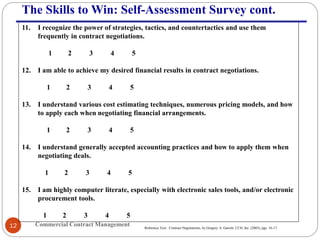
The Skills to Win: Self-Assessment Survey cont.
11. I recognize the power of strategies, tactics, and countertactics and use them
frequently in contract negotiations.
1 2 3 4 5
12. I am able to achieve my desired financial results in contract negotiations.
1 2 3 4 5
13. I understand various cost estimating techniques, numerous pricing models, and how
to apply each when negotiating financial arrangements.
1 2 3 4 5
14. I understand generally accepted accounting practices and how to apply them when
negotiating deals.
1 2 3 4 5
15. I am highly computer literate, especially with electronic sales tools, and/or electronic
procurement tools.
1 2 3 4 5
Reference Text: Contract Negotiations, by Gregory A. Garrett, CCH, Inc. (2005), pgs. 16-17.
Commercial Contract Management13
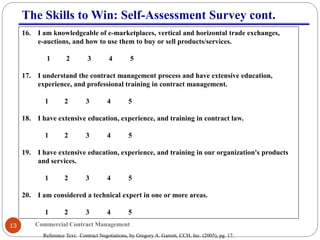
The Skills to Win: Self-Assessment Survey cont.
16. I am knowledgeable of e-marketplaces, vertical and horizontal trade exchanges,
e-auctions, and how to use them to buy or sell products/services.
1 2 3 4 5
17. I understand the contract management process and have extensive education,
experience, and professional training in contract management.
1 2 3 4 5
18. I have extensive education, experience, and training in contract law.
1 2 3 4 5
19. I have extensive education, experience, and training in our organization's products
and services.
1 2 3 4 5
20. I am considered a technical expert in one or more areas.
1 2 3 4 5
Reference Text: Contract Negotiations, by Gregory A. Garrett, CCH, Inc. (2005), pg. 17.
Commercial Contract Management14
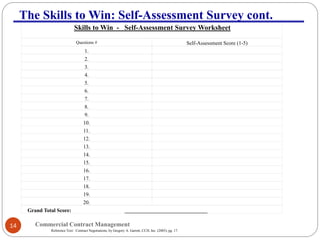
Skills to Win - Self-Assessment Survey Worksheet
Questions # Self-Assessment Score (1-5)
1.
2.
3.
4.
5.
6.
7.
8.
9.
10.
11.
12.
13.
14.
15.
16.
17.
18.
19.
20.
Grand Total Score: _______________________________
The Skills to Win: Self-Assessment Survey cont.
Reference Text: Contract Negotiations, by Gregory A. Garrett, CCH, Inc. (2005), pg. 17.
Commercial Contract Management15
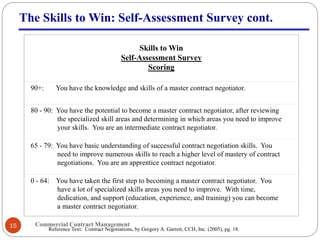
Skills to Win
Self-Assessment Survey
Scoring
90+: You have the knowledge and skills of a master contract negotiator.
80 - 90: You have the potential to become a master contract negotiator, after reviewing
the specialized skill areas and determining in which areas you need to improve
your skills. You are an intermediate contract negotiator.
65 - 79: You have basic understanding of successful contract negotiation skills. You
need to improve numerous skills to reach a higher level of mastery of contract
negotiations. You are an apprentice contract negotiator.
0 - 64: You have taken the first step to becoming a master contract negotiator. You
have a lot of specialized skills areas you need to improve. With time,
dedication, and support (education, experience, and training) you can become
a master contract negotiator.
The Skills to Win: Self-Assessment Survey cont.
Reference Text: Contract Negotiations, by Gregory A. Garrett, CCH, Inc. (2005), pg. 18.
Commercial Contract Management16
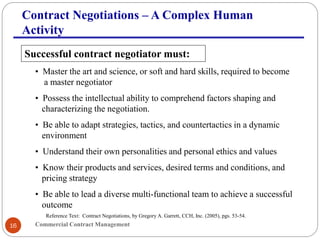
Contract Negotiations – A Complex Human
Activity
Successful contract negotiator must:
• Master the art and science, or soft and hard skills, required to become
a master negotiator
• Possess the intellectual ability to comprehend factors shaping and
characterizing the negotiation.
• Be able to adapt strategies, tactics, and countertactics in a dynamic
environment
• Understand their own personalities and personal ethics and values
• Know their products and services, desired terms and conditions, and
pricing strategy
• Be able to lead a diverse multi-functional team to achieve a successful
outcome
Reference Text: Contract Negotiations, by Gregory A. Garrett, CCH, Inc. (2005), pgs. 53-54.
Commercial Contract Management17
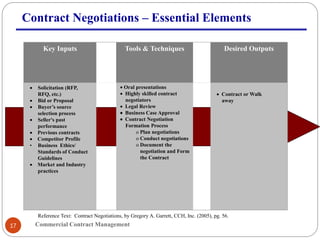
Contract Negotiations – Essential Elements
Key Inputs Tools & Techniques Desired Outputs
 Solicitation (RFP,
RFQ, etc.)
 Bid or Proposal
 Buyer’s source
selection process
 Seller's past
performance
 Previous contracts
 Competitor Profile
• Business Ethics/
Standards of Conduct
Guidelines
 Market and Industry
practices
 Oral presentations
 Highly skilled contract
negotiators
 Legal Review
 Business Case Approval
 Contract Negotiation
Formation Process
o Plan negotiations
o Conduct negotiations
o Document the
negotiation and Form
the Contract
 Contract or Walk
away
Reference Text: Contract Negotiations, by Gregory A. Garrett, CCH, Inc. (2005), pg. 56.
Commercial Contract Management18
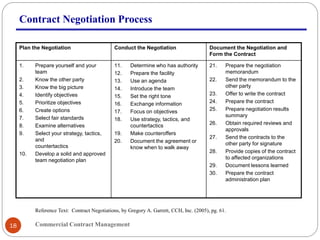
Contract Negotiation Process
Plan the Negotiation Conduct the Negotiation Document the Negotiation and
Form the Contract
1. Prepare yourself and your
team
2. Know the other party
3. Know the big picture
4. Identify objectives
5. Prioritize objectives
6. Create options
7. Select fair standards
8. Examine alternatives
9. Select your strategy, tactics,
and
countertactics
10. Develop a solid and approved
team negotiation plan
11. Determine who has authority
12. Prepare the facility
13. Use an agenda
14. Introduce the team
15. Set the right tone
16. Exchange information
17. Focus on objectives
18. Use strategy, tactics, and
countertactics
19. Make counteroffers
20. Document the agreement or
know when to walk away
21. Prepare the negotiation
memorandum
22. Send the memorandum to the
other party
23. Offer to write the contract
24. Prepare the contract
25. Prepare negotiation results
summary
26. Obtain required reviews and
approvals
27. Send the contracts to the
other party for signature
28. Provide copies of the contract
to affected organizations
29. Document lessons learned
30. Prepare the contract
administration plan
Reference Text: Contract Negotiations, by Gregory A. Garrett, CCH, Inc. (2005), pg. 61.
Commercial Contract Management19
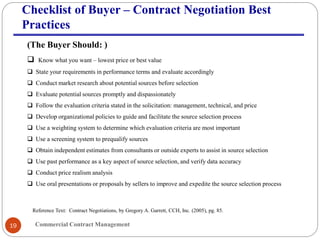
Checklist of Buyer – Contract Negotiation Best
Practices
(The Buyer Should: )
 Know what you want – lowest price or best value
 State your requirements in performance terms and evaluate accordingly
 Conduct market research about potential sources before selection
 Evaluate potential sources promptly and dispassionately
 Follow the evaluation criteria stated in the solicitation: management, technical, and price
 Develop organizational policies to guide and facilitate the source selection process
 Use a weighting system to determine which evaluation criteria are most important
 Use a screening system to prequalify sources
 Obtain independent estimates from consultants or outside experts to assist in source selection
 Use past performance as a key aspect of source selection, and verify data accuracy
 Conduct price realism analysis
 Use oral presentations or proposals by sellers to improve and expedite the source selection process
Reference Text: Contract Negotiations, by Gregory A. Garrett, CCH, Inc. (2005), pg. 85.
Commercial Contract Management20
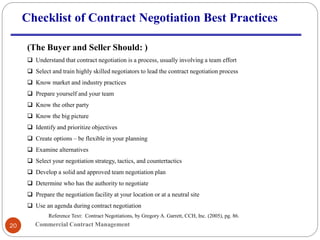
Checklist of Contract Negotiation Best Practices
(The Buyer and Seller Should: )
 Understand that contract negotiation is a process, usually involving a team effort
 Select and train highly skilled negotiators to lead the contract negotiation process
 Know market and industry practices
 Prepare yourself and your team
 Know the other party
 Know the big picture
 Identify and prioritize objectives
 Create options – be flexible in your planning
 Examine alternatives
 Select your negotiation strategy, tactics, and countertactics
 Develop a solid and approved team negotiation plan
 Determine who has the authority to negotiate
 Prepare the negotiation facility at your location or at a neutral site
 Use an agenda during contract negotiation
Reference Text: Contract Negotiations, by Gregory A. Garrett, CCH, Inc. (2005), pg. 86.
Commercial Contract Management21
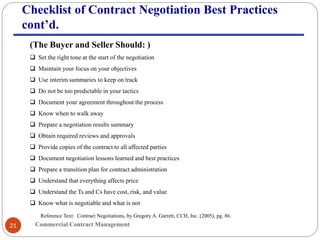
Checklist of Contract Negotiation Best Practices
cont’d.
(The Buyer and Seller Should: )
 Set the right tone at the start of the negotiation
 Maintain your focus on your objectives
 Use interim summaries to keep on track
 Do not be too predictable in your tactics
 Document your agreement throughout the process
 Know when to walk away
 Prepare a negotiation results summary
 Obtain required reviews and approvals
 Provide copies of the contract to all affected parties
 Document negotiation lessons learned and best practices
 Prepare a transition plan for contract administration
 Understand that everything affects price
 Understand the Ts and Cs have cost, risk, and value
 Know what is negotiable and what is not
Reference Text: Contract Negotiations, by Gregory A. Garrett, CCH, Inc. (2005), pg. 86.

Contract negotiations

  • 1.
    Commercial Contract Management1 ContractNegotiations ADEL ABOUHANA
  • 2.
    Commercial Contract Management2 ContractNegotiations Skills, Tools, and Best Practices An Interactive Adventure into the Art & Science of the Deal!
  • 3.
    Commercial Contract Management3 ContractNegotiations – An NCMA National Education Seminar (NES) & CD-ROM Key Topics of Discussion:  The Need for Contract Negotiation Skills * Q&A - Exercise  Contract Negotiation Competencies – The Skills to Win * Self-Assessment Survey  The Contract Negotiation Process * Buyer & Seller – Checklist of Best Practices
  • 4.
    Commercial Contract Management4 CMIYear 2001 Study - Results "Which metrics do you believe your organization will use in the next 3 to 5 years to evaluate personnel performance?" The respondents Top 10 choices: 1. Business Judgment 6. Integrity/ethics 2. Decision making 7. Education 3. Problem-solving 8. Interpersonal Relations 4. Negotiation skills 9. Responsiveness 5. Customer service 10. Communications Reference Text: Contract Negotiations, by Gregory A. Garrett, CCH, Inc. (2005), pg. 10.
  • 5.
    Commercial Contract Management5 ContractNegotiation Skills Gap Key Facts • Many of the Master Contract Negotiators in both the public and private business sectors, have retired, or retiring, or are retirement eligible by 2015** • Significant increase in the complexity of contracts and related projects *** ** Survey by Garrett Consulting Services, 2010 *** Center for Business Practices (CBP) study, 2009
  • 6.
    Commercial Contract Management6 Exercise– Q & A 1. How important are contract negotiation skills to ensure business success? 2. How well do you negotiate? 3. Does your organization have the number and level of skilled master contract negotiators needed? Reference Text: Contract Negotiations, by Gregory A. Garrett, CCH, Inc. (2005), pg. 12.
  • 7.
    Commercial Contract Management7 ContractNegotiation Competencies The Skills to Win! Contract Negotiations – An NCMA NES & CD-ROM
  • 8.
    Commercial Contract Management8 TheContract Negotiator’s Competencies Model Reference Text: Contract Negotiations, by Gregory A. Garrett, CCH, Inc. (2005), pg. 14.
  • 9.
    Commercial Contract Management9 Skillsto Win: Self-Assessment Survey • Complete the 20 question – Skills to Win: Self-Assessment Survey (1 = Low Skills to 5 = High Skills) • Summarize and add-up your score on the survey worksheet (pg. 3) • Compare your result to the Self-Assessment Survey Scoring table Reference Text: Contract Negotiations, by Gregory A. Garrett, CCH, Inc. (2005), pgs. 15-16.
  • 10.
    Commercial Contract Management10 TheSkills to Win: Self-Assessment Survey 1. I am a person of high integrity. 1 2 3 4 5 2. I always act as a true business professional, especially in contract negotiations. 1 2 3 4 5 3. I ensure all of my business partners and team members act honestly, ethically, and legally, especially when involved in contract negotiations and contract formation. 1 2 3 4 5 4. I verbally communicate clearly and concisely. 1 2 3 4 5 5. I am an effective and persuasive contract negotiator. 1 2 3 4 5 Reference Text: Contract Negotiations, by Gregory A. Garrett, CCH, Inc. (2005), pg. 16.
  • 11.
    Commercial Contract Management11 TheSkills to Win: Self-Assessment Survey cont. 6. My written communications are professional, timely, and appropriate. 1 2 3 4 5 7. I am an excellent team leader. 1 2 3 4 5 8. I consistently build high performance teams, which meet or exceed contract requirements. 1 2 3 4 5 9. I am willing to compromise when necessary to solve problems. 1 2 3 4 5 10. I confront the issues, not the person, in a problem-solving environment. 1 2 3 4 5 Reference Text: Contract Negotiations, by Gregory A. Garrett, CCH, Inc. (2005), pg. 16.
  • 12.
    Commercial Contract Management12 TheSkills to Win: Self-Assessment Survey cont. 11. I recognize the power of strategies, tactics, and countertactics and use them frequently in contract negotiations. 1 2 3 4 5 12. I am able to achieve my desired financial results in contract negotiations. 1 2 3 4 5 13. I understand various cost estimating techniques, numerous pricing models, and how to apply each when negotiating financial arrangements. 1 2 3 4 5 14. I understand generally accepted accounting practices and how to apply them when negotiating deals. 1 2 3 4 5 15. I am highly computer literate, especially with electronic sales tools, and/or electronic procurement tools. 1 2 3 4 5 Reference Text: Contract Negotiations, by Gregory A. Garrett, CCH, Inc. (2005), pgs. 16-17.
  • 13.
    Commercial Contract Management13 TheSkills to Win: Self-Assessment Survey cont. 16. I am knowledgeable of e-marketplaces, vertical and horizontal trade exchanges, e-auctions, and how to use them to buy or sell products/services. 1 2 3 4 5 17. I understand the contract management process and have extensive education, experience, and professional training in contract management. 1 2 3 4 5 18. I have extensive education, experience, and training in contract law. 1 2 3 4 5 19. I have extensive education, experience, and training in our organization's products and services. 1 2 3 4 5 20. I am considered a technical expert in one or more areas. 1 2 3 4 5 Reference Text: Contract Negotiations, by Gregory A. Garrett, CCH, Inc. (2005), pg. 17.
  • 14.
    Commercial Contract Management14 Skillsto Win - Self-Assessment Survey Worksheet Questions # Self-Assessment Score (1-5) 1. 2. 3. 4. 5. 6. 7. 8. 9. 10. 11. 12. 13. 14. 15. 16. 17. 18. 19. 20. Grand Total Score: _______________________________ The Skills to Win: Self-Assessment Survey cont. Reference Text: Contract Negotiations, by Gregory A. Garrett, CCH, Inc. (2005), pg. 17.
  • 15.
    Commercial Contract Management15 Skillsto Win Self-Assessment Survey Scoring 90+: You have the knowledge and skills of a master contract negotiator. 80 - 90: You have the potential to become a master contract negotiator, after reviewing the specialized skill areas and determining in which areas you need to improve your skills. You are an intermediate contract negotiator. 65 - 79: You have basic understanding of successful contract negotiation skills. You need to improve numerous skills to reach a higher level of mastery of contract negotiations. You are an apprentice contract negotiator. 0 - 64: You have taken the first step to becoming a master contract negotiator. You have a lot of specialized skills areas you need to improve. With time, dedication, and support (education, experience, and training) you can become a master contract negotiator. The Skills to Win: Self-Assessment Survey cont. Reference Text: Contract Negotiations, by Gregory A. Garrett, CCH, Inc. (2005), pg. 18.
  • 16.
    Commercial Contract Management16 ContractNegotiations – A Complex Human Activity Successful contract negotiator must: • Master the art and science, or soft and hard skills, required to become a master negotiator • Possess the intellectual ability to comprehend factors shaping and characterizing the negotiation. • Be able to adapt strategies, tactics, and countertactics in a dynamic environment • Understand their own personalities and personal ethics and values • Know their products and services, desired terms and conditions, and pricing strategy • Be able to lead a diverse multi-functional team to achieve a successful outcome Reference Text: Contract Negotiations, by Gregory A. Garrett, CCH, Inc. (2005), pgs. 53-54.
  • 17.
    Commercial Contract Management17 ContractNegotiations – Essential Elements Key Inputs Tools & Techniques Desired Outputs  Solicitation (RFP, RFQ, etc.)  Bid or Proposal  Buyer’s source selection process  Seller's past performance  Previous contracts  Competitor Profile • Business Ethics/ Standards of Conduct Guidelines  Market and Industry practices  Oral presentations  Highly skilled contract negotiators  Legal Review  Business Case Approval  Contract Negotiation Formation Process o Plan negotiations o Conduct negotiations o Document the negotiation and Form the Contract  Contract or Walk away Reference Text: Contract Negotiations, by Gregory A. Garrett, CCH, Inc. (2005), pg. 56.
  • 18.
    Commercial Contract Management18 ContractNegotiation Process Plan the Negotiation Conduct the Negotiation Document the Negotiation and Form the Contract 1. Prepare yourself and your team 2. Know the other party 3. Know the big picture 4. Identify objectives 5. Prioritize objectives 6. Create options 7. Select fair standards 8. Examine alternatives 9. Select your strategy, tactics, and countertactics 10. Develop a solid and approved team negotiation plan 11. Determine who has authority 12. Prepare the facility 13. Use an agenda 14. Introduce the team 15. Set the right tone 16. Exchange information 17. Focus on objectives 18. Use strategy, tactics, and countertactics 19. Make counteroffers 20. Document the agreement or know when to walk away 21. Prepare the negotiation memorandum 22. Send the memorandum to the other party 23. Offer to write the contract 24. Prepare the contract 25. Prepare negotiation results summary 26. Obtain required reviews and approvals 27. Send the contracts to the other party for signature 28. Provide copies of the contract to affected organizations 29. Document lessons learned 30. Prepare the contract administration plan Reference Text: Contract Negotiations, by Gregory A. Garrett, CCH, Inc. (2005), pg. 61.
  • 19.
    Commercial Contract Management19 Checklistof Buyer – Contract Negotiation Best Practices (The Buyer Should: )  Know what you want – lowest price or best value  State your requirements in performance terms and evaluate accordingly  Conduct market research about potential sources before selection  Evaluate potential sources promptly and dispassionately  Follow the evaluation criteria stated in the solicitation: management, technical, and price  Develop organizational policies to guide and facilitate the source selection process  Use a weighting system to determine which evaluation criteria are most important  Use a screening system to prequalify sources  Obtain independent estimates from consultants or outside experts to assist in source selection  Use past performance as a key aspect of source selection, and verify data accuracy  Conduct price realism analysis  Use oral presentations or proposals by sellers to improve and expedite the source selection process Reference Text: Contract Negotiations, by Gregory A. Garrett, CCH, Inc. (2005), pg. 85.
  • 20.
    Commercial Contract Management20 Checklistof Contract Negotiation Best Practices (The Buyer and Seller Should: )  Understand that contract negotiation is a process, usually involving a team effort  Select and train highly skilled negotiators to lead the contract negotiation process  Know market and industry practices  Prepare yourself and your team  Know the other party  Know the big picture  Identify and prioritize objectives  Create options – be flexible in your planning  Examine alternatives  Select your negotiation strategy, tactics, and countertactics  Develop a solid and approved team negotiation plan  Determine who has the authority to negotiate  Prepare the negotiation facility at your location or at a neutral site  Use an agenda during contract negotiation Reference Text: Contract Negotiations, by Gregory A. Garrett, CCH, Inc. (2005), pg. 86.
  • 21.
    Commercial Contract Management21 Checklistof Contract Negotiation Best Practices cont’d. (The Buyer and Seller Should: )  Set the right tone at the start of the negotiation  Maintain your focus on your objectives  Use interim summaries to keep on track  Do not be too predictable in your tactics  Document your agreement throughout the process  Know when to walk away  Prepare a negotiation results summary  Obtain required reviews and approvals  Provide copies of the contract to all affected parties  Document negotiation lessons learned and best practices  Prepare a transition plan for contract administration  Understand that everything affects price  Understand the Ts and Cs have cost, risk, and value  Know what is negotiable and what is not Reference Text: Contract Negotiations, by Gregory A. Garrett, CCH, Inc. (2005), pg. 86.