GROUP RESEARCH PROJECT  SOCIAL ACTION: FIGHT HUNGER Athanasios Tom Kokkinias Instructor Members Fatuma Hassan Khadija Abubakar Maryelle Data Qinghua Sun
Definition hun·ger /ˈhʌŋgər/  [huhng-ger] – noun  1. a compelling need or desire for food.  2. the painful sensation or state of weakness caused by the need of food: to collapse from hunger.  3. a shortage of food; famine.
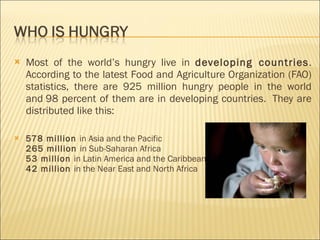
Most of the world’s hungry live in  developing countries . According to the latest Food and Agriculture Organization (FAO) statistics, there are 925 million hungry people in the world and 98 percent of them are in developing countries.  They are distributed like this: 578 million  in Asia and the Pacific 265 million  in Sub-Saharan Africa  53 million  in Latin America and the Caribbean  42 million  in the Near East and North Africa
Nature: earthquake, floods, drought War: displaced people, food used as a weapon, farm and wells mined Poverty Trap: poor farmer cannot afford seeds and  poor people cannot afford to buy food Poor agricultural infrastructure: roads, water, food storage,  Over-exploitation of environment:  deforestation, overcropping and overgrazing  Harmful economic policies
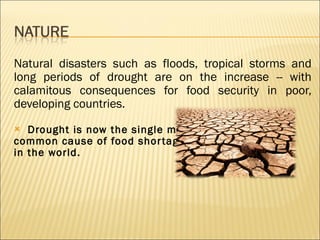
Natural disasters such as floods, tropical storms and long periods of drought are on the increase -- with calamitous consequences for food security in poor, developing countries. Drought is now the single most  common cause of food shortages  in the world.
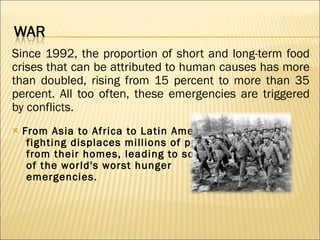
Since 1992, the proportion of short and long-term food crises that can be attributed to human causes has more than doubled, rising from 15 percent to more than 35 percent. All too often, these emergencies are triggered by conflicts. From Asia to Africa to Latin America,  fighting displaces millions of people  from their homes, leading to some  of the world's worst hunger  emergencies.    
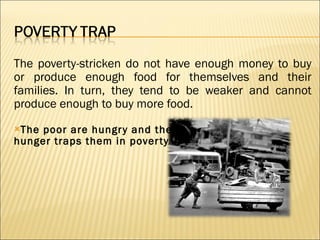
The poverty-stricken do not have enough money to buy or produce enough food for themselves and their families. In turn, they tend to be weaker and cannot produce enough to buy more food. The poor are hungry and their  hunger traps them in poverty.
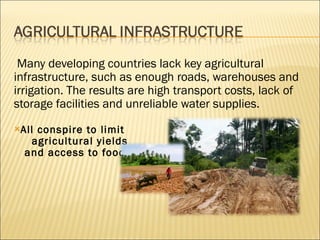
  Many developing countries lack key agricultural infrastructure, such as enough roads, warehouses and irrigation. The results are high transport costs, lack of storage facilities and unreliable water supplies.  All conspire to limit  agricultural yields  and access to food.
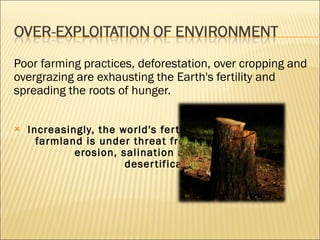
Poor farming practices, deforestation, over cropping and overgrazing are exhausting the Earth's fertility and spreading the roots of hunger. Increasingly, the world's fertile  farmland is under threat from  erosion, salination and  desertification.  
Every year 15 million children die of hunger Every 3.6 seconds someone dies of hunger To satisfy the world's sanitation and food requirements would cost only US$13 billion- what the people of the United States and the European Union spend on perfume each year.  For the price of one missile, a school full of hungry children could eat lunch every day for 5 years
More than 40% of people in low- or lower middle income households reported food insecurity. Even in middle-income households, almost 25% reported at least one aspect of the problem. About 18% of people aged 12 to 44 had experienced food insecurity. 18% increase in Food Bank use in 2009 87% people who use food bank are in rented accommodation
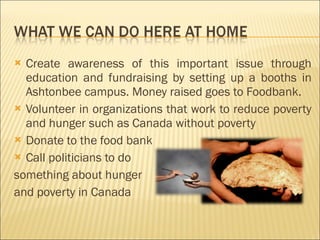
Create awareness of this important issue through education and fundraising by setting up a booths in Ashtonbee campus. Money raised goes to Foodbank. Volunteer in organizations that work to reduce poverty and hunger such as Canada without poverty Donate to the food bank Call politicians to do  something about hunger  and poverty in Canada
Buy products that promote fair trade Educate ourselves on global issues and how it impacts hunger and poverty example makehungerhistory.org campaign Donate to advocacy organizations
LINKS FOR THE IMAGES https://wikis.nyu.edu/ek6/modernamerica/index.php/AmericanPowerAmpCulturalHegemony/African-AmericanMusic http://www.unioncpchurch.com/images/womensministry/hungry.jpg http://www.gaatlargeinc.com/images/Feeding%20The%20Hungry.jpg http://www.ourplanet.org.uk/drought-climate-change.asp http://trendsupdates.com/70-percent-more-food-needed-by-2050-for-projected-9-1-billion-world-population/ http://ka-bayan-ko.blogspot.com/2010/07/education-and-poverty-in-philippines.html http://www.canonbiechurch.org.uk/fairtrade.php http://gizmodo.com/5108282/hackers-help-loggers-smuggle-17-million-cubic-meters-of-wood-out-of-brazil http://www.aambis.com/ http://farmlandgrab.org/wp-content/uploads/2009/12/infrastructure.jpg
FACTS LINKS http://dictionary.reference.com/browse/hunger http://www.makehungerhistory.org/content/view/53 http://www.cwp-csp.ca http://www.statcan.gc.ca/studies http://www.cafb-acba.ca/documents/HungerCount2009NOV16.pdf http://library.thinkquest.org/C002291/high/present/stats.htm http://www.wfp.org/hunger/causes http://www.wfp.org/hunger/causes http://www.worldhunger.org/harmfuleconomicsystems.htm

Hunger Presentation

  • 1.
    GROUP RESEARCH PROJECT SOCIAL ACTION: FIGHT HUNGER Athanasios Tom Kokkinias Instructor Members Fatuma Hassan Khadija Abubakar Maryelle Data Qinghua Sun
  • 2.
    Definition hun·ger /ˈhʌŋgər/ [huhng-ger] – noun 1. a compelling need or desire for food. 2. the painful sensation or state of weakness caused by the need of food: to collapse from hunger. 3. a shortage of food; famine.
  • 3.
    Most of theworld’s hungry live in developing countries . According to the latest Food and Agriculture Organization (FAO) statistics, there are 925 million hungry people in the world and 98 percent of them are in developing countries.  They are distributed like this: 578 million in Asia and the Pacific 265 million  in Sub-Saharan Africa 53 million  in Latin America and the Caribbean 42 million  in the Near East and North Africa
  • 4.
    Nature: earthquake, floods,drought War: displaced people, food used as a weapon, farm and wells mined Poverty Trap: poor farmer cannot afford seeds and poor people cannot afford to buy food Poor agricultural infrastructure: roads, water, food storage, Over-exploitation of environment: deforestation, overcropping and overgrazing Harmful economic policies
  • 5.
    Natural disasters suchas floods, tropical storms and long periods of drought are on the increase -- with calamitous consequences for food security in poor, developing countries. Drought is now the single most common cause of food shortages in the world.
  • 6.
    Since 1992, theproportion of short and long-term food crises that can be attributed to human causes has more than doubled, rising from 15 percent to more than 35 percent. All too often, these emergencies are triggered by conflicts. From Asia to Africa to Latin America, fighting displaces millions of people from their homes, leading to some of the world's worst hunger emergencies.    
  • 7.
    The poverty-stricken donot have enough money to buy or produce enough food for themselves and their families. In turn, they tend to be weaker and cannot produce enough to buy more food. The poor are hungry and their hunger traps them in poverty.
  • 8.
      Many developingcountries lack key agricultural infrastructure, such as enough roads, warehouses and irrigation. The results are high transport costs, lack of storage facilities and unreliable water supplies.  All conspire to limit agricultural yields and access to food.
  • 9.
    Poor farming practices,deforestation, over cropping and overgrazing are exhausting the Earth's fertility and spreading the roots of hunger. Increasingly, the world's fertile farmland is under threat from erosion, salination and desertification.  
  • 10.
    Every year 15million children die of hunger Every 3.6 seconds someone dies of hunger To satisfy the world's sanitation and food requirements would cost only US$13 billion- what the people of the United States and the European Union spend on perfume each year. For the price of one missile, a school full of hungry children could eat lunch every day for 5 years
  • 11.
    More than 40%of people in low- or lower middle income households reported food insecurity. Even in middle-income households, almost 25% reported at least one aspect of the problem. About 18% of people aged 12 to 44 had experienced food insecurity. 18% increase in Food Bank use in 2009 87% people who use food bank are in rented accommodation
  • 12.
    Create awareness ofthis important issue through education and fundraising by setting up a booths in Ashtonbee campus. Money raised goes to Foodbank. Volunteer in organizations that work to reduce poverty and hunger such as Canada without poverty Donate to the food bank Call politicians to do something about hunger and poverty in Canada
  • 13.
    Buy products thatpromote fair trade Educate ourselves on global issues and how it impacts hunger and poverty example makehungerhistory.org campaign Donate to advocacy organizations
  • 14.
    LINKS FOR THEIMAGES https://wikis.nyu.edu/ek6/modernamerica/index.php/AmericanPowerAmpCulturalHegemony/African-AmericanMusic http://www.unioncpchurch.com/images/womensministry/hungry.jpg http://www.gaatlargeinc.com/images/Feeding%20The%20Hungry.jpg http://www.ourplanet.org.uk/drought-climate-change.asp http://trendsupdates.com/70-percent-more-food-needed-by-2050-for-projected-9-1-billion-world-population/ http://ka-bayan-ko.blogspot.com/2010/07/education-and-poverty-in-philippines.html http://www.canonbiechurch.org.uk/fairtrade.php http://gizmodo.com/5108282/hackers-help-loggers-smuggle-17-million-cubic-meters-of-wood-out-of-brazil http://www.aambis.com/ http://farmlandgrab.org/wp-content/uploads/2009/12/infrastructure.jpg
  • 15.
    FACTS LINKS http://dictionary.reference.com/browse/hungerhttp://www.makehungerhistory.org/content/view/53 http://www.cwp-csp.ca http://www.statcan.gc.ca/studies http://www.cafb-acba.ca/documents/HungerCount2009NOV16.pdf http://library.thinkquest.org/C002291/high/present/stats.htm http://www.wfp.org/hunger/causes http://www.wfp.org/hunger/causes http://www.worldhunger.org/harmfuleconomicsystems.htm

Editor's Notes

  • #3 http://oxforddictionaries.com/view/entry/m_en_gb0391970#m_en_gb0391970
  • #4 http://www.wfp.org/hunger/causes
  • #5 http://www.wfp.org/hunger/causes, http://www.worldhunger.org/harmfuleconomicsystems.htm
  • #11 http://library.thinkquest.org/C002291/high/present/stats.htm
  • #12 http://www.statcan.gc.ca/studies, http://www.cafb-acba.ca/documents/HungerCount2009NOV16.pdf
  • #13 http://www.cwp-csp.ca
  • #14 http://www.makehungerhistory.org/content/view/53