PROSTATE HYPERPLASIA
IN DOG
Mir Md. Ashique Babu
Faculty of Veterinary Science
Bangladesh Agricultural University
CONTENTS
Introduction
Etiology
Clinical signs
Diagnosis
Treatment
INTRODUCTION
The dog is the only domestic species
known to exhibit prostate hyperplasia.
This disorder occurs in most dogs aged
more than six years.
ETIOLOGY
It is a natural consequence of aging.
Both estrogen & androgen must be
present for marked hyperplasia to
occur.
CLINICAL SIGNS
Affected animals usually have no signs of
illness.
Serosanguinous urethral discharge may be
evident.
Cloudy or bloody urine may be observed.
Tenesmus may occur.
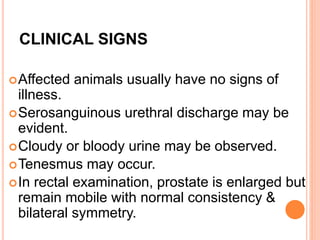
In rectal examination, prostate is enlarged but
remain mobile with normal consistency &
bilateral symmetry.
Prostate in dog located near the neck of
the urinary bladder.
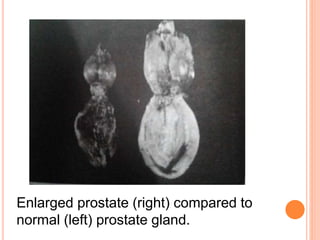
Enlarged prostate (right) compared to
normal (left) prostate gland.
DIAGNOSIS
Rectal examination
Ultrasound examination
Cytological examination
TREATMENT
The most effective treatment is castration.
This causes involution of the enlarged
prostate gland.
Low dose estrogen treatment with
diethylstilbestrol which depresses pituitary
gonadotrophin secretion.
Prostate hyperplasia in Dog

Prostate hyperplasia in Dog