Reproductive System
Dr. Radhika
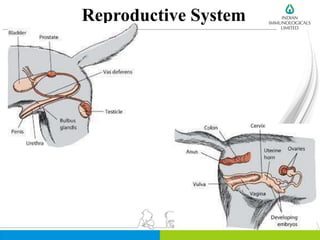
Reproductive System
Introduction
• The reproductive system is the group of organs that produce offspring.
• In both males and females, the reproductive system is composed of primary sex organs and
primary regulatory centers.
• The primary sex organs in males: testes and genital tract
• The primary sex organs in females: ovaries, fallopian tubes, and uterus in females.
• The primary regulatory centers are in the brain (the pituitary gland and hypothalamus).
Male reproductive disorders in cats and dogs
• Cryptorchidism
• Brucellosis
• Transmissible Venereal Tumors (TVT)
Most Common conditions:
Female reproductive disorders in cats and dogs
• Pyometra
• Pseudo pregnancy
• Mammary Tumor
Most Common conditions:
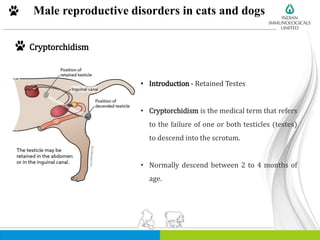
Cryptorchidism
• Introduction - Retained Testes
• Cryptorchidism is the medical term that refers
to the failure of one or both testicles (testes)
to descend into the scrotum.
• Normally descend between 2 to 4 months of
age.
Male reproductive disorders in cats and dogs
Cryptorchidism
• Cryptorchidism- common in toy breeds- toy Poodles and Pomeranians at higher
risk.
• 75% of cases of cryptorchidism- one retained testicle
• 25% involve failure of both testicles to descend
• The right testicle is more than twice as likely to be retained Cryptorchidism
affects
• affects 1-3% of all dogs.
• Hereditary
Cryptorchidism- Signs
• Rarely associated with pain or other signs unless a complication develops.
• One complication of cryptorchidism is spermatic cord torsion -sudden and
severe abdominal pain.
• A retained testicle may turn cancerous.
"If both testicles are retained, the dog may be infertile."
Cryptorchidism
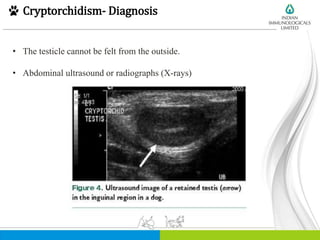
Cryptorchidism- Diagnosis
• The testicle cannot be felt from the outside.
• Abdominal ultrasound or radiographs (X-rays)
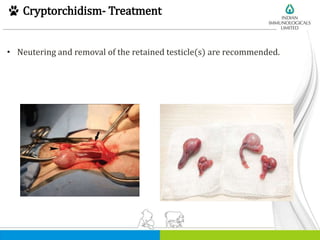
Cryptorchidism- Treatment
• Neutering and removal of the retained testicle(s) are recommended.
Canine Brucellosis
Introduction-
• Canine brucellosis is a contagious bacterial infection caused by the
bacterium, Brucella canis (B. canis).
• Highly contagious between dogs.
• Brucella canis is zoonotic in nature
Canine Brucellosis
Route of Transmission-
• B. canis bacteria is shed in the genital secretions (semen or vaginal discharges)
• Smaller amounts of bacteria shed-in urine or saliva.
• Female dog- aborted material and discharges.
Canine Brucellosis
Symptoms in Male Dogs
• epididymitis, an infection in part of the
testicle.
• enlarged scrotum or an enlarged testicle
• The dog may be infertile.
• In chronic cases- testicles will atrophy
Symptoms in Female Dogs
• Female dogs infected with brucellosis
develop an infection of the uterus.
• Infertility
• Abortion in the late stages of pregnancy.
• persistent vaginal discharge.
Canine Brucellosis
Diagnosis
• Rapid slide agglutination test or RSAT
Canine Brucellosis
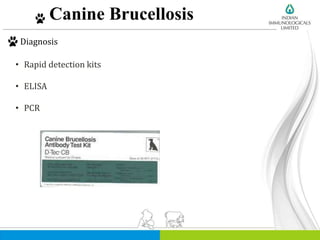
Diagnosis
• Rapid detection kits
• ELISA
• PCR
Canine Brucellosis
Treatment
• Any dog that has been infected with B. canis should be considered to be infected
for life.
• the dog may shed bacteria intermittently for the rest of its life.
• acute infection can be controlled with antibiotics
• Surgical sterilization of the infected dog will decrease shedding of the organisms
into the environment, thereby reducing the risk to other dogs.
• Antibiotic Therapy:
Doxycycline
Doxy Must (10 tab), SkyEC MRP Rs 125
Doxy PET (10 tab), Sava vet MRP Rs 70
@10 mg/kg B.wt o.i.d in cats and dogs
Canine Brucellosis-Treatment
• Acute infection can be controlled with antibiotics
Transmissible Venereal Tumor
Introduction:
• Transmissible venereal tumors (TVT) are tumors that arise from the dysregulated
growth of cells called histiocytes.
• Histocytes are a type of immune system cell found in many areas of the body,
including the skin.
• TVTs are malignant (cancerous) tumors.
• Different from other cancers, TVTs can spread between dogs.
Transmissible Venereal Tumor
Spread:
• It is sexually transmitted.
• The most common cause of this cancer is direct contact with a dog with TVT, which
includes sexual contact (intercourse), licking, biting, and sniffing the tumor affected
areas.
Transmissible Venereal Tumor
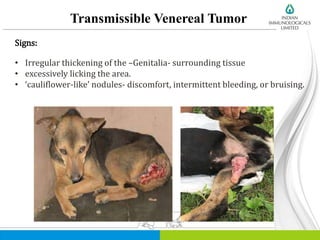
Signs:
• Irregular thickening of the –Genitalia- surrounding tissue
• excessively licking the area.
• ā€˜cauliflower-like’ nodules- discomfort, intermittent bleeding, or bruising.
Transmissible Venereal Tumor
Diagnosis:
• Cytology
Samples can be collected either by cotton-tipped swab or by fine needle aspiration (FNA)
• Biopsy
The surgical excision of a piece of tumor.(Histopathology)
.
Neoplastic round cells had a high rate of proliferation with frequent mitotic figures (arrowheads)
"TVTs usually continue to grow and can become
increasingly bothersome without treatment."
Transmissible Venereal Tumor
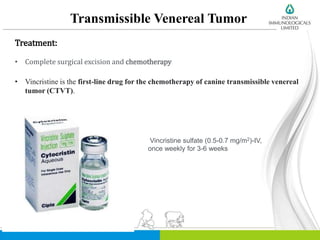
Treatment:
• Complete surgical excision and chemotherapy
• Vincristine is the first-line drug for the chemotherapy of canine transmissible venereal
tumor (CTVT).
Vincristine sulfate (0.5-0.7 mg/m2)-IV,
once weekly for 3-6 weeks
Transmissible Venereal Tumor
Supplementary Therapy:
•Improves Quality of life in cancer patients
DOGS : 1 ml per 5 kg b.i.d
Rs 1750 for 150ml
.
Pyometra
• Introduction - ā€œPus in the Uterusā€
• Pyometra is a secondary infection that
occurs as a result of hormonal changes in
the reproductive tract.
• Following estrus, progesterone is elevated
for up to two months and causes the lining
of the uterus to thicken in preparation for
pregnancy.
• If pregnancy consecutively doesn’t occur the
uterine lining continues to increase in
thickness.
• "
Female reproductive disorders in cats and dogs
https://vcahospitals.com/know-your-pet/pyometra-in-dogs
Pyometra
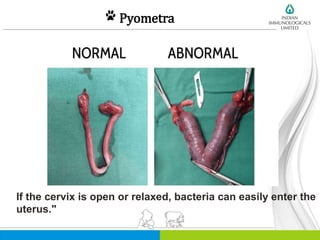
If the cervix is open or relaxed, bacteria can easily enter the
uterus."
Pyometra
When does Pyometra occur?
• Pyometra may occur in any sexually intact young to middle-
aged dog; however, it is most common in older dogs.
• occurs two to eight weeks after the last estrus.
Pyometra
When does Pyometra occur?
• Pyometra may occur in any sexually intact young to middle-
aged dog; however, it is most common in older dogs.
• occurs two to eight weeks after the last estrus.
Pyometra
Classification
• Open Pyometra: Cervix open, Pus drains out
• Closed Pyometra: Cervix closed, distended abdomen
Open Pyoderma Closed Pyoderma
Pyometra
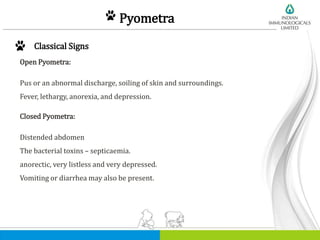
Classical Signs
Open Pyometra:
Pus or an abnormal discharge, soiling of skin and surroundings.
Fever, lethargy, anorexia, and depression.
Closed Pyometra:
Distended abdomen
The bacterial toxins – septicaemia.
anorectic, very listless and very depressed.
Vomiting or diarrhea may also be present.
Pyometra
Diagnosis
• Based on clinical signs.
• Blood picture: WBC
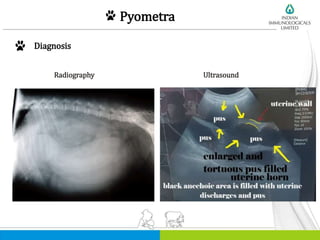
• Radiography
• Ultrasound
Pyometra
Diagnosis
Radiography Ultrasound
Pyometra
Treatment
• Ovariohysterectomy (spay).
• Intravenous fluids are required to stabilize the dog before
and after surgery.
• Antibiotics are usually given for two weeks after surgery.
• Antibiotic Therapy:
Ceftriaxone
Pyometra
Intacef Pet 500mg ,Intas, MRP Rs 40
@15 mg/kg B.wt o.i.d in dogs
25 mg/kg B.wt o.i.d in cats
Pyoderma
Treatment-
Pain Medication :
Carprofen- 4.4 mg/kg b.wt
Meloxicam- 0.2mg/kg b.wt
Melonex by Intas, Rs 77 Carodyl by Savavet, Rs 165
Pyometra
Treatment-
Fluid Therapy : (To Stabilize animal- thumb rule DNS, NS- 2-
6ml/kg/hr)
Mammary Tumor
Introduction-
• A mammary tumor develops because of abnormal replication of the cells that make up
the breast tissue.
• Can be benign (non-cancerous) or malignant (cancerous).
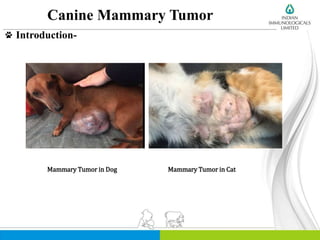
Canine Mammary Tumor
Introduction-
Mammary Tumor in Dog Mammary Tumor in Cat
Mammary Tumor
Why does it happen?.. Who is at Risk?-
• The exact causes for the development of mammary tumors in dogs are not fully
understood.
• Hormonal imbalance- progesterone, increases the risk of developing mammary.
• Risk significantly higher in senior dogs and cats > 7 yr of age.
• Breed predisposition-Chihuahuas, Poodles, Dachshunds, Cocker Spaniels, Boxer
Dogs, and Doberman
"Dogs spayed prior to their first heat have only a
0.5% risk of developing mammary tumor(s)"
Mammary Tumor
Symptoms
• One (or more) palpable masses underneath the skin of the abdomen.
• Mass follow along the mammary chain.
• The size of the mass(es) and appearance may vary
• Firm and nodular mass.
• Mass may ulcerate and bleed
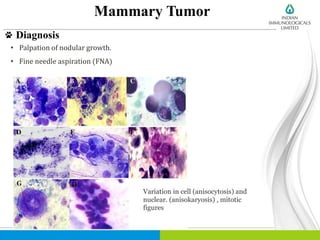
Mammary Tumor
Diagnosis
• Palpation of nodular growth.
• Fine needle aspiration (FNA)
Variation in cell (anisocytosis) and
nuclear. (anisokaryosis) , mitotic
figures
Mammary Tumor
Treatment
• For dogs with solitary mammary tumors, surgery is by far the best treatment
• For dogs with multiple tumors of one or both mammary chains, the associated – or all –
of the mammary glands may need to be removed.
• If intact, an ovariohysterectomy is recommended
• If metastatized- chemotherapy
Mammary Tumor
Treatment
• For dogs with solitary mammary tumors, surgery is by far the best treatment
• For dogs with multiple tumors of one or both mammary chains, the associated – or all –
of the mammary glands may need to be removed.
• If intact, an ovariohysterectomy is recommended
Thank You

Reproductive system.pptx

  • 1.
  • 2.
    Reproductive System Introduction • Thereproductive system is the group of organs that produce offspring. • In both males and females, the reproductive system is composed of primary sex organs and primary regulatory centers. • The primary sex organs in males: testes and genital tract • The primary sex organs in females: ovaries, fallopian tubes, and uterus in females. • The primary regulatory centers are in the brain (the pituitary gland and hypothalamus).
  • 3.
    Male reproductive disordersin cats and dogs • Cryptorchidism • Brucellosis • Transmissible Venereal Tumors (TVT) Most Common conditions:
  • 4.
    Female reproductive disordersin cats and dogs • Pyometra • Pseudo pregnancy • Mammary Tumor Most Common conditions:
  • 5.
    Cryptorchidism • Introduction -Retained Testes • Cryptorchidism is the medical term that refers to the failure of one or both testicles (testes) to descend into the scrotum. • Normally descend between 2 to 4 months of age. Male reproductive disorders in cats and dogs
  • 6.
    Cryptorchidism • Cryptorchidism- commonin toy breeds- toy Poodles and Pomeranians at higher risk. • 75% of cases of cryptorchidism- one retained testicle • 25% involve failure of both testicles to descend • The right testicle is more than twice as likely to be retained Cryptorchidism affects • affects 1-3% of all dogs. • Hereditary
  • 7.
    Cryptorchidism- Signs • Rarelyassociated with pain or other signs unless a complication develops. • One complication of cryptorchidism is spermatic cord torsion -sudden and severe abdominal pain. • A retained testicle may turn cancerous. "If both testicles are retained, the dog may be infertile."
  • 8.
  • 9.
    Cryptorchidism- Diagnosis • Thetesticle cannot be felt from the outside. • Abdominal ultrasound or radiographs (X-rays)
  • 10.
    Cryptorchidism- Treatment • Neuteringand removal of the retained testicle(s) are recommended.
  • 11.
    Canine Brucellosis Introduction- • Caninebrucellosis is a contagious bacterial infection caused by the bacterium, Brucella canis (B. canis). • Highly contagious between dogs. • Brucella canis is zoonotic in nature
  • 12.
    Canine Brucellosis Route ofTransmission- • B. canis bacteria is shed in the genital secretions (semen or vaginal discharges) • Smaller amounts of bacteria shed-in urine or saliva. • Female dog- aborted material and discharges.
  • 13.
    Canine Brucellosis Symptoms inMale Dogs • epididymitis, an infection in part of the testicle. • enlarged scrotum or an enlarged testicle • The dog may be infertile. • In chronic cases- testicles will atrophy Symptoms in Female Dogs • Female dogs infected with brucellosis develop an infection of the uterus. • Infertility • Abortion in the late stages of pregnancy. • persistent vaginal discharge.
  • 14.
    Canine Brucellosis Diagnosis • Rapidslide agglutination test or RSAT
  • 15.
    Canine Brucellosis Diagnosis • Rapiddetection kits • ELISA • PCR
  • 16.
    Canine Brucellosis Treatment • Anydog that has been infected with B. canis should be considered to be infected for life. • the dog may shed bacteria intermittently for the rest of its life. • acute infection can be controlled with antibiotics • Surgical sterilization of the infected dog will decrease shedding of the organisms into the environment, thereby reducing the risk to other dogs.
  • 17.
    • Antibiotic Therapy: Doxycycline DoxyMust (10 tab), SkyEC MRP Rs 125 Doxy PET (10 tab), Sava vet MRP Rs 70 @10 mg/kg B.wt o.i.d in cats and dogs Canine Brucellosis-Treatment • Acute infection can be controlled with antibiotics
  • 18.
    Transmissible Venereal Tumor Introduction: •Transmissible venereal tumors (TVT) are tumors that arise from the dysregulated growth of cells called histiocytes. • Histocytes are a type of immune system cell found in many areas of the body, including the skin. • TVTs are malignant (cancerous) tumors. • Different from other cancers, TVTs can spread between dogs.
  • 19.
    Transmissible Venereal Tumor Spread: •It is sexually transmitted. • The most common cause of this cancer is direct contact with a dog with TVT, which includes sexual contact (intercourse), licking, biting, and sniffing the tumor affected areas.
  • 20.
    Transmissible Venereal Tumor Signs: •Irregular thickening of the –Genitalia- surrounding tissue • excessively licking the area. • ā€˜cauliflower-like’ nodules- discomfort, intermittent bleeding, or bruising.
  • 21.
    Transmissible Venereal Tumor Diagnosis: •Cytology Samples can be collected either by cotton-tipped swab or by fine needle aspiration (FNA) • Biopsy The surgical excision of a piece of tumor.(Histopathology) . Neoplastic round cells had a high rate of proliferation with frequent mitotic figures (arrowheads)
  • 22.
    "TVTs usually continueto grow and can become increasingly bothersome without treatment."
  • 23.
    Transmissible Venereal Tumor Treatment: •Complete surgical excision and chemotherapy • Vincristine is the first-line drug for the chemotherapy of canine transmissible venereal tumor (CTVT). Vincristine sulfate (0.5-0.7 mg/m2)-IV, once weekly for 3-6 weeks
  • 24.
    Transmissible Venereal Tumor SupplementaryTherapy: •Improves Quality of life in cancer patients DOGS : 1 ml per 5 kg b.i.d Rs 1750 for 150ml .
  • 25.
    Pyometra • Introduction -ā€œPus in the Uterusā€ • Pyometra is a secondary infection that occurs as a result of hormonal changes in the reproductive tract. • Following estrus, progesterone is elevated for up to two months and causes the lining of the uterus to thicken in preparation for pregnancy. • If pregnancy consecutively doesn’t occur the uterine lining continues to increase in thickness. • " Female reproductive disorders in cats and dogs https://vcahospitals.com/know-your-pet/pyometra-in-dogs
  • 26.
    Pyometra If the cervixis open or relaxed, bacteria can easily enter the uterus."
  • 27.
    Pyometra When does Pyometraoccur? • Pyometra may occur in any sexually intact young to middle- aged dog; however, it is most common in older dogs. • occurs two to eight weeks after the last estrus.
  • 28.
    Pyometra When does Pyometraoccur? • Pyometra may occur in any sexually intact young to middle- aged dog; however, it is most common in older dogs. • occurs two to eight weeks after the last estrus.
  • 29.
    Pyometra Classification • Open Pyometra:Cervix open, Pus drains out • Closed Pyometra: Cervix closed, distended abdomen Open Pyoderma Closed Pyoderma
  • 30.
    Pyometra Classical Signs Open Pyometra: Pusor an abnormal discharge, soiling of skin and surroundings. Fever, lethargy, anorexia, and depression. Closed Pyometra: Distended abdomen The bacterial toxins – septicaemia. anorectic, very listless and very depressed. Vomiting or diarrhea may also be present.
  • 31.
    Pyometra Diagnosis • Based onclinical signs. • Blood picture: WBC • Radiography • Ultrasound
  • 32.
  • 33.
    Pyometra Treatment • Ovariohysterectomy (spay). •Intravenous fluids are required to stabilize the dog before and after surgery. • Antibiotics are usually given for two weeks after surgery.
  • 34.
    • Antibiotic Therapy: Ceftriaxone Pyometra IntacefPet 500mg ,Intas, MRP Rs 40 @15 mg/kg B.wt o.i.d in dogs 25 mg/kg B.wt o.i.d in cats
  • 35.
    Pyoderma Treatment- Pain Medication : Carprofen-4.4 mg/kg b.wt Meloxicam- 0.2mg/kg b.wt Melonex by Intas, Rs 77 Carodyl by Savavet, Rs 165
  • 36.
    Pyometra Treatment- Fluid Therapy :(To Stabilize animal- thumb rule DNS, NS- 2- 6ml/kg/hr)
  • 37.
    Mammary Tumor Introduction- • Amammary tumor develops because of abnormal replication of the cells that make up the breast tissue. • Can be benign (non-cancerous) or malignant (cancerous).
  • 38.
    Canine Mammary Tumor Introduction- MammaryTumor in Dog Mammary Tumor in Cat
  • 39.
    Mammary Tumor Why doesit happen?.. Who is at Risk?- • The exact causes for the development of mammary tumors in dogs are not fully understood. • Hormonal imbalance- progesterone, increases the risk of developing mammary. • Risk significantly higher in senior dogs and cats > 7 yr of age. • Breed predisposition-Chihuahuas, Poodles, Dachshunds, Cocker Spaniels, Boxer Dogs, and Doberman "Dogs spayed prior to their first heat have only a 0.5% risk of developing mammary tumor(s)"
  • 40.
    Mammary Tumor Symptoms • One(or more) palpable masses underneath the skin of the abdomen. • Mass follow along the mammary chain. • The size of the mass(es) and appearance may vary • Firm and nodular mass. • Mass may ulcerate and bleed
  • 41.
    Mammary Tumor Diagnosis • Palpationof nodular growth. • Fine needle aspiration (FNA) Variation in cell (anisocytosis) and nuclear. (anisokaryosis) , mitotic figures
  • 42.
    Mammary Tumor Treatment • Fordogs with solitary mammary tumors, surgery is by far the best treatment • For dogs with multiple tumors of one or both mammary chains, the associated – or all – of the mammary glands may need to be removed. • If intact, an ovariohysterectomy is recommended • If metastatized- chemotherapy
  • 43.
    Mammary Tumor Treatment • Fordogs with solitary mammary tumors, surgery is by far the best treatment • For dogs with multiple tumors of one or both mammary chains, the associated – or all – of the mammary glands may need to be removed. • If intact, an ovariohysterectomy is recommended
  • 44.