Dr / Musa Alganadi
Al-Hikma University
Medical College , Level: 3rd
Introduction
Normal Structure of Prostate:
The prostate gland in the normal adult weighs
approximately 20 gm.
It surrounds the commencement of the male urethra
and is composed of 5 lobes during embryonic
development—
anterior, middle, posterior and two lateral lobes.
But at birth, the five lobes fuse to form 3 distinct
lobes—two major lateral lobes and a small median lobe
Introduction
The prostate has numerous blood vessels and nerves.
In addition to nervous control, the prostate is an
endocrine dependent organ.
Based on hormonal responsiveness, the
prostate is divided into 2 separate parts:
1- The inner periurethral female part which is
sensitive to oestrogen and androgen.
2- The outer subcapsular true male part which is
sensitive to androgen.
Introduction
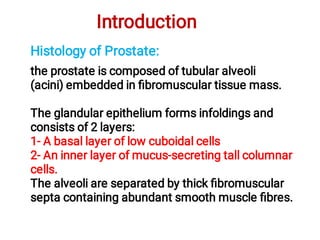
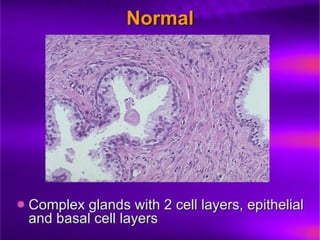
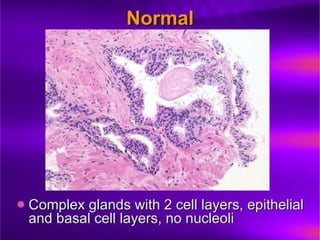
Histology of Prostate:
the prostate is composed of tubular alveoli
(acini) embedded in fibromuscular tissue mass.
The glandular epithelium forms infoldings and
consists of 2 layers:
1- A basal layer of low cuboidal cells
2- An inner layer of mucus-secreting tall columnar
cells.
The alveoli are separated by thick fibromuscular
septa containing abundant smooth muscle fibres.
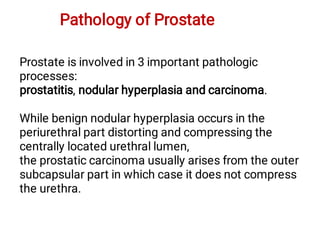
Pathology of Prostate
Prostate is involved in 3 important pathologic
processes:
prostatitis, nodular hyperplasia and carcinoma.
While benign nodular hyperplasia occurs in the
periurethral part distorting and compressing the
centrally located urethral lumen,
the prostatic carcinoma usually arises from the outer
subcapsular part in which case it does not compress
the urethra.
NODULAR HYPERPLASIA
• Non-neoplastic tumour-like enlargement of the
prostate,
commonly termed benign nodular hyperplasia
(BNH) or
benign enlargement of prostate (BEP)
• Is a very common
condition in men and considered by some as
normal ageing
process.
• More frequent above the age of 50 years and its
incidence approaches 75-80% in men above
80 years.
NODULAR HYPERPLASIA
ETIOLOGY :
The cause of BEP has not been fully established.
However, a few etiologic factors such as
endocrinologic, racial,
inflammation and arteriosclerosis have been
implicated but
endocrine basis for hyperplasia has been more fully
investigated and considered a strong possibility in its
genesis.
NODULAR HYPERPLASIA
The periurethral inner prostate
which is primarily involved in BEP is responsive
to the rising level of oestrogen, whereas the
outer prostate which is mainly involved in the
carcinoma is responsive to androgen.
NODULAR HYPERPLASIA
MORPHOLOGIC FEATURES :
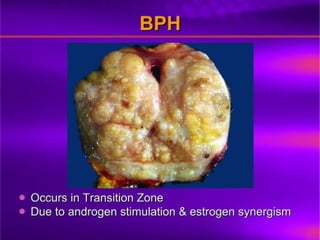
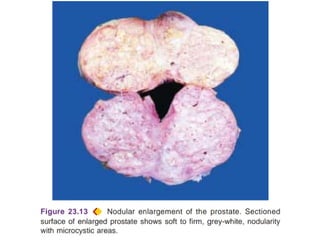
Grossly, the enlarged prostate is nodular, smooth
and firm and weighs 2-4 times its normal weight
i.e. may weigh up to 40-80 gm.
The appearance on cut section varies depending
upon whether the hyperplasia is predominantly of
the glandular or fibromuscular tissue.
NODULAR HYPERPLASIA
MORPHOLOGIC FEATURES :
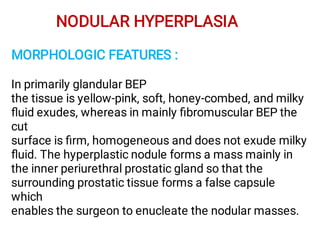
In primarily glandular BEP
the tissue is yellow-pink, soft, honey-combed, and milky
fluid exudes, whereas in mainly fibromuscular BEP the
cut
surface is firm, homogeneous and does not exude milky
fluid. The hyperplastic nodule forms a mass mainly in
the inner periurethral prostatic gland so that the
surrounding prostatic tissue forms a false capsule
which
enables the surgeon to enucleate the nodular masses.
NODULAR HYPERPLASIA
MORPHOLOGIC FEATURES :
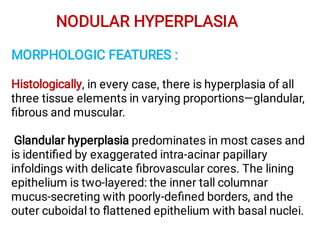
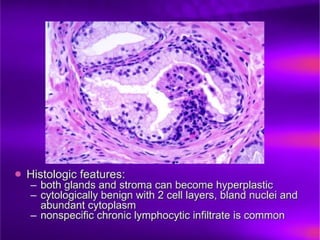
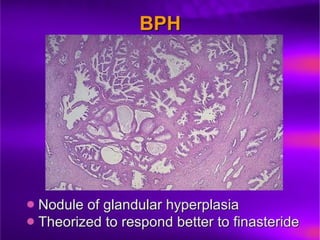
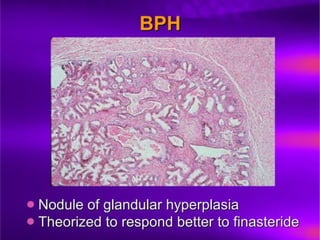
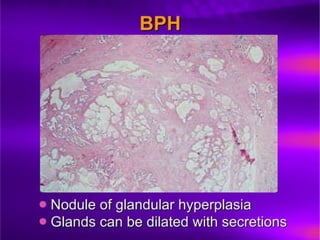
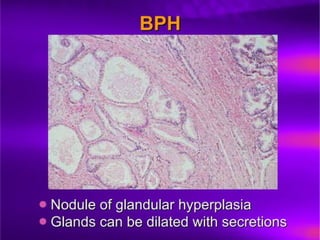
Histologically, in every case, there is hyperplasia of all
three tissue elements in varying proportions—glandular,
fibrous and muscular.
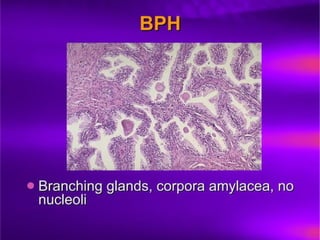
Glandular hyperplasia predominates in most cases and
is identified by exaggerated intra-acinar papillary
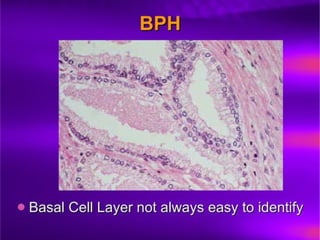
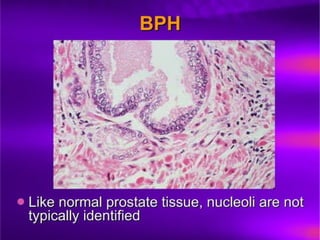
infoldings with delicate fibrovascular cores. The lining
epithelium is two-layered: the inner tall columnar
mucus-secreting with poorly-defined borders, and the
outer cuboidal to flattened epithelium with basal nuclei.
NODULAR HYPERPLASIA
MORPHOLOGIC FEATURES :
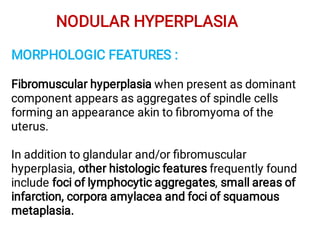
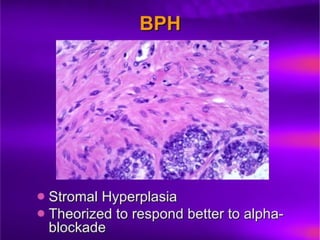
Fibromuscular hyperplasia when present as dominant
component appears as aggregates of spindle cells
forming an appearance akin to fibromyoma of the
uterus.
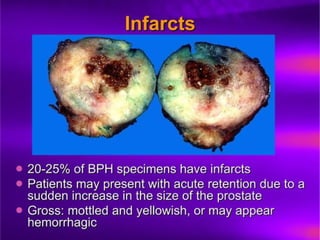
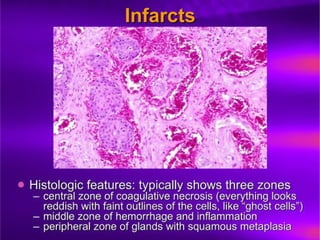
In addition to glandular and/or fibromuscular
hyperplasia, other histologic features frequently found
include foci of lymphocytic aggregates, small areas of
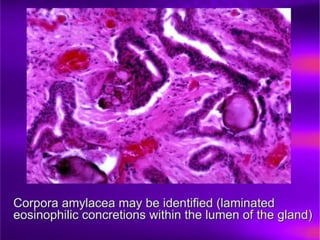
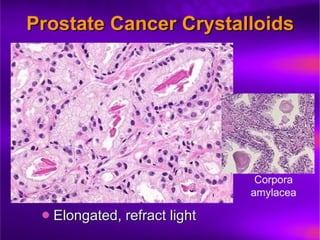
infarction, corpora amylacea and foci of squamous
metaplasia.
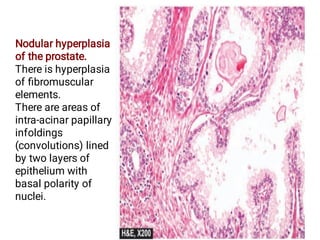
Nodular hyperplasia
of the prostate.
There is hyperplasia
of fibromuscular
elements.
There are areas of
intra-acinar papillary
infoldings
(convolutions) lined
by two layers of
epithelium with
basal polarity of
nuclei.
Complications of BPH
Prostate Cancer
Prostate cancer represents the second most common
cancer in men worldwide and the fifth most common
cause of cancer death in men;
in the United States, it is the most common cancer in
men and the second most common cause of cancer
deaths in men.
Acinar adenocarcinoma of the prostate comprises
90-95% of prostate cancers.
Introduction
Types of Prostate Cancer
4 Types :
1. Latent carcinoma.
2. Incidental carcinoma.
3. Occult carcinoma.
4. Clinical carcinoma.
Morphologic Features
Grossly :
The prostate may be enlarged, normal in size or
smaller than normal.
In 95% of cases, prostatic carcinoma is located in the
peripheral zone, especially in the posterior lobe.
The malignant prostate is firm and fibrous. Cut
section is homogeneous and contains irregular
yellowish areas.
Morphologic Features
Microscopically :
4 histologic types are described :
adenocarcinoma, transitional cell carcinoma,
squamous cell carcinoma and undifferentiated
carcinoma.
Adenocarcinoma is the most common type found in
90-95% of cases and is the one generally referred to
as carcinoma of the prostate.
The other three histologic types are rare
Etiology of Prostate Cancer
The cause of prostatic cancer remains obscure.
However, a few factors have been suspected.
These are as under:
1. Endocrinologic factors.
2. Racial and geographic influences.
3. Environmental influences.
4. Nodular hyperplasia.
5. Heredity.
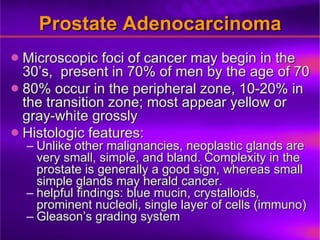
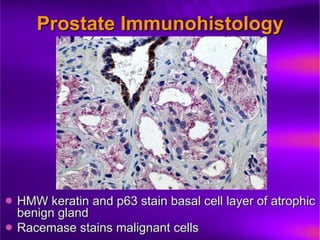
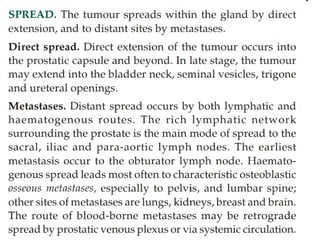
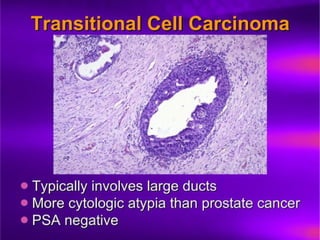
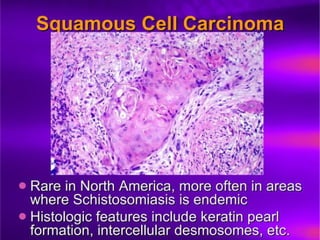
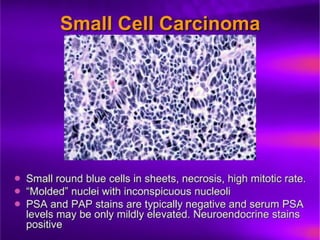
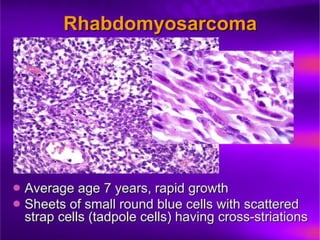
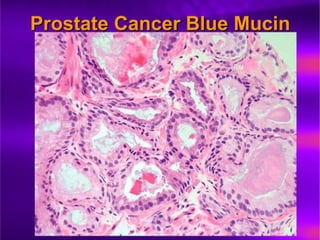
Other Histologic Types
of
Prostate Cancers
Prostate Pathophysiology23.ppt prostate cancer prostatic hyperplasia

Prostate Pathophysiology23.ppt prostate cancer prostatic hyperplasia

  • 1.
    Dr / MusaAlganadi Al-Hikma University Medical College , Level: 3rd
  • 3.
    Introduction Normal Structure ofProstate: The prostate gland in the normal adult weighs approximately 20 gm. It surrounds the commencement of the male urethra and is composed of 5 lobes during embryonic development— anterior, middle, posterior and two lateral lobes. But at birth, the five lobes fuse to form 3 distinct lobes—two major lateral lobes and a small median lobe
  • 4.
    Introduction The prostate hasnumerous blood vessels and nerves. In addition to nervous control, the prostate is an endocrine dependent organ. Based on hormonal responsiveness, the prostate is divided into 2 separate parts: 1- The inner periurethral female part which is sensitive to oestrogen and androgen. 2- The outer subcapsular true male part which is sensitive to androgen.
  • 5.
    Introduction Histology of Prostate: theprostate is composed of tubular alveoli (acini) embedded in fibromuscular tissue mass. The glandular epithelium forms infoldings and consists of 2 layers: 1- A basal layer of low cuboidal cells 2- An inner layer of mucus-secreting tall columnar cells. The alveoli are separated by thick fibromuscular septa containing abundant smooth muscle fibres.
  • 8.
    Pathology of Prostate Prostateis involved in 3 important pathologic processes: prostatitis, nodular hyperplasia and carcinoma. While benign nodular hyperplasia occurs in the periurethral part distorting and compressing the centrally located urethral lumen, the prostatic carcinoma usually arises from the outer subcapsular part in which case it does not compress the urethra.
  • 9.
    NODULAR HYPERPLASIA • Non-neoplastictumour-like enlargement of the prostate, commonly termed benign nodular hyperplasia (BNH) or benign enlargement of prostate (BEP) • Is a very common condition in men and considered by some as normal ageing process. • More frequent above the age of 50 years and its incidence approaches 75-80% in men above 80 years.
  • 10.
    NODULAR HYPERPLASIA ETIOLOGY : Thecause of BEP has not been fully established. However, a few etiologic factors such as endocrinologic, racial, inflammation and arteriosclerosis have been implicated but endocrine basis for hyperplasia has been more fully investigated and considered a strong possibility in its genesis.
  • 11.
    NODULAR HYPERPLASIA The periurethralinner prostate which is primarily involved in BEP is responsive to the rising level of oestrogen, whereas the outer prostate which is mainly involved in the carcinoma is responsive to androgen.
  • 12.
    NODULAR HYPERPLASIA MORPHOLOGIC FEATURES: Grossly, the enlarged prostate is nodular, smooth and firm and weighs 2-4 times its normal weight i.e. may weigh up to 40-80 gm. The appearance on cut section varies depending upon whether the hyperplasia is predominantly of the glandular or fibromuscular tissue.
  • 13.
    NODULAR HYPERPLASIA MORPHOLOGIC FEATURES: In primarily glandular BEP the tissue is yellow-pink, soft, honey-combed, and milky fluid exudes, whereas in mainly fibromuscular BEP the cut surface is firm, homogeneous and does not exude milky fluid. The hyperplastic nodule forms a mass mainly in the inner periurethral prostatic gland so that the surrounding prostatic tissue forms a false capsule which enables the surgeon to enucleate the nodular masses.
  • 16.
    NODULAR HYPERPLASIA MORPHOLOGIC FEATURES: Histologically, in every case, there is hyperplasia of all three tissue elements in varying proportions—glandular, fibrous and muscular. Glandular hyperplasia predominates in most cases and is identified by exaggerated intra-acinar papillary infoldings with delicate fibrovascular cores. The lining epithelium is two-layered: the inner tall columnar mucus-secreting with poorly-defined borders, and the outer cuboidal to flattened epithelium with basal nuclei.
  • 17.
    NODULAR HYPERPLASIA MORPHOLOGIC FEATURES: Fibromuscular hyperplasia when present as dominant component appears as aggregates of spindle cells forming an appearance akin to fibromyoma of the uterus. In addition to glandular and/or fibromuscular hyperplasia, other histologic features frequently found include foci of lymphocytic aggregates, small areas of infarction, corpora amylacea and foci of squamous metaplasia.
  • 18.
    Nodular hyperplasia of theprostate. There is hyperplasia of fibromuscular elements. There are areas of intra-acinar papillary infoldings (convolutions) lined by two layers of epithelium with basal polarity of nuclei.
  • 31.
  • 32.
    Prostate Cancer Prostate cancerrepresents the second most common cancer in men worldwide and the fifth most common cause of cancer death in men; in the United States, it is the most common cancer in men and the second most common cause of cancer deaths in men. Acinar adenocarcinoma of the prostate comprises 90-95% of prostate cancers. Introduction
  • 33.
    Types of ProstateCancer 4 Types : 1. Latent carcinoma. 2. Incidental carcinoma. 3. Occult carcinoma. 4. Clinical carcinoma.
  • 34.
    Morphologic Features Grossly : Theprostate may be enlarged, normal in size or smaller than normal. In 95% of cases, prostatic carcinoma is located in the peripheral zone, especially in the posterior lobe. The malignant prostate is firm and fibrous. Cut section is homogeneous and contains irregular yellowish areas.
  • 35.
    Morphologic Features Microscopically : 4histologic types are described : adenocarcinoma, transitional cell carcinoma, squamous cell carcinoma and undifferentiated carcinoma. Adenocarcinoma is the most common type found in 90-95% of cases and is the one generally referred to as carcinoma of the prostate. The other three histologic types are rare
  • 36.
    Etiology of ProstateCancer The cause of prostatic cancer remains obscure. However, a few factors have been suspected. These are as under: 1. Endocrinologic factors. 2. Racial and geographic influences. 3. Environmental influences. 4. Nodular hyperplasia. 5. Heredity.
  • 42.