UDIT RUSTAGI
B.TECH(CSE )
U.P.T.U
GENERATION OF
NETWORK
TECHNOLOGY

CONTENTS
 INTRODUCTION OF INTERNET TECHNOLOGY
 0G TECHNOLOGY
 1G TECHNOLOGY
 2G TECHNOLOGY
 2.5G TECHNOLOGY
 2.75 TECHNOLOGY
 3G TECHNOLOGY
 3.5G TECHNOLOGY
 4GLTE TECHNOLOGY
 5G TECHNOLOGY
 6G AIR FIBRE TECHNOLOGY
 CONCLUSION

LOOK OF 0G MODEL

0G TECHNOLOGY
 At the end of the 1940’s, the first radio telephone service was
introduced, and was designed to users in cars to the public
land-line based telephone network.
 In the 1960’s, a system launched by Bell Systems, called,
Improved Mobile Telephone Service (IMTS), brought quite a
few improvements such as direct dialing and more bandwidth.
The very first analog systems were based upon IMTS and were
created in the late 60s and early 70s.

1G TECHNOLOGY
(1G) is the original analog (An analog or analogue signal is any
continuous signal.
The time varying feature (variable) of the signal is a representation of
some other time varying quantity.
These are voice-only cellular telephone standard, developed in the
1980s.

LOOK OF 1G MODEL

TECHNOLOGY USED
 MTS (MOBILE TELEPHONE
SYSTEM).
 AMTS(ADVANCED MOBILE
TELEPHONE SYSTEM).
 IMTS (IMPROVED MOBILE
TELEPHONE SERVICE)
 PTT (PUSH TO TALK)

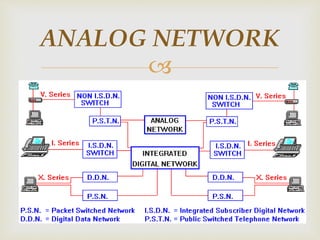
ANALOG NETWORK

DIGITAL NETWORK

DIFFERENCE BETWEEN
ANALOG AND DIGITAL
• There are different forms of signals one of them is the analog
signal. Different type of minute fluctuations are used for the
sake of process by analog signals. They also use the same
method to pass on the information between different places.
Wires are used for the processes of analog signals.
• Digital signals are quite different from the analog signals
because they are based on the numeric methods. Some times
they are said to be more reliable in the field of computer
technology because they are used to transfer data.

2G TECHNOLOGY
Fielded in the late 1980s & finished in late 1990s
Speed up to 64kbps
Digital handsets that are used today
voice transmission with digital signal

MOVE FROM 2G TO 3G
2G
3G

3G GENERATION
Speeds from 125kbps-2Mbps
WCDMA, WLAN Bluetooth & mobile devices area (cell phone & GPS)
Data sent through packet switching technology
Voice calls interpreted using circuit switching
Access to Global Roaming,Clarity in voice calls
Fast Communication,Internet, Mobile T.V, Video Conferencing,Video
Calls,(MMS), 3D gaming etc

3G MOBILE SYSTEM

3G Application,Market
&Service

FDMA,TDMA,CDMA

1G,2G,2.5G,3G CHART

Conceptual framework ,iscussion point to address
future needs of a high speed wireless network
Cellular,broadband multimedia services everywhere
2010 – 2015 arrival
Smooth global roaming everywhere with lower cost.

4G COMMUNICATION

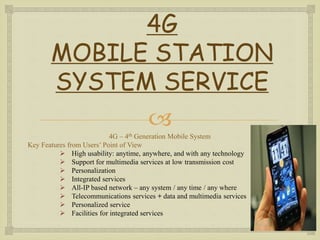
4G
MOBILE STATION
SYSTEM SERVICE
4G – 4th Generation Mobile System
Key Features from Users’ Point of View
 High usability: anytime, anywhere, and with any technology
 Support for multimedia services at low transmission cost
 Personalization
 Integrated services
 All-IP based network – any system / any time / any where
 Telecommunications services + data and multimedia services
 Personalized service
 Facilities for integrated services

5G WIRELESS
SYSTEM
 Complete wireless communication with
almost no limitation
 Multi-Media Newspapers, watch T.V
programs with the clarity as to that of an
HD T.V.
 Faster data transmission that of the
previous generations
 Real world wireless or called “WWWW:
World Wide Wireless Web.

EVOLUTION OF
CELLULAR SYSTEM

WHAT 5G
TECHNOLOGY
OFFERS??
World Wide Cellular phones
Extra ordinary data capabilities
High connectivity
Bright future

SPEED OF 5G

ADVANTAGE OF 5G
 The 5G Transmission is very good and less
time consuming process.
 In 5G Speed 100 movies download in just 3
seconds.
 This generation is 65,000 times faster than 4G
Current download.
 The downloading speed of 5G is 300Gbps.

LET SEE THE FUTURE
6G BPS
AIR
FIBRE

6G GENERATION

6G TECHNOLOGY

ADVANTAGE OF 6G
 6G AIR FIBRE WORKS ONLY IPV6(INTERNET PROTOCOL
VERSION 2).
 WE PLAY THE ONLINE GAMES WITH THE USE OF AIR
FIBRE TECHNOLOGY.
 ITS MAIN ADVANTAGE IN THE WIRELESS NETWORK
BECAUSE IT IS PROTOCOL VERSION IS UPDATED.

Udit

  • 1.
  • 2.
  • 3.
     CONTENTS  INTRODUCTION OFINTERNET TECHNOLOGY  0G TECHNOLOGY  1G TECHNOLOGY  2G TECHNOLOGY  2.5G TECHNOLOGY  2.75 TECHNOLOGY  3G TECHNOLOGY  3.5G TECHNOLOGY  4GLTE TECHNOLOGY  5G TECHNOLOGY  6G AIR FIBRE TECHNOLOGY  CONCLUSION
  • 4.
  • 5.
     0G TECHNOLOGY  Atthe end of the 1940’s, the first radio telephone service was introduced, and was designed to users in cars to the public land-line based telephone network.  In the 1960’s, a system launched by Bell Systems, called, Improved Mobile Telephone Service (IMTS), brought quite a few improvements such as direct dialing and more bandwidth. The very first analog systems were based upon IMTS and were created in the late 60s and early 70s.
  • 6.
     1G TECHNOLOGY (1G) isthe original analog (An analog or analogue signal is any continuous signal. The time varying feature (variable) of the signal is a representation of some other time varying quantity. These are voice-only cellular telephone standard, developed in the 1980s.
  • 7.
  • 8.
     TECHNOLOGY USED  MTS(MOBILE TELEPHONE SYSTEM).  AMTS(ADVANCED MOBILE TELEPHONE SYSTEM).  IMTS (IMPROVED MOBILE TELEPHONE SERVICE)  PTT (PUSH TO TALK)
  • 9.
  • 10.
  • 11.
     DIFFERENCE BETWEEN ANALOG ANDDIGITAL • There are different forms of signals one of them is the analog signal. Different type of minute fluctuations are used for the sake of process by analog signals. They also use the same method to pass on the information between different places. Wires are used for the processes of analog signals. • Digital signals are quite different from the analog signals because they are based on the numeric methods. Some times they are said to be more reliable in the field of computer technology because they are used to transfer data.
  • 12.
     2G TECHNOLOGY Fielded inthe late 1980s & finished in late 1990s Speed up to 64kbps Digital handsets that are used today voice transmission with digital signal
  • 13.
     MOVE FROM 2GTO 3G 2G 3G
  • 14.
     3G GENERATION Speeds from125kbps-2Mbps WCDMA, WLAN Bluetooth & mobile devices area (cell phone & GPS) Data sent through packet switching technology Voice calls interpreted using circuit switching Access to Global Roaming,Clarity in voice calls Fast Communication,Internet, Mobile T.V, Video Conferencing,Video Calls,(MMS), 3D gaming etc
  • 15.
  • 16.
  • 17.
  • 18.
  • 19.
     Conceptual framework ,iscussionpoint to address future needs of a high speed wireless network Cellular,broadband multimedia services everywhere 2010 – 2015 arrival Smooth global roaming everywhere with lower cost.
  • 20.
  • 21.
     4G MOBILE STATION SYSTEM SERVICE 4G– 4th Generation Mobile System Key Features from Users’ Point of View  High usability: anytime, anywhere, and with any technology  Support for multimedia services at low transmission cost  Personalization  Integrated services  All-IP based network – any system / any time / any where  Telecommunications services + data and multimedia services  Personalized service  Facilities for integrated services
  • 22.
     5G WIRELESS SYSTEM  Completewireless communication with almost no limitation  Multi-Media Newspapers, watch T.V programs with the clarity as to that of an HD T.V.  Faster data transmission that of the previous generations  Real world wireless or called “WWWW: World Wide Wireless Web.
  • 23.
  • 24.
     WHAT 5G TECHNOLOGY OFFERS?? World WideCellular phones Extra ordinary data capabilities High connectivity Bright future
  • 25.
  • 26.
     ADVANTAGE OF 5G The 5G Transmission is very good and less time consuming process.  In 5G Speed 100 movies download in just 3 seconds.  This generation is 65,000 times faster than 4G Current download.  The downloading speed of 5G is 300Gbps.
  • 27.
     LET SEE THEFUTURE 6G BPS AIR FIBRE
  • 28.
  • 29.
  • 30.
     ADVANTAGE OF 6G 6G AIR FIBRE WORKS ONLY IPV6(INTERNET PROTOCOL VERSION 2).  WE PLAY THE ONLINE GAMES WITH THE USE OF AIR FIBRE TECHNOLOGY.  ITS MAIN ADVANTAGE IN THE WIRELESS NETWORK BECAUSE IT IS PROTOCOL VERSION IS UPDATED.