Introduction SQL Analytics
on Lakehouse Architecture
Instructor: Doug Bateman
About Your Instructor
▪ Principal Data Engineering
Instructor at Databricks
▪ Joined Databricks in 2016
▪ 20+ Years of Industry Experience
Doug Bateman
About Your Instructor (Personal)
▪ Two children
▪ 2 and 5 years old
▪ For fun:
▪ Sailing
▪ Rock Climbing
▪ Snowboarding (badly)
▪ Chess (badly)
Doug Bateman
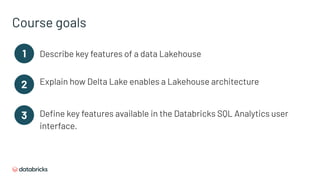
Course goals
Describe key features of a data Lakehouse
Explain how Delta Lake enables a Lakehouse architecture
1
2
3 Define key features available in the Databricks SQL Analytics user
interface.
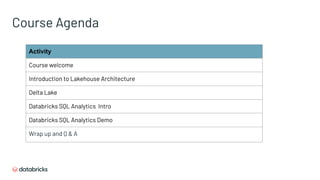
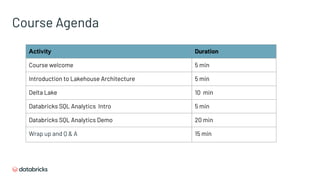
Course Agenda
Activity
Course welcome
Introduction to Lakehouse Architecture
Delta Lake
Databricks SQL Analytics Intro
Databricks SQL Analytics Demo
Wrap up and Q & A
Access the Slides
https://tinyurl.com/lakehouse-webinar
About You (Polls)
Introduction to Lakehouse Architecture
Data Driven Decisions
Data Warehouses
were purpose-built
for BI and reporting,
however…
▪ No support for video, audio, text
▪ No support for data science, ML
▪ Limited support for streaming
▪ Closed & proprietary formats
Therefore, most data is stored in
data lakes & blob stores
ETL
External Data Operational Data
Data Warehouses
BI Reports
Data Lakes
could store all your data
and determine what you
want to know later
▪ Poor BI support
▪ Complex to set up
▪ Poor performance
▪ Unreliable data swamps
BIData
Science
Machine
Learning
Structured, Semi-Structured and Unstructured
Data
Data Lake
Real-Time
Database
Reports
Data
Warehouses
Data Prep and
Validation
ETL
How do we get the best of both worlds?
BIData
Science
Machine
Learning
Structured, Semi-Structured and Unstructured
Data
Data Lake
Real-Time
Database
Reports
Data
Warehouses
Data Prep and
Validation
ETL
ETL
External Data Operational Data
Data Warehouses
BI Reports
Lakehouse
Data Warehouse Data Lake
Streaming
Analytics
BI Data
Science
Machine
Learning
Structured, Semi-Structured and Unstructured
Data
Lakehouse Summary
A Lakehouse has the following key features:
● support for diverse data types and formats
● data reliability and consistency
● support for diverse workloads (BI, data science, machine
learning, and analytics)
● ability to use BI tools directly on source data
The core components we need to build a Lakehouse
Building a Lakehouse
1. Your data lake (cloud blob storage, open source format)
2. Transaction layer to provide consistency (Delta)
3. ETL and data cleansing workflow (Spark + Databricks Delta Pipelines)
4. Security, data integrity, and performance (Databricks Delta Engine)
5. As well as integrations for all of your user communities:
a. SQL (Databricks SQL Analytics)
b. BI tools and dashboards
c. ML
d. Streaming
Delta Lake
Really cheap, durable storage
10 nines of durability. Cheap. Infinite scale.
The Emergence of Data Lakes
Store all types of raw data
Video, audio, text, structured, unstructured
Open, standardized formats
Parquet format, big ecosystem of tools operate on these file
formats
Challenges with data lakes
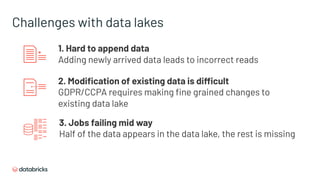
1. Hard to append data
Adding newly arrived data leads to incorrect reads
2. Modification of existing data is difficult
GDPR/CCPA requires making fine grained changes to
existing data lake
3. Jobs failing mid way
Half of the data appears in the data lake, the rest is missing
Challenges with data lakes
4. Real-time operations
Mixing streaming and batch leads to inconsistency
5. Costly to keep historical versions of the data
Regulated environments require reproducibility, auditing,
governance
6. Difficult to handle large metadata
For large data lakes the metadata itself becomes difficult to
manage
Challenges with data lakes
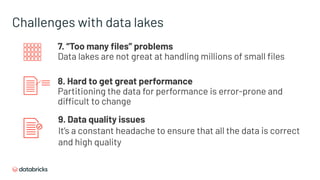
7. “Too many files” problems
Data lakes are not great at handling millions of small files
8. Hard to get great performance
Partitioning the data for performance is error-prone and
difficult to change
9. Data quality issues
It’s a constant headache to ensure that all the data is correct
and high quality
A new standard for building data lakes
An opinionated approach to
building Data Lakes
■ Adds reliability, quality,
performance to Data Lakes
■ Brings the best of data
warehousing and data lakes
■ Based on open source and
open format (Parquet) - Delta
Lake is also open source
1. Hard to append data
2. Modification of existing data difficult
3. Jobs failing mid way
4. Real-time operations hard
5. Costly to keep historical data versions
6. Difficult to handle large metadata
7. “Too many files” problems
8. Poor performance
9. Data quality issues
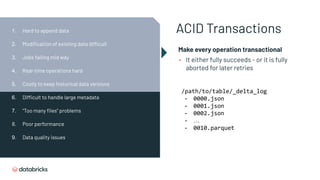
ACID Transactions
Make every operation transactional
• It either fully succeeds - or it is fully
aborted for later retries
/path/to/table/_delta_log
- 0000.json
- 0001.json
- 0002.json
- …
- 0010.parquet
1. Hard to append data
2. Modification of existing data difficult
3. Jobs failing mid way
4. Real-time operations hard
5. Costly to keep historical data versions
6. Difficult to handle large metadata
7. “Too many files” problems
8. Poor performance
9. Data quality issues
ACID Transactions
Make every operation transactional
• It either fully succeeds - or it is fully
aborted for later retries
/path/to/table/_delta_log
- 0000.json
- 0001.json
- 0002.json
- …
- 0010.parquet
{Add file1.parquet
Add file2.parquet
...
1. Hard to append data
2. Modification of existing data difficult
3. Jobs failing mid way
4. Real-time operations hard
5. Costly to keep historical data versions
6. Difficult to handle large metadata
7. “Too many files” problems
8. Poor performance
9. Data quality issues
ACID Transactions
Make every operation transactional
• It either fully succeeds - or it is fully
aborted for later retries
/path/to/table/_delta_log
- 0000.json
- 0001.json
- 0002.json
- …
- 0010.parquet
{Remove file1.parquet
Add file3.parquet
...
1. Hard to append data
2. Modification of existing data difficult
3. Jobs failing mid way
4. Real-time operations hard
5. Costly to keep historical data versions
6. Difficult to handle large metadata
7. “Too many files” problems
8. Poor performance
9. Data quality issues
ACID Transactions
Make every operation transactional
• It either fully succeeds - or it is fully
aborted for later retries
/path/to/table/_delta_log
- 0000.json
- 0001.json
- 0002.json
- …
- 0010.parquet
- 0010.json
- 0011.json
1. Hard to append data
2. Modification of existing data difficult
3. Jobs failing mid way
4. Real-time operations hard
5. Costly to keep historical data versions
6. Difficult to handle large metadata
7. “Too many files” problems
8. Poor performance
9. Data quality issues
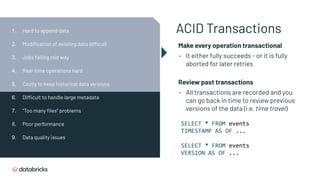
ACID Transactions
Make every operation transactional
• It either fully succeeds - or it is fully
aborted for later retries
Review past transactions
• All transactions are recorded and you
can go back in time to review previous
versions of the data (i.e. time travel)
SELECT * FROM events
TIMESTAMP AS OF ...
SELECT * FROM events
VERSION AS OF ...
1. Hard to append data
2. Modification of existing data difficult
3. Jobs failing mid way
4. Real-time operations hard
5. Costly to keep historical data versions
6. Difficult to handle large metadata
7. “Too many files” problems
8. Poor performance
9. Data quality issues
Spark under the hood
• Spark is built for handling large
amounts of data
• All Delta Lake metadata stored in open
Parquet format
• Portions of it cached and optimized for
fast access
• Data and it’s metadata always co-exist.
No need to keep catalog<>data in sync
1. Hard to append data
2. Modification of existing data difficult
3. Jobs failing mid way
4. Real-time operations hard
5. Costly to keep historical data versions
6. Difficult to handle large metadata
7. “Too many files” problems
8. Poor performance
9. Data quality issues
File Consolidation
Automatically optimize a layout that
enables fast access
• Partitioning: layout for typical queries
• Data skipping: prune files based on
statistics on numericals
• Z-ordering: layout to optimize multiple
columns
1. Hard to append data
2. Modification of existing data difficult
3. Jobs failing mid way
4. Real-time operations hard
5. Costly to keep historical data versions
6. Difficult to handle large metadata
7. “Too many files” problems
8. Poor performance
9. Data quality issues
OPTIMIZE events
ZORDER BY (eventType)
Schema validation
Schema validation and evolution
• All data in Delta Tables have to adhere
to a strict schema (star, etc)
• Includes schema evolution in merge
operations
1. Hard to append data
2. Modification of existing data difficult
3. Jobs failing mid way
4. Real-time operations hard
5. Costly to keep historical data versions
6. Difficult to handle large metadata
7. “Too many files” problems
8. Poor performance
9. Data quality issues
MERGE INTO events
USING changes
ON events.id = changes.id
WHEN MATCHED THEN
UPDATE SET *
WHEN NOT MATCHED THEN
INSERT *
Delta Lake Summary
▪ Core component of a Lakehouse
architecture
▪ Offers guaranteed consistency
because it's ACID compliant
▪ Robust data store
▪ Designed to work with Apache
Spark
Elements of Delta Lake
▪ Delta Architecture
▪ Delta Storage Layer
▪ Delta Engine
Delta architecture
AI &
Reporting
Streaming
Analytics
Bronze Silver Gold
Data quality
DATA
Raw
Ingestion
Filtered, Cleaned,
Augmented
Business level
Aggregates
Delta Storage Layer
Streaming
Analytics
BI Data
Science
Machine
Learning
Structured, Semi-Structured and Unstructured
Data
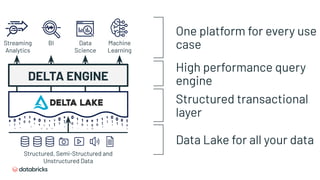
Data Lake for all your data
One platform for every use case
Structured transactional layer
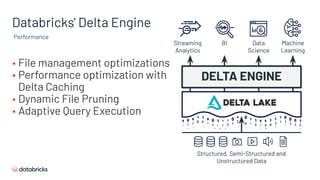
Databricks' Delta Engine
▪ File management optimizations
▪ Performance optimization with
Delta Caching
▪ Dynamic File Pruning
▪ Adaptive Query Execution
DELTA ENGINE
Streaming
Analytics
BI Data
Science
Machine
Learning
Structured, Semi-Structured and
Unstructured Data
Performance
High performance query
engineDELTA ENGINE
One platform for every use
caseStreaming
Analytics
BI Data
Science
Machine
Learning
Data Lake for all your data
Structured, Semi-Structured and
Unstructured Data
Structured transactional
layer
SQL Analytics
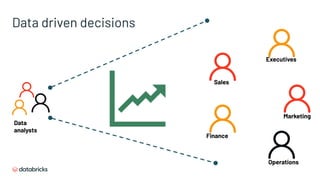
Data driven decisions
Data
analysts
Sales
Executives
Marketing
Operations
Finance
Challenges solved by Delta Lake
Stale dataIncomplete
data silos
Complexity
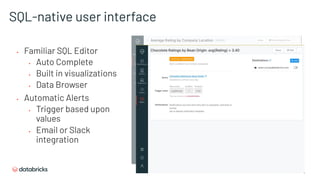
SQL-native user interface
▪ Familiar SQL Editor
▪ Auto Complete
▪ Built in visualizations
▪ Data Browser
SQL-native user interface
▪ Familiar SQL Editor
▪ Auto Complete
▪ Built in visualizations
▪ Data Browser
▪ Automatic Alerts
▪ Trigger based upon
values
▪ Email or Slack
integration
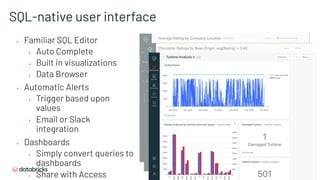
SQL-native user interface
▪ Familiar SQL Editor
▪ Auto Complete
▪ Built in visualizations
▪ Data Browser
▪ Automatic Alerts
▪ Trigger based upon
values
▪ Email or Slack
integration
▪ Dashboards
▪ Simply convert queries to
dashboards
▪ Share with Access
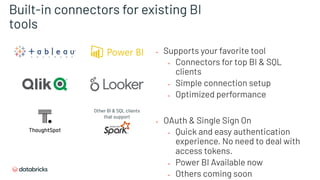
Built-in connectors for existing BI
tools
Other BI & SQL clients
that support
▪ Supports your favorite tool
▪ Connectors for top BI & SQL
clients
▪ Simple connection setup
▪ Optimized performance
▪ OAuth & Single Sign On
▪ Quick and easy authentication
experience. No need to deal with
access tokens.
▪ Power BI Available now
▪ Others coming soon
SQL Analytics Demo
Join us for Part 2
Login and use SQL Analytics hands-on:
Dec 15 at 10am (San Francisco Time)
Thanks for coming!
Setup &
Administration
SQL Endpoints
SQL Optimized Compute
SQL Endpoints give a quick way to setup
SQL / BI optimized compute. You pick a
tshirt size. Databricks will ensure
configuration that provides the highest
price/performance.
Concurrency Scaling Built-in
[Private Preview]
Virtual clusters can load balance queries
across multiple clusters behind the scenes,
providing unlimited concurrency.
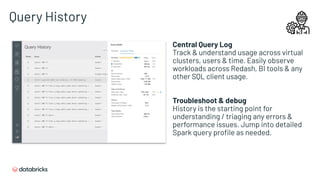
Query History
Central Query Log
Track & understand usage across virtual
clusters, users & time. Easily observe
workloads across Redash, BI tools & any
other SQL client usage.
Troubleshoot & debug
History is the starting point for
understanding / triaging any errors &
performance issues. Jump into detailed
Spark query profile as needed.
Performance
DATABRICKS CONFIDENTIAL
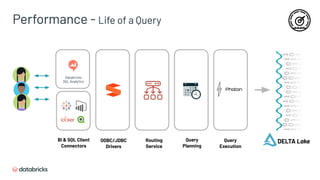
Performance - Life of a Query
DELTA LakeODBC/JDBC
Drivers
BI & SQL Client
Connectors
Routing
Service
Query
Planning
Query
Execution
Databricks
SQL Analytics
Up to 9x better price/performance
30TB TPC-DS Price/Performance
Lower is
better
Course Agenda
Activity Duration
Course welcome 5 min
Introduction to Lakehouse Architecture 5 min
Delta Lake 10 min
Databricks SQL Analytics Intro 5 min
Databricks SQL Analytics Demo 20 min
Wrap up and Q & A 15 min

Introduction SQL Analytics on Lakehouse Architecture

  • 1.
    Introduction SQL Analytics onLakehouse Architecture Instructor: Doug Bateman
  • 2.
    About Your Instructor ▪Principal Data Engineering Instructor at Databricks ▪ Joined Databricks in 2016 ▪ 20+ Years of Industry Experience Doug Bateman
  • 3.
    About Your Instructor(Personal) ▪ Two children ▪ 2 and 5 years old ▪ For fun: ▪ Sailing ▪ Rock Climbing ▪ Snowboarding (badly) ▪ Chess (badly) Doug Bateman
  • 4.
    Course goals Describe keyfeatures of a data Lakehouse Explain how Delta Lake enables a Lakehouse architecture 1 2 3 Define key features available in the Databricks SQL Analytics user interface.
  • 5.
    Course Agenda Activity Course welcome Introductionto Lakehouse Architecture Delta Lake Databricks SQL Analytics Intro Databricks SQL Analytics Demo Wrap up and Q & A
  • 6.
  • 7.
  • 8.
  • 9.
  • 10.
    Data Warehouses were purpose-built forBI and reporting, however… ▪ No support for video, audio, text ▪ No support for data science, ML ▪ Limited support for streaming ▪ Closed & proprietary formats Therefore, most data is stored in data lakes & blob stores ETL External Data Operational Data Data Warehouses BI Reports
  • 11.
    Data Lakes could storeall your data and determine what you want to know later ▪ Poor BI support ▪ Complex to set up ▪ Poor performance ▪ Unreliable data swamps BIData Science Machine Learning Structured, Semi-Structured and Unstructured Data Data Lake Real-Time Database Reports Data Warehouses Data Prep and Validation ETL
  • 12.
    How do weget the best of both worlds? BIData Science Machine Learning Structured, Semi-Structured and Unstructured Data Data Lake Real-Time Database Reports Data Warehouses Data Prep and Validation ETL ETL External Data Operational Data Data Warehouses BI Reports
  • 13.
    Lakehouse Data Warehouse DataLake Streaming Analytics BI Data Science Machine Learning Structured, Semi-Structured and Unstructured Data
  • 14.
    Lakehouse Summary A Lakehousehas the following key features: ● support for diverse data types and formats ● data reliability and consistency ● support for diverse workloads (BI, data science, machine learning, and analytics) ● ability to use BI tools directly on source data
  • 15.
    The core componentswe need to build a Lakehouse Building a Lakehouse 1. Your data lake (cloud blob storage, open source format) 2. Transaction layer to provide consistency (Delta) 3. ETL and data cleansing workflow (Spark + Databricks Delta Pipelines) 4. Security, data integrity, and performance (Databricks Delta Engine) 5. As well as integrations for all of your user communities: a. SQL (Databricks SQL Analytics) b. BI tools and dashboards c. ML d. Streaming
  • 16.
  • 17.
    Really cheap, durablestorage 10 nines of durability. Cheap. Infinite scale. The Emergence of Data Lakes Store all types of raw data Video, audio, text, structured, unstructured Open, standardized formats Parquet format, big ecosystem of tools operate on these file formats
  • 18.
    Challenges with datalakes 1. Hard to append data Adding newly arrived data leads to incorrect reads 2. Modification of existing data is difficult GDPR/CCPA requires making fine grained changes to existing data lake 3. Jobs failing mid way Half of the data appears in the data lake, the rest is missing
  • 19.
    Challenges with datalakes 4. Real-time operations Mixing streaming and batch leads to inconsistency 5. Costly to keep historical versions of the data Regulated environments require reproducibility, auditing, governance 6. Difficult to handle large metadata For large data lakes the metadata itself becomes difficult to manage
  • 20.
    Challenges with datalakes 7. “Too many files” problems Data lakes are not great at handling millions of small files 8. Hard to get great performance Partitioning the data for performance is error-prone and difficult to change 9. Data quality issues It’s a constant headache to ensure that all the data is correct and high quality
  • 21.
    A new standardfor building data lakes An opinionated approach to building Data Lakes ■ Adds reliability, quality, performance to Data Lakes ■ Brings the best of data warehousing and data lakes ■ Based on open source and open format (Parquet) - Delta Lake is also open source
  • 22.
    1. Hard toappend data 2. Modification of existing data difficult 3. Jobs failing mid way 4. Real-time operations hard 5. Costly to keep historical data versions 6. Difficult to handle large metadata 7. “Too many files” problems 8. Poor performance 9. Data quality issues
  • 23.
    ACID Transactions Make everyoperation transactional • It either fully succeeds - or it is fully aborted for later retries /path/to/table/_delta_log - 0000.json - 0001.json - 0002.json - … - 0010.parquet 1. Hard to append data 2. Modification of existing data difficult 3. Jobs failing mid way 4. Real-time operations hard 5. Costly to keep historical data versions 6. Difficult to handle large metadata 7. “Too many files” problems 8. Poor performance 9. Data quality issues
  • 24.
    ACID Transactions Make everyoperation transactional • It either fully succeeds - or it is fully aborted for later retries /path/to/table/_delta_log - 0000.json - 0001.json - 0002.json - … - 0010.parquet {Add file1.parquet Add file2.parquet ... 1. Hard to append data 2. Modification of existing data difficult 3. Jobs failing mid way 4. Real-time operations hard 5. Costly to keep historical data versions 6. Difficult to handle large metadata 7. “Too many files” problems 8. Poor performance 9. Data quality issues
  • 25.
    ACID Transactions Make everyoperation transactional • It either fully succeeds - or it is fully aborted for later retries /path/to/table/_delta_log - 0000.json - 0001.json - 0002.json - … - 0010.parquet {Remove file1.parquet Add file3.parquet ... 1. Hard to append data 2. Modification of existing data difficult 3. Jobs failing mid way 4. Real-time operations hard 5. Costly to keep historical data versions 6. Difficult to handle large metadata 7. “Too many files” problems 8. Poor performance 9. Data quality issues
  • 26.
    ACID Transactions Make everyoperation transactional • It either fully succeeds - or it is fully aborted for later retries /path/to/table/_delta_log - 0000.json - 0001.json - 0002.json - … - 0010.parquet - 0010.json - 0011.json 1. Hard to append data 2. Modification of existing data difficult 3. Jobs failing mid way 4. Real-time operations hard 5. Costly to keep historical data versions 6. Difficult to handle large metadata 7. “Too many files” problems 8. Poor performance 9. Data quality issues
  • 27.
    ACID Transactions Make everyoperation transactional • It either fully succeeds - or it is fully aborted for later retries Review past transactions • All transactions are recorded and you can go back in time to review previous versions of the data (i.e. time travel) SELECT * FROM events TIMESTAMP AS OF ... SELECT * FROM events VERSION AS OF ... 1. Hard to append data 2. Modification of existing data difficult 3. Jobs failing mid way 4. Real-time operations hard 5. Costly to keep historical data versions 6. Difficult to handle large metadata 7. “Too many files” problems 8. Poor performance 9. Data quality issues
  • 28.
    Spark under thehood • Spark is built for handling large amounts of data • All Delta Lake metadata stored in open Parquet format • Portions of it cached and optimized for fast access • Data and it’s metadata always co-exist. No need to keep catalog<>data in sync 1. Hard to append data 2. Modification of existing data difficult 3. Jobs failing mid way 4. Real-time operations hard 5. Costly to keep historical data versions 6. Difficult to handle large metadata 7. “Too many files” problems 8. Poor performance 9. Data quality issues
  • 29.
    File Consolidation Automatically optimizea layout that enables fast access • Partitioning: layout for typical queries • Data skipping: prune files based on statistics on numericals • Z-ordering: layout to optimize multiple columns 1. Hard to append data 2. Modification of existing data difficult 3. Jobs failing mid way 4. Real-time operations hard 5. Costly to keep historical data versions 6. Difficult to handle large metadata 7. “Too many files” problems 8. Poor performance 9. Data quality issues OPTIMIZE events ZORDER BY (eventType)
  • 30.
    Schema validation Schema validationand evolution • All data in Delta Tables have to adhere to a strict schema (star, etc) • Includes schema evolution in merge operations 1. Hard to append data 2. Modification of existing data difficult 3. Jobs failing mid way 4. Real-time operations hard 5. Costly to keep historical data versions 6. Difficult to handle large metadata 7. “Too many files” problems 8. Poor performance 9. Data quality issues MERGE INTO events USING changes ON events.id = changes.id WHEN MATCHED THEN UPDATE SET * WHEN NOT MATCHED THEN INSERT *
  • 31.
    Delta Lake Summary ▪Core component of a Lakehouse architecture ▪ Offers guaranteed consistency because it's ACID compliant ▪ Robust data store ▪ Designed to work with Apache Spark
  • 32.
    Elements of DeltaLake ▪ Delta Architecture ▪ Delta Storage Layer ▪ Delta Engine
  • 33.
    Delta architecture AI & Reporting Streaming Analytics BronzeSilver Gold Data quality DATA Raw Ingestion Filtered, Cleaned, Augmented Business level Aggregates
  • 34.
    Delta Storage Layer Streaming Analytics BIData Science Machine Learning Structured, Semi-Structured and Unstructured Data Data Lake for all your data One platform for every use case Structured transactional layer
  • 35.
    Databricks' Delta Engine ▪File management optimizations ▪ Performance optimization with Delta Caching ▪ Dynamic File Pruning ▪ Adaptive Query Execution DELTA ENGINE Streaming Analytics BI Data Science Machine Learning Structured, Semi-Structured and Unstructured Data Performance
  • 36.
    High performance query engineDELTAENGINE One platform for every use caseStreaming Analytics BI Data Science Machine Learning Data Lake for all your data Structured, Semi-Structured and Unstructured Data Structured transactional layer
  • 37.
  • 38.
  • 39.
    Challenges solved byDelta Lake Stale dataIncomplete data silos Complexity
  • 40.
    SQL-native user interface ▪Familiar SQL Editor ▪ Auto Complete ▪ Built in visualizations ▪ Data Browser
  • 41.
    SQL-native user interface ▪Familiar SQL Editor ▪ Auto Complete ▪ Built in visualizations ▪ Data Browser ▪ Automatic Alerts ▪ Trigger based upon values ▪ Email or Slack integration
  • 42.
    SQL-native user interface ▪Familiar SQL Editor ▪ Auto Complete ▪ Built in visualizations ▪ Data Browser ▪ Automatic Alerts ▪ Trigger based upon values ▪ Email or Slack integration ▪ Dashboards ▪ Simply convert queries to dashboards ▪ Share with Access
  • 43.
    Built-in connectors forexisting BI tools Other BI & SQL clients that support ▪ Supports your favorite tool ▪ Connectors for top BI & SQL clients ▪ Simple connection setup ▪ Optimized performance ▪ OAuth & Single Sign On ▪ Quick and easy authentication experience. No need to deal with access tokens. ▪ Power BI Available now ▪ Others coming soon
  • 44.
  • 45.
    Join us forPart 2 Login and use SQL Analytics hands-on: Dec 15 at 10am (San Francisco Time) Thanks for coming!
  • 46.
  • 47.
    SQL Endpoints SQL OptimizedCompute SQL Endpoints give a quick way to setup SQL / BI optimized compute. You pick a tshirt size. Databricks will ensure configuration that provides the highest price/performance. Concurrency Scaling Built-in [Private Preview] Virtual clusters can load balance queries across multiple clusters behind the scenes, providing unlimited concurrency.
  • 48.
    Query History Central QueryLog Track & understand usage across virtual clusters, users & time. Easily observe workloads across Redash, BI tools & any other SQL client usage. Troubleshoot & debug History is the starting point for understanding / triaging any errors & performance issues. Jump into detailed Spark query profile as needed.
  • 49.
  • 50.
    DATABRICKS CONFIDENTIAL Performance -Life of a Query DELTA LakeODBC/JDBC Drivers BI & SQL Client Connectors Routing Service Query Planning Query Execution Databricks SQL Analytics
  • 51.
    Up to 9xbetter price/performance 30TB TPC-DS Price/Performance Lower is better
  • 52.
    Course Agenda Activity Duration Coursewelcome 5 min Introduction to Lakehouse Architecture 5 min Delta Lake 10 min Databricks SQL Analytics Intro 5 min Databricks SQL Analytics Demo 20 min Wrap up and Q & A 15 min