Graph RAG Varieties
Atanas Kiryakov,
LDBC TUC Meeting, Aug 2024
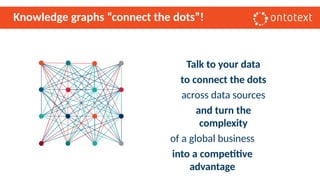
Knowledge graphs “connect the dots”!
Talk to your data
to connect the dots
across data sources
and turn the
complexity
of a global business
into a competitive
advantage
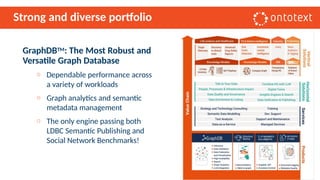
Strong and diverse portfolio
GraphDBTM: The Most Robust and
Versatile Graph Database
o Dependable performance across
a variety of workloads
o Graph analytics and semantic
metadata management
o The only engine passing both
LDBC Semantic Publishing and
Social Network Benchmarks!
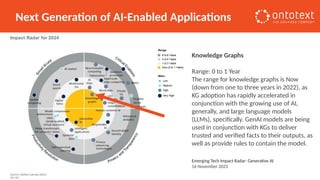
Next Generation of AI-Enabled Applications
Knowledge Graphs
Range: 0 to 1 Year
The range for knowledge graphs is Now
(down from one to three years in 2022), as
KG adoption has rapidly accelerated in
conjunction with the growing use of AI,
generally, and large language models
(LLMs), specifically. GenAI models are being
used in conjunction with KGs to deliver
trusted and verified facts to their outputs, as
well as provide rules to contain the model.
Emerging Tech Impact Radar: Generative AI
16 November 2023
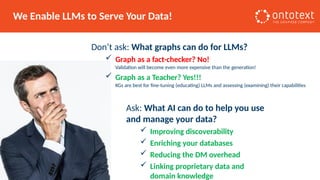
We Enable LLMs to Serve Your Data!
Don’t ask: What graphs can do for LLMs?
 Graph as a fact-checker? No!
Validation will become even more expensive than the generation!
 Graph as a Teacher? Yes!!!
KGs are best for fine-tuning (educating) LLMs and assessing (examining) their capabilities
Ask: What AI can do to help you use
and manage your data?
 Improving discoverability
 Enriching your databases
 Reducing the DM overhead
 Linking proprietary data and
domain knowledge
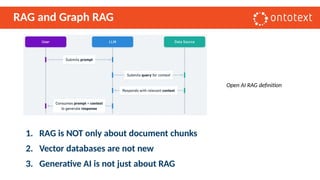
RAG and Graph RAG
1. RAG is NOT only about document chunks
2. Vector databases are not new
3. Generative AI is not just about RAG
Open AI RAG definition
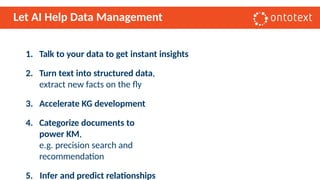
Let AI Help Data Management
1. Talk to your data to get instant insights
2. Turn text into structured data,
extract new facts on the fly
3. Accelerate KG development
4. Categorize documents to
power KM,
e.g. precision search and
recommendation
5. Infer and predict relationships
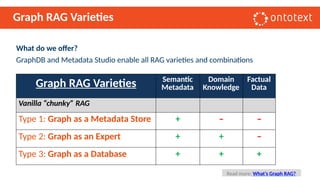
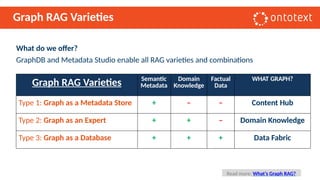
Graph RAG Varieties
What do we offer?
GraphDB and Metadata Studio enable all RAG varieties and combinations
Read more: What’s Graph RAG?
Graph RAG Varieties Semantic
Metadata
Domain
Knowledge
Factual
Data
Vanilla “chunky” RAG
Type 1: Graph as a Metadata Store + – –
Type 2: Graph as аn Expert + + –
Type 3: Graph as a Database + + +
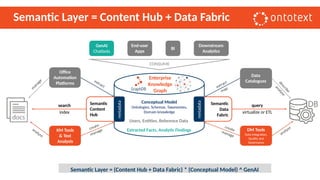
Semantic Layer = Content Hub + Data Fabric
GenAI
Chatbots
Downstream
Analytics
End-user
Apps
BI
CONSUME
KM Tools
& Text
Analysis
Office
Automation
Platforms
Data
Catalogues
DM Tools
Data Integration,
Quality and
Governance
Semantic Layer = (Content Hub + Data Fabric) * (Conceptual Model) ^ GenAI
Conceptual Model
Ontologies, Schemas, Taxonomies,
Domain knowledge
Users, Entities, Reference Data
Extracted Facts, Analytic Findings
Enterprise
Knowledge
Graph
search
index
Semantic
Content
Hub
metadata
query
virtualize or ETL
Semantic
Data
Fabric
metadata
Graph RAG Varieties
What do we offer?
GraphDB and Metadata Studio enable all RAG varieties and combinations
Read more: What’s Graph RAG?
Graph RAG Varieties Semantic
Metadata
Domain
Knowledge
Factual
Data
WHAT GRAPH?
Type 1: Graph as a Metadata Store + – – Content Hub
Type 2: Graph as аn Expert + + – Domain Knowledge
Type 3: Graph as a Database + + + Data Fabric
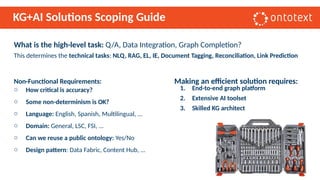
KG+AI Solutions Scoping Guide
1. End-to-end graph platform
2. Extensive AI toolset
3. Skilled KG architect
What is the high-level task: Q/A, Data Integration, Graph Completion?
This determines the technical tasks: NLQ, RAG, EL, IE, Document Tagging, Reconciliation, Link Prediction
Non-Functional Requirements: Making an efficient solution requires:
o How critical is accuracy?
o Some non-determinism is OK?
o Language: English, Spanish, Multilingual, …
o Domain: General, LSC, FSI, …
o Can we reuse a public ontology: Yes/No
o Design pattern: Data Fabric, Content Hub, …
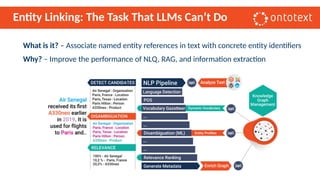
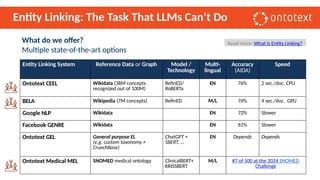
Entity Linking: The Task That LLMs Can’t Do
What is it? – Associate named entity references in text with concrete entity identifiers
Why? – Improve the performance of NLQ, RAG, and information extraction
Entity Linking: The Task That LLMs Can’t Do
Read more: What is Entity Linking?
Entity Linking System Reference Data or Graph Model /
Technology
Multi-
lingual
Accuracy
(AIDA)
Speed
Ontotext CEEL Wikidata (38M concepts
recognized out of 100M)
RefinED/
RoBERTa
EN 76% 2 sec./doc. CPU
BELA Wikipedia (7M concepts) RefinED M/L 74% 4 sec./doc. GPU
Google NLP Wikidata EN 72% Slower
Facebook GENRE Wikidata EN 61% Slower
Ontotext GEL General purpose EL
(e.g. custom taxonomy +
CrunchBase)
ChatGPT +
SBERT, …
EN Depends Depends
Ontotext Medical MEL SNOMED medical ontology ClinicalBERT+
KRISSBERT
M/L #7 of 500 at the 2024 SNOMED
Challenge
What do we offer?
Multiple state-of-the-art options
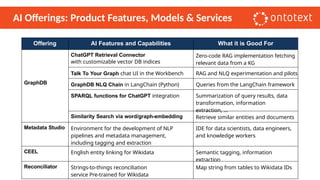
AI Offerings: Product Features, Models & Services
Offering AI Features and Capabilities What it is Good For
GraphDB
ChatGPT Retrieval Connector
with customizable vector DB indices
Zero-code RAG implementation fetching
relevant data from a KG
Talk To Your Graph chat UI in the Workbench RAG and NLQ experimentation and pilots
GraphDB NLQ Chain in LangChain (Python) Queries from the LangChain framework
SPARQL functions for ChatGPT integration Summarization of query results, data
transformation, information
extraction, …
Similarity Search via word/graph-embedding Retrieve similar entities and documents
Metadata Studio Environment for the development of NLP
pipelines and metadata management,
including tagging and extraction
IDE for data scientists, data engineers,
and knowledge workers
CEEL English entity linking for Wikidata Semantic tagging, information
extraction
Reconciliator Strings-to-things reconciliation
service Pre-trained for Wikidata
Map string from tables to Wikidata IDs
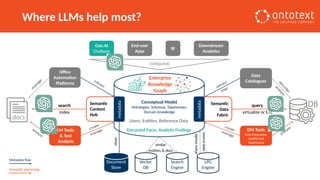
Where LLMs help most?
Metadata flow
Semantic processing
Gen.AI
Chatbots
Downstream
Analytics
End-user
Apps
BI
CONSUME
Vector
DB
Search
Engine
similar
entities & docs
LPG
Engine
source
data
share
results
KM Tools
& Text
Analysis
Office
Automation
Platforms
Data
Catalogues
DM Tools
Data Integration,
Quality and
Governance
Conceptual Model
Ontologies, Schemas, Taxonomies,
Domain knowledge
Users, Entities, Reference Data
Extracted Facts, Analytic Findings
Enterprise
Knowledge
Graph
search
index
Semantic
Content
Hub
metadata
query
virtualize or ETL
Semantic
Data
Fabric
metadata
Document
Store
store
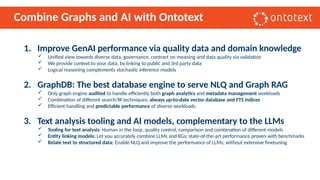
Combine Graphs and AI with Ontotext
1. Improve GenAI performance via quality data and domain knowledge
 Unified view towards diverse data, governance, contract on meaning and data quality via validation
 We provide context to your data, by linking to public and 3rd party data
 Logical reasoning complements stochastic inference models
2. GraphDB: The best database engine to serve NLQ and Graph RAG
 Only graph engine audited to handle efficiently both graph analytics and metadata management workloads
 Combination of different search/IR techniques; always up-to-date vector database and FTS indices
 Efficient handling and predictable performance of diverse workloads
3. Text analysis tooling and AI models, complementary to the LLMs
 Tooling for text analysis: Human in the loop, quality control, comparison and combination of different models
 Entity linking models: Let you accurately combine LLMs and KGs; state-of-the-art performance proven with benchmarks
 Relate text to structured data: Enable NLQ and improve the performance of LLMs, without extensive finetuning
Graph+AI Opinion Maker
We are on 1st page in Google for:
 Knowledge graphs (#3)
 Linked data (#1)
 Semantic annotation (#1)
 SPARQL (#1)
 Graph RAG (#1)
 Entity linking (#3)
 NLQ (#3)
Join the Graph & AI in Action
LinkedIn Group!
And promote your KG+AI story
We make AI help you use
and manage your data
The “NASA RAG Problem”
The task: Find a document mentioning NASA when searching for “Government Agency”
Demo Context: Ask the OTKG chat about “U.S. Gov customers of Ontotext”
The challenges:
1. Naïve RAG doesn’t work, because there is no mention of government in the chunk
2. There are too many chunks that mention U.S. Gov. organizations
The Chunky RAG Limitations
Graph RAG Type 2 approach:
1. Use CEEL Entity Linking to tag documents with
mentions of Wikidata entities
2. Enrich chunks with entity descriptions from WD
▪ The enriched chunks, mentioning NASA, also mention
US Gov. as part of NASA’s description
▪ We also implemented question enrichment
3. Use GraphDB’s ChatGPT Retrieval Connector
for zero-code RAG
It didn’t solve “The NASA problem”
1. There were 100s of chunks relevant
to the question
2. We can only pass ~10 to ChatGPT
3. All the 4 chunks mentioning NASA
scored beyond position 20, because
there were more relevant chunks
The Chunky RAG Axiom:
If the information required to answer the question is spread across more chunks
than what we can pass to the LLM, the answer will be incomplete.
Read the full story in “Okay, RAG… We Have a Problem” AI-in-Action blog
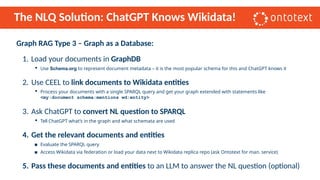
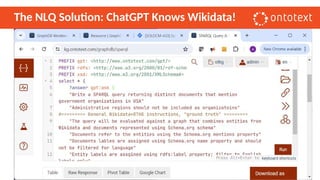
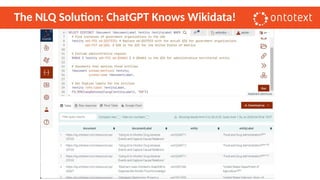
The NLQ Solution: ChatGPT Knows Wikidata!
Graph RAG Type 3 – Graph as a Database:
1. Load your documents in GraphDB
▪ Use Schema.org to represent document metadata – it is the most popular schema for this and ChatGPT knows it
2. Use CEEL to link documents to Wikidata entities
▪ Process your documents with a single SPARQL query and get your graph extended with statements like
<my:document schema:mentions wd:entity>
3. Ask ChatGPT to convert NL question to SPARQL
▪ Tell ChatGPT what’s in the graph and what schemata are used
4. Get the relevant documents and entities
▪ Evaluate the SPARQL query
▪ Access Wikidata via federation or load your data next to Wikidata replica repo (ask Ontotext for man. service)
5. Pass these documents and entities to an LLM to answer the NL question (optional)
The NLQ Solution: ChatGPT Knows Wikidata!
Why does this experiment matter?
1. Wikidata is an example of a general-purpose source of “semantic context”
2. Every engineer can implement custom Graph RAG with 5 SPARQL queries, zero code
3. One can combine existing ontologies with proprietary data
4. We can provide all the tools, AI models and services needed to:
▪ Let your engineers play with the data and develop the basics
▪ Make a PoV and demonstrate it to customers or sponsors
▪ Control the quality and manage production system

Graph RAG Varieties and Their Enterprise Applications

  • 1.
    Graph RAG Varieties AtanasKiryakov, LDBC TUC Meeting, Aug 2024
  • 2.
    Knowledge graphs “connectthe dots”! Talk to your data to connect the dots across data sources and turn the complexity of a global business into a competitive advantage
  • 3.
    Strong and diverseportfolio GraphDBTM: The Most Robust and Versatile Graph Database o Dependable performance across a variety of workloads o Graph analytics and semantic metadata management o The only engine passing both LDBC Semantic Publishing and Social Network Benchmarks!
  • 4.
    Next Generation ofAI-Enabled Applications Knowledge Graphs Range: 0 to 1 Year The range for knowledge graphs is Now (down from one to three years in 2022), as KG adoption has rapidly accelerated in conjunction with the growing use of AI, generally, and large language models (LLMs), specifically. GenAI models are being used in conjunction with KGs to deliver trusted and verified facts to their outputs, as well as provide rules to contain the model. Emerging Tech Impact Radar: Generative AI 16 November 2023
  • 5.
    We Enable LLMsto Serve Your Data! Don’t ask: What graphs can do for LLMs?  Graph as a fact-checker? No! Validation will become even more expensive than the generation!  Graph as a Teacher? Yes!!! KGs are best for fine-tuning (educating) LLMs and assessing (examining) their capabilities Ask: What AI can do to help you use and manage your data?  Improving discoverability  Enriching your databases  Reducing the DM overhead  Linking proprietary data and domain knowledge
  • 6.
    RAG and GraphRAG 1. RAG is NOT only about document chunks 2. Vector databases are not new 3. Generative AI is not just about RAG Open AI RAG definition
  • 7.
    Let AI HelpData Management 1. Talk to your data to get instant insights 2. Turn text into structured data, extract new facts on the fly 3. Accelerate KG development 4. Categorize documents to power KM, e.g. precision search and recommendation 5. Infer and predict relationships
  • 8.
    Graph RAG Varieties Whatdo we offer? GraphDB and Metadata Studio enable all RAG varieties and combinations Read more: What’s Graph RAG? Graph RAG Varieties Semantic Metadata Domain Knowledge Factual Data Vanilla “chunky” RAG Type 1: Graph as a Metadata Store + – – Type 2: Graph as аn Expert + + – Type 3: Graph as a Database + + +
  • 9.
    Semantic Layer =Content Hub + Data Fabric GenAI Chatbots Downstream Analytics End-user Apps BI CONSUME KM Tools & Text Analysis Office Automation Platforms Data Catalogues DM Tools Data Integration, Quality and Governance Semantic Layer = (Content Hub + Data Fabric) * (Conceptual Model) ^ GenAI Conceptual Model Ontologies, Schemas, Taxonomies, Domain knowledge Users, Entities, Reference Data Extracted Facts, Analytic Findings Enterprise Knowledge Graph search index Semantic Content Hub metadata query virtualize or ETL Semantic Data Fabric metadata
  • 10.
    Graph RAG Varieties Whatdo we offer? GraphDB and Metadata Studio enable all RAG varieties and combinations Read more: What’s Graph RAG? Graph RAG Varieties Semantic Metadata Domain Knowledge Factual Data WHAT GRAPH? Type 1: Graph as a Metadata Store + – – Content Hub Type 2: Graph as аn Expert + + – Domain Knowledge Type 3: Graph as a Database + + + Data Fabric
  • 11.
    KG+AI Solutions ScopingGuide 1. End-to-end graph platform 2. Extensive AI toolset 3. Skilled KG architect What is the high-level task: Q/A, Data Integration, Graph Completion? This determines the technical tasks: NLQ, RAG, EL, IE, Document Tagging, Reconciliation, Link Prediction Non-Functional Requirements: Making an efficient solution requires: o How critical is accuracy? o Some non-determinism is OK? o Language: English, Spanish, Multilingual, … o Domain: General, LSC, FSI, … o Can we reuse a public ontology: Yes/No o Design pattern: Data Fabric, Content Hub, …
  • 12.
    Entity Linking: TheTask That LLMs Can’t Do What is it? – Associate named entity references in text with concrete entity identifiers Why? – Improve the performance of NLQ, RAG, and information extraction
  • 13.
    Entity Linking: TheTask That LLMs Can’t Do Read more: What is Entity Linking? Entity Linking System Reference Data or Graph Model / Technology Multi- lingual Accuracy (AIDA) Speed Ontotext CEEL Wikidata (38M concepts recognized out of 100M) RefinED/ RoBERTa EN 76% 2 sec./doc. CPU BELA Wikipedia (7M concepts) RefinED M/L 74% 4 sec./doc. GPU Google NLP Wikidata EN 72% Slower Facebook GENRE Wikidata EN 61% Slower Ontotext GEL General purpose EL (e.g. custom taxonomy + CrunchBase) ChatGPT + SBERT, … EN Depends Depends Ontotext Medical MEL SNOMED medical ontology ClinicalBERT+ KRISSBERT M/L #7 of 500 at the 2024 SNOMED Challenge What do we offer? Multiple state-of-the-art options
  • 14.
    AI Offerings: ProductFeatures, Models & Services Offering AI Features and Capabilities What it is Good For GraphDB ChatGPT Retrieval Connector with customizable vector DB indices Zero-code RAG implementation fetching relevant data from a KG Talk To Your Graph chat UI in the Workbench RAG and NLQ experimentation and pilots GraphDB NLQ Chain in LangChain (Python) Queries from the LangChain framework SPARQL functions for ChatGPT integration Summarization of query results, data transformation, information extraction, … Similarity Search via word/graph-embedding Retrieve similar entities and documents Metadata Studio Environment for the development of NLP pipelines and metadata management, including tagging and extraction IDE for data scientists, data engineers, and knowledge workers CEEL English entity linking for Wikidata Semantic tagging, information extraction Reconciliator Strings-to-things reconciliation service Pre-trained for Wikidata Map string from tables to Wikidata IDs
  • 15.
    Where LLMs helpmost? Metadata flow Semantic processing Gen.AI Chatbots Downstream Analytics End-user Apps BI CONSUME Vector DB Search Engine similar entities & docs LPG Engine source data share results KM Tools & Text Analysis Office Automation Platforms Data Catalogues DM Tools Data Integration, Quality and Governance Conceptual Model Ontologies, Schemas, Taxonomies, Domain knowledge Users, Entities, Reference Data Extracted Facts, Analytic Findings Enterprise Knowledge Graph search index Semantic Content Hub metadata query virtualize or ETL Semantic Data Fabric metadata Document Store store
  • 16.
    Combine Graphs andAI with Ontotext 1. Improve GenAI performance via quality data and domain knowledge  Unified view towards diverse data, governance, contract on meaning and data quality via validation  We provide context to your data, by linking to public and 3rd party data  Logical reasoning complements stochastic inference models 2. GraphDB: The best database engine to serve NLQ and Graph RAG  Only graph engine audited to handle efficiently both graph analytics and metadata management workloads  Combination of different search/IR techniques; always up-to-date vector database and FTS indices  Efficient handling and predictable performance of diverse workloads 3. Text analysis tooling and AI models, complementary to the LLMs  Tooling for text analysis: Human in the loop, quality control, comparison and combination of different models  Entity linking models: Let you accurately combine LLMs and KGs; state-of-the-art performance proven with benchmarks  Relate text to structured data: Enable NLQ and improve the performance of LLMs, without extensive finetuning
  • 17.
    Graph+AI Opinion Maker Weare on 1st page in Google for:  Knowledge graphs (#3)  Linked data (#1)  Semantic annotation (#1)  SPARQL (#1)  Graph RAG (#1)  Entity linking (#3)  NLQ (#3) Join the Graph & AI in Action LinkedIn Group! And promote your KG+AI story
  • 18.
    We make AIhelp you use and manage your data
  • 19.
    The “NASA RAGProblem” The task: Find a document mentioning NASA when searching for “Government Agency” Demo Context: Ask the OTKG chat about “U.S. Gov customers of Ontotext” The challenges: 1. Naïve RAG doesn’t work, because there is no mention of government in the chunk 2. There are too many chunks that mention U.S. Gov. organizations
  • 20.
    The Chunky RAGLimitations Graph RAG Type 2 approach: 1. Use CEEL Entity Linking to tag documents with mentions of Wikidata entities 2. Enrich chunks with entity descriptions from WD ▪ The enriched chunks, mentioning NASA, also mention US Gov. as part of NASA’s description ▪ We also implemented question enrichment 3. Use GraphDB’s ChatGPT Retrieval Connector for zero-code RAG It didn’t solve “The NASA problem” 1. There were 100s of chunks relevant to the question 2. We can only pass ~10 to ChatGPT 3. All the 4 chunks mentioning NASA scored beyond position 20, because there were more relevant chunks The Chunky RAG Axiom: If the information required to answer the question is spread across more chunks than what we can pass to the LLM, the answer will be incomplete. Read the full story in “Okay, RAG… We Have a Problem” AI-in-Action blog
  • 21.
    The NLQ Solution:ChatGPT Knows Wikidata! Graph RAG Type 3 – Graph as a Database: 1. Load your documents in GraphDB ▪ Use Schema.org to represent document metadata – it is the most popular schema for this and ChatGPT knows it 2. Use CEEL to link documents to Wikidata entities ▪ Process your documents with a single SPARQL query and get your graph extended with statements like <my:document schema:mentions wd:entity> 3. Ask ChatGPT to convert NL question to SPARQL ▪ Tell ChatGPT what’s in the graph and what schemata are used 4. Get the relevant documents and entities ▪ Evaluate the SPARQL query ▪ Access Wikidata via federation or load your data next to Wikidata replica repo (ask Ontotext for man. service) 5. Pass these documents and entities to an LLM to answer the NL question (optional)
  • 22.
    The NLQ Solution:ChatGPT Knows Wikidata!
  • 23.
    The NLQ Solution:ChatGPT Knows Wikidata!
  • 24.
    Why does thisexperiment matter? 1. Wikidata is an example of a general-purpose source of “semantic context” 2. Every engineer can implement custom Graph RAG with 5 SPARQL queries, zero code 3. One can combine existing ontologies with proprietary data 4. We can provide all the tools, AI models and services needed to: ▪ Let your engineers play with the data and develop the basics ▪ Make a PoV and demonstrate it to customers or sponsors ▪ Control the quality and manage production system