Knowledge Discovery Quest
1
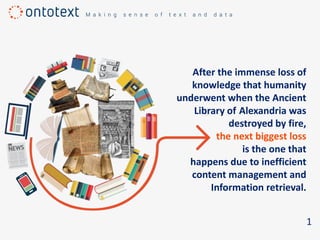
After the immense loss of
knowledge that humanity
underwent when the Ancient
Library of Alexandria was
destroyed by fire,
the next biggest loss
is the one that
happens due to inefficient
content management and
Information retrieval.
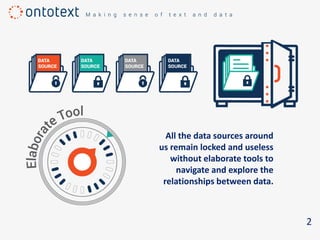
All the data sources around
us remain locked and useless
without elaborate tools to
navigate and explore the
relationships between data.
2
3
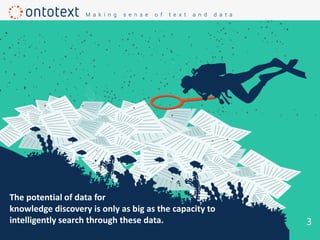
The potential of data for
knowledge discovery is only as big as the capacity to
intelligently search through these data.
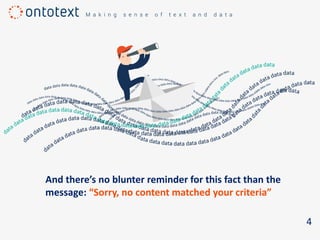
And there’s no blunter reminder for this fact than the
message: “Sorry, no content matched your criteria”
4
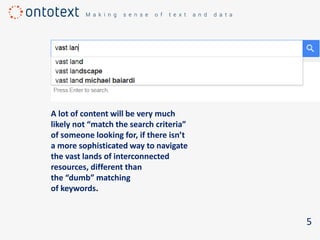
A lot of content will be very much
likely not “match the search criteria”
of someone looking for, if there isn’t
a more sophisticated way to navigate
the vast lands of interconnected
resources, different than
the “dumb” matching
of keywords.
5
6
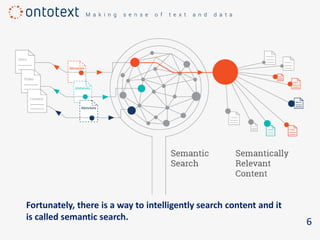
Fortunately, there is a way to intelligently search content and it
is called semantic search.
7
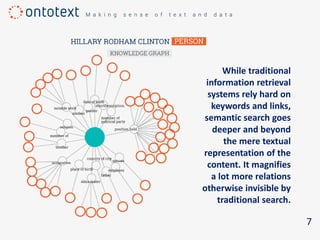
While traditional
information retrieval
systems rely hard on
keywords and links,
semantic search goes
deeper and beyond
the mere textual
representation of the
content. It magnifies
a lot more relations
otherwise invisible by
traditional search.
8
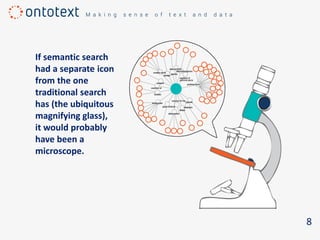
If semantic search
had a separate icon
from the one
traditional search
has (the ubiquitous
magnifying glass),
it would probably
have been a
microscope.
9
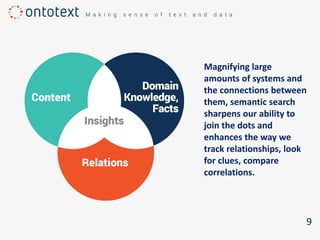
Magnifying large
amounts of systems and
the connections between
them, semantic search
sharpens our ability to
join the dots and
enhances the way we
track relationships, look
for clues, compare
correlations.
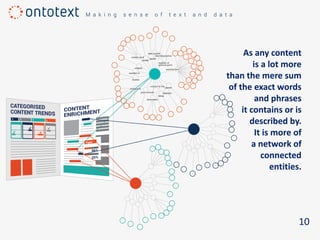
As any content
is a lot more
than the mere sum
of the exact words
and phrases
it contains or is
described by.
It is more of
a network of
connected
entities.
10
11
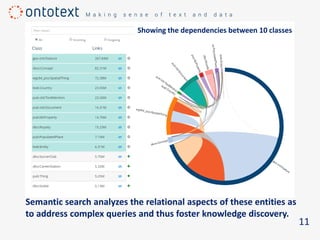
Semantic search analyzes the relational aspects of these entities as
to address complex queries and thus foster knowledge discovery.
Showing the dependencies between 10 classes
12
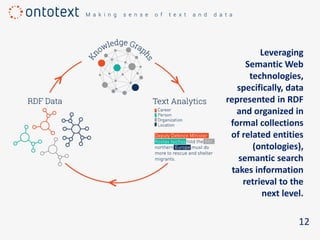
Leveraging
Semantic Web
technologies,
specifically, data
represented in RDF
and organized in
formal collections
of related entities
(ontologies),
semantic search
takes information
retrieval to the
next level.
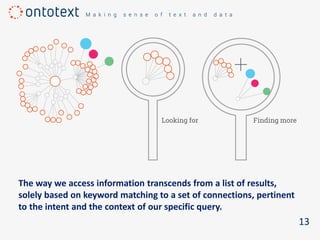
The way we access information transcends from a list of results,
solely based on keyword matching to a set of connections, pertinent
to the intent and the context of our specific query.
13
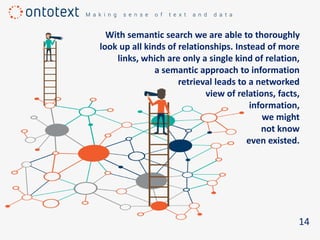
With semantic search we are able to thoroughly
look up all kinds of relationships. Instead of more
links, which are only a single kind of relation,
a semantic approach to information
retrieval leads to a networked
view of relations, facts,
information,
we might
not know
even existed.
14
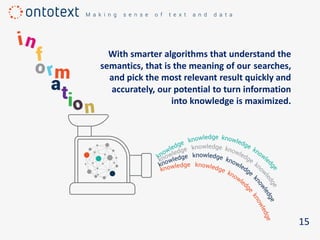
With smarter algorithms that understand the
semantics, that is the meaning of our searches,
and pick the most relevant result quickly and
accurately, our potential to turn information
into knowledge is maximized.
15
M a k i n g s e n s e o f t e x t a n d d a t a
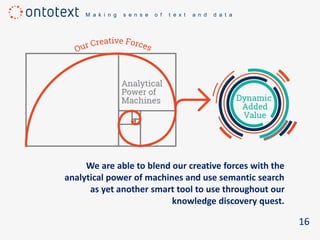
We are able to blend our creative forces with the
analytical power of machines and use semantic search
as yet another smart tool to use throughout our
knowledge discovery quest.
16
www.ontotext.com
You can also reach us via email at
info@ontotext.com
and directly by calling
1-866-972-6686 (North America),
or +359 2 974 61 60 (Europe)
Want to learn how semantic search can help enterprises
turn data into insights? Try GraphDB Free and see how to lay
the foundations of any smart data system.

The Knowledge Discovery Quest

  • 1.
  • 2.
    1 After the immenseloss of knowledge that humanity underwent when the Ancient Library of Alexandria was destroyed by fire, the next biggest loss is the one that happens due to inefficient content management and Information retrieval.
  • 3.
    All the datasources around us remain locked and useless without elaborate tools to navigate and explore the relationships between data. 2
  • 4.
    3 The potential ofdata for knowledge discovery is only as big as the capacity to intelligently search through these data.
  • 5.
    And there’s noblunter reminder for this fact than the message: “Sorry, no content matched your criteria” 4
  • 6.
    A lot ofcontent will be very much likely not “match the search criteria” of someone looking for, if there isn’t a more sophisticated way to navigate the vast lands of interconnected resources, different than the “dumb” matching of keywords. 5
  • 7.
    6 Fortunately, there isa way to intelligently search content and it is called semantic search.
  • 8.
    7 While traditional information retrieval systemsrely hard on keywords and links, semantic search goes deeper and beyond the mere textual representation of the content. It magnifies a lot more relations otherwise invisible by traditional search.
  • 9.
    8 If semantic search hada separate icon from the one traditional search has (the ubiquitous magnifying glass), it would probably have been a microscope.
  • 10.
    9 Magnifying large amounts ofsystems and the connections between them, semantic search sharpens our ability to join the dots and enhances the way we track relationships, look for clues, compare correlations.
  • 11.
    As any content isa lot more than the mere sum of the exact words and phrases it contains or is described by. It is more of a network of connected entities. 10
  • 12.
    11 Semantic search analyzesthe relational aspects of these entities as to address complex queries and thus foster knowledge discovery. Showing the dependencies between 10 classes
  • 13.
    12 Leveraging Semantic Web technologies, specifically, data representedin RDF and organized in formal collections of related entities (ontologies), semantic search takes information retrieval to the next level.
  • 14.
    The way weaccess information transcends from a list of results, solely based on keyword matching to a set of connections, pertinent to the intent and the context of our specific query. 13
  • 15.
    With semantic searchwe are able to thoroughly look up all kinds of relationships. Instead of more links, which are only a single kind of relation, a semantic approach to information retrieval leads to a networked view of relations, facts, information, we might not know even existed. 14
  • 16.
    With smarter algorithmsthat understand the semantics, that is the meaning of our searches, and pick the most relevant result quickly and accurately, our potential to turn information into knowledge is maximized. 15
  • 17.
    M a ki n g s e n s e o f t e x t a n d d a t a We are able to blend our creative forces with the analytical power of machines and use semantic search as yet another smart tool to use throughout our knowledge discovery quest. 16
  • 18.
    www.ontotext.com You can alsoreach us via email at info@ontotext.com and directly by calling 1-866-972-6686 (North America), or +359 2 974 61 60 (Europe) Want to learn how semantic search can help enterprises turn data into insights? Try GraphDB Free and see how to lay the foundations of any smart data system.