SEEDLINGS
EVALUATION
Germination Test
The Germination Test
The object of the germination test is to determine the maximum
germination potential of a seed lot, which can then in turn be used to
compare the quality of different lots and also estimate the field planting
value
Testing under field conditions is normally unsatisfactory, as the results
cannot be repeated with reliability. Laboratory methods Have, therefore,
been evolved in which the external conditions are controlled to give the
most regular, rapid and complete germination for the majority of samples
of a particular species. The conditions have been standardized to enable
the test results to be reproduced within limits as near as possible to those
determined by random sample variation.
Germination Process
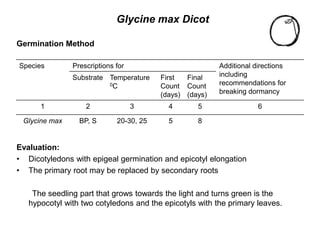
The development of a dry seed into a new plant involves four groups of processes:
•the imbibition of water;
•the formation of enzyme systems,
•the initiation of growth, i.e. rupture of the seed coat and radicle emergence; and
•finally the Growth and development of the seedling.
Glycine max Dicot
Germination Method
Evaluation:
• Dicotyledons with epigeal germination and epicotyl elongation
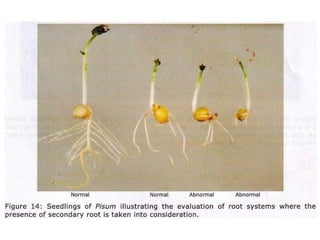
• The primary root may be replaced by secondary roots
The seedling part that grows towards the light and turns green is the
hypocotyl with two cotyledons and the epicotyls with the primary leaves.
Species Prescriptions for Additional directions
including
recommendations for
breaking dormancy
Substrate Temperature
0C
First
Count
(days)
Final
Count
(days)
1 2 3 4 5 6
Glycine max BP, S 20-30, 25 5 8
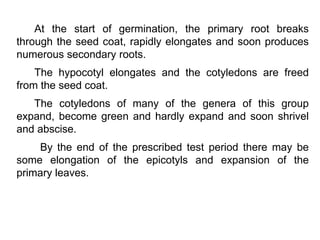
At the start of germination, the primary root breaks
through the seed coat, rapidly elongates and soon produces
numerous secondary roots.
The hypocotyl elongates and the cotyledons are freed
from the seed coat.
The cotyledons of many of the genera of this group
expand, become green and hardly expand and soon shrivel
and abscise.
By the end of the prescribed test period there may be
some elongation of the epicotyls and expansion of the
primary leaves.
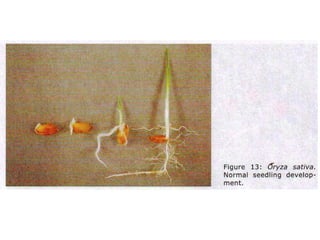
Normal Seedlings
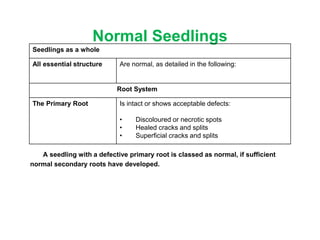
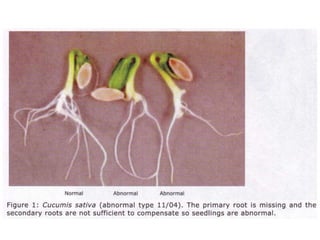
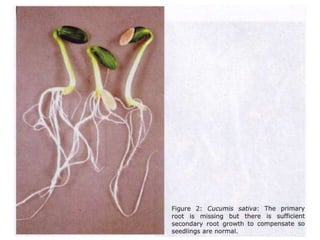
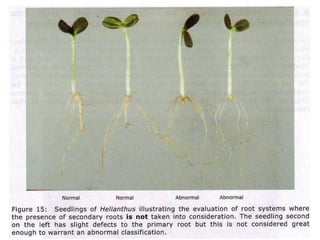
A seedling with a defective primary root is classed as normal, if sufficient
normal secondary roots have developed.
Seedlings as a whole
All essential structure Are normal, as detailed in the following:
Root System
The Primary Root Is intact or shows acceptable defects:
• Discoloured or necrotic spots
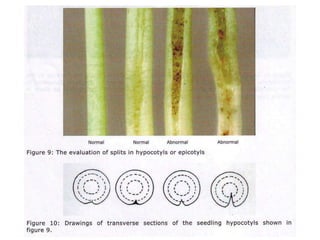
• Healed cracks and splits
• Superficial cracks and splits
Normal Seedlings
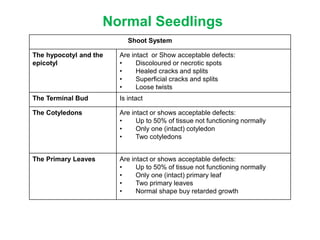
Shoot System
The hypocotyl and the
epicotyl
Are intact or Show acceptable defects:
• Discoloured or necrotic spots
• Healed cracks and splits
• Superficial cracks and splits
• Loose twists
The Terminal Bud Is intact
The Cotyledons Are intact or shows acceptable defects:
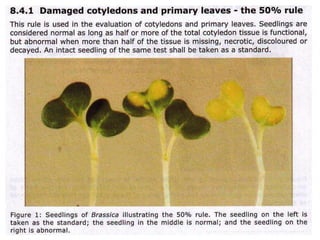
• Up to 50% of tissue not functioning normally
• Only one (intact) cotyledon
• Two cotyledons
The Primary Leaves Are intact or shows acceptable defects:
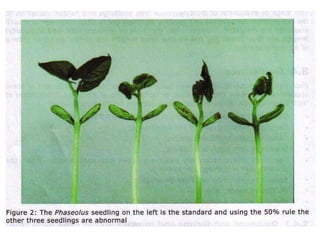
• Up to 50% of tissue not functioning normally
• Only one (intact) primary leaf
• Two primary leaves
• Normal shape buy retarded growth
Abnormal Seedlings
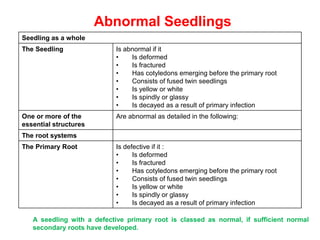
A seedling with a defective primary root is classed as normal, if sufficient normal
secondary roots have developed.
Seedling as a whole
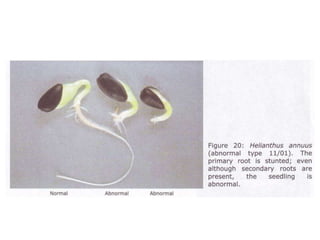
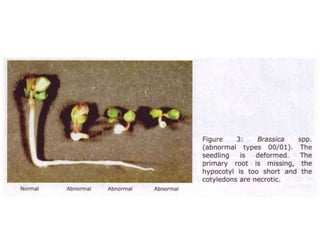
The Seedling Is abnormal if it
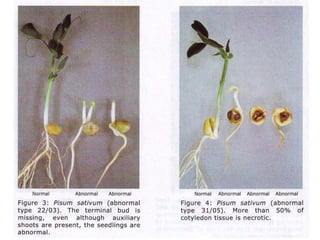
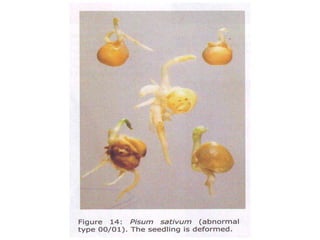
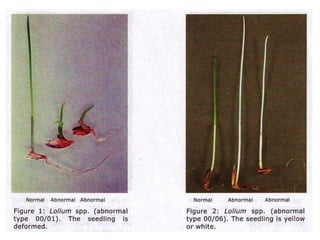
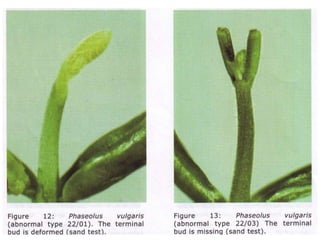
• Is deformed
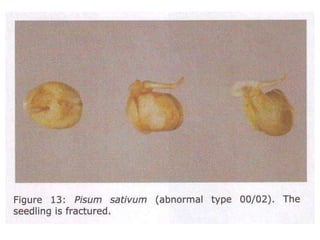
• Is fractured
• Has cotyledons emerging before the primary root
• Consists of fused twin seedlings
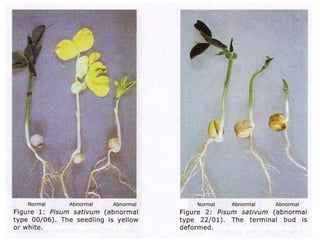
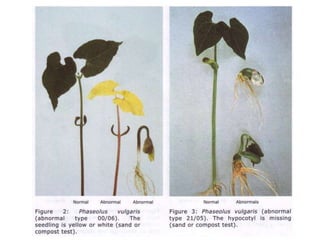
• Is yellow or white
• Is spindly or glassy
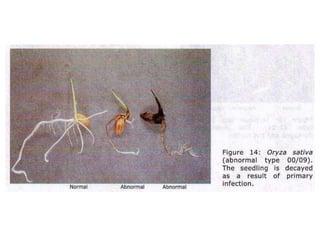
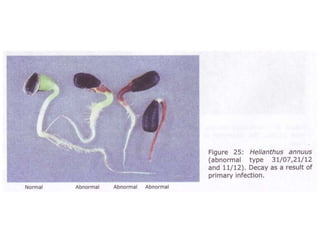
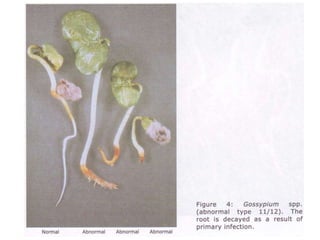
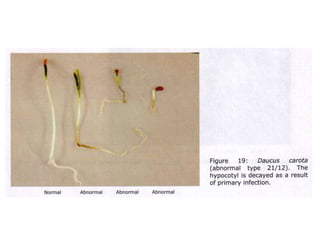
• Is decayed as a result of primary infection
One or more of the
essential structures
Are abnormal as detailed in the following:
The root systems
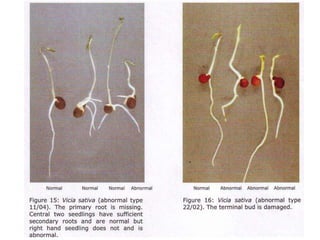
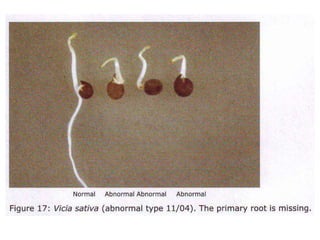
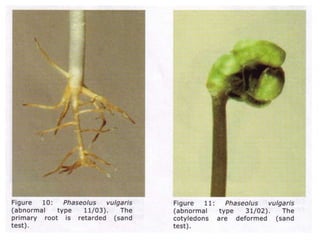
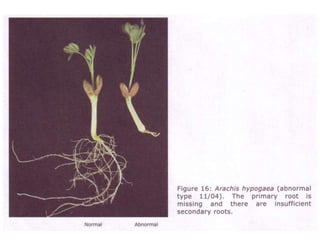
The Primary Root Is defective if it :
• Is deformed
• Is fractured
• Has cotyledons emerging before the primary root
• Consists of fused twin seedlings
• Is yellow or white
• Is spindly or glassy
• Is decayed as a result of primary infection
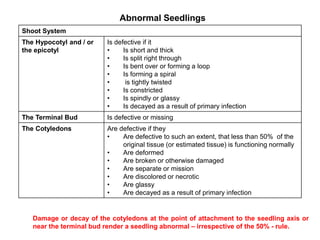
Abnormal Seedlings
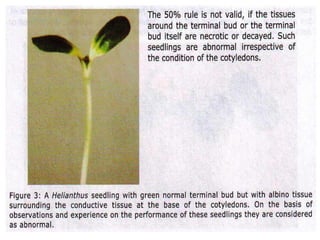
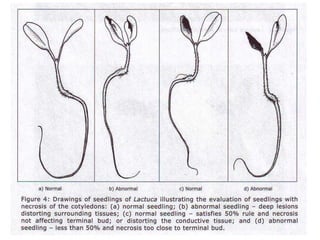
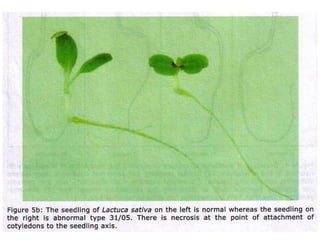
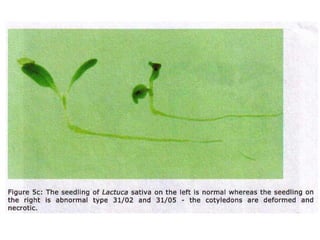
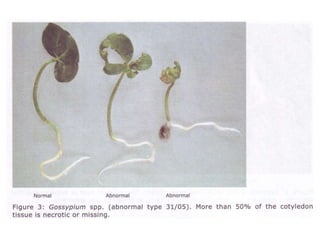
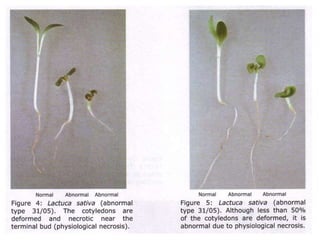
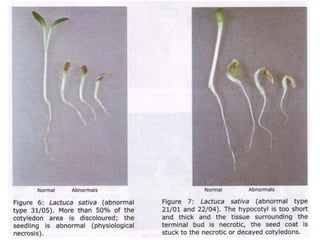
Damage or decay of the cotyledons at the point of attachment to the seedling axis or
near the terminal bud render a seedling abnormal – irrespective of the 50% - rule.
Shoot System
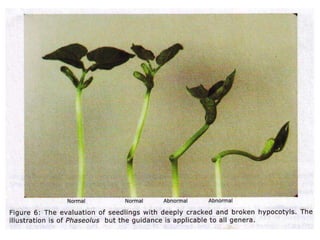
The Hypocotyl and / or
the epicotyl
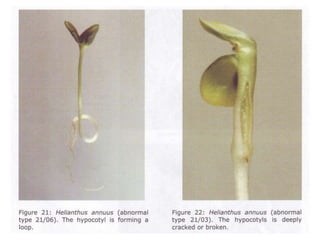
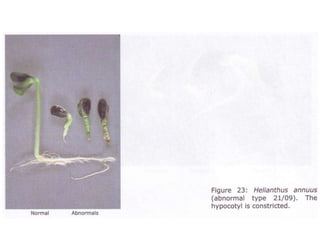
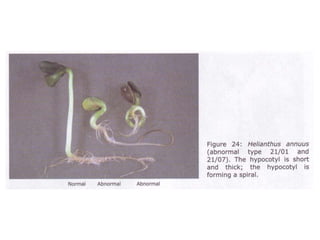
Is defective if it
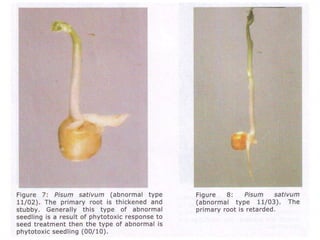
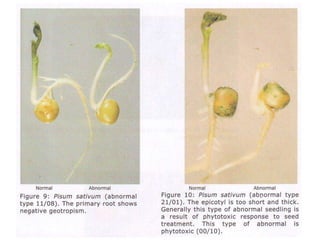
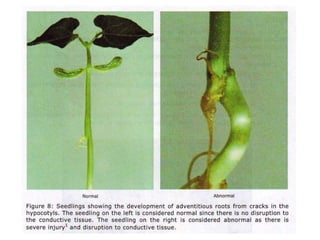
• Is short and thick
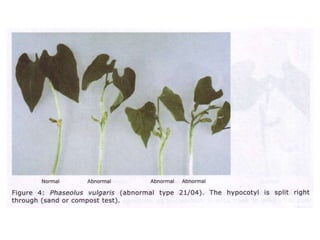
• Is split right through
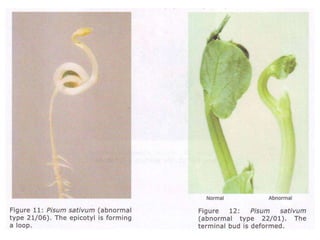
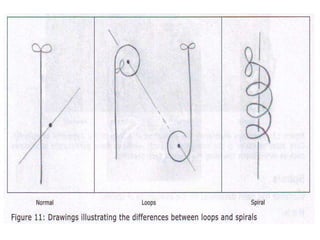
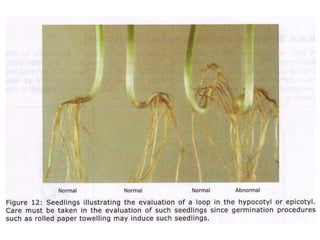
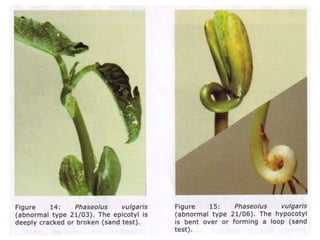
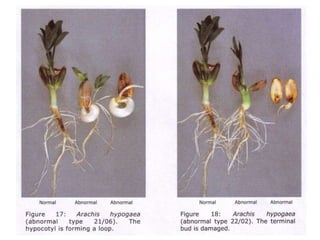
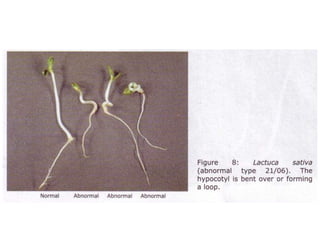
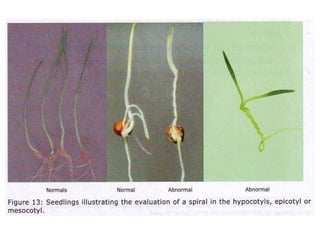
• Is bent over or forming a loop
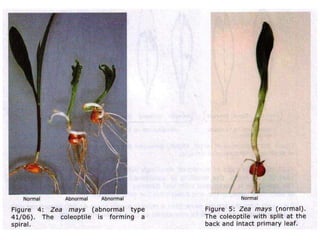
• Is forming a spiral
• is tightly twisted
• Is constricted
• Is spindly or glassy
• Is decayed as a result of primary infection
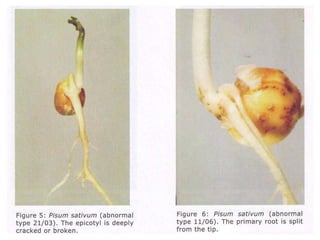
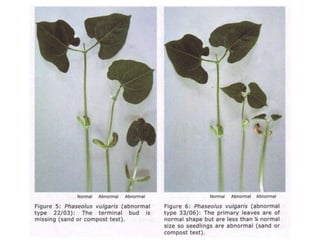
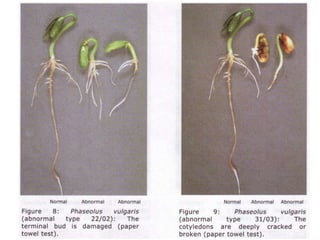
The Terminal Bud Is defective or missing
The Cotyledons Are defective if they
• Are defective to such an extent, that less than 50% of the
original tissue (or estimated tissue) is functioning normally
• Are deformed
• Are broken or otherwise damaged
• Are separate or mission
• Are discolored or necrotic
• Are glassy
• Are decayed as a result of primary infection
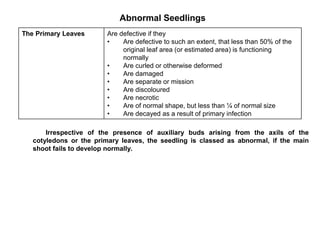
Abnormal Seedlings
Irrespective of the presence of auxiliary buds arising from the axils of the
cotyledons or the primary leaves, the seedling is classed as abnormal, if the main
shoot fails to develop normally.
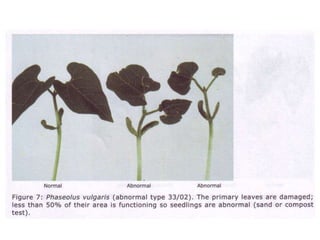
The Primary Leaves Are defective if they
• Are defective to such an extent, that less than 50% of the
original leaf area (or estimated area) is functioning
normally
• Are curled or otherwise deformed
• Are damaged
• Are separate or mission
• Are discoloured
• Are necrotic
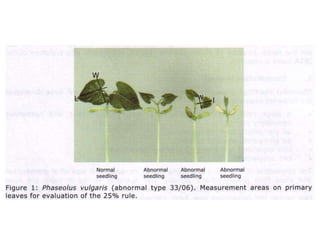
• Are of normal shape, but less than ¼ of normal size
• Are decayed as a result of primary infection
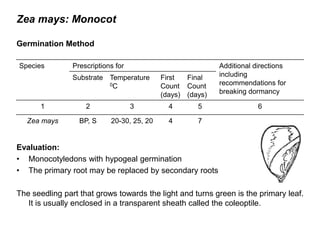
Zea mays: Monocot
Germination Method
Evaluation:
• Monocotyledons with hypogeal germination
• The primary root may be replaced by secondary roots
The seedling part that grows towards the light and turns green is the primary leaf.
It is usually enclosed in a transparent sheath called the coleoptile.
Species Prescriptions for Additional directions
including
recommendations for
breaking dormancy
Substrate Temperature
0C
First
Count
(days)
Final
Count
(days)
1 2 3 4 5 6
Zea mays BP, S 20-30, 25, 20 4 7
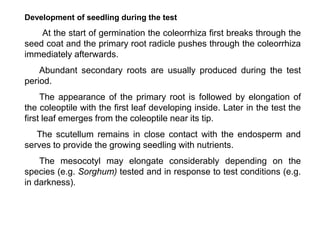
Development of seedling during the test
At the start of germination the coleorrhiza first breaks through the
seed coat and the primary root radicle pushes through the coleorrhiza
immediately afterwards.
Abundant secondary roots are usually produced during the test
period.
The appearance of the primary root is followed by elongation of
the coleoptile with the first leaf developing inside. Later in the test the
first leaf emerges from the coleoptile near its tip.
The scutellum remains in close contact with the endosperm and
serves to provide the growing seedling with nutrients.
The mesocotyl may elongate considerably depending on the
species (e.g. Sorghum) tested and in response to test conditions (e.g.
in darkness).
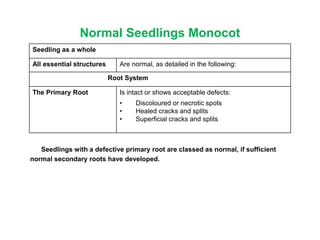
Normal Seedlings Monocot
Seedlings with a defective primary root are classed as normal, if sufficient
normal secondary roots have developed.
Seedling as a whole
All essential structures Are normal, as detailed in the following:
Root System
The Primary Root Is intact or shows acceptable defects:
• Discoloured or necrotic spots
• Healed cracks and splits
• Superficial cracks and splits
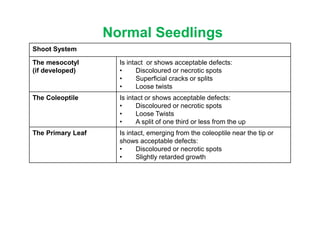
Normal Seedlings
Shoot System
The mesocotyl
(if developed)
Is intact or shows acceptable defects:
• Discoloured or necrotic spots
• Superficial cracks or splits
• Loose twists
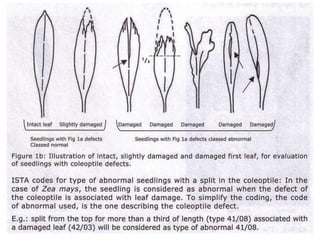
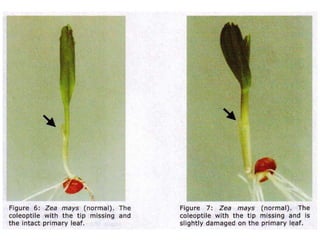
The Coleoptile Is intact or shows acceptable defects:
• Discoloured or necrotic spots
• Loose Twists
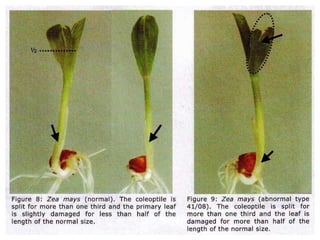
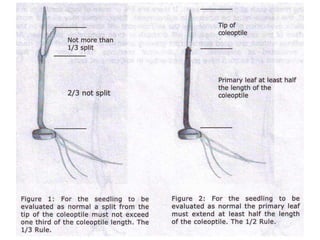
• A split of one third or less from the up
The Primary Leaf Is intact, emerging from the coleoptile near the tip or
shows acceptable defects:
• Discoloured or necrotic spots
• Slightly retarded growth
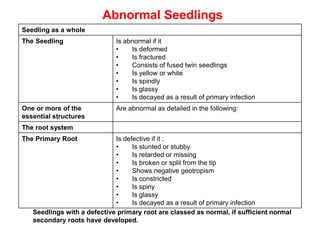
Abnormal Seedlings
Seedlings with a defective primary root are classed as normal, if sufficient normal
secondary roots have developed.
Seedling as a whole
The Seedling Is abnormal if it
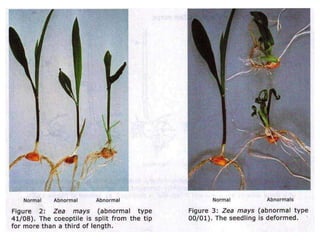
• Is deformed
• Is fractured
• Consists of fused twin seedlings
• Is yellow or white
• Is spindly
• Is glassy
• Is decayed as a result of primary infection
One or more of the
essential structures
Are abnormal as detailed in the following:
The root system
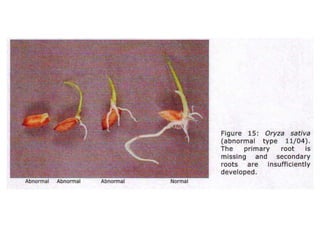
The Primary Root Is defective if it :
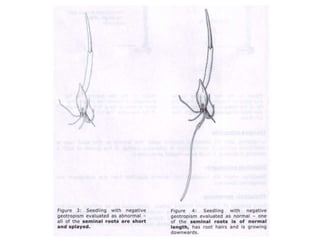
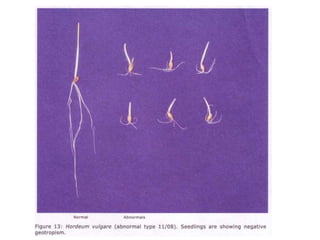
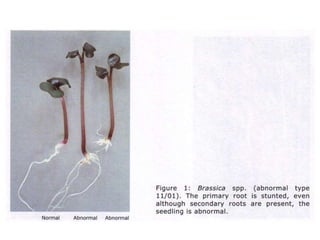
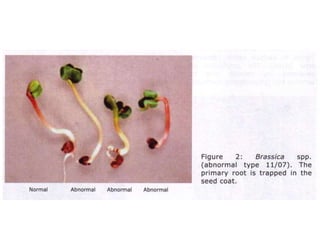
• Is stunted or stubby
• Is retarded or missing
• Is broken or split from the tip
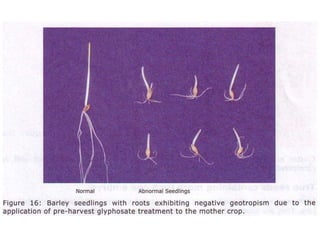
• Shows negative geotropism
• Is constricted
• Is spiny
• Is glassy
• Is decayed as a result of primary infection
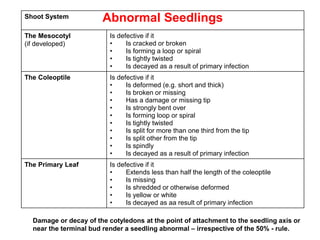
Abnormal Seedlings
Damage or decay of the cotyledons at the point of attachment to the seedling axis or
near the terminal bud render a seedling abnormal – irrespective of the 50% - rule.
Shoot System
The Mesocotyl
(if developed)
Is defective if it
• Is cracked or broken
• Is forming a loop or spiral
• Is tightly twisted
• Is decayed as a result of primary infection
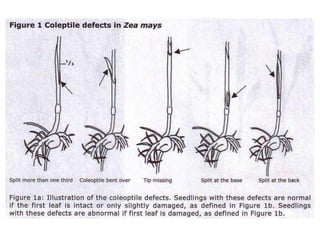
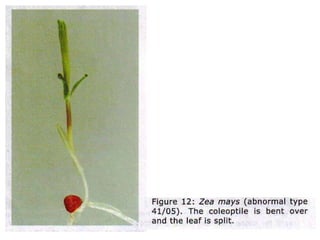
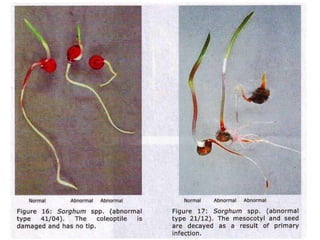
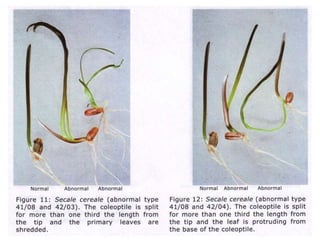
The Coleoptile Is defective if it
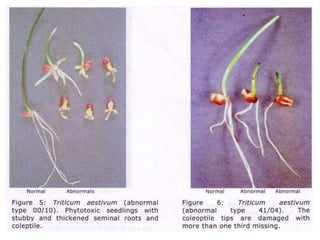
• Is deformed (e.g. short and thick)
• Is broken or missing
• Has a damage or missing tip
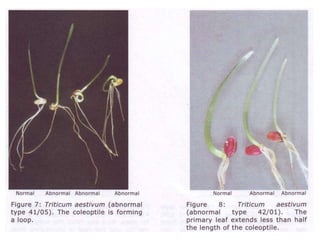
• Is strongly bent over
• Is forming loop or spiral
• Is tightly twisted
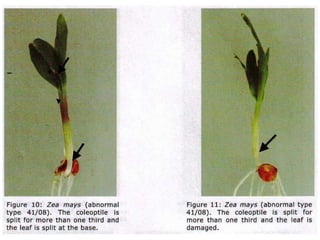
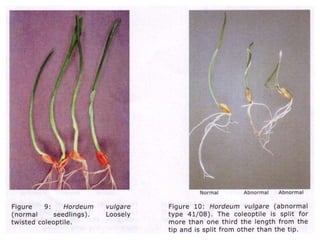
• Is split for more than one third from the tip
• Is split other from the tip
• Is spindly
• Is decayed as a result of primary infection
The Primary Leaf Is defective if it
• Extends less than half the length of the coleoptile
• Is missing
• Is shredded or otherwise deformed
• Is yellow or white
• Is decayed as aa result of primary infection
Thanks for Kind Attention

Seedling eva. revised

  • 1.
  • 2.
    Germination Test The GerminationTest The object of the germination test is to determine the maximum germination potential of a seed lot, which can then in turn be used to compare the quality of different lots and also estimate the field planting value Testing under field conditions is normally unsatisfactory, as the results cannot be repeated with reliability. Laboratory methods Have, therefore, been evolved in which the external conditions are controlled to give the most regular, rapid and complete germination for the majority of samples of a particular species. The conditions have been standardized to enable the test results to be reproduced within limits as near as possible to those determined by random sample variation.
  • 3.
    Germination Process The developmentof a dry seed into a new plant involves four groups of processes: •the imbibition of water; •the formation of enzyme systems, •the initiation of growth, i.e. rupture of the seed coat and radicle emergence; and •finally the Growth and development of the seedling.
  • 4.
    Glycine max Dicot GerminationMethod Evaluation: • Dicotyledons with epigeal germination and epicotyl elongation • The primary root may be replaced by secondary roots The seedling part that grows towards the light and turns green is the hypocotyl with two cotyledons and the epicotyls with the primary leaves. Species Prescriptions for Additional directions including recommendations for breaking dormancy Substrate Temperature 0C First Count (days) Final Count (days) 1 2 3 4 5 6 Glycine max BP, S 20-30, 25 5 8
  • 5.
    At the startof germination, the primary root breaks through the seed coat, rapidly elongates and soon produces numerous secondary roots. The hypocotyl elongates and the cotyledons are freed from the seed coat. The cotyledons of many of the genera of this group expand, become green and hardly expand and soon shrivel and abscise. By the end of the prescribed test period there may be some elongation of the epicotyls and expansion of the primary leaves.
  • 6.
    Normal Seedlings A seedlingwith a defective primary root is classed as normal, if sufficient normal secondary roots have developed. Seedlings as a whole All essential structure Are normal, as detailed in the following: Root System The Primary Root Is intact or shows acceptable defects: • Discoloured or necrotic spots • Healed cracks and splits • Superficial cracks and splits
  • 7.
    Normal Seedlings Shoot System Thehypocotyl and the epicotyl Are intact or Show acceptable defects: • Discoloured or necrotic spots • Healed cracks and splits • Superficial cracks and splits • Loose twists The Terminal Bud Is intact The Cotyledons Are intact or shows acceptable defects: • Up to 50% of tissue not functioning normally • Only one (intact) cotyledon • Two cotyledons The Primary Leaves Are intact or shows acceptable defects: • Up to 50% of tissue not functioning normally • Only one (intact) primary leaf • Two primary leaves • Normal shape buy retarded growth
  • 8.
    Abnormal Seedlings A seedlingwith a defective primary root is classed as normal, if sufficient normal secondary roots have developed. Seedling as a whole The Seedling Is abnormal if it • Is deformed • Is fractured • Has cotyledons emerging before the primary root • Consists of fused twin seedlings • Is yellow or white • Is spindly or glassy • Is decayed as a result of primary infection One or more of the essential structures Are abnormal as detailed in the following: The root systems The Primary Root Is defective if it : • Is deformed • Is fractured • Has cotyledons emerging before the primary root • Consists of fused twin seedlings • Is yellow or white • Is spindly or glassy • Is decayed as a result of primary infection
  • 9.
    Abnormal Seedlings Damage ordecay of the cotyledons at the point of attachment to the seedling axis or near the terminal bud render a seedling abnormal – irrespective of the 50% - rule. Shoot System The Hypocotyl and / or the epicotyl Is defective if it • Is short and thick • Is split right through • Is bent over or forming a loop • Is forming a spiral • is tightly twisted • Is constricted • Is spindly or glassy • Is decayed as a result of primary infection The Terminal Bud Is defective or missing The Cotyledons Are defective if they • Are defective to such an extent, that less than 50% of the original tissue (or estimated tissue) is functioning normally • Are deformed • Are broken or otherwise damaged • Are separate or mission • Are discolored or necrotic • Are glassy • Are decayed as a result of primary infection
  • 10.
    Abnormal Seedlings Irrespective ofthe presence of auxiliary buds arising from the axils of the cotyledons or the primary leaves, the seedling is classed as abnormal, if the main shoot fails to develop normally. The Primary Leaves Are defective if they • Are defective to such an extent, that less than 50% of the original leaf area (or estimated area) is functioning normally • Are curled or otherwise deformed • Are damaged • Are separate or mission • Are discoloured • Are necrotic • Are of normal shape, but less than ¼ of normal size • Are decayed as a result of primary infection
  • 11.
    Zea mays: Monocot GerminationMethod Evaluation: • Monocotyledons with hypogeal germination • The primary root may be replaced by secondary roots The seedling part that grows towards the light and turns green is the primary leaf. It is usually enclosed in a transparent sheath called the coleoptile. Species Prescriptions for Additional directions including recommendations for breaking dormancy Substrate Temperature 0C First Count (days) Final Count (days) 1 2 3 4 5 6 Zea mays BP, S 20-30, 25, 20 4 7
  • 12.
    Development of seedlingduring the test At the start of germination the coleorrhiza first breaks through the seed coat and the primary root radicle pushes through the coleorrhiza immediately afterwards. Abundant secondary roots are usually produced during the test period. The appearance of the primary root is followed by elongation of the coleoptile with the first leaf developing inside. Later in the test the first leaf emerges from the coleoptile near its tip. The scutellum remains in close contact with the endosperm and serves to provide the growing seedling with nutrients. The mesocotyl may elongate considerably depending on the species (e.g. Sorghum) tested and in response to test conditions (e.g. in darkness).
  • 13.
    Normal Seedlings Monocot Seedlingswith a defective primary root are classed as normal, if sufficient normal secondary roots have developed. Seedling as a whole All essential structures Are normal, as detailed in the following: Root System The Primary Root Is intact or shows acceptable defects: • Discoloured or necrotic spots • Healed cracks and splits • Superficial cracks and splits
  • 14.
    Normal Seedlings Shoot System Themesocotyl (if developed) Is intact or shows acceptable defects: • Discoloured or necrotic spots • Superficial cracks or splits • Loose twists The Coleoptile Is intact or shows acceptable defects: • Discoloured or necrotic spots • Loose Twists • A split of one third or less from the up The Primary Leaf Is intact, emerging from the coleoptile near the tip or shows acceptable defects: • Discoloured or necrotic spots • Slightly retarded growth
  • 15.
    Abnormal Seedlings Seedlings witha defective primary root are classed as normal, if sufficient normal secondary roots have developed. Seedling as a whole The Seedling Is abnormal if it • Is deformed • Is fractured • Consists of fused twin seedlings • Is yellow or white • Is spindly • Is glassy • Is decayed as a result of primary infection One or more of the essential structures Are abnormal as detailed in the following: The root system The Primary Root Is defective if it : • Is stunted or stubby • Is retarded or missing • Is broken or split from the tip • Shows negative geotropism • Is constricted • Is spiny • Is glassy • Is decayed as a result of primary infection
  • 16.
    Abnormal Seedlings Damage ordecay of the cotyledons at the point of attachment to the seedling axis or near the terminal bud render a seedling abnormal – irrespective of the 50% - rule. Shoot System The Mesocotyl (if developed) Is defective if it • Is cracked or broken • Is forming a loop or spiral • Is tightly twisted • Is decayed as a result of primary infection The Coleoptile Is defective if it • Is deformed (e.g. short and thick) • Is broken or missing • Has a damage or missing tip • Is strongly bent over • Is forming loop or spiral • Is tightly twisted • Is split for more than one third from the tip • Is split other from the tip • Is spindly • Is decayed as a result of primary infection The Primary Leaf Is defective if it • Extends less than half the length of the coleoptile • Is missing • Is shredded or otherwise deformed • Is yellow or white • Is decayed as aa result of primary infection
  • 97.
    Thanks for KindAttention

Editor's Notes