Please write the names of sexual and asexual propagation methods and explain all detailed?
What is Plant propagation?
Plant propagation is the technique in which we produce a fresh plant from the older one. There are two
techniques of plant propagation
Sexual Propagation
Asexual Propagation
What is sexual Propagation?
The method in which the joining of pollen of male with egg of female and in result gain a seed. Seed is
form of major three parts:
 Outer coat of seed
 Endosperm
 Embryo
The techniques of sexual propagation are:
 Spore
 Seed
What is asexual Propagation?
The technique in which stem, root, leaves or some other part of parent (except seed) plant is doing the
propagation and a new plant produce which is result of identical to parent. Sometime it is also call as
vegetative propagation.
Grafting
Budding
Layering
Cutting
Division
Special Techniques
 Micro Propagation
 Tissue Culture
Spore Technique:
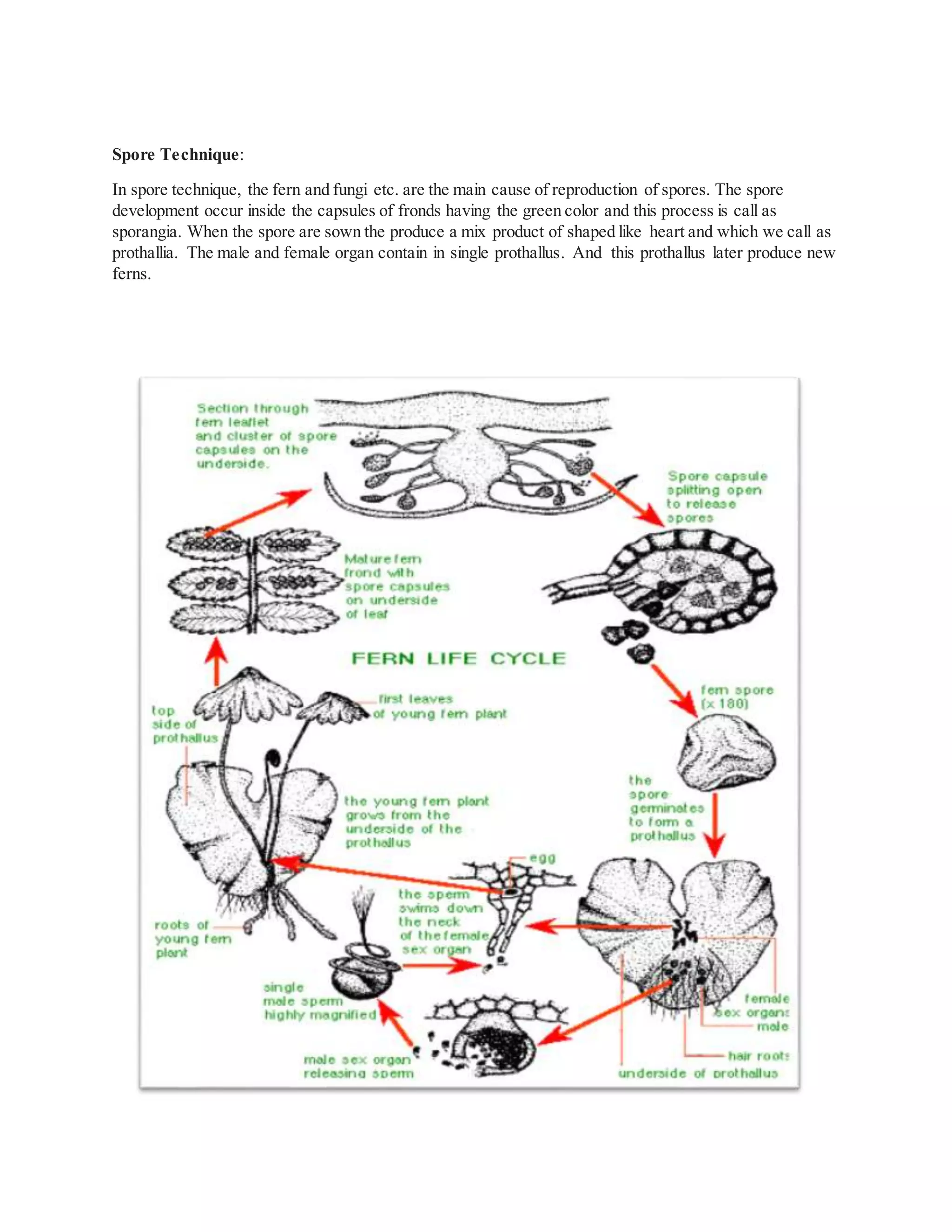
In spore technique, the fern and fungi etc. are the main cause of reproduction of spores. The spore
development occur inside the capsules of fronds having the green color and this process is call as
sporangia. When the spore are sown the produce a mix product of shaped like heart and which we call as
prothallia. The male and female organ contain in single prothallus. And this prothallus later produce new
ferns.
Seed technique:
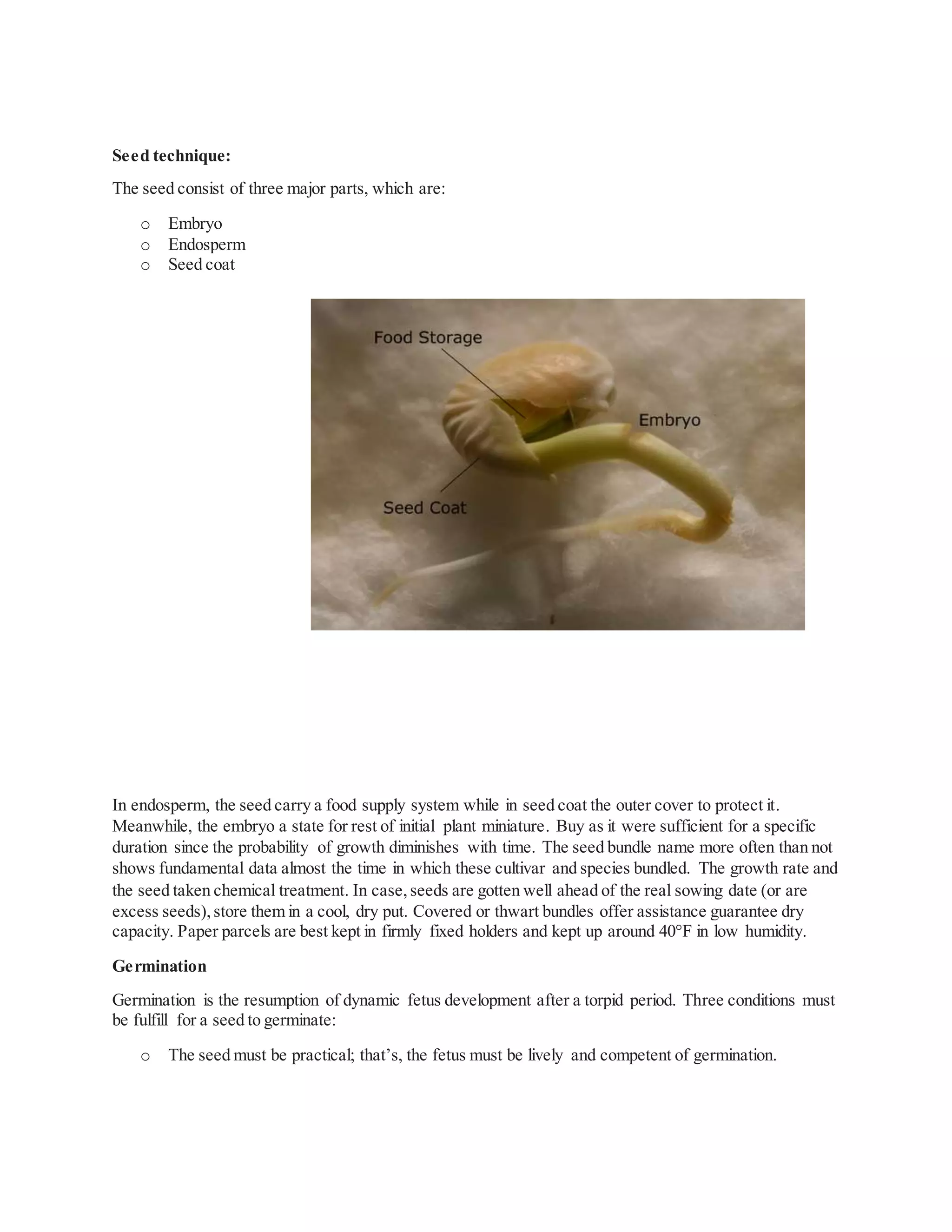
The seed consist of three major parts, which are:
o Embryo
o Endosperm
o Seed coat
In endosperm, the seed carry a food supply system while in seed coat the outer cover to protect it.
Meanwhile, the embryo a state for rest of initial plant miniature. Buy as it were sufficient for a specific
duration since the probability of growth diminishes with time. The seed bundle name more often than not
shows fundamental data almost the time in which these cultivar and species bundled. The growth rate and
the seed taken chemical treatment. In case,seeds are gotten well ahead of the real sowing date (or are
excess seeds),store them in a cool, dry put. Covered or thwart bundles offer assistance guarantee dry
capacity. Paper parcels are best kept in firmly fixed holders and kept up around 40°F in low humidity.
Germination
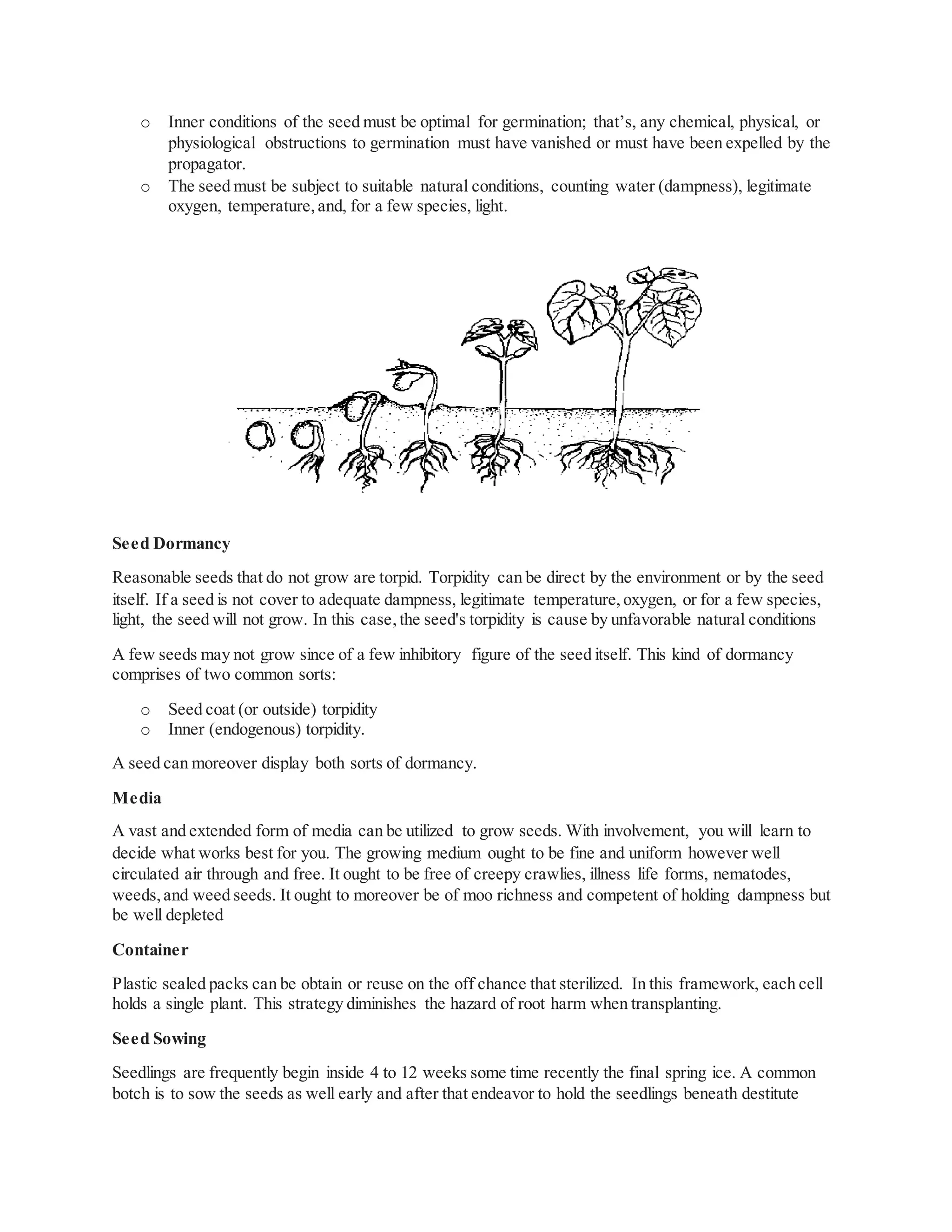
Germination is the resumption of dynamic fetus development after a torpid period. Three conditions must
be fulfill for a seed to germinate:
o The seed must be practical; that’s, the fetus must be lively and competent of germination.
o Inner conditions of the seed must be optimal for germination; that’s, any chemical, physical, or
physiological obstructions to germination must have vanished or must have been expelled by the
propagator.
o The seed must be subject to suitable natural conditions, counting water (dampness), legitimate
oxygen, temperature,and, for a few species, light.
Seed Dormancy
Reasonable seeds that do not grow are torpid. Torpidity can be direct by the environment or by the seed
itself. If a seed is not cover to adequate dampness, legitimate temperature,oxygen, or for a few species,
light, the seed will not grow. In this case,the seed's torpidity is cause by unfavorable natural conditions
A few seeds may not grow since of a few inhibitory figure of the seed itself. This kind of dormancy
comprises of two common sorts:
o Seed coat (or outside) torpidity
o Inner (endogenous) torpidity.
A seed can moreover display both sorts of dormancy.
Media
A vast and extended form of media can be utilized to grow seeds. With involvement, you will learn to
decide what works best for you. The growing medium ought to be fine and uniform however well
circulated air through and free. It ought to be free of creepy crawlies, illness life forms, nematodes,
weeds,and weed seeds. It ought to moreover be of moo richness and competent of holding dampness but
be well depleted
Container
Plastic sealed packs can be obtain or reuse on the off chance that sterilized. In this framework, each cell
holds a single plant. This strategy diminishes the hazard of root harm when transplanting.
Seed Sowing
Seedlings are frequently begin inside 4 to 12 weeks some time recently the final spring ice. A common
botch is to sow the seeds as well early and after that endeavor to hold the seedlings beneath destitute
natural conditions. This more often than not comes about in tall, weak, spindly plants that do not perform
well within the cultivated. The taking after sections donate common rules for sowing seeds for
transplants. By the by, it is vital to allude to the informational on the seed parcelfor more particular data.
Water and Light
Soak the planting medium altogether some time recently planting. After seeding, splash with a fine fog or
put the holders in a container or plate that contains almost 1 inch of warm water. Maintain a strategic
distance from sprinkling or intemperate flooding, which might uproot little seeds. When the planting
blend is immersed, set the holder aside to deplete. The soil ought to be wet but not excessively damp.
After the seeds have developed, move the pads to a well-lighted area; the temperature ought to be 65 to
70°F amid the day and 55°F to 60°F at night. This anticipates delicate, leggy development and minimizes
malady issues. A few crops,of course, may develop best at distinctive temperatures.
Transplanting Seedling
Plants not seeded separately must in the long run be transplanted into their claim holders as seedlings to
deliver them appropriate developing space. A common botch is to take off the seedlings within the level
as well long. The perfect time to transplant young seedlings is when the primary genuine takes off show
up.
Asexualllllllllllllllll
Grafting
Grafting is the combination of the stems of two plants to develop as one. The parcel of the cultivar that's
to be proliferated is called the scion. It consists of a bit of shoot with torpid buds that will deliver the stem
and branches. The rootstock, or stock, gives the modern plant’s root framework and some of the time the
lower part of the stem. The cambium could be a layer of cells found between the wood and bark of a stem
from which modern bark and wood cells begin.
Four conditions necessary for uniting to be fruitful
 The offspring and rootstock must be consistent
 Each must be at the correct physiological arrange
 The cambial layers of the offspring and stock must meet
 And the unite union must be kept wet until the wound has recuperated.
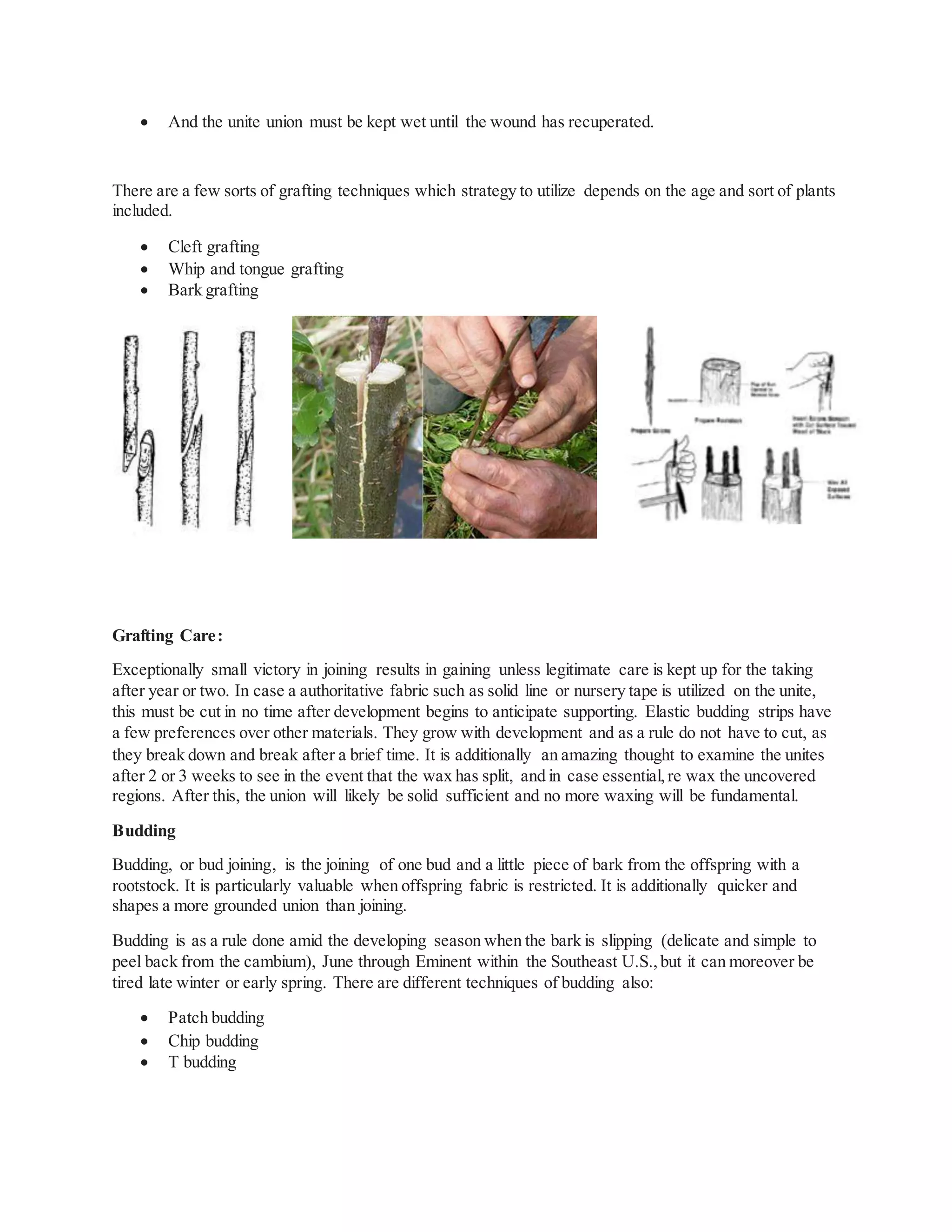
There are a few sorts of grafting techniques which strategy to utilize depends on the age and sort of plants
included.
 Cleft grafting
 Whip and tongue grafting
 Bark grafting
Grafting Care:
Exceptionally small victory in joining results in gaining unless legitimate care is kept up for the taking
after year or two. In case a authoritative fabric such as solid line or nursery tape is utilized on the unite,
this must be cut in no time after development begins to anticipate supporting. Elastic budding strips have
a few preferences over other materials. They grow with development and as a rule do not have to cut, as
they break down and break after a brief time. It is additionally an amazing thought to examine the unites
after 2 or 3 weeks to see in the event that the wax has split, and in case essential,re wax the uncovered
regions. After this, the union will likely be solid sufficient and no more waxing will be fundamental.
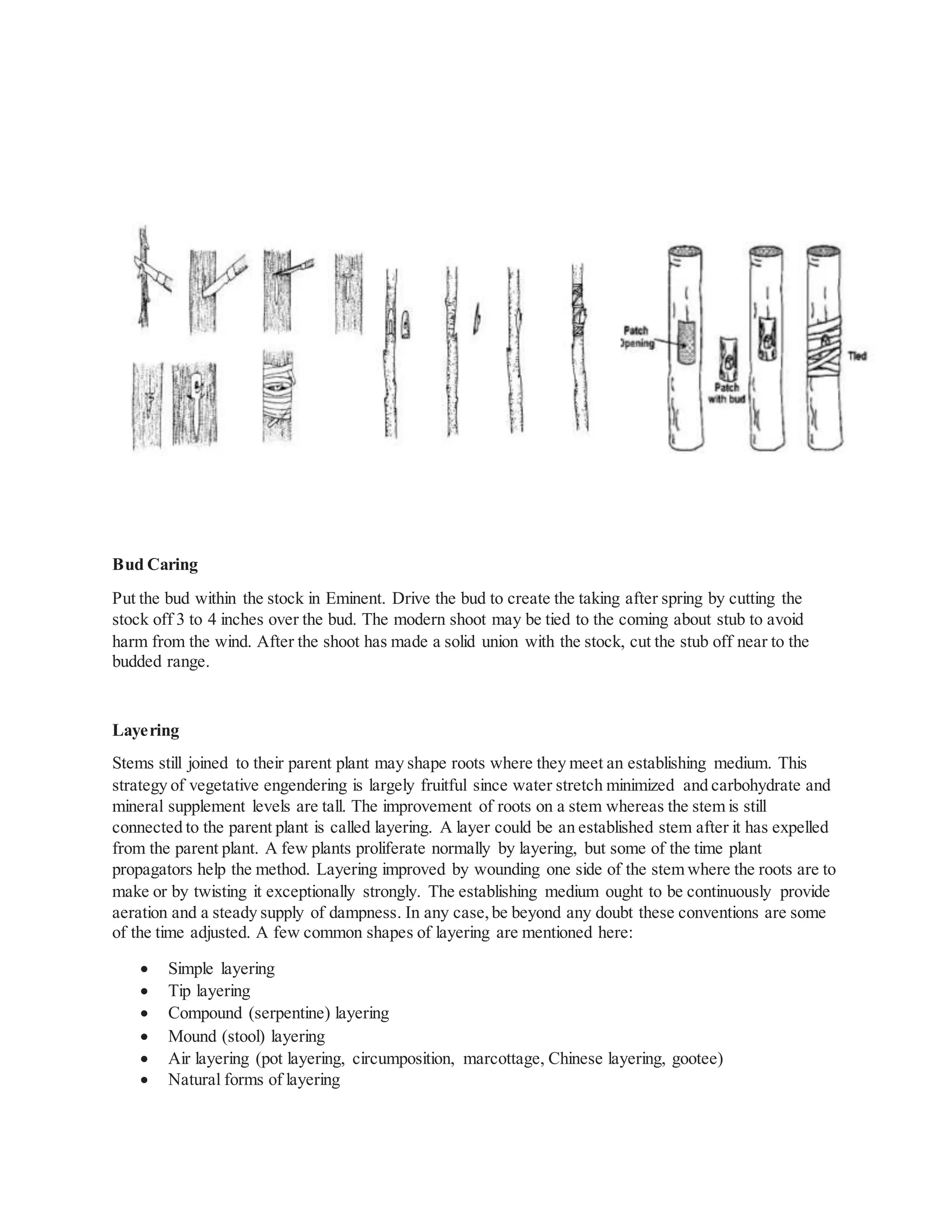
Budding
Budding, or bud joining, is the joining of one bud and a little piece of bark from the offspring with a
rootstock. It is particularly valuable when offspring fabric is restricted. It is additionally quicker and
shapes a more grounded union than joining.
Budding is as a rule done amid the developing season when the bark is slipping (delicate and simple to
peel back from the cambium), June through Eminent within the Southeast U.S.,but it can moreover be
tired late winter or early spring. There are different techniques of budding also:
 Patch budding
 Chip budding
 T budding
Bud Caring
Put the bud within the stock in Eminent. Drive the bud to create the taking after spring by cutting the
stock off 3 to 4 inches over the bud. The modern shoot may be tied to the coming about stub to avoid
harm from the wind. After the shoot has made a solid union with the stock, cut the stub off near to the
budded range.
Layering
Stems still joined to their parent plant may shape roots where they meet an establishing medium. This
strategy of vegetative engendering is largely fruitful since water stretch minimized and carbohydrate and
mineral supplement levels are tall. The improvement of roots on a stem whereas the stem is still
connected to the parent plant is called layering. A layer could be an established stem after it has expelled
from the parent plant. A few plants proliferate normally by layering, but some of the time plant
propagators help the method. Layering improved by wounding one side of the stem where the roots are to
make or by twisting it exceptionally strongly. The establishing medium ought to be continuously provide
aeration and a steady supply of dampness. In any case,be beyond any doubt these conventions are some
of the time adjusted. A few common shapes of layering are mentioned here:
 Simple layering
 Tip layering
 Compound (serpentine) layering
 Mound (stool) layering
 Air layering (pot layering, circumposition, marcottage, Chinese layering, gootee)
 Natural forms of layering
Cutting:
Numerous sorts of plants, both woody and herbaceous,are regularly proliferated by cuttings. A cutting
could be a vegetative plant portion, which disjoined from the parent plant in, arrange to recover itself, in
this manner shaping an entire modern plant.
Take cuttings with a sharp edge to decrease damage to the parent plant. Plunge the cutting apparatus in
rubbing liquor or a blend of one portion dye: nine parts water to avoid transmitting infections from tainted
plant parts to sound ones. Evacuate blossoms and blossom buds from cuttings to permit the cutting to
utilize its vitality, put away carbohydrates for root, and shoot arrangement instead of natural product and
seed generation. To hurry establishing, increment the number of roots, or to get uniform establishing (but
on delicate, plump stems), utilize an establishing hormone, ideally one containing a fungicide. Prevent
possible defilement of the whole supply of establishing hormone by putting a few in a partitioned holder
for plunging cuttings.
Embed cuttings into a establishing medium such as coarse sand,vermiculite, soil, water,or a blend of
peat and perlite. It is critical to select the right establishing medium to urge ideal establishing within the
most limited time. In general, the establishing medium ought to be sterile, moo in richness, deplete well
sufficient to supply oxygen, and hold sufficient dampness to anticipate water push. Soak the medium
some time recently embedding cuttings, and keep it equally sodden whereas cuttings are rooting and
shaping modern shoots.
Place stem and leaf cuttings in shinning, backhanded light. Root cuttings keep within the dim until
modern shoots show up. The most prominent techniques of cutting are given below:
Leaf cutting
 leaf with petiole
 leaf without petiole
 Split vein
 Leaf section
Cane cutting
Leaf Bud cutting
Stem cutting
 Herbaceous Cutting
 Semi-hardwood Cutting
 Hardwood Cutting
 Softwood Cutting
 Medial Cutting
 Single eye Cutting
 Double eye Cutting
Root cutting
 large roots
 Small roots
Separation
Separation could be a term connected to a shape of proliferation by which plants that create bulbs or
corms duplicate.
Bulb: Modern bulbs frame close to the initially planted bulb. Isolate these bulb clumps each 3 to 5 a long
time for biggest sprouts and to extended bulb populace. Burrow up the clump after the clears out have
wilted. Tenderly drag the bulbs separated and replant them quickly so their roots can start to create. Little,
modern bulbs may not blossom for two or three a long time, but large ones ought to sprout the primary
year. Cases:narcissus, tulip
Corms:A huge modern corm shapes on best of the ancient corm, and modest cormels frame around the
huge corm. After the clears out shrivel, burrow up the corms and permit them to dry in backhanded light
for 2 or 3 weeks. Evacuate the cormels, and after that tenderly isolated the modern corm from the ancient
corm. Clean all modern corms with a fungicide and store in a cool put until planting time. Cases:crocus,
gladiolus.
Division
Plants with more than one established crown chances of partitioned and the crowns planted
independently. In the event that the stems not joined, tenderly drag the plants separated. In case flat stems
join the crowns together, cut the stems and roots with a sharp cut to play down harm. Divisions of a few
open air plants ought to tidy with a fungicide some time recently they are replant. Cases:day lilies,
dahlias, rhubarb, iris.
Micro propagation:
Micro propagation includes the application of tissue culture methods to proliferate plants from
exceptionally little plant parts (parts of clears out, stems, shoot tips, root tips, single cells, and dust
grains). The little plant portion is developed (refined) in a test tube, petri dish, or other sterilized holder
with a culture medium and exact natural conditions. The holder and developing medium necessary to
sterilized. Since plants regularly harbor bacterial and contagious spores, the plant tissue necessary to
sanitized.
It is a quickly developing part of the plant engendering industry. It is not down to earth for most domestic
nursery workers since of the exceptionally particular necessities of the culture media and the steady
endeavors that necessary to dodge conceivable defilement from illness life forms. For nurseries,
uncommon care necessary in transporting micro propagated plants from the lab to the store since they are
not acclimated to open air-developing conditions
Tissue Culture:
Tissue culture includes utilization of little pieces of plant tissue, which are refined in a supplement
medium beneath sterile conditions. Utilizing the fitting developing conditions for each explant sort, plants
can initiate to quickly deliver modern shoots, and, with the expansion of reasonable hormones modern
roots. These plantlets can moreover be isolated, ordinarily at the shoot organize, to deliver expansive
numbers of unused plantlets. The modern plants can at that point put in soil and developed within the
ordinary way.

sexual propagation

  • 1.
    Please write thenames of sexual and asexual propagation methods and explain all detailed? What is Plant propagation? Plant propagation is the technique in which we produce a fresh plant from the older one. There are two techniques of plant propagation Sexual Propagation Asexual Propagation What is sexual Propagation? The method in which the joining of pollen of male with egg of female and in result gain a seed. Seed is form of major three parts:  Outer coat of seed  Endosperm  Embryo The techniques of sexual propagation are:  Spore  Seed What is asexual Propagation? The technique in which stem, root, leaves or some other part of parent (except seed) plant is doing the propagation and a new plant produce which is result of identical to parent. Sometime it is also call as vegetative propagation. Grafting Budding Layering Cutting Division Special Techniques  Micro Propagation  Tissue Culture
  • 2.
    Spore Technique: In sporetechnique, the fern and fungi etc. are the main cause of reproduction of spores. The spore development occur inside the capsules of fronds having the green color and this process is call as sporangia. When the spore are sown the produce a mix product of shaped like heart and which we call as prothallia. The male and female organ contain in single prothallus. And this prothallus later produce new ferns.
  • 3.
    Seed technique: The seedconsist of three major parts, which are: o Embryo o Endosperm o Seed coat In endosperm, the seed carry a food supply system while in seed coat the outer cover to protect it. Meanwhile, the embryo a state for rest of initial plant miniature. Buy as it were sufficient for a specific duration since the probability of growth diminishes with time. The seed bundle name more often than not shows fundamental data almost the time in which these cultivar and species bundled. The growth rate and the seed taken chemical treatment. In case,seeds are gotten well ahead of the real sowing date (or are excess seeds),store them in a cool, dry put. Covered or thwart bundles offer assistance guarantee dry capacity. Paper parcels are best kept in firmly fixed holders and kept up around 40°F in low humidity. Germination Germination is the resumption of dynamic fetus development after a torpid period. Three conditions must be fulfill for a seed to germinate: o The seed must be practical; that’s, the fetus must be lively and competent of germination.
  • 4.
    o Inner conditionsof the seed must be optimal for germination; that’s, any chemical, physical, or physiological obstructions to germination must have vanished or must have been expelled by the propagator. o The seed must be subject to suitable natural conditions, counting water (dampness), legitimate oxygen, temperature,and, for a few species, light. Seed Dormancy Reasonable seeds that do not grow are torpid. Torpidity can be direct by the environment or by the seed itself. If a seed is not cover to adequate dampness, legitimate temperature,oxygen, or for a few species, light, the seed will not grow. In this case,the seed's torpidity is cause by unfavorable natural conditions A few seeds may not grow since of a few inhibitory figure of the seed itself. This kind of dormancy comprises of two common sorts: o Seed coat (or outside) torpidity o Inner (endogenous) torpidity. A seed can moreover display both sorts of dormancy. Media A vast and extended form of media can be utilized to grow seeds. With involvement, you will learn to decide what works best for you. The growing medium ought to be fine and uniform however well circulated air through and free. It ought to be free of creepy crawlies, illness life forms, nematodes, weeds,and weed seeds. It ought to moreover be of moo richness and competent of holding dampness but be well depleted Container Plastic sealed packs can be obtain or reuse on the off chance that sterilized. In this framework, each cell holds a single plant. This strategy diminishes the hazard of root harm when transplanting. Seed Sowing Seedlings are frequently begin inside 4 to 12 weeks some time recently the final spring ice. A common botch is to sow the seeds as well early and after that endeavor to hold the seedlings beneath destitute
  • 5.
    natural conditions. Thismore often than not comes about in tall, weak, spindly plants that do not perform well within the cultivated. The taking after sections donate common rules for sowing seeds for transplants. By the by, it is vital to allude to the informational on the seed parcelfor more particular data. Water and Light Soak the planting medium altogether some time recently planting. After seeding, splash with a fine fog or put the holders in a container or plate that contains almost 1 inch of warm water. Maintain a strategic distance from sprinkling or intemperate flooding, which might uproot little seeds. When the planting blend is immersed, set the holder aside to deplete. The soil ought to be wet but not excessively damp. After the seeds have developed, move the pads to a well-lighted area; the temperature ought to be 65 to 70°F amid the day and 55°F to 60°F at night. This anticipates delicate, leggy development and minimizes malady issues. A few crops,of course, may develop best at distinctive temperatures. Transplanting Seedling Plants not seeded separately must in the long run be transplanted into their claim holders as seedlings to deliver them appropriate developing space. A common botch is to take off the seedlings within the level as well long. The perfect time to transplant young seedlings is when the primary genuine takes off show up. Asexualllllllllllllllll Grafting Grafting is the combination of the stems of two plants to develop as one. The parcel of the cultivar that's to be proliferated is called the scion. It consists of a bit of shoot with torpid buds that will deliver the stem and branches. The rootstock, or stock, gives the modern plant’s root framework and some of the time the lower part of the stem. The cambium could be a layer of cells found between the wood and bark of a stem from which modern bark and wood cells begin. Four conditions necessary for uniting to be fruitful  The offspring and rootstock must be consistent  Each must be at the correct physiological arrange  The cambial layers of the offspring and stock must meet
  • 6.
     And theunite union must be kept wet until the wound has recuperated. There are a few sorts of grafting techniques which strategy to utilize depends on the age and sort of plants included.  Cleft grafting  Whip and tongue grafting  Bark grafting Grafting Care: Exceptionally small victory in joining results in gaining unless legitimate care is kept up for the taking after year or two. In case a authoritative fabric such as solid line or nursery tape is utilized on the unite, this must be cut in no time after development begins to anticipate supporting. Elastic budding strips have a few preferences over other materials. They grow with development and as a rule do not have to cut, as they break down and break after a brief time. It is additionally an amazing thought to examine the unites after 2 or 3 weeks to see in the event that the wax has split, and in case essential,re wax the uncovered regions. After this, the union will likely be solid sufficient and no more waxing will be fundamental. Budding Budding, or bud joining, is the joining of one bud and a little piece of bark from the offspring with a rootstock. It is particularly valuable when offspring fabric is restricted. It is additionally quicker and shapes a more grounded union than joining. Budding is as a rule done amid the developing season when the bark is slipping (delicate and simple to peel back from the cambium), June through Eminent within the Southeast U.S.,but it can moreover be tired late winter or early spring. There are different techniques of budding also:  Patch budding  Chip budding  T budding
  • 7.
    Bud Caring Put thebud within the stock in Eminent. Drive the bud to create the taking after spring by cutting the stock off 3 to 4 inches over the bud. The modern shoot may be tied to the coming about stub to avoid harm from the wind. After the shoot has made a solid union with the stock, cut the stub off near to the budded range. Layering Stems still joined to their parent plant may shape roots where they meet an establishing medium. This strategy of vegetative engendering is largely fruitful since water stretch minimized and carbohydrate and mineral supplement levels are tall. The improvement of roots on a stem whereas the stem is still connected to the parent plant is called layering. A layer could be an established stem after it has expelled from the parent plant. A few plants proliferate normally by layering, but some of the time plant propagators help the method. Layering improved by wounding one side of the stem where the roots are to make or by twisting it exceptionally strongly. The establishing medium ought to be continuously provide aeration and a steady supply of dampness. In any case,be beyond any doubt these conventions are some of the time adjusted. A few common shapes of layering are mentioned here:  Simple layering  Tip layering  Compound (serpentine) layering  Mound (stool) layering  Air layering (pot layering, circumposition, marcottage, Chinese layering, gootee)  Natural forms of layering
  • 8.
    Cutting: Numerous sorts ofplants, both woody and herbaceous,are regularly proliferated by cuttings. A cutting could be a vegetative plant portion, which disjoined from the parent plant in, arrange to recover itself, in this manner shaping an entire modern plant. Take cuttings with a sharp edge to decrease damage to the parent plant. Plunge the cutting apparatus in rubbing liquor or a blend of one portion dye: nine parts water to avoid transmitting infections from tainted plant parts to sound ones. Evacuate blossoms and blossom buds from cuttings to permit the cutting to utilize its vitality, put away carbohydrates for root, and shoot arrangement instead of natural product and seed generation. To hurry establishing, increment the number of roots, or to get uniform establishing (but on delicate, plump stems), utilize an establishing hormone, ideally one containing a fungicide. Prevent possible defilement of the whole supply of establishing hormone by putting a few in a partitioned holder for plunging cuttings. Embed cuttings into a establishing medium such as coarse sand,vermiculite, soil, water,or a blend of peat and perlite. It is critical to select the right establishing medium to urge ideal establishing within the most limited time. In general, the establishing medium ought to be sterile, moo in richness, deplete well sufficient to supply oxygen, and hold sufficient dampness to anticipate water push. Soak the medium some time recently embedding cuttings, and keep it equally sodden whereas cuttings are rooting and shaping modern shoots. Place stem and leaf cuttings in shinning, backhanded light. Root cuttings keep within the dim until modern shoots show up. The most prominent techniques of cutting are given below: Leaf cutting  leaf with petiole  leaf without petiole  Split vein  Leaf section Cane cutting Leaf Bud cutting Stem cutting  Herbaceous Cutting  Semi-hardwood Cutting  Hardwood Cutting  Softwood Cutting  Medial Cutting  Single eye Cutting
  • 9.
     Double eyeCutting Root cutting  large roots  Small roots Separation Separation could be a term connected to a shape of proliferation by which plants that create bulbs or corms duplicate. Bulb: Modern bulbs frame close to the initially planted bulb. Isolate these bulb clumps each 3 to 5 a long time for biggest sprouts and to extended bulb populace. Burrow up the clump after the clears out have wilted. Tenderly drag the bulbs separated and replant them quickly so their roots can start to create. Little, modern bulbs may not blossom for two or three a long time, but large ones ought to sprout the primary year. Cases:narcissus, tulip Corms:A huge modern corm shapes on best of the ancient corm, and modest cormels frame around the huge corm. After the clears out shrivel, burrow up the corms and permit them to dry in backhanded light for 2 or 3 weeks. Evacuate the cormels, and after that tenderly isolated the modern corm from the ancient corm. Clean all modern corms with a fungicide and store in a cool put until planting time. Cases:crocus, gladiolus. Division Plants with more than one established crown chances of partitioned and the crowns planted independently. In the event that the stems not joined, tenderly drag the plants separated. In case flat stems join the crowns together, cut the stems and roots with a sharp cut to play down harm. Divisions of a few open air plants ought to tidy with a fungicide some time recently they are replant. Cases:day lilies, dahlias, rhubarb, iris. Micro propagation: Micro propagation includes the application of tissue culture methods to proliferate plants from exceptionally little plant parts (parts of clears out, stems, shoot tips, root tips, single cells, and dust grains). The little plant portion is developed (refined) in a test tube, petri dish, or other sterilized holder with a culture medium and exact natural conditions. The holder and developing medium necessary to sterilized. Since plants regularly harbor bacterial and contagious spores, the plant tissue necessary to sanitized.
  • 10.
    It is aquickly developing part of the plant engendering industry. It is not down to earth for most domestic nursery workers since of the exceptionally particular necessities of the culture media and the steady endeavors that necessary to dodge conceivable defilement from illness life forms. For nurseries, uncommon care necessary in transporting micro propagated plants from the lab to the store since they are not acclimated to open air-developing conditions Tissue Culture: Tissue culture includes utilization of little pieces of plant tissue, which are refined in a supplement medium beneath sterile conditions. Utilizing the fitting developing conditions for each explant sort, plants can initiate to quickly deliver modern shoots, and, with the expansion of reasonable hormones modern roots. These plantlets can moreover be isolated, ordinarily at the shoot organize, to deliver expansive numbers of unused plantlets. The modern plants can at that point put in soil and developed within the ordinary way.