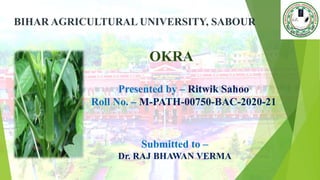
OKRA
Presented by – Ritwik Sahoo
Roll No. – M-PATH-00750-BAC-2020-21
BIHAR AGRICULTURAL UNIVERSITY, SABOUR
Submitted to –
Dr. RAJ BHAWAN VERMA
Introduction
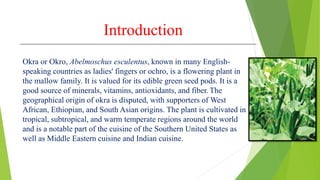
Okra or Okro, Abelmoschus esculentus, known in many English-
speaking countries as ladies' fingers or ochro, is a flowering plant in
the mallow family. It is valued for its edible green seed pods. It is a
good source of minerals, vitamins, antioxidants, and fiber. The
geographical origin of okra is disputed, with supporters of West
African, Ethiopian, and South Asian origins. The plant is cultivated in
tropical, subtropical, and warm temperate regions around the world
and is a notable part of the cuisine of the Southern United States as
well as Middle Eastern cuisine and Indian cuisine.
Area, Production & Productivity
 The total area and production under okra is reported to be 1148.0
thousand ha and 7896.3 thousand tons. It is mainly grown in India,
Nigeria, Sudan, Pakistan, Ghana, Egypt, Benin, Saudi Arabia,
Mexico and Cameroon. Largest area and production is in India (498
thousand ha, 5784 thousand ton) followed by Nigeria. Highest
productivity is reported from Egypt followed by Saudi Arabia.
Productivity from India is 11.60 mt/ha. [ Source : Indian
Horticulture Database – 2011]
 Andhra Pradesh is the leading okra producing followed by West
Bengal & Bihar & also has highest productivity in India. West
Bengal has highest area of production. [ Source : Indian Horticulture
Database – 2011]
Economic importance and uses
 Okra (Bhindi) annual vegetable crop propagated from seed in tropical and subtropical regions of
the world. After harvesting, fruits can be easily transported in bulk and stored for few days
without much loss of quality.
 Okra is more remunerative than the leafy vegetables.
 Fresh okra fruits are important and used as vegetable in India, Brazil, West Africa and many other
countries. For year round consumption sun-dried (Africa, India), frozen and sterilized (USA)
fruits are important market products.
 Tender green fruits are cooked in curry and at also used in soups.
 The root and stem are useful for clearing cane juice in preparation of jaggary.
 100g consumable unripe bhindi fruits contain 10.4g dry-matter, 3,100 calorie energy, 1.8g protein,
90mg calcium, 1mg iron, 0.1mg carotene, 0.07mg thiamin, 0.08mg riboflavin, 0.08mg niacin and
18mg vitamin C with almost compatible constituents, barring a few, in the leaves.
 In the Far East countries like Papua, New Guinea, Fiji and Solomon Islands, the species A.
manihot is also used as a leafy vegetable.
 It has multiple uses - The dry seeds contain 13-22% edible oil and 20-21% protein.
 The refined oil may be substitute for common edible oils especially cotton seed oil.
 The seed cake is also used as an animal feed.
 The dry fruit shell and stem containing crude fibre suitable for use in manufacture of paper and
cardboard.
Export
 Okra has tremendous export potential as fresh vegetable.
 It contains for 70% of the 30% exchange earnings, other than
onion, from export of vegetables.
 It is exported to Gulf, South-East Asia – Sri Lanka, Malaysia,
Bangladesh, Middle-East countries like – Qatar, Saudi Arabia,
Tehran, Abu Dhabi etc.
Origin & Distribution
 Okra originated from the Abyssinian center, an area that includes Ethiopia, a portion of
Eritrea, and the eastern, higher part of the Anglo-Egyptian Sudan. The crop was probably
taken into Egypt by Moslems from the East who conquered Egypt in the seventh century.
Its cultivation spread throughout North Africa and the Middle East.
 The cultivation of okra extends throughout the tropics and warmer parts of temperate
Asia. It is commercially grown in India, Turkey, Iran, West Africa, Yugoslavia,
Bangladesh, Afghanistan, Pakistan, West Bengal, Burma, Japan, Malaysia, Brazil,
Ghana, Ethiopia, Cyprus, and the southern USA.
 Wild Species – Abelmoschus tuberculatus
 Cultivated Species – A. esculentus, A. manihot, A. moschatus
Taxonomy
 Kingdom – Plantae
 Order – Malvales
 Family – Malvaceae
 Genus – Abelmoschus
 Species – A. esculentus
 The cultivated bhindi was earlier known as Hibiscus esculentus. Since in bhindi
calyx, corolla & staminal column are fused together at the base and fall together after
anthesis, this has been renamed as Abelmoschus esculentus, distinguishing it from
Hibiscus in which calyx is persistent.
 The hypothesis that A. esculentus has somatic chromosome number 2n = 130 and is
an amphidiploid of A. tuberculatus with 2n = 58 & an unknown species with 2n = 72,
makes this material most likely source of complimentary genome.
Breeding Methods
Bhindi flowers are self fertile but usually up to 10% cross-
pollination occurs by insects, thus it is classified as an often cross-
pollinated crop.
The breeding methods be such as plant introduction, pure line
selection, intra-specific hybridization pedigree selection,
interspecific hybridization using back cross technique and mutation
breeding are used for improvement.
Improvement in yield and its contributing characters, and resistance
to YVMV have been the major breeding objectives in bhindi.
Crop Production
 Climate – Hot humid season, favourable temperature – 25 to 35 degree C,
fail to germinate below 17 degree C & above 42 degree C causes desiccation
of flower buds and yield loss.
 Soil – It is grown on a wide range of soil but because of it tap root system it
does best on light, well drained, loose friable, well manured soil & pH should
be 6 to 6.8.
 Season – June – July (as a Kharif Crop), February – March (Spring-Summer
Crop) in eastern states, November sowing (Winter Crop) is done in northern
states as there is mild winter, Mid August sowing (Late Kharif Crop) is done
in northern plains.
 Cropping System – Potato-Carrot-Okra, Okra-Potato-Tomato (Sequential
Cropping) gives 300% cropping intensity; Okra+French Bean, Okra+Radish
(Intercropping) gives 193% outyield as compared with sole crops.
 Seed & Sowing – Seed Drilling, Hand Dibbling or behind the plough are recommended.
Seed Rate is 18-22 kg./ha. (Spring Summer Crop), 8-10 Kg./ha. (Kharif Crop) and
higher seed rate could be used for winter crop.
 Spacing – 60x30 cm. (Branching Types), 45x30 cm. (Non-Branching Types), 45x20 cm.
(Spring-Summer Crop), lower spacing for winter crop.
 Seed & Soil Treatment – Seed treatment by 0.2% Bavistin, Soil treatment by Furadan
@2 Kg. ai/ha. During initial 4 to 5 weeks.
 Nutrient – The fertilizer dose depends upon the fertility of soil and amount of organic
manure applied to the crop. About 20-25 t/ha of FYM is mixed at the time of land
preparation. Generally, application of 100 kg N, 60 kg P2O5 and 50 kg K2O is
recommended for optimum yield. Half dose of N and full dose of P2O5 and K2O are
applied at the time of planting. The balance half of N if given 30 days after sowing
followed by earthing up operation. For hybrid varieties the recommended dose is 150 kg
N, 112 kg P2O5 and 75 Kg K2O. Out of this dose, 30 % of N and 50 % of P & K is
applied as basal dose. Remaining 50 % of P and 40 % of N and 25 % of K is applied as
first top dressing four weeks after sowing. Balance quantity of 30 % N and 25 % K is
applied as second top dressing about 7 weeks after sowing. Zinc, Molybdenum are also
used as micronutrients.
 Irrigation - Irrigation frequency in bhendi crop varies with the season and the soil type.
Bhendi is grown without irrigation in rainy season in high rainfall area where distribution of
rainfall is uniform throughout the growing season. A light irrigation is given soon after seed
sowing to ensure good germination. The crop is irrigated at an interval of 4-5 days in summer.
Moisture stress at fruit setting stage reduces the fruit quality and the yield. Normally the crop
is irrigated by adopting the furrow method of irrigation.
 Interculture Operation - Weed control - It is necessary to keep the crop weed free during the
first 20-25 days of plant growth. A total of 3 to 4 weedings are needed. The first weeding is
done when the seedlings are two weeks old and subsequent weedings are done at an interval of
25 days. Pre-emergence application of Basalin 48 EC (1.5kg a.i./ha) or Stomp 30 EC (0.75 kg
a.i./ha) followed by one hand weeding at 20-25 days after sowing effectively controls the
weed growth.
 Harvesting and Yield - The fruits are ready for harvest in about 45-60 days after seed sowing
depending upon variety and season. Size of the pod and stage at which it is harvested varies
with variety/hybrid and market preference. Generally, medium sized (7-10 cm long) tender
pods, which can be easily snapped from the plant, are harvested. As all the fruits do not mature
at the same time, harvesting is carried out once in 3-4 days. Frequent picking promotes fruit
development and prevents the pods from growing too large. Yield of the Bhendi varies greatly
depending upon variety and season of cultivation. On an average bhendi yields 7.5-10 t/ha
while the yield of hybrid varieties ranges from 15-22 t/ha.
 Use of Plant Growth Regulators – Seed treatment by GA (400 ppm.), IAA 920
ppm.) enhanced seed germination, Ethephon (100-500 ppm.) weakened apical
dominance, Cycocel (1000-1500 ppm.) reduced plant height and @ 100 ppm.
Enhanced shelf life of fruits.
 Maturity Standards – A variety with over 16 cm. long fruits could reach
maximum growth at 28.1 degree C in 8 days of flowering, harvest maturity at 5-6
days, fibre development beyond 7 days & maximum growth rate between 4th to
6th day.
 Storage and Marketing – It could be stored at 7-9 degree C & 70-75% RH. For
processing purpose and fresh fruits export 6-8 cm. fruits are sorted out and longer
fruits are for fresh market. For local markets, fruits are cooled and filled in jute
bags, covered and then water sprinkled over them. This helps in cooling as well
as in turgidity of fruits which tightens the pack and saves products from bruises,
blemishes and blackening. In air tight containers the fruits may turn pale during
transit due to heat generated by fruits. For export, suitable size perforated paper
cartons are taken and pre-cooled fruits are packed and transported preferably in
refrigerated vans.
Plant Protection
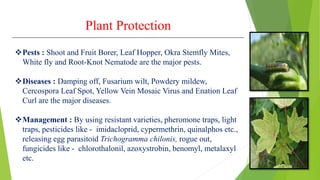
Pests : Shoot and Fruit Borer, Leaf Hopper, Okra Stemfly Mites,
White fly and Root-Knot Nematode are the major pests.
Diseases : Damping off, Fusarium wilt, Powdery mildew,
Cercospora Leaf Spot, Yellow Vein Mosaic Virus and Enation Leaf
Curl are the major diseases.
Management : By using resistant varieties, pheromone traps, light
traps, pesticides like - imidacloprid, cypermethrin, quinalphos etc.,
releasing egg parasitoid Trichogramma chilonis, rogue out,
fungicides like - chlorothalonil, azoxystrobin, benomyl, metalaxyl
etc.
Varieties
Before 1955 there were no improved varieties in bhindi and mostly local cultivars
were cultivated. During this period, Dr. Harbhajan Singh initiated systematic research
work on improvement of bhindi. With the development of Pusa Sawani during late
fifties as yellow vein mosaic virus (YVMV) resistant variety with wide adaptability.
 Some important varieties are listed here –
 Pusa Makhmali – From IARI, suited for cultivation in hills but susceptible to
YVMV.
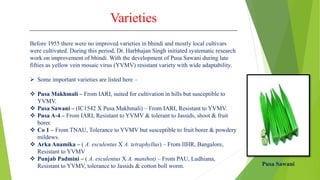
 Pusa Sawani – (IC1542 X Pusa Makhmali) – From IARI, Resistant to YVMV.
 Pusa A-4 – From IARI, Resistant to YVMV & tolerant to Jassids, shoot & fruit
borer.
 Co 1 – From TNAU, Tolerance to YVMV but susceptible to fruit borer & powdery
mildews.
 Arka Anamika – ( A. esculentus X A. tetraphyllus) – From IIHR, Bangalore,
Resistant to YVMV
 Punjab Padmini – ( A. esculentus X A. manihot) – From PAU, Ludhiana,
Resistant to YVMV, tolerance to Jassids & cotton boll worm. Pusa Sawani
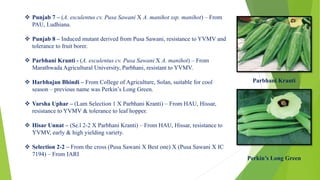
 Punjab 7 – (A. esculentus cv. Pusa Sawani X A. manihot ssp. manihot) – From
PAU, Ludhiana.
 Punjab 8 – Induced mutant derived from Pusa Sawani, resistance to YVMV and
tolerance to fruit borer.
 Parbhani Kranti - (A. esculentus cv. Pusa Sawani X A. manihot) – From
Marathwada Agricultural University, Parbhani, resistant to YVMV.
 Harbhajan Bhindi – From College of Agriculture, Solan, suitable for cool
season – previous name was Perkin’s Long Green.
 Varsha Uphar – (Lam Selection 1 X Parbhani Kranti) – From HAU, Hissar,
resistance to YVMV & tolerance to leaf hopper.
 Hisar Unnat – (Se.l 2-2 X Parbhani Kranti) – From HAU, Hissar, resistance to
YVMV, early & high yielding variety.
 Selection 2-2 – From the cross (Pusa Sawani X Best one) X (Pusa Sawani X IC
7194) – From IARI
Parbhani Kranti
Perkin’s Long Green
References
1.https://vikaspedia.in
2.Textbook of Vegetables, Tubercrops
and Spices – S & Narendra Singh
Thamburaj
Okra

Okra

  • 1.
    OKRA Presented by –Ritwik Sahoo Roll No. – M-PATH-00750-BAC-2020-21 BIHAR AGRICULTURAL UNIVERSITY, SABOUR Submitted to – Dr. RAJ BHAWAN VERMA
  • 2.
    Introduction Okra or Okro,Abelmoschus esculentus, known in many English- speaking countries as ladies' fingers or ochro, is a flowering plant in the mallow family. It is valued for its edible green seed pods. It is a good source of minerals, vitamins, antioxidants, and fiber. The geographical origin of okra is disputed, with supporters of West African, Ethiopian, and South Asian origins. The plant is cultivated in tropical, subtropical, and warm temperate regions around the world and is a notable part of the cuisine of the Southern United States as well as Middle Eastern cuisine and Indian cuisine.
  • 3.
    Area, Production &Productivity  The total area and production under okra is reported to be 1148.0 thousand ha and 7896.3 thousand tons. It is mainly grown in India, Nigeria, Sudan, Pakistan, Ghana, Egypt, Benin, Saudi Arabia, Mexico and Cameroon. Largest area and production is in India (498 thousand ha, 5784 thousand ton) followed by Nigeria. Highest productivity is reported from Egypt followed by Saudi Arabia. Productivity from India is 11.60 mt/ha. [ Source : Indian Horticulture Database – 2011]  Andhra Pradesh is the leading okra producing followed by West Bengal & Bihar & also has highest productivity in India. West Bengal has highest area of production. [ Source : Indian Horticulture Database – 2011]
  • 4.
    Economic importance anduses  Okra (Bhindi) annual vegetable crop propagated from seed in tropical and subtropical regions of the world. After harvesting, fruits can be easily transported in bulk and stored for few days without much loss of quality.  Okra is more remunerative than the leafy vegetables.  Fresh okra fruits are important and used as vegetable in India, Brazil, West Africa and many other countries. For year round consumption sun-dried (Africa, India), frozen and sterilized (USA) fruits are important market products.  Tender green fruits are cooked in curry and at also used in soups.  The root and stem are useful for clearing cane juice in preparation of jaggary.  100g consumable unripe bhindi fruits contain 10.4g dry-matter, 3,100 calorie energy, 1.8g protein, 90mg calcium, 1mg iron, 0.1mg carotene, 0.07mg thiamin, 0.08mg riboflavin, 0.08mg niacin and 18mg vitamin C with almost compatible constituents, barring a few, in the leaves.  In the Far East countries like Papua, New Guinea, Fiji and Solomon Islands, the species A. manihot is also used as a leafy vegetable.  It has multiple uses - The dry seeds contain 13-22% edible oil and 20-21% protein.  The refined oil may be substitute for common edible oils especially cotton seed oil.  The seed cake is also used as an animal feed.  The dry fruit shell and stem containing crude fibre suitable for use in manufacture of paper and cardboard.
  • 5.
    Export  Okra hastremendous export potential as fresh vegetable.  It contains for 70% of the 30% exchange earnings, other than onion, from export of vegetables.  It is exported to Gulf, South-East Asia – Sri Lanka, Malaysia, Bangladesh, Middle-East countries like – Qatar, Saudi Arabia, Tehran, Abu Dhabi etc.
  • 6.
    Origin & Distribution Okra originated from the Abyssinian center, an area that includes Ethiopia, a portion of Eritrea, and the eastern, higher part of the Anglo-Egyptian Sudan. The crop was probably taken into Egypt by Moslems from the East who conquered Egypt in the seventh century. Its cultivation spread throughout North Africa and the Middle East.  The cultivation of okra extends throughout the tropics and warmer parts of temperate Asia. It is commercially grown in India, Turkey, Iran, West Africa, Yugoslavia, Bangladesh, Afghanistan, Pakistan, West Bengal, Burma, Japan, Malaysia, Brazil, Ghana, Ethiopia, Cyprus, and the southern USA.  Wild Species – Abelmoschus tuberculatus  Cultivated Species – A. esculentus, A. manihot, A. moschatus
  • 7.
    Taxonomy  Kingdom –Plantae  Order – Malvales  Family – Malvaceae  Genus – Abelmoschus  Species – A. esculentus  The cultivated bhindi was earlier known as Hibiscus esculentus. Since in bhindi calyx, corolla & staminal column are fused together at the base and fall together after anthesis, this has been renamed as Abelmoschus esculentus, distinguishing it from Hibiscus in which calyx is persistent.  The hypothesis that A. esculentus has somatic chromosome number 2n = 130 and is an amphidiploid of A. tuberculatus with 2n = 58 & an unknown species with 2n = 72, makes this material most likely source of complimentary genome.
  • 8.
    Breeding Methods Bhindi flowersare self fertile but usually up to 10% cross- pollination occurs by insects, thus it is classified as an often cross- pollinated crop. The breeding methods be such as plant introduction, pure line selection, intra-specific hybridization pedigree selection, interspecific hybridization using back cross technique and mutation breeding are used for improvement. Improvement in yield and its contributing characters, and resistance to YVMV have been the major breeding objectives in bhindi.
  • 9.
    Crop Production  Climate– Hot humid season, favourable temperature – 25 to 35 degree C, fail to germinate below 17 degree C & above 42 degree C causes desiccation of flower buds and yield loss.  Soil – It is grown on a wide range of soil but because of it tap root system it does best on light, well drained, loose friable, well manured soil & pH should be 6 to 6.8.  Season – June – July (as a Kharif Crop), February – March (Spring-Summer Crop) in eastern states, November sowing (Winter Crop) is done in northern states as there is mild winter, Mid August sowing (Late Kharif Crop) is done in northern plains.  Cropping System – Potato-Carrot-Okra, Okra-Potato-Tomato (Sequential Cropping) gives 300% cropping intensity; Okra+French Bean, Okra+Radish (Intercropping) gives 193% outyield as compared with sole crops.
  • 10.
     Seed &Sowing – Seed Drilling, Hand Dibbling or behind the plough are recommended. Seed Rate is 18-22 kg./ha. (Spring Summer Crop), 8-10 Kg./ha. (Kharif Crop) and higher seed rate could be used for winter crop.  Spacing – 60x30 cm. (Branching Types), 45x30 cm. (Non-Branching Types), 45x20 cm. (Spring-Summer Crop), lower spacing for winter crop.  Seed & Soil Treatment – Seed treatment by 0.2% Bavistin, Soil treatment by Furadan @2 Kg. ai/ha. During initial 4 to 5 weeks.  Nutrient – The fertilizer dose depends upon the fertility of soil and amount of organic manure applied to the crop. About 20-25 t/ha of FYM is mixed at the time of land preparation. Generally, application of 100 kg N, 60 kg P2O5 and 50 kg K2O is recommended for optimum yield. Half dose of N and full dose of P2O5 and K2O are applied at the time of planting. The balance half of N if given 30 days after sowing followed by earthing up operation. For hybrid varieties the recommended dose is 150 kg N, 112 kg P2O5 and 75 Kg K2O. Out of this dose, 30 % of N and 50 % of P & K is applied as basal dose. Remaining 50 % of P and 40 % of N and 25 % of K is applied as first top dressing four weeks after sowing. Balance quantity of 30 % N and 25 % K is applied as second top dressing about 7 weeks after sowing. Zinc, Molybdenum are also used as micronutrients.
  • 11.
     Irrigation -Irrigation frequency in bhendi crop varies with the season and the soil type. Bhendi is grown without irrigation in rainy season in high rainfall area where distribution of rainfall is uniform throughout the growing season. A light irrigation is given soon after seed sowing to ensure good germination. The crop is irrigated at an interval of 4-5 days in summer. Moisture stress at fruit setting stage reduces the fruit quality and the yield. Normally the crop is irrigated by adopting the furrow method of irrigation.  Interculture Operation - Weed control - It is necessary to keep the crop weed free during the first 20-25 days of plant growth. A total of 3 to 4 weedings are needed. The first weeding is done when the seedlings are two weeks old and subsequent weedings are done at an interval of 25 days. Pre-emergence application of Basalin 48 EC (1.5kg a.i./ha) or Stomp 30 EC (0.75 kg a.i./ha) followed by one hand weeding at 20-25 days after sowing effectively controls the weed growth.  Harvesting and Yield - The fruits are ready for harvest in about 45-60 days after seed sowing depending upon variety and season. Size of the pod and stage at which it is harvested varies with variety/hybrid and market preference. Generally, medium sized (7-10 cm long) tender pods, which can be easily snapped from the plant, are harvested. As all the fruits do not mature at the same time, harvesting is carried out once in 3-4 days. Frequent picking promotes fruit development and prevents the pods from growing too large. Yield of the Bhendi varies greatly depending upon variety and season of cultivation. On an average bhendi yields 7.5-10 t/ha while the yield of hybrid varieties ranges from 15-22 t/ha.
  • 12.
     Use ofPlant Growth Regulators – Seed treatment by GA (400 ppm.), IAA 920 ppm.) enhanced seed germination, Ethephon (100-500 ppm.) weakened apical dominance, Cycocel (1000-1500 ppm.) reduced plant height and @ 100 ppm. Enhanced shelf life of fruits.  Maturity Standards – A variety with over 16 cm. long fruits could reach maximum growth at 28.1 degree C in 8 days of flowering, harvest maturity at 5-6 days, fibre development beyond 7 days & maximum growth rate between 4th to 6th day.  Storage and Marketing – It could be stored at 7-9 degree C & 70-75% RH. For processing purpose and fresh fruits export 6-8 cm. fruits are sorted out and longer fruits are for fresh market. For local markets, fruits are cooled and filled in jute bags, covered and then water sprinkled over them. This helps in cooling as well as in turgidity of fruits which tightens the pack and saves products from bruises, blemishes and blackening. In air tight containers the fruits may turn pale during transit due to heat generated by fruits. For export, suitable size perforated paper cartons are taken and pre-cooled fruits are packed and transported preferably in refrigerated vans.
  • 13.
    Plant Protection Pests :Shoot and Fruit Borer, Leaf Hopper, Okra Stemfly Mites, White fly and Root-Knot Nematode are the major pests. Diseases : Damping off, Fusarium wilt, Powdery mildew, Cercospora Leaf Spot, Yellow Vein Mosaic Virus and Enation Leaf Curl are the major diseases. Management : By using resistant varieties, pheromone traps, light traps, pesticides like - imidacloprid, cypermethrin, quinalphos etc., releasing egg parasitoid Trichogramma chilonis, rogue out, fungicides like - chlorothalonil, azoxystrobin, benomyl, metalaxyl etc.
  • 14.
    Varieties Before 1955 therewere no improved varieties in bhindi and mostly local cultivars were cultivated. During this period, Dr. Harbhajan Singh initiated systematic research work on improvement of bhindi. With the development of Pusa Sawani during late fifties as yellow vein mosaic virus (YVMV) resistant variety with wide adaptability.  Some important varieties are listed here –  Pusa Makhmali – From IARI, suited for cultivation in hills but susceptible to YVMV.  Pusa Sawani – (IC1542 X Pusa Makhmali) – From IARI, Resistant to YVMV.  Pusa A-4 – From IARI, Resistant to YVMV & tolerant to Jassids, shoot & fruit borer.  Co 1 – From TNAU, Tolerance to YVMV but susceptible to fruit borer & powdery mildews.  Arka Anamika – ( A. esculentus X A. tetraphyllus) – From IIHR, Bangalore, Resistant to YVMV  Punjab Padmini – ( A. esculentus X A. manihot) – From PAU, Ludhiana, Resistant to YVMV, tolerance to Jassids & cotton boll worm. Pusa Sawani
  • 15.
     Punjab 7– (A. esculentus cv. Pusa Sawani X A. manihot ssp. manihot) – From PAU, Ludhiana.  Punjab 8 – Induced mutant derived from Pusa Sawani, resistance to YVMV and tolerance to fruit borer.  Parbhani Kranti - (A. esculentus cv. Pusa Sawani X A. manihot) – From Marathwada Agricultural University, Parbhani, resistant to YVMV.  Harbhajan Bhindi – From College of Agriculture, Solan, suitable for cool season – previous name was Perkin’s Long Green.  Varsha Uphar – (Lam Selection 1 X Parbhani Kranti) – From HAU, Hissar, resistance to YVMV & tolerance to leaf hopper.  Hisar Unnat – (Se.l 2-2 X Parbhani Kranti) – From HAU, Hissar, resistance to YVMV, early & high yielding variety.  Selection 2-2 – From the cross (Pusa Sawani X Best one) X (Pusa Sawani X IC 7194) – From IARI Parbhani Kranti Perkin’s Long Green
  • 16.
    References 1.https://vikaspedia.in 2.Textbook of Vegetables,Tubercrops and Spices – S & Narendra Singh Thamburaj