Commas Notes Set #3
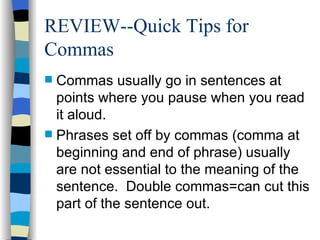
REVIEW--Quick Tips for Commas Commas usually go in sentences at points where you pause when you read it aloud. Phrases set off by commas (comma at beginning and end of phrase) usually are not essential to the meaning of the sentence.  Double commas=can cut this part of the sentence out.
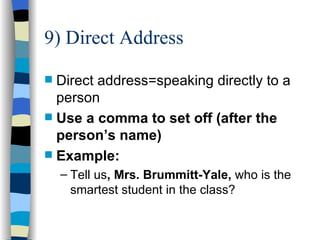
9) Direct Address Direct address=speaking directly to a person Use a comma to set off (after the person’s name) Example: Tell us , Mrs. Brummitt-Yale,  who is the smartest student in the class?
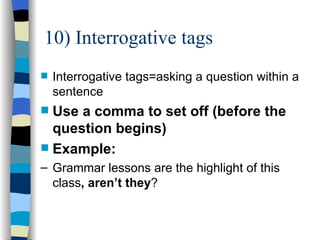
10) Interrogative tags Interrogative tags=asking a question within a sentence Use a comma to set off (before the question begins) Example: Grammar lessons are the highlight of this class , aren’t they ?
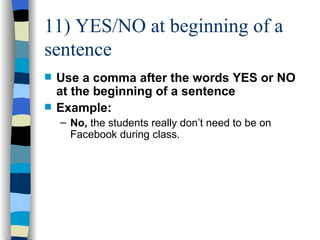
11) YES/NO at beginning of a sentence Use a comma after the words YES or NO at the beginning of a sentence Example: No,  the students really don’t need to be on Facebook during class.
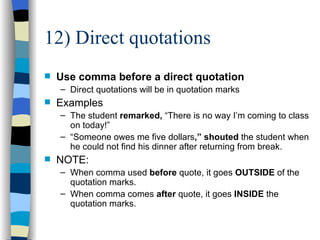
12) Direct quotations Use comma before a direct quotation Direct quotations will be in quotation marks Examples The student  remarked,  “There is no way I’m coming to class on today!” “ Someone owes me five dollars ,” shouted  the student when he could not find his dinner after returning from break. NOTE: When comma used  before  quote, it goes  OUTSIDE  of the quotation marks. When comma comes  after  quote, it goes  INSIDE  the quotation marks.
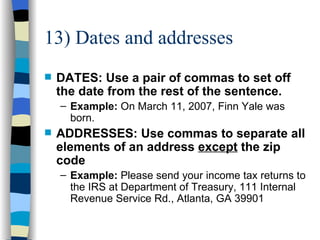
13) Dates and addresses DATES: Use a pair of commas to set off the date from the rest of the sentence. Example:  On March 11, 2007, Finn Yale was born. ADDRESSES: Use commas to separate all elements of an address  except  the zip code Example:  Please send your income tax returns to the IRS at Department of Treasury, 111 Internal Revenue Service Rd., Atlanta, GA 39901
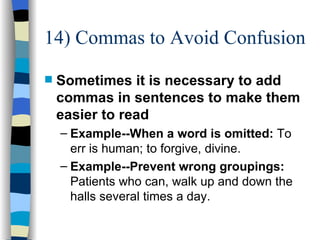
14) Commas to Avoid Confusion Sometimes it is necessary to add commas in sentences to make them easier to read Example--When a word is omitted:  To err is human; to forgive, divine. Example--Prevent wrong groupings:  Patients who can, walk up and down the halls several times a day.

Commas notes 3 powerpoint

  • 1.
  • 2.
    REVIEW--Quick Tips forCommas Commas usually go in sentences at points where you pause when you read it aloud. Phrases set off by commas (comma at beginning and end of phrase) usually are not essential to the meaning of the sentence. Double commas=can cut this part of the sentence out.
  • 3.
    9) Direct AddressDirect address=speaking directly to a person Use a comma to set off (after the person’s name) Example: Tell us , Mrs. Brummitt-Yale, who is the smartest student in the class?
  • 4.
    10) Interrogative tagsInterrogative tags=asking a question within a sentence Use a comma to set off (before the question begins) Example: Grammar lessons are the highlight of this class , aren’t they ?
  • 5.
    11) YES/NO atbeginning of a sentence Use a comma after the words YES or NO at the beginning of a sentence Example: No, the students really don’t need to be on Facebook during class.
  • 6.
    12) Direct quotationsUse comma before a direct quotation Direct quotations will be in quotation marks Examples The student remarked, “There is no way I’m coming to class on today!” “ Someone owes me five dollars ,” shouted the student when he could not find his dinner after returning from break. NOTE: When comma used before quote, it goes OUTSIDE of the quotation marks. When comma comes after quote, it goes INSIDE the quotation marks.
  • 7.
    13) Dates andaddresses DATES: Use a pair of commas to set off the date from the rest of the sentence. Example: On March 11, 2007, Finn Yale was born. ADDRESSES: Use commas to separate all elements of an address except the zip code Example: Please send your income tax returns to the IRS at Department of Treasury, 111 Internal Revenue Service Rd., Atlanta, GA 39901
  • 8.
    14) Commas toAvoid Confusion Sometimes it is necessary to add commas in sentences to make them easier to read Example--When a word is omitted: To err is human; to forgive, divine. Example--Prevent wrong groupings: Patients who can, walk up and down the halls several times a day.