Promoting Knowledge Gain & Behavior
Change through Effective Education
https://learn.extension.org/events/2040
Sign up for webinar email notifications
http://bit.ly/MFLN-Notify
Provide feedback and earn CEU credit with one link:
We will provide this link at the end of the webinar
Research and evidenced-based
professional development
through engaged online communities.
eXtension.org/militaryfamilies
POLL
How would you best describe your current employer?
Providing educational tools and caregiving tips for military professionals and family caregivers
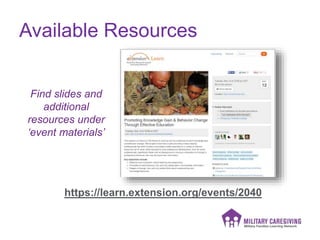
https://learn.extension.org/events/2040
Find slides and
additional
resources under
‘event materials’
Available Resources
Evaluation and CE Credit
The Military Caregiving Concentration team will
offer 1.00 CE credit hour from the National
Association of Social Workers (NASW).
*Must complete evaluation and pass post-test
with 80% or higher to receive a certificate.
A link to the evaluation and post-test will be
available at the end of today’s presentation.
Promoting Knowledge Gain
& Behavior Change through
Effective Education
Andrew B. Crocker
Extension Program Specialist III –
Gerontology & Health
Texas A&M AgriLife Extension Service
http://aging.tamu.edu
2015
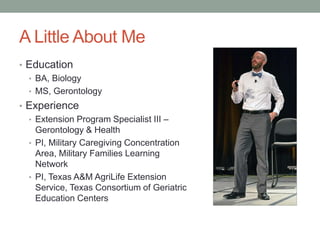
A Little About Me
• Education
• BA, Biology
• MS, Gerontology
• Experience
• Extension Program Specialist III –
Gerontology & Health
• PI, Military Caregiving Concentration
Area, Military Families Learning
Network
• PI, Texas A&M AgriLife Extension
Service, Texas Consortium of Geriatric
Education Centers
Today We’ll Talk About…
• Effective Communication
• Active listening and responding
• Principles of Adult Learning
• How and why adults take in and
process information
• Stages of Change
• How and why adults think about
implementing knew knowledge
and/or behaviors.
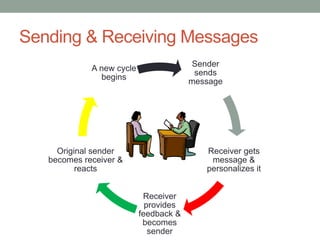
Sending & Receiving Messages
Sender
sends
message
Receiver gets
message &
personalizes it
Receiver
provides
feedback &
becomes
sender
Original sender
becomes receiver &
reacts
A new cycle
begins
Where Did It All Go Wrong?
• Differences between the
sender and receiver may
affect successful
communication
• Language
• Attitude/Bias
• Information Level
• Social System
• Sensory Perception
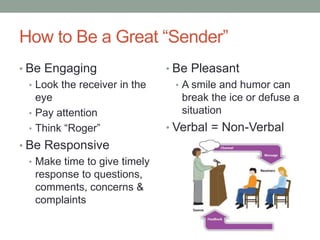
How to Be a Great “Sender”
• Be Engaging
• Look the receiver in the
eye
• Pay attention
• Think “Roger”
• Be Responsive
• Make time to give timely
response to questions,
comments, concerns &
complaints
• Be Pleasant
• A smile and humor can
break the ice or defuse a
situation
• Verbal = Non-Verbal
Are Hearing and Listening the Same?
• Hearing is the sense by
which noises & tones are
received – it gathers sound
waves indiscriminately
• We can hear something
without choosing to listen
• Listening is a voluntary
activity
• Listening includes interpreting
or processing the sound
• When you focus only on
yourself, you often forget
to listen
• Listening is the basis of
effective communication
• Think about the last time
you noticed someone
obviously not paying
attention
• What specific behaviors led
you to believe that he or she
was not paying attention?
• What impact did this have on
you?
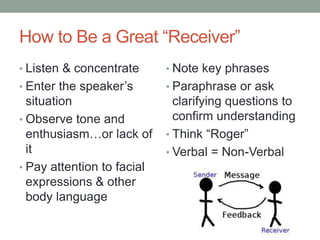
How to Be a Great “Receiver”
• Listen & concentrate
• Enter the speaker’s
situation
• Observe tone and
enthusiasm…or lack of
it
• Pay attention to facial
expressions & other
body language
• Note key phrases
• Paraphrase or ask
clarifying questions to
confirm understanding
• Think “Roger”
• Verbal = Non-Verbal
What Do We Know About Learning?
• Learning is a change
in behavior
• Acquiring new
information or
knowledge
• Change in knowledge or
skill
• Adults may seek out
learning opportunities
• Learning is individual
• Characteristics of Adult
Learners
• Autonomous & self-
directed
• Accumulated a
foundation of experience
& knowledge
• Goal oriented
• Practical
• Need to be shown
respect
Russell, S.S. (2006). An Overview of Adult Learning Processes. Urol Nurs. 26(5): 349-52.
Knowles, M. (1970). The Modern Practice of Adult Education. Englewood Cliffs: Prentice Hall/Cambridge.
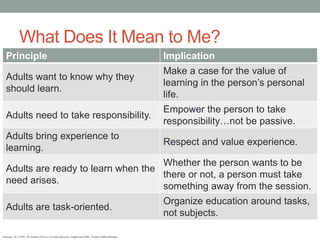
What Does It Mean to Me?
Principle Implication
Adults want to know why they
should learn.
Make a case for the value of
learning in the person’s personal
life.
Adults need to take responsibility.
Empower the person to take
responsibility…not be passive.
Adults bring experience to
learning.
Respect and value experience.
Adults are ready to learn when the
need arises.
Whether the person wants to be
there or not, a person must take
something away from the session.
Adults are task-oriented.
Organize education around tasks,
not subjects.
Knowles, M. (1970). The Modern Practice of Adult Education. Englewood Cliffs: Prentice Hall/Cambridge.
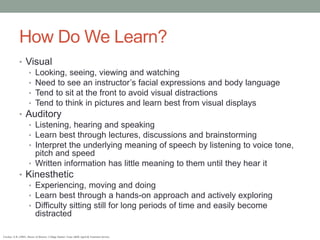
How Do We Learn?
• Visual
• Looking, seeing, viewing and watching
• Need to see an instructor’s facial expressions and body language
• Tend to sit at the front to avoid visual distractions
• Tend to think in pictures and learn best from visual displays
• Auditory
• Listening, hearing and speaking
• Learn best through lectures, discussions and brainstorming
• Interpret the underlying meaning of speech by listening to voice tone,
pitch and speed
• Written information has little meaning to them until they hear it
• Kinesthetic
• Experiencing, moving and doing
• Learn best through a hands-on approach and actively exploring
• Difficulty sitting still for long periods of time and easily become
distracted
Crocker, A.B. (2005). Master of Memory. College Station: Texas A&M AgriLife Extension Service.
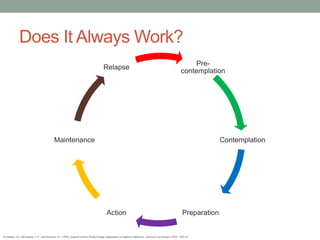
Does It Always Work?
Pre-
contemplation
Contemplation
PreparationAction
Maintenance
Relapse
Prochaska, J.O., DiClemente, C.C., and Norcross, J.C. (1992). Insearch of How People Change Applications to Addictive Behaviors. American Psychologist. 47(9): 1102-14.
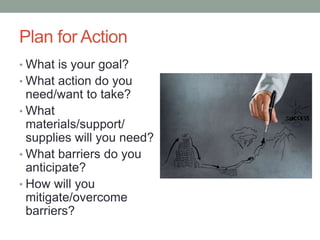
Plan for Action
• What is your goal?
• What action do you
need/want to take?
• What
materials/support/
supplies will you need?
• What barriers do you
anticipate?
• How will you
mitigate/overcome
barriers?
Plan for Action – Fill in the Blank
• What is your goal?
• Comply with doctor’s advice regarding my condition.
• What action do you need/want to take?
• Take medications as prescribed.
• What materials/support/supplies will you need?
• ?
• What barriers do you anticipate?
• ?
• How will you mitigate/overcome those barriers?
• ?
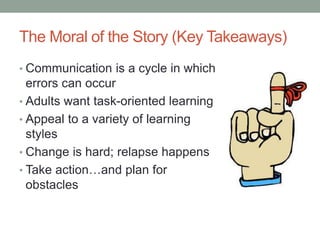
The Moral of the Story (Key Takeaways)
• Communication is a cycle in which
errors can occur
• Adults want task-oriented learning
• Appeal to a variety of learning
styles
• Change is hard; relapse happens
• Take action…and plan for
obstacles
Evaluation & CE Credit Process
The Military Caregiving Concentration team will
offer 1.00 CE credit hour from NASW.
To receive CE credit please complete the
evaluation and post-test found at:
https://vte.co1.qualtrics.com/SE/?SID=SV_bIucC4
zuR24j3eZ
*Must completion evaluation and pass post-test
with 80% or higher to receive certificate.
Upcoming Caregiving Event
Understanding Respite Care for Military
Caregivers
• Date: June 10, 2015
• Time: 11:00 a.m. Eastern
• Location: https://learn.extension.org/events/2090
For more information on MFLN-Military Caregiving go to:
http://www.extension.org/pages/60576
Virtual Learning Event
Conceptualizing content for military service
providers through an innovative virtual learning
environment focusing on areas of building trust,
cultural competencies and compassion fatigue.
For more information on MFLN-Military Caregiving go to:
http://www.extension.org/pages/60576
Coming August 2015
Find all upcoming and recorded webinars
covering:
Personal Finance
Military Caregiving
Family Development
Family Transitions
Network Literacy
Nutrition & Wellness
Community Capacity Building
http://www.extension.org/62581

Promoting Knowledge Gain & Behavior Change through Effective Education

  • 1.
    Promoting Knowledge Gain& Behavior Change through Effective Education https://learn.extension.org/events/2040
  • 2.
    Sign up forwebinar email notifications http://bit.ly/MFLN-Notify Provide feedback and earn CEU credit with one link: We will provide this link at the end of the webinar
  • 3.
    Research and evidenced-based professionaldevelopment through engaged online communities. eXtension.org/militaryfamilies
  • 4.
    POLL How would youbest describe your current employer?
  • 5.
    Providing educational toolsand caregiving tips for military professionals and family caregivers
  • 6.
  • 7.
    Evaluation and CECredit The Military Caregiving Concentration team will offer 1.00 CE credit hour from the National Association of Social Workers (NASW). *Must complete evaluation and pass post-test with 80% or higher to receive a certificate. A link to the evaluation and post-test will be available at the end of today’s presentation.
  • 8.
    Promoting Knowledge Gain &Behavior Change through Effective Education Andrew B. Crocker Extension Program Specialist III – Gerontology & Health Texas A&M AgriLife Extension Service http://aging.tamu.edu 2015
  • 9.
    A Little AboutMe • Education • BA, Biology • MS, Gerontology • Experience • Extension Program Specialist III – Gerontology & Health • PI, Military Caregiving Concentration Area, Military Families Learning Network • PI, Texas A&M AgriLife Extension Service, Texas Consortium of Geriatric Education Centers
  • 10.
    Today We’ll TalkAbout… • Effective Communication • Active listening and responding • Principles of Adult Learning • How and why adults take in and process information • Stages of Change • How and why adults think about implementing knew knowledge and/or behaviors.
  • 11.
    Sending & ReceivingMessages Sender sends message Receiver gets message & personalizes it Receiver provides feedback & becomes sender Original sender becomes receiver & reacts A new cycle begins
  • 12.
    Where Did ItAll Go Wrong? • Differences between the sender and receiver may affect successful communication • Language • Attitude/Bias • Information Level • Social System • Sensory Perception
  • 13.
    How to Bea Great “Sender” • Be Engaging • Look the receiver in the eye • Pay attention • Think “Roger” • Be Responsive • Make time to give timely response to questions, comments, concerns & complaints • Be Pleasant • A smile and humor can break the ice or defuse a situation • Verbal = Non-Verbal
  • 14.
    Are Hearing andListening the Same? • Hearing is the sense by which noises & tones are received – it gathers sound waves indiscriminately • We can hear something without choosing to listen • Listening is a voluntary activity • Listening includes interpreting or processing the sound • When you focus only on yourself, you often forget to listen • Listening is the basis of effective communication • Think about the last time you noticed someone obviously not paying attention • What specific behaviors led you to believe that he or she was not paying attention? • What impact did this have on you?
  • 15.
    How to Bea Great “Receiver” • Listen & concentrate • Enter the speaker’s situation • Observe tone and enthusiasm…or lack of it • Pay attention to facial expressions & other body language • Note key phrases • Paraphrase or ask clarifying questions to confirm understanding • Think “Roger” • Verbal = Non-Verbal
  • 16.
    What Do WeKnow About Learning? • Learning is a change in behavior • Acquiring new information or knowledge • Change in knowledge or skill • Adults may seek out learning opportunities • Learning is individual • Characteristics of Adult Learners • Autonomous & self- directed • Accumulated a foundation of experience & knowledge • Goal oriented • Practical • Need to be shown respect Russell, S.S. (2006). An Overview of Adult Learning Processes. Urol Nurs. 26(5): 349-52. Knowles, M. (1970). The Modern Practice of Adult Education. Englewood Cliffs: Prentice Hall/Cambridge.
  • 17.
    What Does ItMean to Me? Principle Implication Adults want to know why they should learn. Make a case for the value of learning in the person’s personal life. Adults need to take responsibility. Empower the person to take responsibility…not be passive. Adults bring experience to learning. Respect and value experience. Adults are ready to learn when the need arises. Whether the person wants to be there or not, a person must take something away from the session. Adults are task-oriented. Organize education around tasks, not subjects. Knowles, M. (1970). The Modern Practice of Adult Education. Englewood Cliffs: Prentice Hall/Cambridge.
  • 18.
    How Do WeLearn? • Visual • Looking, seeing, viewing and watching • Need to see an instructor’s facial expressions and body language • Tend to sit at the front to avoid visual distractions • Tend to think in pictures and learn best from visual displays • Auditory • Listening, hearing and speaking • Learn best through lectures, discussions and brainstorming • Interpret the underlying meaning of speech by listening to voice tone, pitch and speed • Written information has little meaning to them until they hear it • Kinesthetic • Experiencing, moving and doing • Learn best through a hands-on approach and actively exploring • Difficulty sitting still for long periods of time and easily become distracted Crocker, A.B. (2005). Master of Memory. College Station: Texas A&M AgriLife Extension Service.
  • 19.
    Does It AlwaysWork? Pre- contemplation Contemplation PreparationAction Maintenance Relapse Prochaska, J.O., DiClemente, C.C., and Norcross, J.C. (1992). Insearch of How People Change Applications to Addictive Behaviors. American Psychologist. 47(9): 1102-14.
  • 20.
    Plan for Action •What is your goal? • What action do you need/want to take? • What materials/support/ supplies will you need? • What barriers do you anticipate? • How will you mitigate/overcome barriers?
  • 21.
    Plan for Action– Fill in the Blank • What is your goal? • Comply with doctor’s advice regarding my condition. • What action do you need/want to take? • Take medications as prescribed. • What materials/support/supplies will you need? • ? • What barriers do you anticipate? • ? • How will you mitigate/overcome those barriers? • ?
  • 22.
    The Moral ofthe Story (Key Takeaways) • Communication is a cycle in which errors can occur • Adults want task-oriented learning • Appeal to a variety of learning styles • Change is hard; relapse happens • Take action…and plan for obstacles
  • 23.
    Evaluation & CECredit Process The Military Caregiving Concentration team will offer 1.00 CE credit hour from NASW. To receive CE credit please complete the evaluation and post-test found at: https://vte.co1.qualtrics.com/SE/?SID=SV_bIucC4 zuR24j3eZ *Must completion evaluation and pass post-test with 80% or higher to receive certificate.
  • 24.
    Upcoming Caregiving Event UnderstandingRespite Care for Military Caregivers • Date: June 10, 2015 • Time: 11:00 a.m. Eastern • Location: https://learn.extension.org/events/2090 For more information on MFLN-Military Caregiving go to: http://www.extension.org/pages/60576
  • 25.
    Virtual Learning Event Conceptualizingcontent for military service providers through an innovative virtual learning environment focusing on areas of building trust, cultural competencies and compassion fatigue. For more information on MFLN-Military Caregiving go to: http://www.extension.org/pages/60576 Coming August 2015
  • 26.
    Find all upcomingand recorded webinars covering: Personal Finance Military Caregiving Family Development Family Transitions Network Literacy Nutrition & Wellness Community Capacity Building http://www.extension.org/62581