


Surgical Learning – It’s Not Just
PowerPoint Anymore
or
What I did with my Winter Vacation
Michael E. Shapiro, M.D.
General Surgery Program Director
Rutgers – New Jersey Medical School
Harvard – Macy Scholar
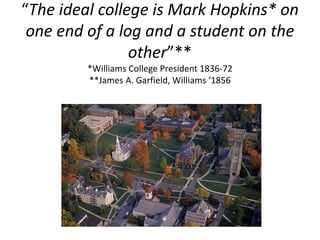
“The ideal college is Mark Hopkins* on
one end of a log and a student on the
other”**
*Williams College President 1836-72
**James A. Garfield, Williams ‘1856
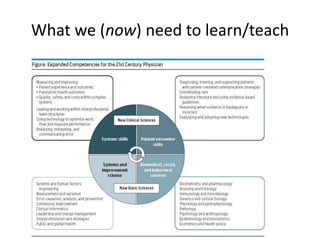
What we (now) need to learn/teach
An Experiment:
At the end of this talk, there will be a
quiz.
The Basics - 1
• As an educator, what is our prime role?
– To promote learning
• What is learning?
– Change (in knowledge, beliefs, behavior) that is
sustained
• What is teaching?
– The act of promoting/catalyzing change
– (ideally, done intentionally and informed by best
practices)
The Basics - 2
• What is assessment/feedback?
– Measuring change –
• To promote further learning
– Identify strengths and weakness to the learner
– Learner centered
• To demonstrate competence
– Patient safety
– Entrustable professional activities (EPAs)
– Certification
– System centered
– Need balance of both
The Basics - 3
• Who is the assessment/feedback we do really for
(i.e., who are the stakeholders)?
– Learner (e.g., student, resident)
– Teacher – is our teaching of value?
– Regulator
• NJMS
– Dean
– GMEC
• ACGME
• ABS
• How do their interests relate to promoting
learning or insuring competence?
The Basics - 4
• Deliberate teaching = defining planned change,
the developing appropriate strategy to
implement it, and assessment/feedback to
promote it and demonstrate it.
• As an educator, asking what do I/we need/want
to change, what is the best way to accomplish
that, and how would I know if I did?
Case Discussion – the “surprised” resident
• Bob (not real name) is a PGY-3 surgical resident in
the middle of the year. He graduated from a well-
known medical school, and has had excellent
evaluations his first two years. The CCC has just
met to review the PGY-3’s. The evaluations for Bob
this year were very different, and quite negative.
They all noted his failure to progress to a stage
where he can lead a team, make diagnoses and
plans, and make decisions for the patient. All
stated they had provided this feedback to Bob.
This case is a work of fiction. Any
similarities to any person, living or dead, is
purely coincidental and unintentional.
Case - 2
• You meet with Bob as Program Director. You begin
by asking him how he thinks things are going? He
responds that he thinks things are going pretty
well, in fact, “great.” He is happy in the program,
and feels that, although the transition to third year
was initially challenging, he now “has everything
under control.” At first gently, then more firmly,
you raise the concerns of his attendings.
Case - 3
• Bob claims to have never heard any of this negative
commentary before. You try to express your
concerns to Bob, who refuses to accept those
assessments, and states that he “respectfully
disagrees” and the faculty concerns are “unfounded
and incorrect.”
• Now what do you do?
• What do you suspect happened?
• How do you reconcile the different perspectives?
• Does this suggest anything about the need to track
real-time learning?
Adult Learning Theory
• Adult learning is different from children’s
learning.
• Children learn for the joy of learning.
– Some of us never grow up
• Adults learn for a purpose
– Further educational goals
– Gain skills that can be applied
– Pass a regulatory exam
ALT - 2
• Prior knowledge is the foundation for new
learning
• Adult learners should activate and build upon
prior knowledge
• Increasing the links to prior learning is critical
• Adult learners should be actively involved in
constructing individual educational goals and
meanings – they want to learn.
ALT-3
• Adult learners should own their learning
(intrinsic motivation) as opposed to primarily
responding to their teachers/evaluators
(extrinsic motivation). Intrinsic motivation is
associated with deeper learning.
• Teaching adult learners should promote both
learner autonomy and growth, ultimately
making the teacher unnecessary.
• Our job is, ultimately, to become superfluous.
ALT-4
• So, to maximize learning:
– Adult learners need to be actively involved in the
learning process, including:
• Initial self-appraisal
• Setting goals
• Developing mastery
• Participating in the assessment/feedback process
– Adult learners need to be active partners, not
empty vessels to be filled by the teacher.
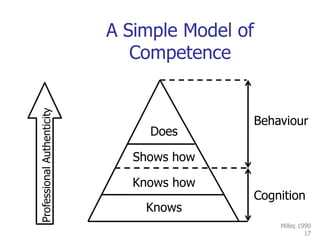
A Simple Model of
CompetenceProfessionalAuthenticity
Behaviour
Does
Shows how
Knows how
Cognition
Knows
Miller, 1990
17
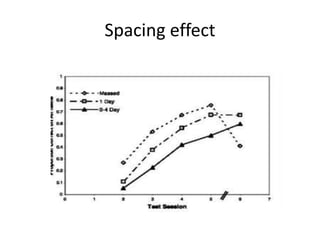
Spacing effect
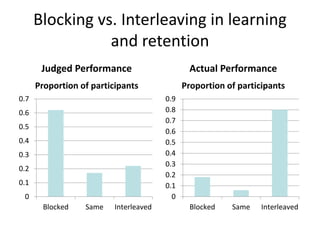
Blocking vs. Interleaving in learning
and retention
Judged Performance
0
0.1
0.2
0.3
0.4
0.5
0.6
0.7
Blocked Same Interleaved
Proportion of participants
Actual Performance
0
0.1
0.2
0.3
0.4
0.5
0.6
0.7
0.8
0.9
Blocked Same Interleaved
Proportion of participants
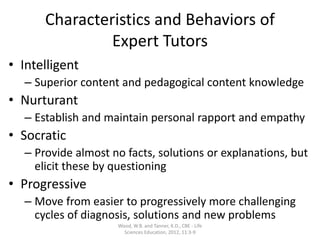
Characteristics and Behaviors of
Expert Tutors
• Intelligent
– Superior content and pedagogical content knowledge
• Nurturant
– Establish and maintain personal rapport and empathy
• Socratic
– Provide almost no facts, solutions or explanations, but
elicit these by questioning
• Progressive
– Move from easier to progressively more challenging
cycles of diagnosis, solutions and new problems
Wood, W.B. and Tanner, K.D., CBE - Life
Sciences Education, 2012, 11:3-9
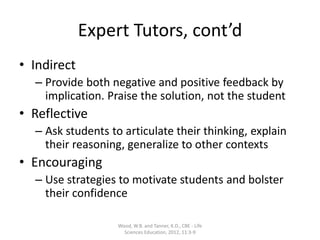
Expert Tutors, cont’d
• Indirect
– Provide both negative and positive feedback by
implication. Praise the solution, not the student
• Reflective
– Ask students to articulate their thinking, explain
their reasoning, generalize to other contexts
• Encouraging
– Use strategies to motivate students and bolster
their confidence
Wood, W.B. and Tanner, K.D., CBE - Life
Sciences Education, 2012, 11:3-9
Translating what effective tutors do to
the lecture hall
• Figure out where your students are starting
• “Flip” the classroom
– Provide the information to the learners to review
before the class – readings, podcasts, handouts
• Be Socratic
– Replace “telling” with “asking”. Allow learners to work
through problems together.
• Avoid direct criticism
– Use students to provide feedback to each other
– Rather than identifying an answer as wrong, find
someone with the correct answer, and praise that
“Lecture” (2)
• Include “testing” as part of the session
– Anonymous audience feedback engages learner
and shows where they fit without embarrassment.
– Teaching and testing gives better retention than
teaching and repeating.
– Real-time testing provides teacher with immediate
feedback about learning and areas of weakness
– Opportunities (digital media) to make testing of
teams, competition generates excitement.
Technology also permits re-testing for incorrect
answers, reinforcement, etc.
Lecture (3)
• Foster metacognitive awareness
– Have learners reflect on their thought processes,
articulate concepts they find difficult or troubling
– Allow learners to “know what they know”
– Encourage learners to identify which learning
strategies are most adaptive for them
• Be supportive – not always a surgical tradition
– “Why didn’t you just take out a gun and shoot him?”
– “Your patient just died…”
A humble proposal to help “Bob” and
all our Surgical learners
• ALT has shown that learners need to be
responsible for their own learning.
• Learning occurs at the “Zone of Proximal
Development”, i.e., the leading edge of the
learners knowledge
• Learners require continuous and immediate
assessment and feedback
• Teachers need to communicate with each
other to do appropriate learner “hand-offs.”
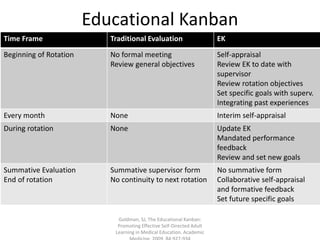
Educational Kanban
Time Frame Traditional Evaluation EK
Beginning of Rotation No formal meeting
Review general objectives
Self-appraisal
Review EK to date with
supervisor
Review rotation objectives
Set specific goals with superv.
Integrating past experiences
Every month None Interim self-appraisal
During rotation None Update EK
Mandated performance
feedback
Review and set new goals
Summative Evaluation
End of rotation
Summative supervisor form
No continuity to next rotation
No summative form
Collaborative self-appraisal
and formative feedback
Set future specific goals
Goldman, SJ, The Educational Kanban:
Promoting Effective Self-Directed Adult
Learning in Medical Education. Academic
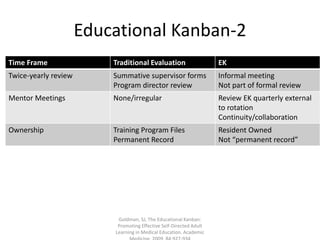
Educational Kanban-2
Time Frame Traditional Evaluation EK
Twice-yearly review Summative supervisor forms
Program director review
Informal meeting
Not part of formal review
Mentor Meetings None/irregular Review EK quarterly external
to rotation
Continuity/collaboration
Ownership Training Program Files
Permanent Record
Resident Owned
Not “permanent record”
Goldman, SJ, The Educational Kanban:
Promoting Effective Self-Directed Adult
Learning in Medical Education. Academic
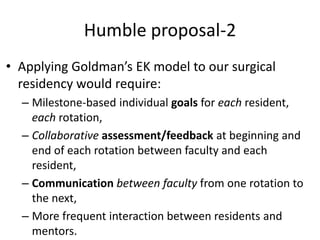
Humble proposal-2
• Applying Goldman’s EK model to our surgical
residency would require:
– Milestone-based individual goals for each resident,
each rotation,
– Collaborative assessment/feedback at beginning and
end of each rotation between faculty and each
resident,
– Communication between faculty from one rotation to
the next,
– More frequent interaction between residents and
mentors.
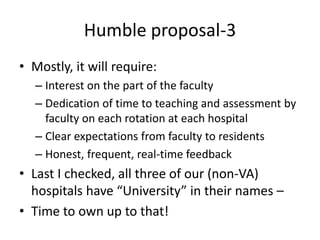
Humble proposal-3
• Mostly, it will require:
– Interest on the part of the faculty
– Dedication of time to teaching and assessment by
faculty on each rotation at each hospital
– Clear expectations from faculty to residents
– Honest, frequent, real-time feedback
• Last I checked, all three of our (non-VA)
hospitals have “University” in their names –
• Time to own up to that!
How many ELEPHANTS were there?
• A – 2
• B – 3
• C – 4
• D – 2 and a Northern White Rhino
• E – there were elephants? I thought the
Williams mascot was a purple cow!
Williams College, Class of 2015

Surgical Learning - It's Not Just PowerPoint Anymore

  • 1.
    Surgical Learning –It’s Not Just PowerPoint Anymore or What I did with my Winter Vacation Michael E. Shapiro, M.D. General Surgery Program Director Rutgers – New Jersey Medical School Harvard – Macy Scholar
  • 2.
    “The ideal collegeis Mark Hopkins* on one end of a log and a student on the other”** *Williams College President 1836-72 **James A. Garfield, Williams ‘1856
  • 3.
    What we (now)need to learn/teach
  • 5.
    An Experiment: At theend of this talk, there will be a quiz.
  • 6.
    The Basics -1 • As an educator, what is our prime role? – To promote learning • What is learning? – Change (in knowledge, beliefs, behavior) that is sustained • What is teaching? – The act of promoting/catalyzing change – (ideally, done intentionally and informed by best practices)
  • 7.
    The Basics -2 • What is assessment/feedback? – Measuring change – • To promote further learning – Identify strengths and weakness to the learner – Learner centered • To demonstrate competence – Patient safety – Entrustable professional activities (EPAs) – Certification – System centered – Need balance of both
  • 8.
    The Basics -3 • Who is the assessment/feedback we do really for (i.e., who are the stakeholders)? – Learner (e.g., student, resident) – Teacher – is our teaching of value? – Regulator • NJMS – Dean – GMEC • ACGME • ABS • How do their interests relate to promoting learning or insuring competence?
  • 9.
    The Basics -4 • Deliberate teaching = defining planned change, the developing appropriate strategy to implement it, and assessment/feedback to promote it and demonstrate it. • As an educator, asking what do I/we need/want to change, what is the best way to accomplish that, and how would I know if I did?
  • 10.
    Case Discussion –the “surprised” resident • Bob (not real name) is a PGY-3 surgical resident in the middle of the year. He graduated from a well- known medical school, and has had excellent evaluations his first two years. The CCC has just met to review the PGY-3’s. The evaluations for Bob this year were very different, and quite negative. They all noted his failure to progress to a stage where he can lead a team, make diagnoses and plans, and make decisions for the patient. All stated they had provided this feedback to Bob. This case is a work of fiction. Any similarities to any person, living or dead, is purely coincidental and unintentional.
  • 11.
    Case - 2 •You meet with Bob as Program Director. You begin by asking him how he thinks things are going? He responds that he thinks things are going pretty well, in fact, “great.” He is happy in the program, and feels that, although the transition to third year was initially challenging, he now “has everything under control.” At first gently, then more firmly, you raise the concerns of his attendings.
  • 12.
    Case - 3 •Bob claims to have never heard any of this negative commentary before. You try to express your concerns to Bob, who refuses to accept those assessments, and states that he “respectfully disagrees” and the faculty concerns are “unfounded and incorrect.” • Now what do you do? • What do you suspect happened? • How do you reconcile the different perspectives? • Does this suggest anything about the need to track real-time learning?
  • 13.
    Adult Learning Theory •Adult learning is different from children’s learning. • Children learn for the joy of learning. – Some of us never grow up • Adults learn for a purpose – Further educational goals – Gain skills that can be applied – Pass a regulatory exam
  • 14.
    ALT - 2 •Prior knowledge is the foundation for new learning • Adult learners should activate and build upon prior knowledge • Increasing the links to prior learning is critical • Adult learners should be actively involved in constructing individual educational goals and meanings – they want to learn.
  • 15.
    ALT-3 • Adult learnersshould own their learning (intrinsic motivation) as opposed to primarily responding to their teachers/evaluators (extrinsic motivation). Intrinsic motivation is associated with deeper learning. • Teaching adult learners should promote both learner autonomy and growth, ultimately making the teacher unnecessary. • Our job is, ultimately, to become superfluous.
  • 16.
    ALT-4 • So, tomaximize learning: – Adult learners need to be actively involved in the learning process, including: • Initial self-appraisal • Setting goals • Developing mastery • Participating in the assessment/feedback process – Adult learners need to be active partners, not empty vessels to be filled by the teacher.
  • 17.
    A Simple Modelof CompetenceProfessionalAuthenticity Behaviour Does Shows how Knows how Cognition Knows Miller, 1990 17
  • 18.
  • 19.
    Blocking vs. Interleavingin learning and retention Judged Performance 0 0.1 0.2 0.3 0.4 0.5 0.6 0.7 Blocked Same Interleaved Proportion of participants Actual Performance 0 0.1 0.2 0.3 0.4 0.5 0.6 0.7 0.8 0.9 Blocked Same Interleaved Proportion of participants
  • 20.
    Characteristics and Behaviorsof Expert Tutors • Intelligent – Superior content and pedagogical content knowledge • Nurturant – Establish and maintain personal rapport and empathy • Socratic – Provide almost no facts, solutions or explanations, but elicit these by questioning • Progressive – Move from easier to progressively more challenging cycles of diagnosis, solutions and new problems Wood, W.B. and Tanner, K.D., CBE - Life Sciences Education, 2012, 11:3-9
  • 21.
    Expert Tutors, cont’d •Indirect – Provide both negative and positive feedback by implication. Praise the solution, not the student • Reflective – Ask students to articulate their thinking, explain their reasoning, generalize to other contexts • Encouraging – Use strategies to motivate students and bolster their confidence Wood, W.B. and Tanner, K.D., CBE - Life Sciences Education, 2012, 11:3-9
  • 22.
    Translating what effectivetutors do to the lecture hall • Figure out where your students are starting • “Flip” the classroom – Provide the information to the learners to review before the class – readings, podcasts, handouts • Be Socratic – Replace “telling” with “asking”. Allow learners to work through problems together. • Avoid direct criticism – Use students to provide feedback to each other – Rather than identifying an answer as wrong, find someone with the correct answer, and praise that
  • 23.
    “Lecture” (2) • Include“testing” as part of the session – Anonymous audience feedback engages learner and shows where they fit without embarrassment. – Teaching and testing gives better retention than teaching and repeating. – Real-time testing provides teacher with immediate feedback about learning and areas of weakness – Opportunities (digital media) to make testing of teams, competition generates excitement. Technology also permits re-testing for incorrect answers, reinforcement, etc.
  • 24.
    Lecture (3) • Fostermetacognitive awareness – Have learners reflect on their thought processes, articulate concepts they find difficult or troubling – Allow learners to “know what they know” – Encourage learners to identify which learning strategies are most adaptive for them • Be supportive – not always a surgical tradition – “Why didn’t you just take out a gun and shoot him?” – “Your patient just died…”
  • 25.
    A humble proposalto help “Bob” and all our Surgical learners • ALT has shown that learners need to be responsible for their own learning. • Learning occurs at the “Zone of Proximal Development”, i.e., the leading edge of the learners knowledge • Learners require continuous and immediate assessment and feedback • Teachers need to communicate with each other to do appropriate learner “hand-offs.”
  • 26.
    Educational Kanban Time FrameTraditional Evaluation EK Beginning of Rotation No formal meeting Review general objectives Self-appraisal Review EK to date with supervisor Review rotation objectives Set specific goals with superv. Integrating past experiences Every month None Interim self-appraisal During rotation None Update EK Mandated performance feedback Review and set new goals Summative Evaluation End of rotation Summative supervisor form No continuity to next rotation No summative form Collaborative self-appraisal and formative feedback Set future specific goals Goldman, SJ, The Educational Kanban: Promoting Effective Self-Directed Adult Learning in Medical Education. Academic
  • 27.
    Educational Kanban-2 Time FrameTraditional Evaluation EK Twice-yearly review Summative supervisor forms Program director review Informal meeting Not part of formal review Mentor Meetings None/irregular Review EK quarterly external to rotation Continuity/collaboration Ownership Training Program Files Permanent Record Resident Owned Not “permanent record” Goldman, SJ, The Educational Kanban: Promoting Effective Self-Directed Adult Learning in Medical Education. Academic
  • 28.
    Humble proposal-2 • ApplyingGoldman’s EK model to our surgical residency would require: – Milestone-based individual goals for each resident, each rotation, – Collaborative assessment/feedback at beginning and end of each rotation between faculty and each resident, – Communication between faculty from one rotation to the next, – More frequent interaction between residents and mentors.
  • 29.
    Humble proposal-3 • Mostly,it will require: – Interest on the part of the faculty – Dedication of time to teaching and assessment by faculty on each rotation at each hospital – Clear expectations from faculty to residents – Honest, frequent, real-time feedback • Last I checked, all three of our (non-VA) hospitals have “University” in their names – • Time to own up to that!
  • 30.
    How many ELEPHANTSwere there? • A – 2 • B – 3 • C – 4 • D – 2 and a Northern White Rhino • E – there were elephants? I thought the Williams mascot was a purple cow!
  • 32.