MC SMS icons
1
https://militaryfamilieslearningnetwork.org/event/22082/
Opportunities & Possibilities: Posttraumatic
Growth in Research & Practice (Pt.1)
Thanks for joining us! We will get started soon.
While you’re waiting you can get handouts etc. by following the below:
This material is based upon work supported by the National Institute of Food and Agriculture, U.S. Department of Agriculture, and the
Office of Military Family Readiness Policy, U.S. Department of Defense under Award Number 2015-48770-24.
Connecting military family service providers
and Cooperative Extension professionals to research
and to each other through engaging online learning opportunities
https://militaryfamilieslearningnetwork.org
MFLN Intro
Sign up for webinar email notifications at https://militaryfamilieslearningnetwork.org/mfln-events/2
Opportunities & Possibilities:
Posttraumatic Growth in
Research & Practice (Pt.1)
Richard Tedeschi, Ph.D.
Professor of Psychology
Health Psychology Doctoral Program
UNC Charlotte
3
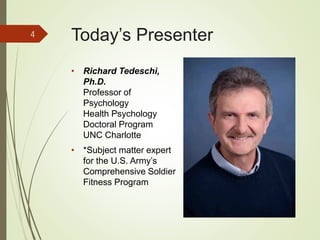
Today’s Presenter
‱ Richard Tedeschi,
Ph.D.
Professor of
Psychology
Health Psychology
Doctoral Program
UNC Charlotte
‱ *Subject matter expert
for the U.S. Army’s
Comprehensive Soldier
Fitness Program
4
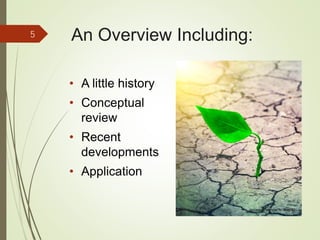
An Overview Including:
‱ A little history
‱ Conceptual
review
‱ Recent
developments
‱ Application
5
iStockphoto Member ID: 8085767
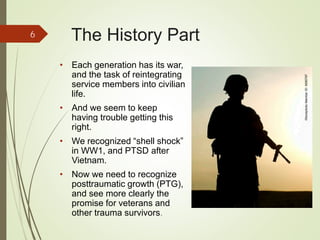
The History Part
‱ Each generation has its war,
and the task of reintegrating
service members into civilian
life.
‱ And we seem to keep
having trouble getting this
right.
‱ We recognized “shell shock”
in WW1, and PTSD after
Vietnam.
‱ Now we need to recognize
posttraumatic growth (PTG),
and see more clearly the
promise for veterans and
other trauma survivors.
6
iStockphotoMemberID:8085767
Can We Recognize the
Strengths of the Veteran?
‱ Can we see the veteran as strong rather than broken
while acknowledging the struggle?
‱ Can we acknowledge that the struggle sometimes is
about combat and sometimes about other traumas?
‱ Can we recognize that military service and combat
experience can strengthen veterans for civilian life?
‱ Can we see the possibility of growth in the aftermath
of trauma?
‱ Can we find ways to facilitate this growth, identify the
strength, and turn this to further service in our
communities?
7
Conceptual Review
‱ What is trauma?
8
iStockphoto Member ID: 8085767
DSM-5 Definition
‱ DSM-5 describes traumatic stress involved
in PTSD as exposure to actual or threatened
death or serious injury, or sexual violence
‱ directly
‱ or witnessing in person
‱ or learning about violent or accidental event
experienced by a family member or other close
friend
‱ Repeated exposure or extreme exposure to
aversive details of events
9
Trauma--Redefined
‱ Threat to physical integrity--perception of
life threat
‱ Threat to psychological integrity
‱ if it represented a severe challenge to individuals’
past ways of understanding the world and their
place in it.
‱ A moral injury
‱ acting in ways that seem counter to previously
held moral codes, core beliefs.
10
Trauma & Core Beliefs
‱ Cognitive reassessments
‱ Challenging or shattering the assumptive
world: Core beliefs about
‱ How benevolent people are
‱ How predictable events are
‱ How controllable the world is
‱ How vulnerable I am
‱ How capable I am
‱ Who I am, what kind of person am I
11
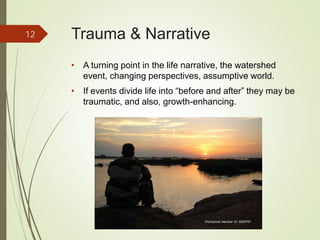
Trauma & Narrative
‱ A turning point in the life narrative, the watershed
event, changing perspectives, assumptive world.
‱ If events divide life into “before and after” they may be
traumatic, and also, growth-enhancing.
12
iStockphoto Member ID: 8085767
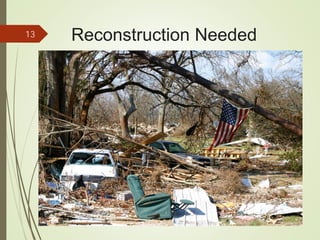
Reconstruction Needed13
iStockphotoMemberID:8085767
Posttraumatic Growth
(PTG)
‱ PTG is both a process and an outcome: The
experience of positive changes in oneself as
a result of the struggle with traumatic events.
New Possibilities
Relating to Others
Personal Strength
Appreciation of Life
Spiritual and Existential Change
14
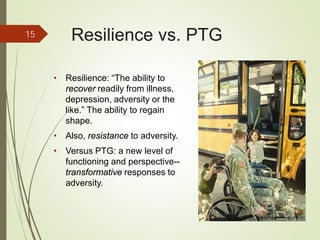
Resilience vs. PTG
‱ Resilience: “The ability to
recover readily from illness,
depression, adversity or the
like.” The ability to regain
shape.
‱ Also, resistance to adversity.
‱ Versus PTG: a new level of
functioning and perspective--
transformative responses to
adversity.
15
iStockphoto Member ID: 8085767
Existential Psychology &
Suffering
‱ See Rollo May, Erich Fromm, Victor Frankl:
‱ The human condition or facts of existence:
‱ Suffering, guilt, and transitoriness.
‱ By engaging these, we have the opportunity to
develop meaning in our living.
‱ Suffering doesn't have to be mere suffering.
‱ It can produce individuation (not necessarily
happiness).
16
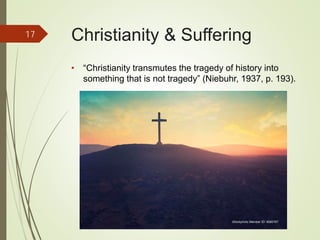
Christianity & Suffering
‱ “Christianity transmutes the tragedy of history into
something that is not tragedy” (Niebuhr, 1937, p. 193).
17
iStockphoto Member ID: 8085767
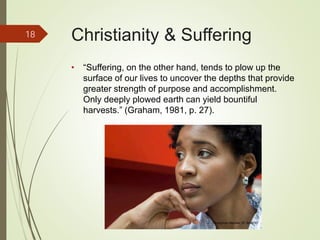
Christianity & Suffering
‱ “Suffering, on the other hand, tends to plow up the
surface of our lives to uncover the depths that provide
greater strength of purpose and accomplishment.
Only deeply plowed earth can yield bountiful
harvests.” (Graham, 1981, p. 27).
18
iStockphoto Member ID: 8085767
Islam & Suffering
‱ In a passion play in which the seventh century Shiite
martyr Husain, about to be killed states: “Trials,
afflictions, and pains, the thicker they fall on man, the
better, dear sister, do they prepare him for his journey
heavenward.”
19
Buddhism & Suffering
‱ The Noble Truths are organized around the
issue of suffering:
‱ “There is suffering.” Do not make it personal and
react to it in a habitual way.
‱ “Suffering should be understood.”
‱ Accept the suffering, stand under or embrace it
rather than just react to it.
‱ When you have actually practiced with suffering -
looking at it, accepting it, knowing it and letting it
be the way it is - then it is understood.
20
The Existential Dilemma of
PTG
‱ “I am a more sensitive person, a more effective
a more sympathetic counselor because of Aaron’s
and death than I would ever have been without it. And
I would give up all those gains in a second if I could
have my son back. If I could choose, I would forego
all of the spiritual growth and depth which has come
my way because of our experiences, and be what I
was fifteen years ago, an average rabbi, an indifferent
counselor, helping some people and unable to help
others, and the father of a bright, happy boy. But I
cannot choose.” (Rabbi Harold Kushner in Viorst, J.
(1996) Necessary Losses. p. 295.)
21
PTG & Wisdom, Resilience,
Gratitude

‱ [Trauma forces a
person] "to be
somebody else, the next
viable you--a stripped-
down whole other clear-
eyed person, realistic as
a sawed-off shotgun and
thankful for air, not to
speak of the human
kindness you'll meet if
you get normal luck.”
(Price, R. (1994). A
Whole New Life. p. 183.)
22
iStockphoto Member ID: 8085767
Trauma as a Gift
‱ “This is the one thing that happened in my life that I
needed to have happen, it was probably the best
thing that ever happened to me. On the outside
looking in that pretty hard to swallow, I’m sure, but
hey, that’s the way I view it. If I hadn’t experienced
this and lived through it, I likely wouldn't be here
today because of my lifestyle previously--I was on a
real self-destructive path. If I had it to do all over
again I would want it to happen the same way. I
would not want it not to happen.”
‱ Tedeschi, R.G., & Calhoun, L.G. (1995). Trauma and
transformation: Growing in the aftermath of suffering.
p. 1.
23
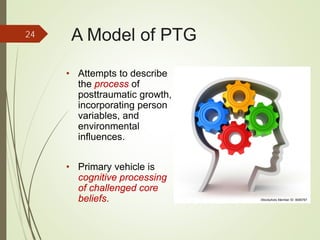
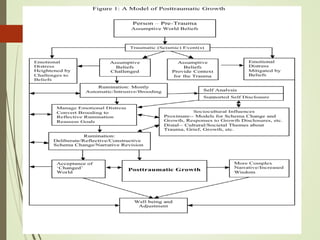
A Model of PTG
‱ Attempts to describe
the process of
posttraumatic growth,
incorporating person
variables, and
environmental
influences.
‱ Primary vehicle is
cognitive processing
of challenged core
beliefs.
24
iStockphoto Member ID: 8085767
25
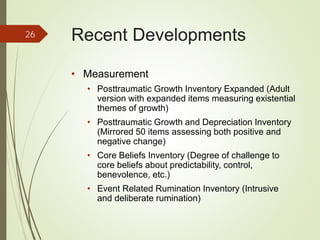
Recent Developments
‱ Measurement
‱ Posttraumatic Growth Inventory Expanded (Adult
version with expanded items measuring existential
themes of growth)
‱ Posttraumatic Growth and Depreciation Inventory
(Mirrored 50 items assessing both positive and
negative change)
‱ Core Beliefs Inventory (Degree of challenge to
core beliefs about predictability, control,
benevolence, etc.)
‱ Event Related Rumination Inventory (Intrusive
and deliberate rumination)
26
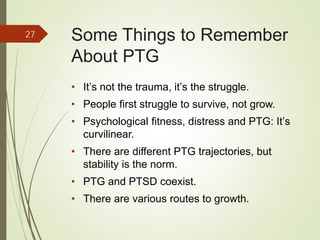
Some Things to Remember
About PTG
‱ It’s not the trauma, it’s the struggle.
‱ People first struggle to survive, not grow.
‱ Psychological fitness, distress and PTG: It’s
curvilinear.
‱ There are different PTG trajectories, but
stability is the norm.
‱ PTG and PTSD coexist.
‱ There are various routes to growth.
27
Using the PTG Model to
Create Interventions
‱ An Existential, Cognitive, Narrative
Integration--Can be integrated with other
approaches to PTSD
‱ Based on the perspective: “It’s not what’s
wrong, it’s what happened”
‱ Therapy, education, self-help approaches
can be derived from the model
‱ The facilitator is an Expert Companion
28
5 Elements of PTG
Intervention/Facilitation
‱ First described by Tedeschi & McNally
(American Psychologist, 2011)
‱ Expanded by Calhoun & Tedeschi into book
(Posttraumatic Growth in Clinical Practice,
2013)
‱ A Self-Help version by Tedeschi & Moore in
the Posttraumatic Growth Workbook, 2016
29
‱ Shattered beliefs form the foundation for later
posttraumatic growth.
‱ Basic physiological and psychological responses are
normal in trauma. For example, combat stress:
‱ Combat stress is perceived as greatest before and after
battle--dread and fatigue.
‱ During fighting, soldiers practice controlled mental and
emotional disengagement, becoming as numb and
unaware as possible to survive--an emotional and
physiological reaction to extraordinary stress of an entire
deployment or one firefight.
‱ These reactions do not indicate a defect in one’s
character, or identity as a soldier.
30 Pt.1: Understanding trauma
response as a precursor to PTG
Pt.2: Emotion Regulation
Enhancement
‱ Managing dysregulated sympathetic nervous
system responses and intrusive thinking
‱ Responses that are adaptive for survival in combat can
provoke long-term maladaptive functioning:
‱ behavioral and emotional effects of circulating
norepinephrine, epinephrine and cortisol (stress
hormones) sustain the body’s alarm reaction
‱ jitteriness, hypervigilance, sleep disruption, appetite
suppression, etc.
‱ Encouraging reflective rumination in contrast
to brooding.
31
Pt.3: Constructive Self-
Disclosure
‱ Allowing emotional support, coherent trauma
narrative, models for healthy trauma
response and posttraumatic growth.
‱ Telling the story of the trauma, but especially
the experience of the aftermath of trauma.
‱ Learning how to use social connections and
establish new ones.
32
Pt.4: Creating a Trauma
Narrative with PTG Domains
‱ Organizing the story of trauma into a coherent
narrative with the trauma as a catalyst, turning point;
‱ Appreciating paradox—”opposites” can coincide
‱ loss & gain
‱ support & individual strength
‱ control & lack of control
‱ grief & gratitude
‱ vulnerability & strength
‱ Referring to the five domains of posttraumatic growth,
with stories of others to illustrate the possibility of
change.
33
Pt.5: Developing Life
Principles that are Robust
to Challenges
‱ Finding ways to serve, be altruistic;
‱ Accepting growth without guilt as benefiting others.
Honoring deceased comrades can mitigate guilt;
‱ Accepting social identity as a trauma survivor, or
compassionate, wise person, somewhat separate from
others, but more closely connected to the human
condition;
‱ Considering the ancient Greek/Roman concept of the
hero as an ordinary person who experiences an
extraordinary event, survives it, and returns to the
everyday world to express an important truth about life.
34
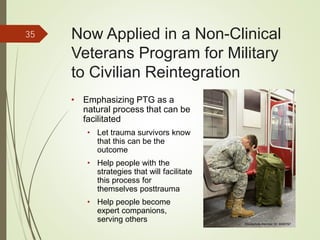
Now Applied in a Non-Clinical
Veterans Program for Military
to Civilian Reintegration
‱ Emphasizing PTG as a
natural process that can be
facilitated
‱ Let trauma survivors know
that this can be the
outcome
‱ Help people with the
strategies that will facilitate
this process for
themselves posttrauma
‱ Help people become
expert companions,
serving others
35
iStockphoto Member ID: 8085767
Now Applied in a Non-Clinical
Veterans Program for Military
to Civilian Reintegration
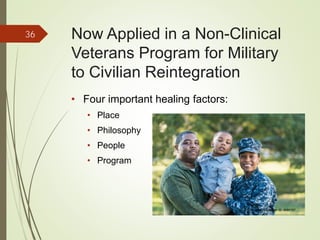
‱ Four important healing factors:
‱ Place
‱ Philosophy
‱ People
‱ Program
36
iStockphoto Member ID: 8085767
Now Applied in a Non-Clinical
Veterans Program for Military
to Civilian Reintegration
‱ Three important healing factors:
‱ Place
‱ People
‱ Program
‱ The place is Boulder Crest Retreat, Bluemont, VA
‱ The people are veterans and civilian trainers in
meditative and recreational practices, working with 6
person groups of veterans
‱ The program is Progressive and Alternative Training for
Healing Heroes: Warrior PATHH
37
Contact me at:
rtedesch@uncc.edu
www.ptgi.uncc.edu
38
CEU Credit & Certificate
One Survey, two different ways to receive a
certificate
‱ MFLN is offering 1.5 CEU credit from the UT Austin, Steve
Hicks School of Social Work to credentialed participants.
‱ MFLN Certificate of Completion for providers interested in
receiving general training.
To receive a CEU credit OR certificate of completion,
please complete the evaluation survey found at:
https://vte.co1.qualtrics.com/jfe/form/SV_aWg1YoO4LWjCvfn
39
Upcoming Event
‱ Title: Opportunities & Possibilities: Posttraumatic
Growth in Research & Practice (Part 2)
‱ Time: 11:00 a.m. – 12:30 p.m. Eastern
‱ Date: Wednesday, August 8, 2018
‱ Location:
https://militaryfamilieslearningnetwork.org/event/21552/
‱ For more information on MFLN webinars go to:
‱ https://militaryfamilieslearningnetwork.org/mfln-events/
40
https://militaryfamilieslearningnetwork.org/mfln-events/
41

Opportunities & Possibilities: Posttraumatic Growth in Research & Practice

  • 1.
    MC SMS icons 1 https://militaryfamilieslearningnetwork.org/event/22082/ Opportunities& Possibilities: Posttraumatic Growth in Research & Practice (Pt.1) Thanks for joining us! We will get started soon. While you’re waiting you can get handouts etc. by following the below: This material is based upon work supported by the National Institute of Food and Agriculture, U.S. Department of Agriculture, and the Office of Military Family Readiness Policy, U.S. Department of Defense under Award Number 2015-48770-24.
  • 2.
    Connecting military familyservice providers and Cooperative Extension professionals to research and to each other through engaging online learning opportunities https://militaryfamilieslearningnetwork.org MFLN Intro Sign up for webinar email notifications at https://militaryfamilieslearningnetwork.org/mfln-events/2
  • 3.
    Opportunities & Possibilities: PosttraumaticGrowth in Research & Practice (Pt.1) Richard Tedeschi, Ph.D. Professor of Psychology Health Psychology Doctoral Program UNC Charlotte 3
  • 4.
    Today’s Presenter ‱ RichardTedeschi, Ph.D. Professor of Psychology Health Psychology Doctoral Program UNC Charlotte ‱ *Subject matter expert for the U.S. Army’s Comprehensive Soldier Fitness Program 4
  • 5.
    An Overview Including: ‱A little history ‱ Conceptual review ‱ Recent developments ‱ Application 5 iStockphoto Member ID: 8085767
  • 6.
    The History Part ‱Each generation has its war, and the task of reintegrating service members into civilian life. ‱ And we seem to keep having trouble getting this right. ‱ We recognized “shell shock” in WW1, and PTSD after Vietnam. ‱ Now we need to recognize posttraumatic growth (PTG), and see more clearly the promise for veterans and other trauma survivors. 6 iStockphotoMemberID:8085767
  • 7.
    Can We Recognizethe Strengths of the Veteran? ‱ Can we see the veteran as strong rather than broken while acknowledging the struggle? ‱ Can we acknowledge that the struggle sometimes is about combat and sometimes about other traumas? ‱ Can we recognize that military service and combat experience can strengthen veterans for civilian life? ‱ Can we see the possibility of growth in the aftermath of trauma? ‱ Can we find ways to facilitate this growth, identify the strength, and turn this to further service in our communities? 7
  • 8.
    Conceptual Review ‱ Whatis trauma? 8 iStockphoto Member ID: 8085767
  • 9.
    DSM-5 Definition ‱ DSM-5describes traumatic stress involved in PTSD as exposure to actual or threatened death or serious injury, or sexual violence ‱ directly ‱ or witnessing in person ‱ or learning about violent or accidental event experienced by a family member or other close friend ‱ Repeated exposure or extreme exposure to aversive details of events 9
  • 10.
    Trauma--Redefined ‱ Threat tophysical integrity--perception of life threat ‱ Threat to psychological integrity ‱ if it represented a severe challenge to individuals’ past ways of understanding the world and their place in it. ‱ A moral injury ‱ acting in ways that seem counter to previously held moral codes, core beliefs. 10
  • 11.
    Trauma & CoreBeliefs ‱ Cognitive reassessments ‱ Challenging or shattering the assumptive world: Core beliefs about ‱ How benevolent people are ‱ How predictable events are ‱ How controllable the world is ‱ How vulnerable I am ‱ How capable I am ‱ Who I am, what kind of person am I 11
  • 12.
    Trauma & Narrative ‱A turning point in the life narrative, the watershed event, changing perspectives, assumptive world. ‱ If events divide life into “before and after” they may be traumatic, and also, growth-enhancing. 12 iStockphoto Member ID: 8085767
  • 13.
  • 14.
    Posttraumatic Growth (PTG) ‱ PTGis both a process and an outcome: The experience of positive changes in oneself as a result of the struggle with traumatic events. New Possibilities Relating to Others Personal Strength Appreciation of Life Spiritual and Existential Change 14
  • 15.
    Resilience vs. PTG ‱Resilience: “The ability to recover readily from illness, depression, adversity or the like.” The ability to regain shape. ‱ Also, resistance to adversity. ‱ Versus PTG: a new level of functioning and perspective-- transformative responses to adversity. 15 iStockphoto Member ID: 8085767
  • 16.
    Existential Psychology & Suffering ‱See Rollo May, Erich Fromm, Victor Frankl: ‱ The human condition or facts of existence: ‱ Suffering, guilt, and transitoriness. ‱ By engaging these, we have the opportunity to develop meaning in our living. ‱ Suffering doesn't have to be mere suffering. ‱ It can produce individuation (not necessarily happiness). 16
  • 17.
    Christianity & Suffering ‱“Christianity transmutes the tragedy of history into something that is not tragedy” (Niebuhr, 1937, p. 193). 17 iStockphoto Member ID: 8085767
  • 18.
    Christianity & Suffering ‱“Suffering, on the other hand, tends to plow up the surface of our lives to uncover the depths that provide greater strength of purpose and accomplishment. Only deeply plowed earth can yield bountiful harvests.” (Graham, 1981, p. 27). 18 iStockphoto Member ID: 8085767
  • 19.
    Islam & Suffering ‱In a passion play in which the seventh century Shiite martyr Husain, about to be killed states: “Trials, afflictions, and pains, the thicker they fall on man, the better, dear sister, do they prepare him for his journey heavenward.” 19
  • 20.
    Buddhism & Suffering ‱The Noble Truths are organized around the issue of suffering: ‱ “There is suffering.” Do not make it personal and react to it in a habitual way. ‱ “Suffering should be understood.” ‱ Accept the suffering, stand under or embrace it rather than just react to it. ‱ When you have actually practiced with suffering - looking at it, accepting it, knowing it and letting it be the way it is - then it is understood. 20
  • 21.
    The Existential Dilemmaof PTG ‱ “I am a more sensitive person, a more effective a more sympathetic counselor because of Aaron’s and death than I would ever have been without it. And I would give up all those gains in a second if I could have my son back. If I could choose, I would forego all of the spiritual growth and depth which has come my way because of our experiences, and be what I was fifteen years ago, an average rabbi, an indifferent counselor, helping some people and unable to help others, and the father of a bright, happy boy. But I cannot choose.” (Rabbi Harold Kushner in Viorst, J. (1996) Necessary Losses. p. 295.) 21
  • 22.
    PTG & Wisdom,Resilience, Gratitude
 ‱ [Trauma forces a person] "to be somebody else, the next viable you--a stripped- down whole other clear- eyed person, realistic as a sawed-off shotgun and thankful for air, not to speak of the human kindness you'll meet if you get normal luck.” (Price, R. (1994). A Whole New Life. p. 183.) 22 iStockphoto Member ID: 8085767
  • 23.
    Trauma as aGift ‱ “This is the one thing that happened in my life that I needed to have happen, it was probably the best thing that ever happened to me. On the outside looking in that pretty hard to swallow, I’m sure, but hey, that’s the way I view it. If I hadn’t experienced this and lived through it, I likely wouldn't be here today because of my lifestyle previously--I was on a real self-destructive path. If I had it to do all over again I would want it to happen the same way. I would not want it not to happen.” ‱ Tedeschi, R.G., & Calhoun, L.G. (1995). Trauma and transformation: Growing in the aftermath of suffering. p. 1. 23
  • 24.
    A Model ofPTG ‱ Attempts to describe the process of posttraumatic growth, incorporating person variables, and environmental influences. ‱ Primary vehicle is cognitive processing of challenged core beliefs. 24 iStockphoto Member ID: 8085767
  • 25.
  • 26.
    Recent Developments ‱ Measurement ‱Posttraumatic Growth Inventory Expanded (Adult version with expanded items measuring existential themes of growth) ‱ Posttraumatic Growth and Depreciation Inventory (Mirrored 50 items assessing both positive and negative change) ‱ Core Beliefs Inventory (Degree of challenge to core beliefs about predictability, control, benevolence, etc.) ‱ Event Related Rumination Inventory (Intrusive and deliberate rumination) 26
  • 27.
    Some Things toRemember About PTG ‱ It’s not the trauma, it’s the struggle. ‱ People first struggle to survive, not grow. ‱ Psychological fitness, distress and PTG: It’s curvilinear. ‱ There are different PTG trajectories, but stability is the norm. ‱ PTG and PTSD coexist. ‱ There are various routes to growth. 27
  • 28.
    Using the PTGModel to Create Interventions ‱ An Existential, Cognitive, Narrative Integration--Can be integrated with other approaches to PTSD ‱ Based on the perspective: “It’s not what’s wrong, it’s what happened” ‱ Therapy, education, self-help approaches can be derived from the model ‱ The facilitator is an Expert Companion 28
  • 29.
    5 Elements ofPTG Intervention/Facilitation ‱ First described by Tedeschi & McNally (American Psychologist, 2011) ‱ Expanded by Calhoun & Tedeschi into book (Posttraumatic Growth in Clinical Practice, 2013) ‱ A Self-Help version by Tedeschi & Moore in the Posttraumatic Growth Workbook, 2016 29
  • 30.
    ‱ Shattered beliefsform the foundation for later posttraumatic growth. ‱ Basic physiological and psychological responses are normal in trauma. For example, combat stress: ‱ Combat stress is perceived as greatest before and after battle--dread and fatigue. ‱ During fighting, soldiers practice controlled mental and emotional disengagement, becoming as numb and unaware as possible to survive--an emotional and physiological reaction to extraordinary stress of an entire deployment or one firefight. ‱ These reactions do not indicate a defect in one’s character, or identity as a soldier. 30 Pt.1: Understanding trauma response as a precursor to PTG
  • 31.
    Pt.2: Emotion Regulation Enhancement ‱Managing dysregulated sympathetic nervous system responses and intrusive thinking ‱ Responses that are adaptive for survival in combat can provoke long-term maladaptive functioning: ‱ behavioral and emotional effects of circulating norepinephrine, epinephrine and cortisol (stress hormones) sustain the body’s alarm reaction ‱ jitteriness, hypervigilance, sleep disruption, appetite suppression, etc. ‱ Encouraging reflective rumination in contrast to brooding. 31
  • 32.
    Pt.3: Constructive Self- Disclosure ‱Allowing emotional support, coherent trauma narrative, models for healthy trauma response and posttraumatic growth. ‱ Telling the story of the trauma, but especially the experience of the aftermath of trauma. ‱ Learning how to use social connections and establish new ones. 32
  • 33.
    Pt.4: Creating aTrauma Narrative with PTG Domains ‱ Organizing the story of trauma into a coherent narrative with the trauma as a catalyst, turning point; ‱ Appreciating paradox—”opposites” can coincide ‱ loss & gain ‱ support & individual strength ‱ control & lack of control ‱ grief & gratitude ‱ vulnerability & strength ‱ Referring to the five domains of posttraumatic growth, with stories of others to illustrate the possibility of change. 33
  • 34.
    Pt.5: Developing Life Principlesthat are Robust to Challenges ‱ Finding ways to serve, be altruistic; ‱ Accepting growth without guilt as benefiting others. Honoring deceased comrades can mitigate guilt; ‱ Accepting social identity as a trauma survivor, or compassionate, wise person, somewhat separate from others, but more closely connected to the human condition; ‱ Considering the ancient Greek/Roman concept of the hero as an ordinary person who experiences an extraordinary event, survives it, and returns to the everyday world to express an important truth about life. 34
  • 35.
    Now Applied ina Non-Clinical Veterans Program for Military to Civilian Reintegration ‱ Emphasizing PTG as a natural process that can be facilitated ‱ Let trauma survivors know that this can be the outcome ‱ Help people with the strategies that will facilitate this process for themselves posttrauma ‱ Help people become expert companions, serving others 35 iStockphoto Member ID: 8085767
  • 36.
    Now Applied ina Non-Clinical Veterans Program for Military to Civilian Reintegration ‱ Four important healing factors: ‱ Place ‱ Philosophy ‱ People ‱ Program 36 iStockphoto Member ID: 8085767
  • 37.
    Now Applied ina Non-Clinical Veterans Program for Military to Civilian Reintegration ‱ Three important healing factors: ‱ Place ‱ People ‱ Program ‱ The place is Boulder Crest Retreat, Bluemont, VA ‱ The people are veterans and civilian trainers in meditative and recreational practices, working with 6 person groups of veterans ‱ The program is Progressive and Alternative Training for Healing Heroes: Warrior PATHH 37
  • 38.
  • 39.
    CEU Credit &Certificate One Survey, two different ways to receive a certificate ‱ MFLN is offering 1.5 CEU credit from the UT Austin, Steve Hicks School of Social Work to credentialed participants. ‱ MFLN Certificate of Completion for providers interested in receiving general training. To receive a CEU credit OR certificate of completion, please complete the evaluation survey found at: https://vte.co1.qualtrics.com/jfe/form/SV_aWg1YoO4LWjCvfn 39
  • 40.
    Upcoming Event ‱ Title:Opportunities & Possibilities: Posttraumatic Growth in Research & Practice (Part 2) ‱ Time: 11:00 a.m. – 12:30 p.m. Eastern ‱ Date: Wednesday, August 8, 2018 ‱ Location: https://militaryfamilieslearningnetwork.org/event/21552/ ‱ For more information on MFLN webinars go to: ‱ https://militaryfamilieslearningnetwork.org/mfln-events/ 40
  • 41.