McKinsey 7s Model
McKinsey7s model wasdevelopedin1980s by McKinseyconsultantsTomPeters,RobertWatermanand
JulienPhilipswithahelpfromRichardPascale andAnthonyG. Athos.Since the introduction,the model
has beenwidelyusedbyacademicsandpractitionersandremainsone of the mostpopularstrategic
planningtools.Itsoughttopresentanemphasisonhumanresources(SoftS),ratherthanthe traditional
mass productiontangiblesof capital,infrastructure andequipment,asa keyto higherorganizational
performance.The goal of the model wasto show how 7 elementsof the company:Structure,Strategy,
Skills,Staff,Style,Systems,andSharedvalues,canbe alignedtogethertoachieve effectivenessina
company.The keypointof the model isthatall the sevenareasare interconnectedandachange inone
area requireschange inthe restof a firmforit to functioneffectively.
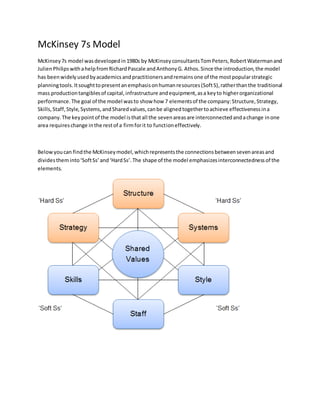
Belowyoucan findthe McKinseymodel,whichrepresentsthe connectionsbetweensevenareasand
dividestheminto‘SoftSs’and‘HardSs’.The shape of the model emphasizesinterconnectednessof the
elements.
In McKinseymodel,the sevenareas oforganization are dividedintothe ‘soft’and ‘hard’ areas.
Strategy, structure and systems are hard elementsthat are much easierto identifyand manage when
compared to soft elements.Onthe other hand, soft areas, although harder to manage, are the
foundationof the organizationand are more likelytocreate the sustainedcompetitive advantage.
Strategy is a plandevelopedbyafirmto achieve sustainedcompetitive advantage andsuccessfully
compete inthe market.What doesa well-alignedstrategymeanin7sMcKinseymodel?Ingeneral,a
soundstrategyisthe one that’sclearlyarticulated,islong-term,helpstoachievecompetitive advantage
and isreinforcedbystrongvision,missionandvalues.Butit’shardto tell if suchstrategyis well-aligned
withotherelementswhenanalyzedalone.Sothe keyin7s model isnotto lookat your companyto find
the great strategy,structure,systemsandetc.butto lookif itsalignedwithotherelements.For
example,short-termstrategyisusuallyapoorchoice fora companybut if itsalignedwithother6
elements,thenitmayprovide strongresults.
Structure representsthe waybusinessdivisionsandunitsare organizedandinclude the informationof
whois accountable towhom.Inotherwords,structure is the organizational chartof the firm.It isalso
one of the mostvisible andeasytochange elementsof the framework.
Systemsare the processesandproceduresof the company,whichreveal business’dailyactivitiesand
howdecisionsare made.Systemsare the areaof the firmthat determineshow businessisdone andit
shouldbe the mainfocusfor managersduringorganizational change.
Skillsare the abilitiesthatfirm’semployeesperformverywell.Theyalsoinclude capabilitiesand
competences.Duringorganizational change,the questionoftenarisesof whatskillsthe companywill
reallyneedtoreinforce itsnewstrategyornew structure.
Staff elementisconcernedwithwhattype andhow manyemployeesanorganizationwill needandhow
theywill be recruited,trained,motivatedandrewarded.
Style representsthe waythe companyismanagedbytop-level managers,how theyinteract,what
actionsdo theytake and theirsymbolicvalue.Inotherwords,itisthe managementstyle of company’s
leaders.
Shared Valuesare at the core of McKinsey7s model.Theyare the norms andstandardsthat guide
employeebehaviorandcompanyactionsandthus,are the foundationof everyorganization.

Mc kinsey 7s model

  • 1.
    McKinsey 7s Model McKinsey7smodel wasdevelopedin1980s by McKinseyconsultantsTomPeters,RobertWatermanand JulienPhilipswithahelpfromRichardPascale andAnthonyG. Athos.Since the introduction,the model has beenwidelyusedbyacademicsandpractitionersandremainsone of the mostpopularstrategic planningtools.Itsoughttopresentanemphasisonhumanresources(SoftS),ratherthanthe traditional mass productiontangiblesof capital,infrastructure andequipment,asa keyto higherorganizational performance.The goal of the model wasto show how 7 elementsof the company:Structure,Strategy, Skills,Staff,Style,Systems,andSharedvalues,canbe alignedtogethertoachieve effectivenessina company.The keypointof the model isthatall the sevenareasare interconnectedandachange inone area requireschange inthe restof a firmforit to functioneffectively. Belowyoucan findthe McKinseymodel,whichrepresentsthe connectionsbetweensevenareasand dividestheminto‘SoftSs’and‘HardSs’.The shape of the model emphasizesinterconnectednessof the elements.
  • 2.
    In McKinseymodel,the sevenareasoforganization are dividedintothe ‘soft’and ‘hard’ areas. Strategy, structure and systems are hard elementsthat are much easierto identifyand manage when compared to soft elements.Onthe other hand, soft areas, although harder to manage, are the foundationof the organizationand are more likelytocreate the sustainedcompetitive advantage. Strategy is a plandevelopedbyafirmto achieve sustainedcompetitive advantage andsuccessfully compete inthe market.What doesa well-alignedstrategymeanin7sMcKinseymodel?Ingeneral,a soundstrategyisthe one that’sclearlyarticulated,islong-term,helpstoachievecompetitive advantage and isreinforcedbystrongvision,missionandvalues.Butit’shardto tell if suchstrategyis well-aligned withotherelementswhenanalyzedalone.Sothe keyin7s model isnotto lookat your companyto find the great strategy,structure,systemsandetc.butto lookif itsalignedwithotherelements.For example,short-termstrategyisusuallyapoorchoice fora companybut if itsalignedwithother6 elements,thenitmayprovide strongresults. Structure representsthe waybusinessdivisionsandunitsare organizedandinclude the informationof whois accountable towhom.Inotherwords,structure is the organizational chartof the firm.It isalso one of the mostvisible andeasytochange elementsof the framework. Systemsare the processesandproceduresof the company,whichreveal business’dailyactivitiesand howdecisionsare made.Systemsare the areaof the firmthat determineshow businessisdone andit shouldbe the mainfocusfor managersduringorganizational change. Skillsare the abilitiesthatfirm’semployeesperformverywell.Theyalsoinclude capabilitiesand competences.Duringorganizational change,the questionoftenarisesof whatskillsthe companywill reallyneedtoreinforce itsnewstrategyornew structure. Staff elementisconcernedwithwhattype andhow manyemployeesanorganizationwill needandhow theywill be recruited,trained,motivatedandrewarded. Style representsthe waythe companyismanagedbytop-level managers,how theyinteract,what actionsdo theytake and theirsymbolicvalue.Inotherwords,itisthe managementstyle of company’s leaders. Shared Valuesare at the core of McKinsey7s model.Theyare the norms andstandardsthat guide employeebehaviorandcompanyactionsandthus,are the foundationof everyorganization.