1
Interesting Statistical
Phenomenon
San Diego State University
DSW/IRSU Brown Bag
3/16
Kevin Cummins
2
Definitions
• Principle: a comprehensive and
fundamental law, doctrine, or
assumption
• Fallacy: a false or mistaken idea
• Paradox: a statement that is seemingly
contradictory or opposed to common
sense and yet is perhaps true
3
Outline
• Objective
• Simpson’s Paradox
• Will Roger’s Paradox
• Lord’s Paradox
• Berkson’s Paradox
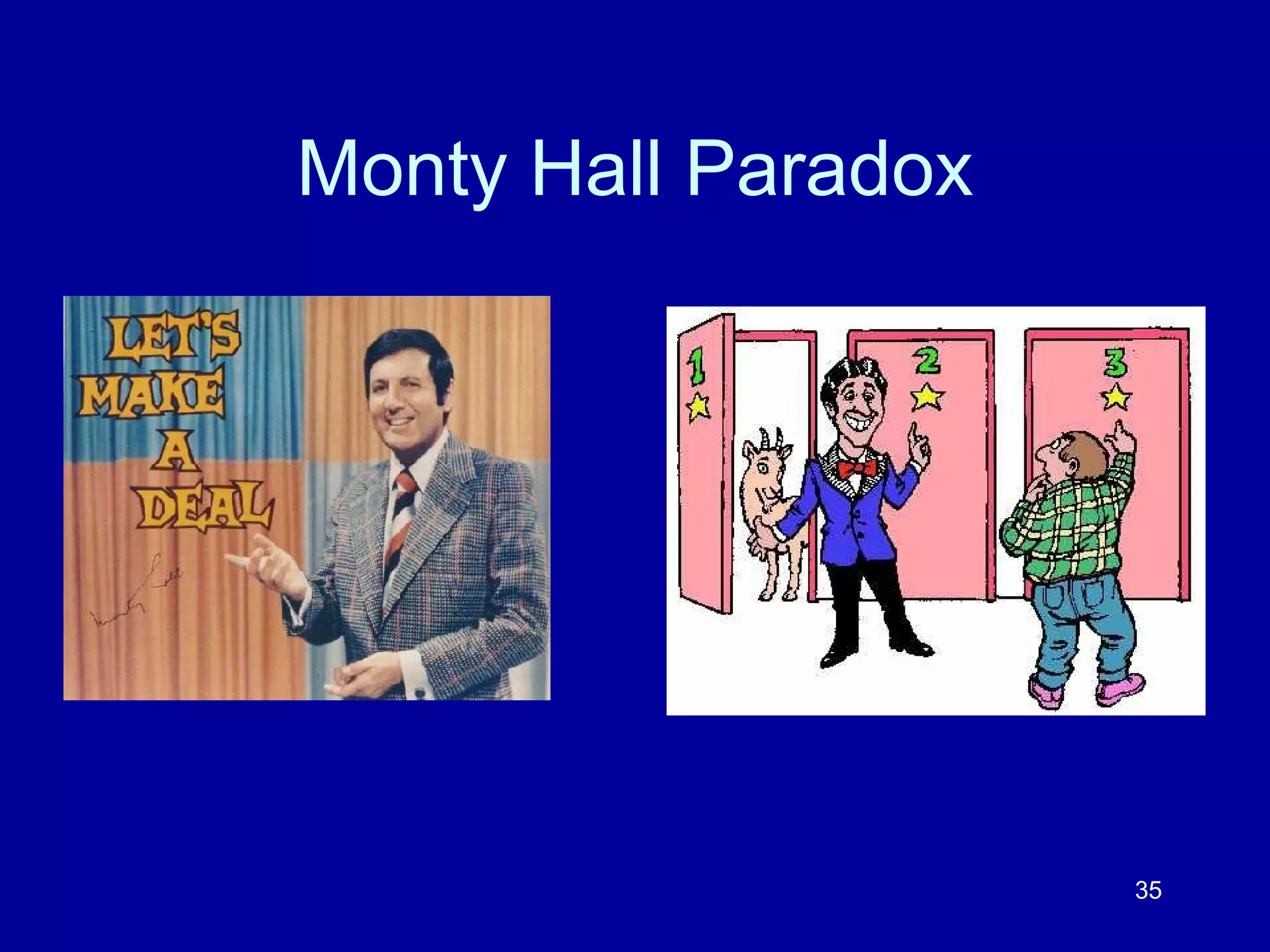
• Monte Hall Paradox
• Others
4
Objectives
• Create awareness of several
statistical issues that might arise during
observational research
• Sneak in an introduction to mosaic plots
• Learn how to win prizes on game shows
5
Outline
• Objective
• Simpson’s Paradox
• Will Roger’s Paradox
• Lord’s Paradox
• Berkson’s Paradox
• Monte Hall Paradox
• Others
6
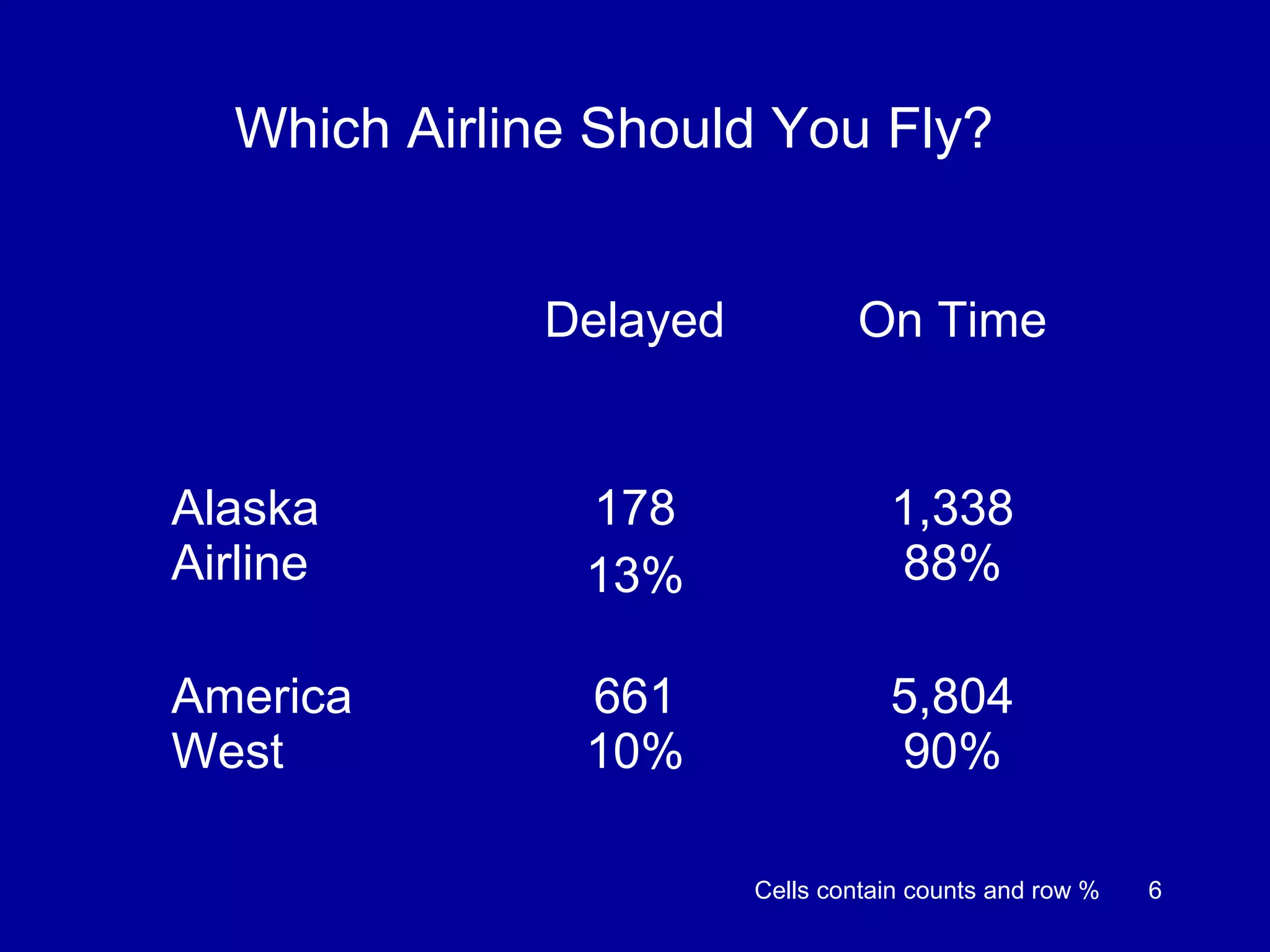
Delayed On Time
Alaska
Airline
178
13%
1,338
88%
America
West
661
10%
5,804
90%
Which Airline Should You Fly?
Cells contain counts and row %
7
8
Alaska Airlines America West
.11
.05
.17 .14
.08
.29
9
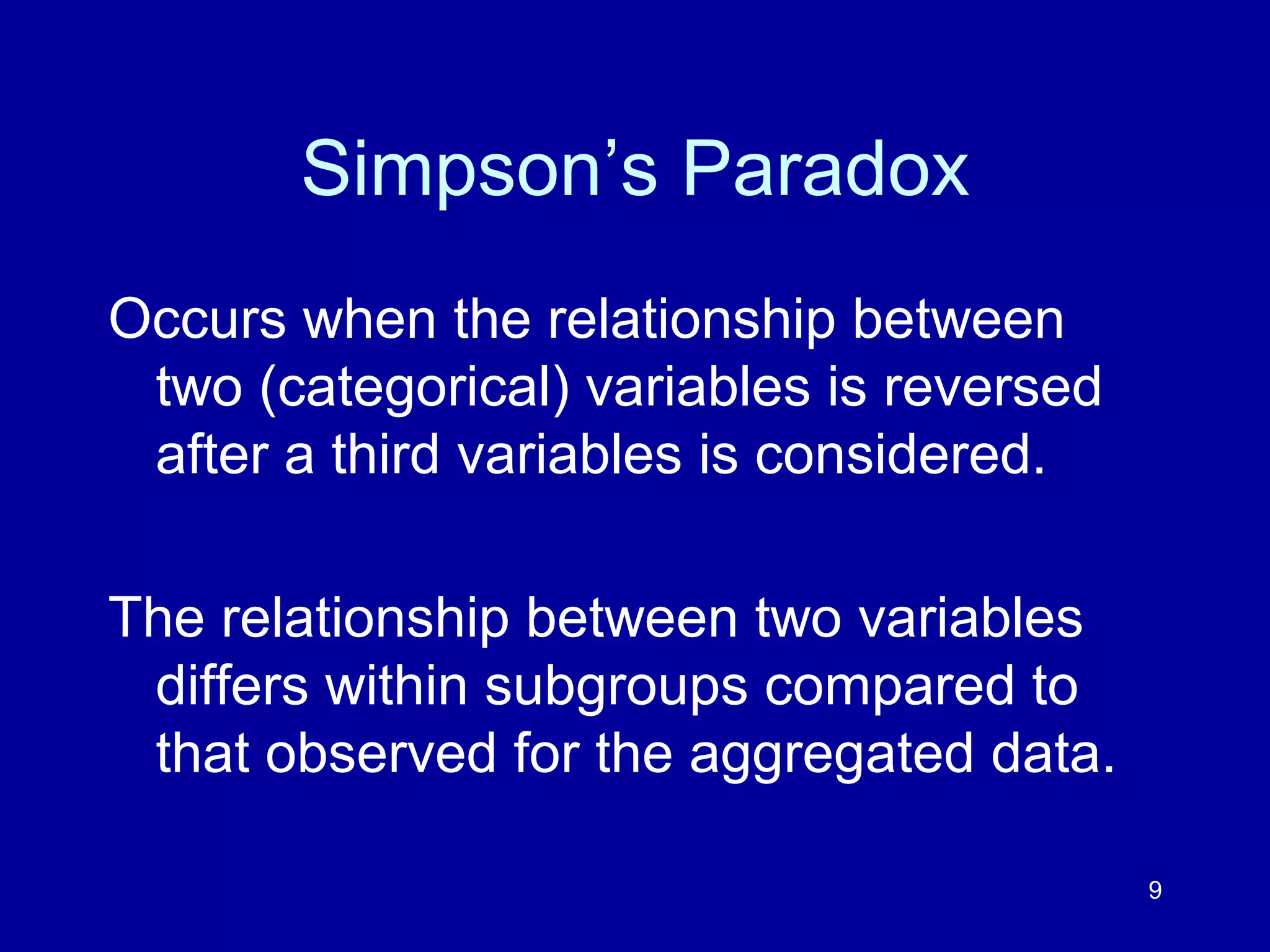
Simpson’s Paradox
Occurs when the relationship between
two (categorical) variables is reversed
after a third variables is considered.
The relationship between two variables
differs within subgroups compared to
that observed for the aggregated data.
10
Simpson’s Paradox:
Remedies/Responses
Study Design
Use Experiments
Collect appropriate covariate data
Know the Research System
Collect appropriate covariate data
Analytically introduce conditionals
(i.e. moderators/covariates)
Use appropriate interpretations
11
Outline
• Objective
• Simpson’s Fallacy
• Will Roger’s Paradox
• Lord’s Paradox
• Berkson’s Paradox
• Monte Hall Paradox
• Others
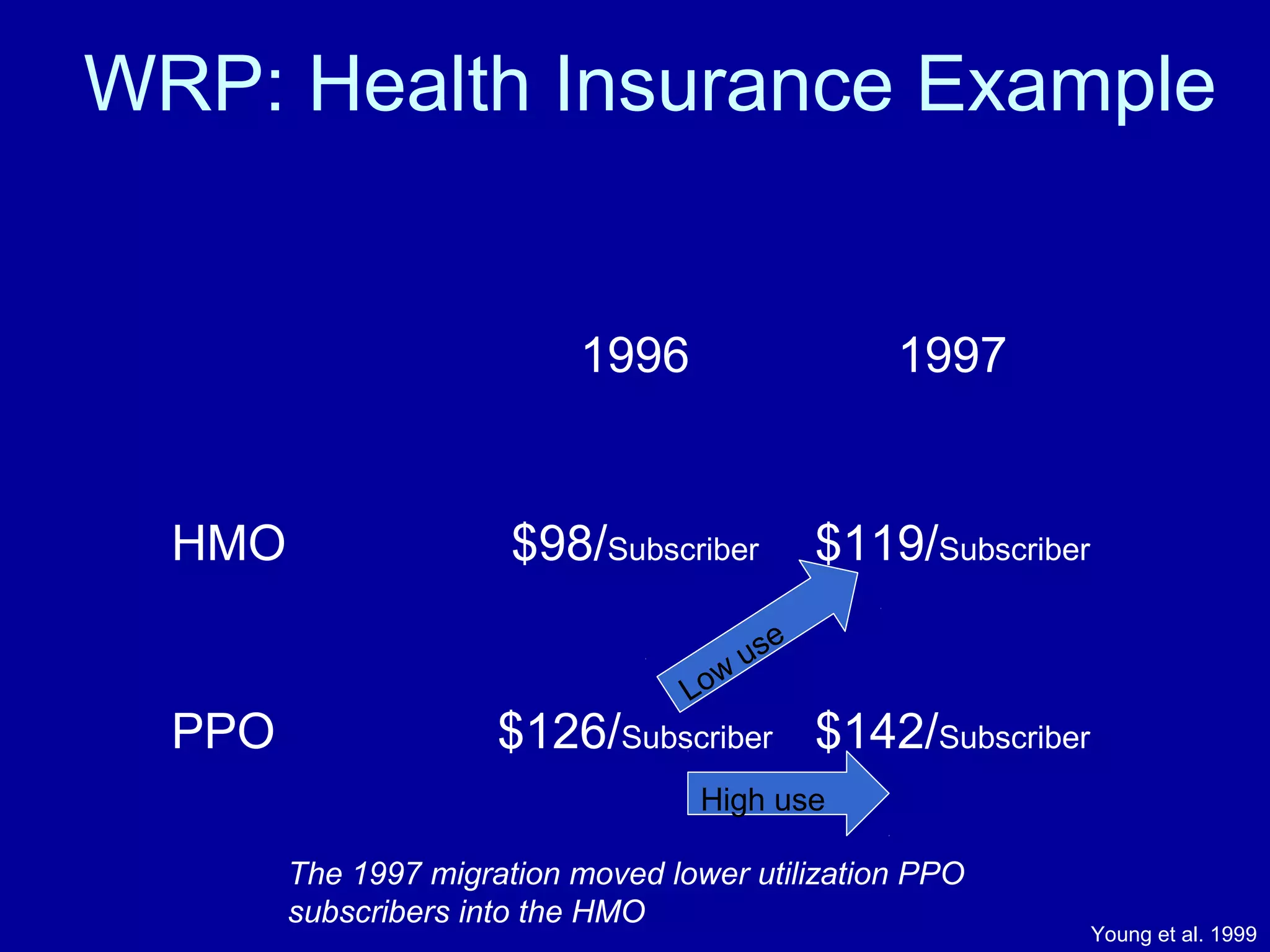
WRP: Health Insurance Example
1996 1997
HMO $98/Subscriber $119/Subscriber
PPO $126/Subscriber $142/Subscriber
PPO No Longer Free
Young et al. 1999
Cells are cost to employer (a hospital system)
Expected Lower
Expenditures
13
Will Roger’s Paradox
“When the Okies left
Oklahoma and moved
to California, they
raised the average
intelligence level in both
states.”
IC: uspsstamps.com
14
The Will Rogers Paradox (WRP) is observed
when moving an element from one set to
another set the mean values of both sets
change in the same direction.
The effect will occur when both of these conditions
are met:
1. The element being moved is below average for
its current set.
2. The element being moved is above the current
average of the set it is entering.
15
WRP: Effect of Shifting One Observation
WRP: Health Insurance Example
1996 1997
HMO $98/Subscriber $119/Subscriber
PPO $126/Subscriber $142/Subscriber
The 1997 migration moved lower utilization PPO
subscribers into the HMO
Young et al. 1999
Low
use
High use
17
Will Rogers:
Remedies/Responses
Know Your System
In This Case:
Statistically adjust/stratify for baseline
costs
18
Outline
• Objective
• Simpson’s Fallacy
• Will Roger’s Paradox
• Lord’s Paradox
• Berkson’s Paradox
• Monte Hall Paradox
• Others
19
Lord’s Paradox
• Occurs in situations where change
score analysis and ANCOVA yield
apparently conflicting results
20
An Extreme Example
• Assessment of a supplemental educational
program
• 10 schools, 5 schools opted into the
programs (free-choice)
• 1 student from each school assessed
• Pre and post assessments given
• No random/sampling/measurement error
(simplified)
22
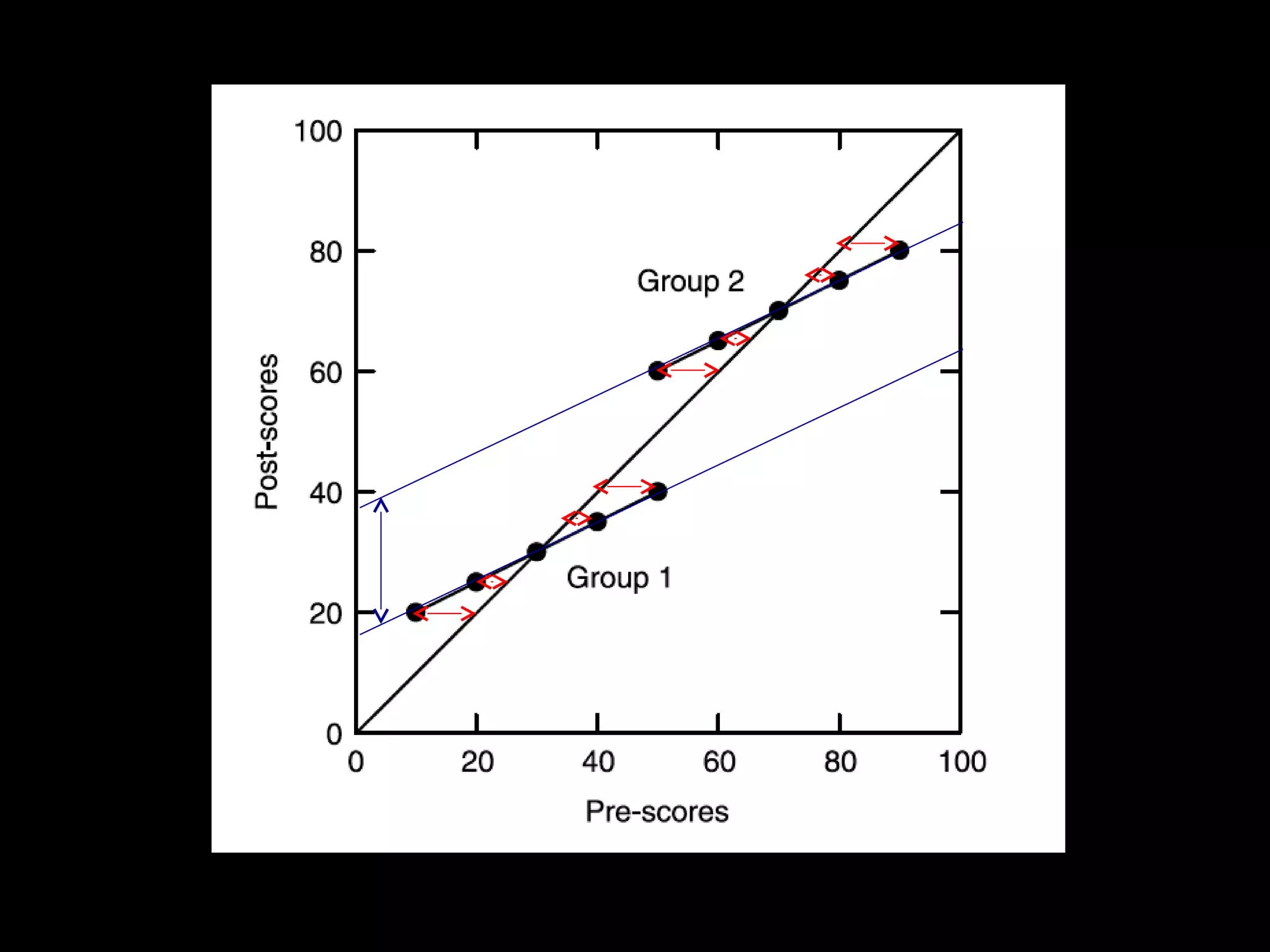
Two Statisticians
Statistician One
• Calculates
difference scores for
each group
• Change scores are
the same for both
groups
Statistician Two
• Adjusts for initial
score
• Finds group
differences
23
Two Statisticians
Paired t-Test
Statistician One
Data: group 1 vs. group 2
t = -0.002, df = 299, p-value = 0.99
ANCOVA
Statistician Two
Coefficients:
Value Pr(>|t|)
(Intercept) 15.0 0.00
Pre 0.5 0.00
Group 20.0 0.00
y1 = 0
y2 = 0
25
Lord’s Paradox:
Remedies/Responses
“With the data available…there is no logical or
statistical procedure that can be counted on to
make allowances for pre-existing conditions
between groups.” Frederic Lord
•Know your system
– Match your samples
•Use the best descriptive statement(s) that match
your questions
•Use and report multiple approaches (Wright 2006)
•Graph your data
26
Outline
• Objective
• Simpson’s Fallacy
• Will Roger’s Paradox
• Lord’s Principle
• Berkson’s Paradox
• Monte Hall Paradox
• Others
27
Berkson’s Paradox
An association reported from a
hospital case-control study can be
distorted
If cases and controls experience differential
hospital admission rates with respect to
the suspected causal factor
28
Typical Berkson Scenario
Example from Roberts et al. 1978
Investigated the relationship between
circulatory and respiratory disease.
Sampled the general population and
hospital populations.
29
OR = 3.9 [95% CI: 1.4-10.9]
CirculatoryDisease
30
CirculatoryDisease
OR = 1.3 [95% CI: 0.9-2.3]
31
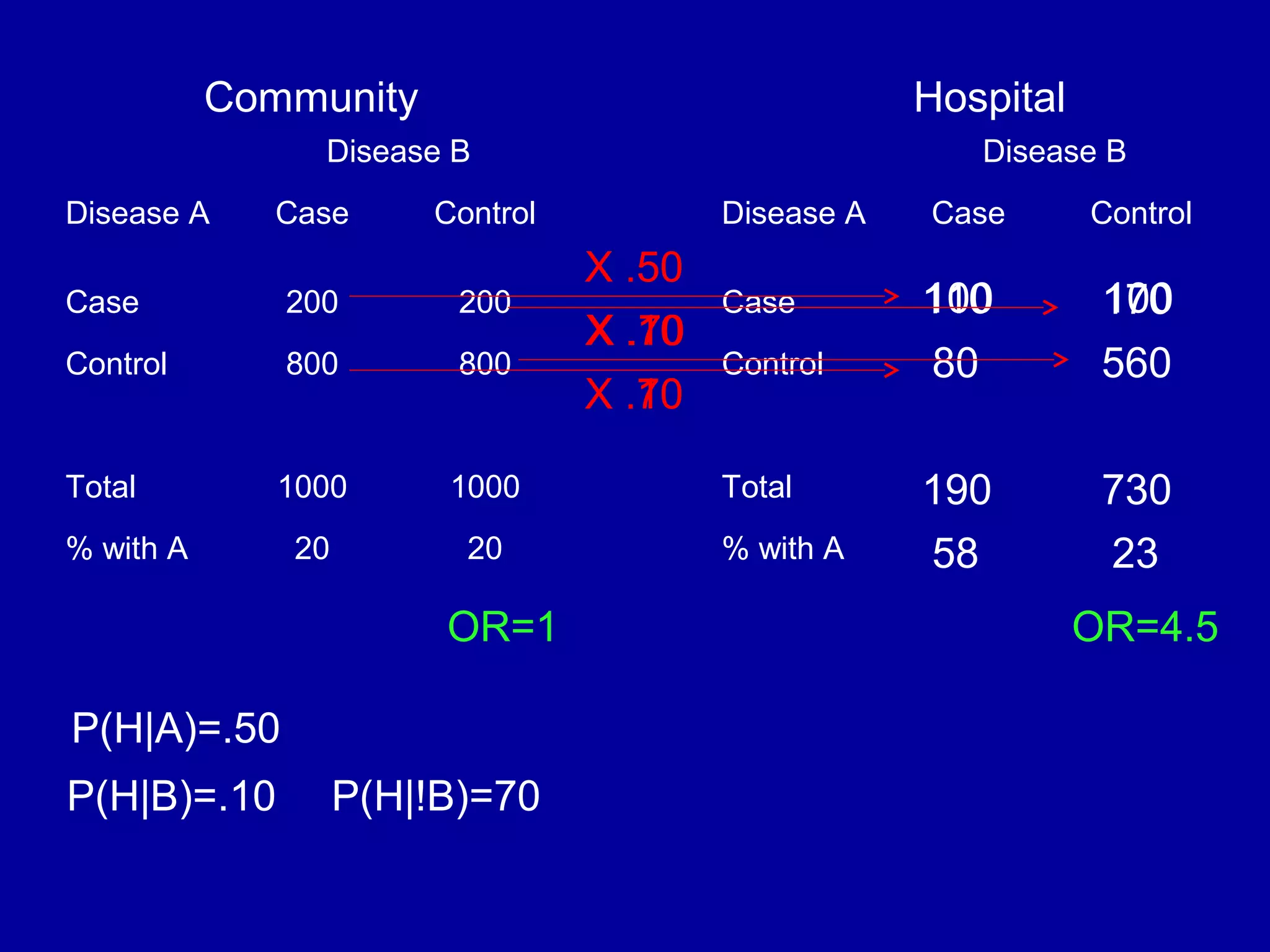
Berkson Example
Example from Lilienfeld and Stolley (1994)
• No greater admission rate for subjects
with multiple conditions
• Different rates of admission for cases and
controls
• Results in an apparent association
between two conditions
Disease B
Disease A Case Control
Case 200 200
Control 800 800
Total 1000 1000
% with A 20 20
Disease B
Disease A Case Control
Case
Control
Total
% with A
110 170
80 560
Community Hospital
P(H|A)=.50
P(H|B)=.10 P(H|!B)=70
100
X .50
X .10
X .50
X .70
100
X .70X .10
190 730
58 23
OR=1 OR=4.5
33
Berkson’s:
Remedies/Responses
–There is no safe analytical mitigation
–Analysis of potential bias
• know your system
• Sensitivity analysis
–Limit conclusions
–Utilize multiple control pools
–Consider alternative study design
34
35
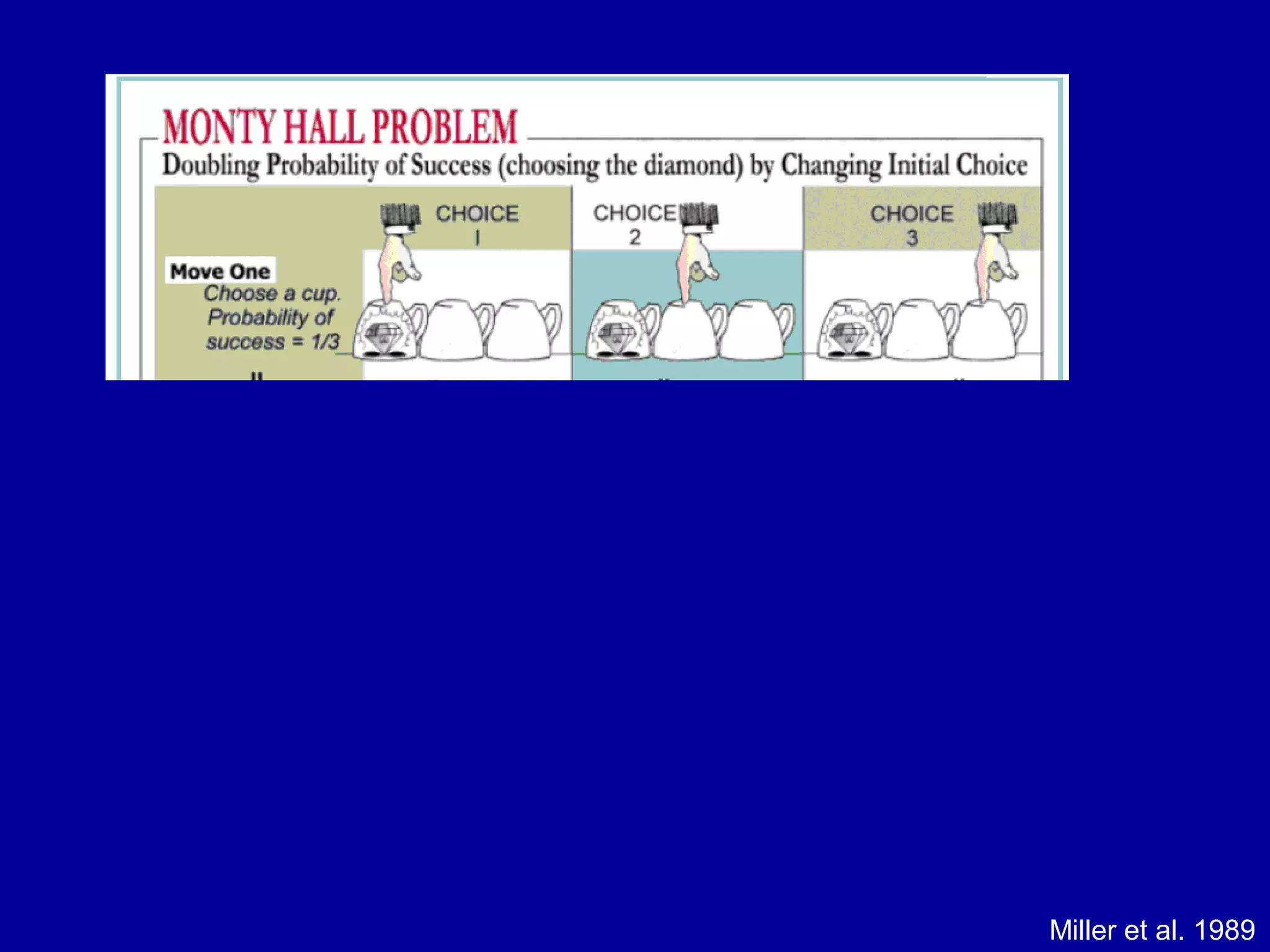
Monty Hall Paradox
36
Miller et al. 1989
37
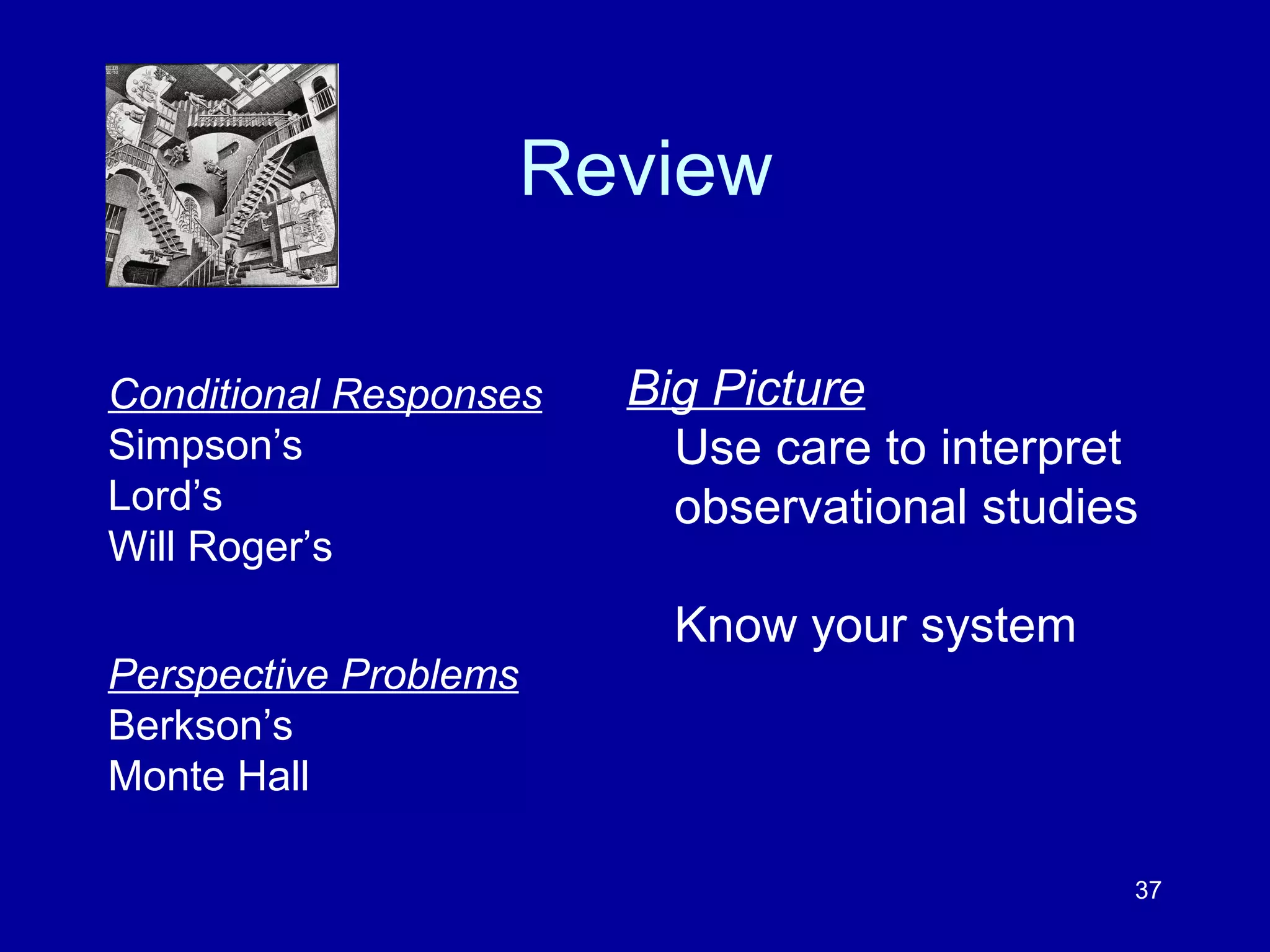
Review
Big Picture
Use care to interpret
observational studies
Know your system
Conditional Responses
Simpson’s
Lord’s
Will Roger’s
Perspective Problems
Berkson’s
Monte Hall
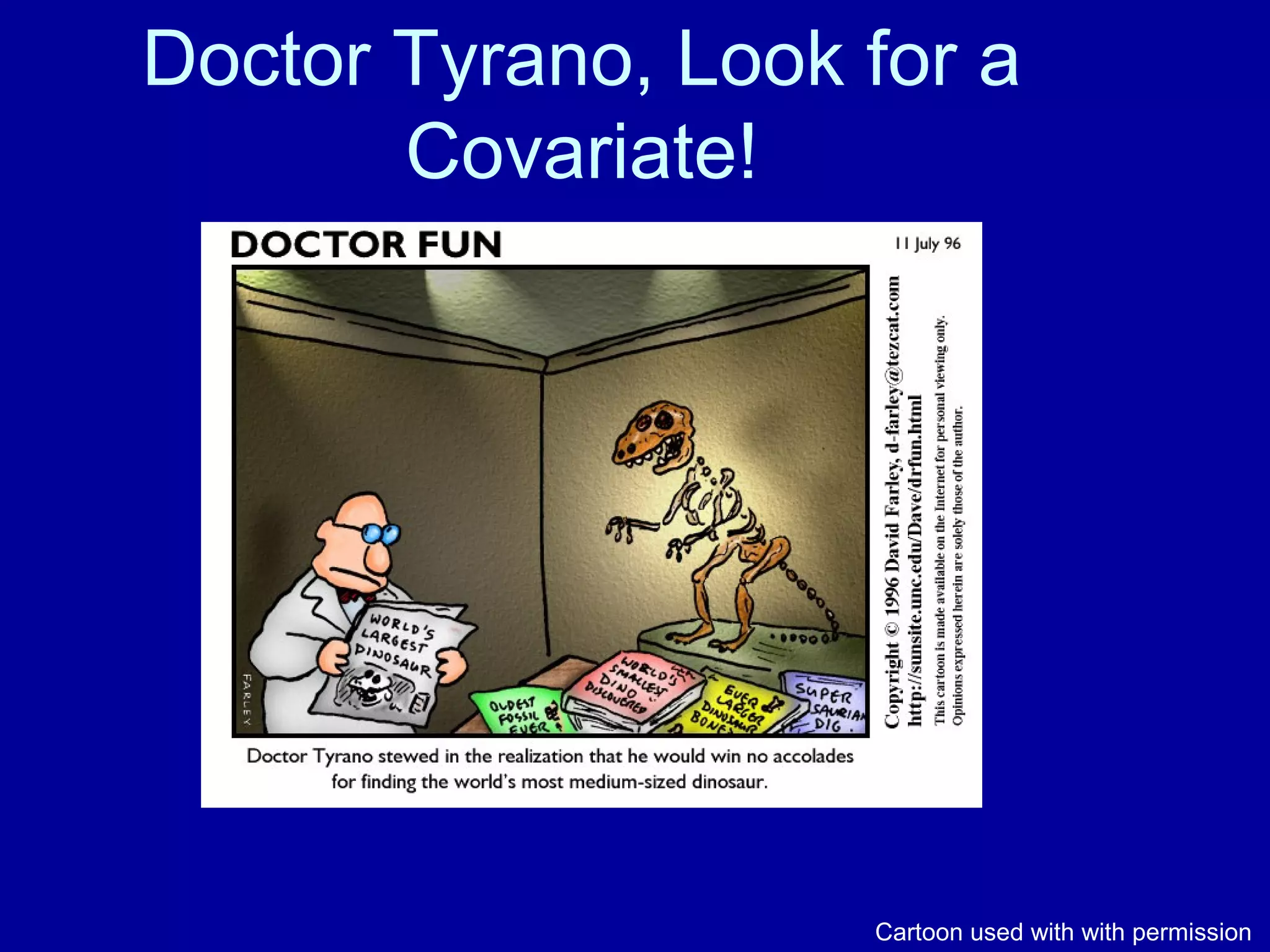
Doctor Tyrano, Look for a
Covariate!
Cartoon used with with permission
39
Benford’s Law
Ones are the most common leading digit in most data.
Notice that if a data entry (base 10) begins with a 1, the entry has
to be at least doubled to have a first significant digit of 2.
However, if a leading digit begins with a 9, it only has to be
increased by, at most, 11% to change the first significant digit
into a 1.
40
Lindley’s Paradox
• Standard Sampling Theory VS.
Bayesian Theory
Under some circumstances strong
evidence against the null hypothesis
doesn’t result in the null being rejected

Kevin Cummins Statistical Phenomenon 02-09-16

  • 1.
    1 Interesting Statistical Phenomenon San DiegoState University DSW/IRSU Brown Bag 3/16 Kevin Cummins
  • 2.
    2 Definitions • Principle: acomprehensive and fundamental law, doctrine, or assumption • Fallacy: a false or mistaken idea • Paradox: a statement that is seemingly contradictory or opposed to common sense and yet is perhaps true
  • 3.
    3 Outline • Objective • Simpson’sParadox • Will Roger’s Paradox • Lord’s Paradox • Berkson’s Paradox • Monte Hall Paradox • Others
  • 4.
    4 Objectives • Create awarenessof several statistical issues that might arise during observational research • Sneak in an introduction to mosaic plots • Learn how to win prizes on game shows
  • 5.
    5 Outline • Objective • Simpson’sParadox • Will Roger’s Paradox • Lord’s Paradox • Berkson’s Paradox • Monte Hall Paradox • Others
  • 6.
  • 7.
  • 8.
    8 Alaska Airlines AmericaWest .11 .05 .17 .14 .08 .29
  • 9.
    9 Simpson’s Paradox Occurs whenthe relationship between two (categorical) variables is reversed after a third variables is considered. The relationship between two variables differs within subgroups compared to that observed for the aggregated data.
  • 10.
    10 Simpson’s Paradox: Remedies/Responses Study Design UseExperiments Collect appropriate covariate data Know the Research System Collect appropriate covariate data Analytically introduce conditionals (i.e. moderators/covariates) Use appropriate interpretations
  • 11.
    11 Outline • Objective • Simpson’sFallacy • Will Roger’s Paradox • Lord’s Paradox • Berkson’s Paradox • Monte Hall Paradox • Others
  • 12.
    WRP: Health InsuranceExample 1996 1997 HMO $98/Subscriber $119/Subscriber PPO $126/Subscriber $142/Subscriber PPO No Longer Free Young et al. 1999 Cells are cost to employer (a hospital system) Expected Lower Expenditures
  • 13.
    13 Will Roger’s Paradox “Whenthe Okies left Oklahoma and moved to California, they raised the average intelligence level in both states.” IC: uspsstamps.com
  • 14.
    14 The Will RogersParadox (WRP) is observed when moving an element from one set to another set the mean values of both sets change in the same direction. The effect will occur when both of these conditions are met: 1. The element being moved is below average for its current set. 2. The element being moved is above the current average of the set it is entering.
  • 15.
    15 WRP: Effect ofShifting One Observation
  • 16.
    WRP: Health InsuranceExample 1996 1997 HMO $98/Subscriber $119/Subscriber PPO $126/Subscriber $142/Subscriber The 1997 migration moved lower utilization PPO subscribers into the HMO Young et al. 1999 Low use High use
  • 17.
    17 Will Rogers: Remedies/Responses Know YourSystem In This Case: Statistically adjust/stratify for baseline costs
  • 18.
    18 Outline • Objective • Simpson’sFallacy • Will Roger’s Paradox • Lord’s Paradox • Berkson’s Paradox • Monte Hall Paradox • Others
  • 19.
    19 Lord’s Paradox • Occursin situations where change score analysis and ANCOVA yield apparently conflicting results
  • 20.
    20 An Extreme Example •Assessment of a supplemental educational program • 10 schools, 5 schools opted into the programs (free-choice) • 1 student from each school assessed • Pre and post assessments given • No random/sampling/measurement error (simplified)
  • 22.
    22 Two Statisticians Statistician One •Calculates difference scores for each group • Change scores are the same for both groups Statistician Two • Adjusts for initial score • Finds group differences
  • 23.
    23 Two Statisticians Paired t-Test StatisticianOne Data: group 1 vs. group 2 t = -0.002, df = 299, p-value = 0.99 ANCOVA Statistician Two Coefficients: Value Pr(>|t|) (Intercept) 15.0 0.00 Pre 0.5 0.00 Group 20.0 0.00 y1 = 0 y2 = 0
  • 25.
    25 Lord’s Paradox: Remedies/Responses “With thedata available…there is no logical or statistical procedure that can be counted on to make allowances for pre-existing conditions between groups.” Frederic Lord •Know your system – Match your samples •Use the best descriptive statement(s) that match your questions •Use and report multiple approaches (Wright 2006) •Graph your data
  • 26.
    26 Outline • Objective • Simpson’sFallacy • Will Roger’s Paradox • Lord’s Principle • Berkson’s Paradox • Monte Hall Paradox • Others
  • 27.
    27 Berkson’s Paradox An associationreported from a hospital case-control study can be distorted If cases and controls experience differential hospital admission rates with respect to the suspected causal factor
  • 28.
    28 Typical Berkson Scenario Examplefrom Roberts et al. 1978 Investigated the relationship between circulatory and respiratory disease. Sampled the general population and hospital populations.
  • 29.
    29 OR = 3.9[95% CI: 1.4-10.9] CirculatoryDisease
  • 30.
  • 31.
    31 Berkson Example Example fromLilienfeld and Stolley (1994) • No greater admission rate for subjects with multiple conditions • Different rates of admission for cases and controls • Results in an apparent association between two conditions
  • 32.
    Disease B Disease ACase Control Case 200 200 Control 800 800 Total 1000 1000 % with A 20 20 Disease B Disease A Case Control Case Control Total % with A 110 170 80 560 Community Hospital P(H|A)=.50 P(H|B)=.10 P(H|!B)=70 100 X .50 X .10 X .50 X .70 100 X .70X .10 190 730 58 23 OR=1 OR=4.5
  • 33.
    33 Berkson’s: Remedies/Responses –There is nosafe analytical mitigation –Analysis of potential bias • know your system • Sensitivity analysis –Limit conclusions –Utilize multiple control pools –Consider alternative study design
  • 34.
  • 35.
  • 36.
  • 37.
    37 Review Big Picture Use careto interpret observational studies Know your system Conditional Responses Simpson’s Lord’s Will Roger’s Perspective Problems Berkson’s Monte Hall
  • 38.
    Doctor Tyrano, Lookfor a Covariate! Cartoon used with with permission
  • 39.
    39 Benford’s Law Ones arethe most common leading digit in most data. Notice that if a data entry (base 10) begins with a 1, the entry has to be at least doubled to have a first significant digit of 2. However, if a leading digit begins with a 9, it only has to be increased by, at most, 11% to change the first significant digit into a 1.
  • 40.
    40 Lindley’s Paradox • StandardSampling Theory VS. Bayesian Theory Under some circumstances strong evidence against the null hypothesis doesn’t result in the null being rejected

Editor's Notes

  • #13 Cost to subscriber went to 80 per month in 1997 for the ppo. Else was free.
  • #18 More complex modeling…
  • #28 valid estimates of effect require the sample of observations to be random equivalent /rep of the population
  • #41 stripplot var1, over(var5) xlabel(0 (1) 1)