Project-based Learning
What, Why, How?
Teaching Essentials: https://blogs.shu.ac.uk/teaching/
Course-focused Practice: https://blogs.shu.ac.uk/cfp
 Active and authentic goal-orientated challenge
 Collaborative: often team-based incorporating roles
 Systematic approach involving student Analysis, Design, Development,
Implementation and Evaluation
 Structured opportunities support continuous self, peer and tutor feedback
 Motivation: intrinsic sense of ownership through application of knowledge
 Outcomes: focuses on developing the individual’s capabilities through the
application of knowledge
 Two tiered:
 Product or goal-focused
 Learning is a structured decision-based process
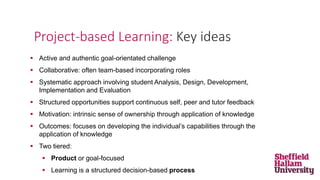
Project-based Learning: Key ideas
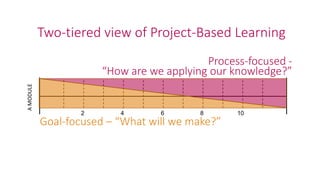
2 4 6 8 10
AMODULE
Two-tiered view of Project-Based Learning
Goal-focused – “What will we make?”
Process-focused -
“How are we applying our knowledge?”
2 4 6 8 10
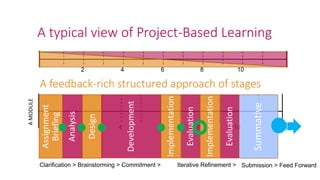
A typical view of Project-Based Learning
2 4 6 8 10
AMODULE
A feedback-rich structured approach of stages
Assignment
Briefing
Analysis
Design
Development
Implementation
Evaluation
Summative
Clarification > Brainstorming > Commitment > Iterative Refinement >
Implementation
Evaluation
Submission > Feed Forward
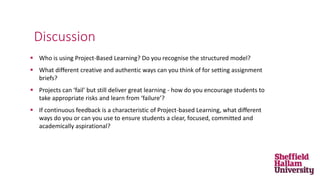
 Who is using Project-Based Learning? Do you recognise the structured model?
 What different creative and authentic ways can you think of for setting assignment
briefs?
 Projects can ‘fail’ but still deliver great learning - how do you encourage students to
take appropriate risks and learn from ‘failure’?
 If continuous feedback is a characteristic of Project-based Learning, what different
ways do you or can you use to ensure students a clear, focused, committed and
academically aspirational?
Discussion
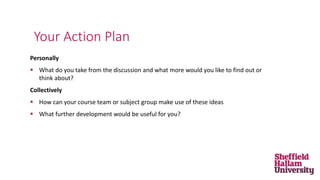
Personally
 What do you take from the discussion and what more would you like to find out or
think about?
Collectively
 How can your course team or subject group make use of these ideas
 What further development would be useful for you?
Your Action Plan

Project-based Learning

  • 1.
    Project-based Learning What, Why,How? Teaching Essentials: https://blogs.shu.ac.uk/teaching/ Course-focused Practice: https://blogs.shu.ac.uk/cfp
  • 2.
     Active andauthentic goal-orientated challenge  Collaborative: often team-based incorporating roles  Systematic approach involving student Analysis, Design, Development, Implementation and Evaluation  Structured opportunities support continuous self, peer and tutor feedback  Motivation: intrinsic sense of ownership through application of knowledge  Outcomes: focuses on developing the individual’s capabilities through the application of knowledge  Two tiered:  Product or goal-focused  Learning is a structured decision-based process Project-based Learning: Key ideas
  • 3.
    2 4 68 10 AMODULE Two-tiered view of Project-Based Learning Goal-focused – “What will we make?” Process-focused - “How are we applying our knowledge?”
  • 4.
    2 4 68 10 A typical view of Project-Based Learning 2 4 6 8 10 AMODULE A feedback-rich structured approach of stages Assignment Briefing Analysis Design Development Implementation Evaluation Summative Clarification > Brainstorming > Commitment > Iterative Refinement > Implementation Evaluation Submission > Feed Forward
  • 5.
     Who isusing Project-Based Learning? Do you recognise the structured model?  What different creative and authentic ways can you think of for setting assignment briefs?  Projects can ‘fail’ but still deliver great learning - how do you encourage students to take appropriate risks and learn from ‘failure’?  If continuous feedback is a characteristic of Project-based Learning, what different ways do you or can you use to ensure students a clear, focused, committed and academically aspirational? Discussion
  • 6.
    Personally  What doyou take from the discussion and what more would you like to find out or think about? Collectively  How can your course team or subject group make use of these ideas  What further development would be useful for you? Your Action Plan

Editor's Notes

  • #2 Project-based learning is an active learning approach in which a student engages in their learning by working through a project usually over the period of a module. As the University commits to being known for Applied Learning, the role of student projects in the curriculum becomes particularly useful. This presentation introduces the key ideas associated with Project-based learning – an approach that is highly flexible and which provides many opportunities for engaging students in developing their understanding of the subject.
  • #3 The main opportunity in project-based learning is to engage students in developing something that can capture their imagination ***and which creates a meaningful challenge that will motivate them to do well. This means taking a goal-focused approach. However, as we will see later, goal attainment drives a learning process. ***Projects are often collaborative and involve group work. But not always – in many respects a dissertation can be understood as a project for example – the student focuses on submitting a substantial piece of work in which they have invested a lot of effort. Along the way they will have been through several learning milestones, each of which have contributed to their understanding. This level of commitment is possible through other forms of project-based approaches. ***Projects are also highly structured – typically, project work involves analysis of a brief, design of a solution, development work, and an iteration of using and evaluating the work. ***Each stage of a project is an opportunity to motivate the students as the challenge develops. During the project the students are likely to be developing their knowledge ‘just-in-time’, either through taught classes and feedback or through discovery as they resolve the problems that emerge along the way. ***The learning outcomes tend to be about how successfully the student responds to the project and its complexities. However, the students are likely to be more focused on achieving their goal, especially in the early days of the project. In the latter stages, it will be only through reflection that will they will begin to fully understand what the project has meant to them and their learning.
  • #4 Initially students are engaged by and encouraged to focus on the product or goal – Their initial focus will be about what they will produce in response to the project brief. Pedagogically the teacher needs to scaffold a shift in the student’s thinking from product or goal focus to the intended learning outcomes that come from a student’s deep engagement in the process of responding to the assignment brief.
  • #5 This shift in focus and motivation is achieved through a structure of stages: e.g. Assignment Brief > ***Analysis > ***Design > ***Development > ***Implementation > and ***Evaluation Scaffolding is achieved through a structure of stages each of which provide an opportunity for rich reflection and feedback indicated by the green dots. The first phase is focused on formative learning The end phase is focused on applying feedback to produce the summative assessment: The iteration around implementation as students improve their project artefact creates a heightened experience that will inform their summative assessment. The Summative Assessment can use methods such as Presentations, Project Reports, Blogging Reflective Accounts, Authentic Trials and Vivas, Portfolio synthesis, and so forth. Importantly, students are engaged in a process of continuous feedback and reflection. It is critical that feedback is light touch and continuous as one stage is dependent on the preceding stages in the project process. Feedback is largely about clarification, correction and reorientation at the beginning, and then later about refinement and enhancement leading to summative assessment. *** This is achieved using techniques like: Feedback to the teacher – i.e. seeking clarification Self-reflection e.g. building individual portfolios of reflective blogs and artefacts such as planning materials and drafts. Peer feedback e.g. from discussion with fellow group members Tutor feedback e.g. based on formative activities such as design specifications or draft plans. Later discussions and feedback focus much more closely on the learning outcomes and academic capabilities of the students.