Course-Focused Practice
What, Why, How?
Teaching Essentials: https://blogs.shu.ac.uk/teaching/
Course-focused Practice: https://blogs.shu.ac.uk/cfp
Including,
 The 'bigger course picture' is obscured
 Poor student attendance and engagement - little sense of course belonging and
becoming
 Assessment and feedback suited to context
 Student engagement with
 Group work
 Feedback
 Formative assessment
We need to focus more on the student’s course experience
Challenges
 Student-centred - relevant, active and applied learning
 Enhancing course meaning and motivation
 Driven by course learning outcomes
 Thinking about learning as experience
 Course satisfaction comes from immersed and driven -
difficult to achieve in module-centric delivery
Looking for connections - within and across modules and
levels
Being Course-Focused?
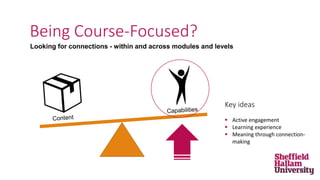
Looking for connections - within and across modules and levels
Being Course-Focused?
Key ideas
 Active engagement
 Learning experience
 Meaning through connection-
making
 Course team approach - co-operative design and supportive delivery
 Relational design - modules are designed in relation to each other
 Being student-centred - keeping learning and graduate identity in mind
Today is a space for you to
Connect - make connections across practice
Share - share and compare practice
Cooperate - find opportunities to work together as peers to enhance practice
What’s it mean in practice?

Course-Focused Practice

  • 1.
    Course-Focused Practice What, Why,How? Teaching Essentials: https://blogs.shu.ac.uk/teaching/ Course-focused Practice: https://blogs.shu.ac.uk/cfp
  • 2.
    Including,  The 'biggercourse picture' is obscured  Poor student attendance and engagement - little sense of course belonging and becoming  Assessment and feedback suited to context  Student engagement with  Group work  Feedback  Formative assessment We need to focus more on the student’s course experience Challenges
  • 3.
     Student-centred -relevant, active and applied learning  Enhancing course meaning and motivation  Driven by course learning outcomes  Thinking about learning as experience  Course satisfaction comes from immersed and driven - difficult to achieve in module-centric delivery Looking for connections - within and across modules and levels Being Course-Focused?
  • 4.
    Looking for connections- within and across modules and levels Being Course-Focused? Key ideas  Active engagement  Learning experience  Meaning through connection- making
  • 5.
     Course teamapproach - co-operative design and supportive delivery  Relational design - modules are designed in relation to each other  Being student-centred - keeping learning and graduate identity in mind Today is a space for you to Connect - make connections across practice Share - share and compare practice Cooperate - find opportunities to work together as peers to enhance practice What’s it mean in practice?

Editor's Notes

  • #2 This presentation introduces Course-focused practice – approaches to teaching that seek to enhance student satisfaction with their course by proactively developing connections across and through their course.
  • #3 While your students enrolled for a course, their actual experience may feel fragmented or disjointed. There is a danger that things don’t feel joined up or coherent. Modules can feel disconnected from each other. For example, in some cases tutors do not make links between what their students are learning in one module and what they are learning in others; both those they are taking now and those they will take later. In this way, learning opportunities are missed and often students can be left wondering whether their course has been designed holistically or just thrown together. With some thought and co-ordination, it is easy to build in all sorts of connections across and through a student’s course. Doing so can develop student satisfaction, and increase their engagement, attendance and personal motivation. By working on connection-making, a narrative can emerge for the students that can help to foster their sense of becoming – they develop a sense of how the course fits together and how this supports the development of their own identity, capabilities and future aspirations. While there are plenty of opportunities for fostering a sense of course belonging, assessment and feedback design are key points for connection-making. Academics and students report several areas that warrant particular attention in terms of engagement. The danger is that when engagement starts to falter, academics will attempt to fix the engagement problem in ways that compound the problem and students will vote with their feet or provide poor evaluations of their modules, including in the NSS. Group work, feedback, and formative assessment activities are hot spots for engagement – when they work well they can make the module exciting and rewarding, but when they begin to fail they can have the opposite effect. ***The message is, “Whatever our role, we need to focus more on the student’s whole course experience.”
  • #4 Being course-focused is similar to being *** student-centred – what you do with your students establishes relevance by taking time to explore the meaning and usefulness of content with the students. Be sure your students know why learning a topic is important and how they will apply this learning later in the module, the course or in life beyond university. This can come from discussion, but it can also be an outcome of active learning strategies that involve the students using knowledge to address problems together. ***Simply, by focusing more on meaning making through activity and discussion you will become student-centred and this inevitably leads to more motivated students. ***Academics on a course must be familiar with the Course Learning Outcomes – often academics focus too much on delivering their module learning outcomes and specific bodies of ‘content’. Being too content and module focused can undermine engagement and can leave the module feeling disconnected and, potentially, irrelevant to some students. *** Learning should never be perceived as a chore – even when it is difficult and challenging. It is about your students having an experience. Think about creating a challenging learning context – that is, a learning context that is intriguing and fosters curiosity and a desire to be able to answer difficult questions or tackle complex problems confidently. Such confidence tends to come from practice, so ask how can you maximise opportunities for your students to apply what they know? ***Being course-focused means working towards creating a learning environment in which your students feel immersed and highly motivated. Their encounters with knowledge should inspire them. Think about what you can devise to stimulate them. Often that will come from helping them to find connections between what they are doing and learning now, and how this will help them later. ***The challenge of the course team is to think about connection-making.
  • #5 While the tendency of a module is to deliver content, often the trick is to work out how to motivate students so that they find out what they need to know as a response to inspiring challenges. There are many sound approaches that can be used to achieve this with names like ‘active learning’, ‘enquiry-based learning’, ‘problem-based learning’, and ‘project-based learning’, amongst others. There is an immense amount of knowledge and guidance available to support such strategies. Common to all these ideas is a shift of emphasis – from the delivery of content knowledge to the development of student capabilities so they learn to learn by exploring and applying knowledge in meaningful ways. That’s why the idea of ‘applied learning’ is so useful.
  • #6 If you are not already taking a course-focused approach, many of your colleagues will be. In either case, adopting student-centred and course-focused approaches is much better done with others. Course teams can work co-operatively in a number of ways to create a supportive teaching environment. Perhaps the single thing to keep in mind is the forming of the student’s identity. Their sense of ‘becoming’. As each student learns they change. Being aware of this change is important to them, because it can drive their motivation. Talking with them about what professionals do or about ‘what you will do as a professional’ can be highly inspiring.