Problem-based and Projectbased Learning
EDP 632
Jiarui Yang

S
Problem Based Instruction

S Problem-based learning is a learner-centered approach

to teaching and learning in which the learner learns about
a subject through problem-solving.
S In a problem-based learning (PBL) model, students

engage complex, challenging problems and
collaboratively work toward their resolution.
S PBL is about students connecting disciplinary knowledge

to real-world problems—the motivation to solve a
problem becomes the motivation to learn.
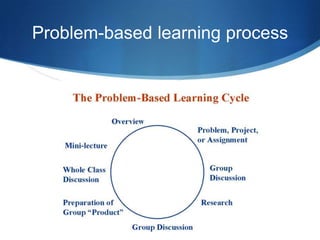
Problem-based learning process
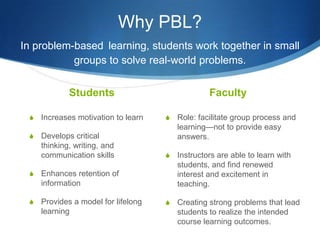
Why PBL?
In problem-based learning, students work together in small
groups to solve real-world problems.
Students

Faculty

S

Increases motivation to learn

S

S

Develops critical
thinking, writing, and
communication skills

Role: facilitate group process and
learning—not to provide easy
answers.

S

Instructors are able to learn with
students, and find renewed
interest and excitement in
teaching.

S

Creating strong problems that lead
students to realize the intended
course learning outcomes.

S

Enhances retention of
information

S

Provides a model for lifelong
learning
Unique aspects that define the PBL
approach

S Problem-based learning is student-centered.
S In a PBL course, students and the instructor become

colearners, coplanners, and coevaluators as they
design, implement, and continually refine their curricula.
S PBL fosters collaboration among students, stresses the

development of problem solving skills within the context of
professional practice, promotes self-directed learning, and is
aimed at increasing motivation for life-long learning.
Seven steps to PBL

S

S

Analyze. The students discuss the
problem. At this stage there is no
sifting of ideas.

Identify learning objectives. The
group reaches a consensus on
learning objectives.
Self Study. Students individually
gather information towards the
learning objectives and prepare to
share their findings with the rest of the
group.

S

7. Report. The students come
together in their groups and share
their results. The facilitator checks
that the learning objectives have been
met.

Define. The students work together
to define what they think the
problem is.

S

S

S

Clarify. The students read through
the problem, then identify and clarify
any words or concepts that they do
not understand.

S

Review. Students now try to
arrange their ideas and explanations
into tentative solutions.
S Develop your diagnostic

Advantages
of

reasoning and analytical
problem-solving skills.
S Determine what knowledge

you need to acquire to
understand the problem, and
others like it.
S Discover the best resources

for acquiring that information.
S Carry out your own

personalized study using a
wide range of resources.
S Apply the information you

have learned back to the
problem.
S Integrate this newly acquired

knowledge with your existing
understanding.
Project Based Learning
Project-Based Learning is a comprehensive
instructional approach to engage learners in
sustained, cooperative investigation (Bransford &
Stein, 1993).

S
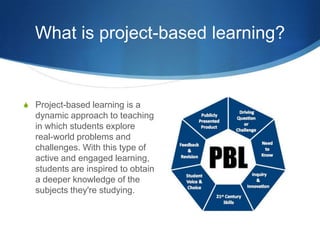
What is project-based learning?

S Project-based learning is a

dynamic approach to teaching
in which students explore
real-world problems and
challenges. With this type of
active and engaged learning,
students are inspired to obtain
a deeper knowledge of the
subjects they're studying.
PBL Pedagogy

S Improved Learning Strategies & Thinking Skills: learning

to learn, life-long learning, active learning and
cooperative learning.
S Contextual Learning
S High Standards for All Learners

S Changing Roles and Increasing Participation: students as

teachers, teachers as coaches, parent and community
involvement.
What makes a good project?

S Purpose. Is the project personally meaningful?
S Time. Sufficient time must be provided for learners to think

about and plan.
S Complexity. The best projects combine multiple subject

areas and call upon the prior knowledge and expertise of
each student.
S Connected. During great projects students are connected

to each other.
What makes a good project?

S Access. Students need access to a wide variety of

concrete and digital materials anytime, anyplace.
S Shareable. Students need to make something that is

shareable with others.
S Novelty. Few project ideas are so profound that every

child needs to engage in its development in every class.
(by Gary Stager, Ph.D.)
Key components of Project-Based
Learning
S Learner-centered environment

S Collaboration
S Curricular content
S Authentic tasks

S Multiple expression modes
S Emphasis on time management
S Innovative assessment
Benefits of Project-Based Learning
S Increased attendance, growth in self-reliance, and improved

attitudes toward learning (Thomas, 2000)
S Academic gains equal to or better than those generated by

other models, with students involved in projects taking greater
responsibility for their own learning than during more traditional
classroom activities (Boaler, 1997; SRI, 2000 )
S Opportunities to develop complex skills, such as higher-order

thinking, problem-solving, collaborating, and communicating
(SRI, 2000)
S Access to a broader range of learning opportunities in the

classroom, providing a strategy for engaging culturally diverse
learners (Railsback, 2002)
References

S Boaler, J. (1999, March 31). Mathematics for the moment, or the

millennium? Education Week.
S Thomas, J.W. (1998). Project-based learning: Overview. Novato,

CA: Buck Institute for Education.
S Railsback, J. (2002). Project-based instruction: Creating

excitement for learning. Portland, OR: Northwest Regional
Educational Laboratory.

Problem based learning

  • 1.
    Problem-based and ProjectbasedLearning EDP 632 Jiarui Yang S
  • 2.
    Problem Based Instruction SProblem-based learning is a learner-centered approach to teaching and learning in which the learner learns about a subject through problem-solving. S In a problem-based learning (PBL) model, students engage complex, challenging problems and collaboratively work toward their resolution. S PBL is about students connecting disciplinary knowledge to real-world problems—the motivation to solve a problem becomes the motivation to learn.
  • 3.
  • 4.
    Why PBL? In problem-basedlearning, students work together in small groups to solve real-world problems. Students Faculty S Increases motivation to learn S S Develops critical thinking, writing, and communication skills Role: facilitate group process and learning—not to provide easy answers. S Instructors are able to learn with students, and find renewed interest and excitement in teaching. S Creating strong problems that lead students to realize the intended course learning outcomes. S Enhances retention of information S Provides a model for lifelong learning
  • 5.
    Unique aspects thatdefine the PBL approach S Problem-based learning is student-centered. S In a PBL course, students and the instructor become colearners, coplanners, and coevaluators as they design, implement, and continually refine their curricula. S PBL fosters collaboration among students, stresses the development of problem solving skills within the context of professional practice, promotes self-directed learning, and is aimed at increasing motivation for life-long learning.
  • 6.
    Seven steps toPBL S S Analyze. The students discuss the problem. At this stage there is no sifting of ideas. Identify learning objectives. The group reaches a consensus on learning objectives. Self Study. Students individually gather information towards the learning objectives and prepare to share their findings with the rest of the group. S 7. Report. The students come together in their groups and share their results. The facilitator checks that the learning objectives have been met. Define. The students work together to define what they think the problem is. S S S Clarify. The students read through the problem, then identify and clarify any words or concepts that they do not understand. S Review. Students now try to arrange their ideas and explanations into tentative solutions.
  • 7.
    S Develop yourdiagnostic Advantages of reasoning and analytical problem-solving skills. S Determine what knowledge you need to acquire to understand the problem, and others like it. S Discover the best resources for acquiring that information. S Carry out your own personalized study using a wide range of resources. S Apply the information you have learned back to the problem. S Integrate this newly acquired knowledge with your existing understanding.
  • 8.
    Project Based Learning Project-BasedLearning is a comprehensive instructional approach to engage learners in sustained, cooperative investigation (Bransford & Stein, 1993). S
  • 9.
    What is project-basedlearning? S Project-based learning is a dynamic approach to teaching in which students explore real-world problems and challenges. With this type of active and engaged learning, students are inspired to obtain a deeper knowledge of the subjects they're studying.
  • 10.
    PBL Pedagogy S ImprovedLearning Strategies & Thinking Skills: learning to learn, life-long learning, active learning and cooperative learning. S Contextual Learning S High Standards for All Learners S Changing Roles and Increasing Participation: students as teachers, teachers as coaches, parent and community involvement.
  • 11.
    What makes agood project? S Purpose. Is the project personally meaningful? S Time. Sufficient time must be provided for learners to think about and plan. S Complexity. The best projects combine multiple subject areas and call upon the prior knowledge and expertise of each student. S Connected. During great projects students are connected to each other.
  • 12.
    What makes agood project? S Access. Students need access to a wide variety of concrete and digital materials anytime, anyplace. S Shareable. Students need to make something that is shareable with others. S Novelty. Few project ideas are so profound that every child needs to engage in its development in every class. (by Gary Stager, Ph.D.)
  • 13.
    Key components ofProject-Based Learning S Learner-centered environment S Collaboration S Curricular content S Authentic tasks S Multiple expression modes S Emphasis on time management S Innovative assessment
  • 14.
    Benefits of Project-BasedLearning S Increased attendance, growth in self-reliance, and improved attitudes toward learning (Thomas, 2000) S Academic gains equal to or better than those generated by other models, with students involved in projects taking greater responsibility for their own learning than during more traditional classroom activities (Boaler, 1997; SRI, 2000 ) S Opportunities to develop complex skills, such as higher-order thinking, problem-solving, collaborating, and communicating (SRI, 2000) S Access to a broader range of learning opportunities in the classroom, providing a strategy for engaging culturally diverse learners (Railsback, 2002)
  • 15.
    References S Boaler, J.(1999, March 31). Mathematics for the moment, or the millennium? Education Week. S Thomas, J.W. (1998). Project-based learning: Overview. Novato, CA: Buck Institute for Education. S Railsback, J. (2002). Project-based instruction: Creating excitement for learning. Portland, OR: Northwest Regional Educational Laboratory.