Project Scope Change
Management
Basic approach to Manage Changes
with Project Risk Management
Compiled by: Alex Iskandar,PMP
Why Changes ?
 These days change is a constant, there is always something
changing somewhere for some reason.
 It is almost impossible to work anywhere without going through
some type of change.
 Change isn't a “bad” or a “god” thing
 In today's business world change is necessary to survive.
 However, if not executed properly change can be damaging, it
can negatively impact to the project.
Compiled by: Alex Iskandar,PMP
What is Change Management ?
 Change management is a structured approach to transitioning
individuals, teams, and organizations from a current state to a
desired future state. Change management (or change control) is
the process during which the changes of a system are
implemented in a controlled manner by following a pre-defined
framework/model with, to some extent, reasonable modifications
[1].
 In project management, change management refers to a project
management process where changes to a project are formally
introduced and approved.[2].
http://en.wikipedia.org/wiki/Change_management
Compiled by: Alex Iskandar,PMP
Change is a constant feature
of projects
 Knowing how to handle changes and requests for
changes is vital to delivering any project on time.
 Change control is the essence of good project
management
 Properly estimating the impact of a requested change
and communicating that impact in a clear way is vital
to the success of any project.
 Project Team must know:
 Why a change is needed (business case)
 What we are changing (scope)
 How long the change will take (schedule)
 How much the change will cost (cost estimate)
Compiled by: Alex Iskandar,PMP
Changes Management as part of
Project Control & Monitoring
Compiled by: Alex Iskandar,PMP
Control and Monitor is:
Control is:
 Noun
 an act or instance of controlling; also : power or authority to
guide or manage
 Verb
 to check, test, or verify by evidence or experiments , to exercise
restraining or directing influence over
Monitor is:
 Noun
 a person who has the job of watching or noticing particular things
 Verb
 to watch, keep track of, or check usually for a special purpose
Compiled by: Alex Iskandar,PMP
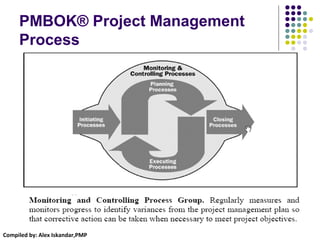
PMBOK® Project Management
Process
Compiled by: Alex Iskandar,PMP
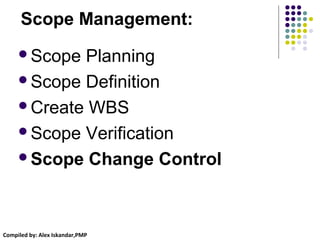
Scope Management:
Scope Planning
Scope Definition
Create WBS
Scope Verification
Scope Change Control
Compiled by: Alex Iskandar,PMP
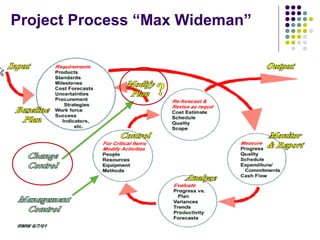
Project Process “Max Wideman”
Compiled by: Alex Iskandar,PMP
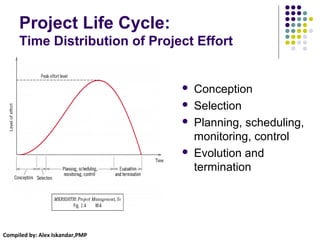
Project Life Cycle:
Time Distribution of Project Effort
 Conception
 Selection
 Planning, scheduling,
monitoring, control
 Evolution and
termination
Compiled by: Alex Iskandar,PMP
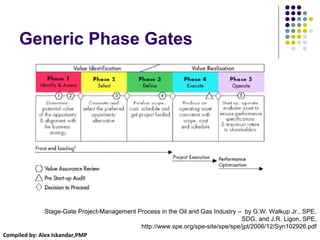
Generic Phase Gates
Stage-Gate Project-Management Process in the Oil and Gas Industry – by G.W. Walkup Jr., SPE,
SDG, and J.R. Ligon, SPE,
http://www.spe.org/spe-site/spe/spe/jpt/2006/12/Syn102926.pdf
Compiled by: Alex Iskandar,PMP
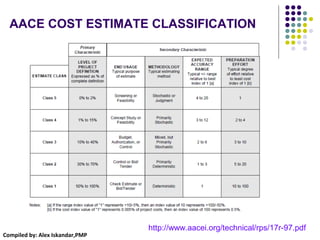
AACE COST ESTIMATE CLASSIFICATION
http://www.aacei.org/technical/rps/17r-97.pdf
Compiled by: Alex Iskandar,PMP
What is Contingency?
http://www.maxwideman.com/pmglossary/PMG_C07.htm
 As a result of risk analysis sums of money or amounts of time may be set
aside as contingency which may be used in the event of risks occurring.
 A Contingency is the planned allotment of time and cost for unforeseeable
elements with a project. Including contingencies will increase the confidence
of the overall project.
 An amount of design margin, time, or money inserted into the corresponding
plan as a safety factor to accommodate unexpected and presently unknown
occurrences that judgment suggests will occur during the project.
Compiled by: Alex Iskandar,PMP
What is Contingency Plan
http://en.wikipedia.org/wiki/Contingency_plan
• A Contingency plan is a plan devised for a specific situation when things
could go wrong. Contingency plans are often devised by governments or
businesses who want to be prepared for anything that could happen. They
are sometimes known as "Back-up plans", "Worst-case scenario plans",
"Scrap Situation" or "Plan B" .
 Contingency plans include specific strategies and actions to deal with
specific variances to assumptions resulting in a particular problem,
emergency or state of affairs. They also include a monitoring process and
“triggers” for initiating planned actions. They are required to help
governments, businesses or individuals to recover from serious incidents in
the minimum time with minimum cost and disruption.
http://www.maxwideman.com/pmglossary/PMG_C07.htm
 A Contingency Plan is fallback position, or workaround in the event of an
adverse occurrence, or risk event, on the project.
 A plan that identifies key assumptions beyond the project manager's
control, and their probability of occurrence. The plan identifies alternative
strategies for achieving project success.
Compiled by: Alex Iskandar,PMP
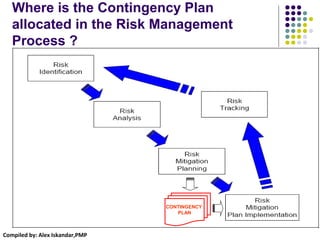
Where is the Contingency Plan
allocated in the Risk Management
Process ?
CONTINGENCY
PLAN
Compiled by: Alex Iskandar,PMP
How to Manage Changes
Manage with Changes & Risks
Possible outcomes for each risk
 Take action to avoid the risk, reduce its likelihood, or reduce its
impact,
 Make contingency plans and deal with the impact and mitigate
the risk should it occur,
 Agree that it is an acceptable business risk to take no action and
hope that the risk does not occur.
Do not wait for situations to come up before you address them
Compiled by: Alex Iskandar,PMP
How to Planning Contingency
Risk Management and Contingency Planning
http://ahds.ac.uk/creating/information-papers/risk-management/
Planning a Risk Response
1. Types of Risk Response
• Avoidance
• Adopting
• Reduction
• Transfer
• Deferral
• Retention
2. Choosing the right response
3. Contingency Plans
• How to Calculating Contingency
http://www.jiscinfonet.ac.uk/InfoKits/risk-management/calculating-contingency
Contingency should be shown in the plan as a separate item and not hidden in
activities as "an extra 10%" on duration or cost.
Compiled by: Alex Iskandar,PMP
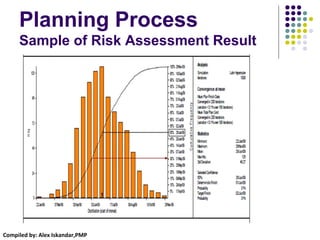
Planning Process
Sample of Risk Assessment Result
Compiled by: Alex Iskandar,PMP
Probabilistic Planning
 P10 Estimate – a 10% chance that the project
cost/schedule will be less than or equal to the estimate
total and a 90% chance that the project cost/schedule
will be greater than the cost estimate total.
 P50 Estimate – a 50% chance that the project
cost/schedule will be less than or equal to the estimate
total and a 50% chance that the project cost/schedule
will be greater than the cost estimate total.
 P90 Estimate – a 90% chance that the project cost will
be less than or equal to the estimate total and a 10%
chance that the project cost/schedule will be greater
than the cost/schedule estimate total.
http://bora.nhh.no/bitstream/2330/511/1/R30_01.pdf
http://www.cooperenergy.com.au/cooper-pdf/Cumulative%20Probability%20P90%20P50%20P10.pdf
Compiled by: Alex Iskandar,PMP
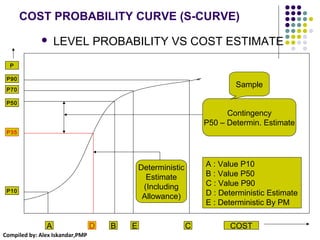
COST PROBABILITY CURVE (S-CURVE)
 LEVEL PROBABILITY VS COST ESTIMATE
A D B CE
P90
P70
P50
P35
P10
A : Value P10
B : Value P50
C : Value P90
D : Deterministic Estimate
E : Deterministic By PM
Deterministic
Estimate
(Including
Allowance)
Contingency
P50 – Determin. Estimate
COST
P
Sample
Compiled by: Alex Iskandar,PMP
We have noted the following
keys:
 Changes
 Changes Management
 Project Life Cycle
 Contingency
 Risk Management
 Scope Changes & Trends
Now going to enter on how to at the
implementation (Execution / EPC Phase) :
Compiled by: Alex Iskandar,PMP
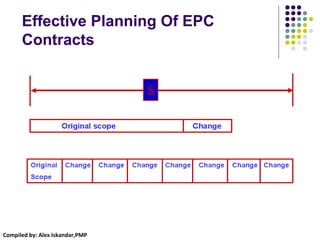
Effective Planning Of EPC
Contracts
Compiled by: Alex Iskandar,PMP http://i.treehugger.com/images/2007/10/24/change_order-1.jpg
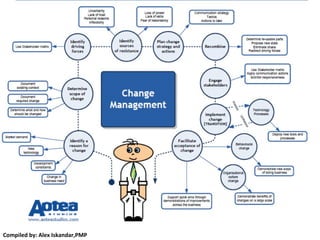
Compiled by: Alex Iskandar,PMP
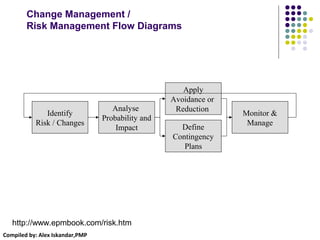
Change Management /
Risk Management Flow Diagrams
Identify
Risk / Changes
Analyse
Probability and
Impact
Apply
Avoidance or
Reduction
Define
Contingency
Plans
Monitor &
Manage
http://www.epmbook.com/risk.htm
Compiled by: Alex Iskandar,PMP
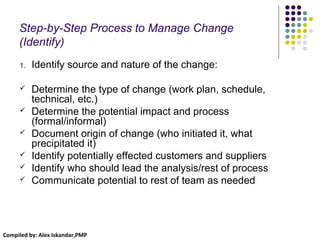
Step-by-Step Process to Manage Change
(Identify)
1. Identify source and nature of the change:
 Determine the type of change (work plan, schedule,
technical, etc.)
 Determine the potential impact and process
(formal/informal)
 Document origin of change (who initiated it, what
precipitated it)
 Identify potentially effected customers and suppliers
 Identify who should lead the analysis/rest of process
 Communicate potential to rest of team as needed
Compiled by: Alex Iskandar,PMP
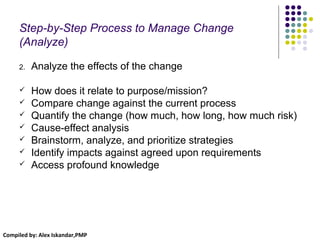
Step-by-Step Process to Manage Change
(Analyze)
2. Analyze the effects of the change
 How does it relate to purpose/mission?
 Compare change against the current process
 Quantify the change (how much, how long, how much risk)
 Cause-effect analysis
 Brainstorm, analyze, and prioritize strategies
 Identify impacts against agreed upon requirements
 Access profound knowledge
Compiled by: Alex Iskandar,PMP
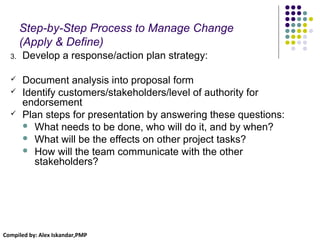
Step-by-Step Process to Manage Change
(Apply & Define)
3. Develop a response/action plan strategy:
 Document analysis into proposal form
 Identify customers/stakeholders/level of authority for
endorsement
 Plan steps for presentation by answering these questions:
 What needs to be done, who will do it, and by when?
 What will be the effects on other project tasks?
 How will the team communicate with the other
stakeholders?
Compiled by: Alex Iskandar,PMP
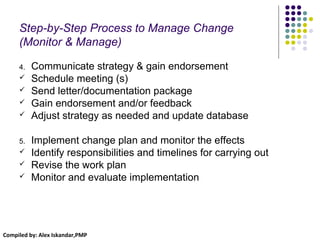
Step-by-Step Process to Manage Change
(Monitor & Manage)
4. Communicate strategy & gain endorsement
 Schedule meeting (s)
 Send letter/documentation package
 Gain endorsement and/or feedback
 Adjust strategy as needed and update database
5. Implement change plan and monitor the effects
 Identify responsibilities and timelines for carrying out
 Revise the work plan
 Monitor and evaluate implementation
Compiled by: Alex Iskandar,PMP
 Project Change Management is just a processProject Change Management is just a process
and tools,and tools, People involvementPeople involvement is the focus ofis the focus of
project successproject success
People contributionPeople contribution and proactively to inform anyand proactively to inform any
changes (Scope, Trends) definitely requires forchanges (Scope, Trends) definitely requires for
Project Changes Management systemProject Changes Management system
implementation successfully.implementation successfully.
Simplicity to see the process, allSimplicity to see the process, all tools can betools can be
utilized, the main key isutilized, the main key is GOOD DOCUMENTATIONGOOD DOCUMENTATION..
Challenge and Recommendation

Project Scope Change Management

  • 1.
    Project Scope Change Management Basicapproach to Manage Changes with Project Risk Management
  • 2.
    Compiled by: AlexIskandar,PMP Why Changes ?  These days change is a constant, there is always something changing somewhere for some reason.  It is almost impossible to work anywhere without going through some type of change.  Change isn't a “bad” or a “god” thing  In today's business world change is necessary to survive.  However, if not executed properly change can be damaging, it can negatively impact to the project.
  • 3.
    Compiled by: AlexIskandar,PMP What is Change Management ?  Change management is a structured approach to transitioning individuals, teams, and organizations from a current state to a desired future state. Change management (or change control) is the process during which the changes of a system are implemented in a controlled manner by following a pre-defined framework/model with, to some extent, reasonable modifications [1].  In project management, change management refers to a project management process where changes to a project are formally introduced and approved.[2]. http://en.wikipedia.org/wiki/Change_management
  • 4.
    Compiled by: AlexIskandar,PMP Change is a constant feature of projects  Knowing how to handle changes and requests for changes is vital to delivering any project on time.  Change control is the essence of good project management  Properly estimating the impact of a requested change and communicating that impact in a clear way is vital to the success of any project.  Project Team must know:  Why a change is needed (business case)  What we are changing (scope)  How long the change will take (schedule)  How much the change will cost (cost estimate)
  • 5.
    Compiled by: AlexIskandar,PMP Changes Management as part of Project Control & Monitoring
  • 6.
    Compiled by: AlexIskandar,PMP Control and Monitor is: Control is:  Noun  an act or instance of controlling; also : power or authority to guide or manage  Verb  to check, test, or verify by evidence or experiments , to exercise restraining or directing influence over Monitor is:  Noun  a person who has the job of watching or noticing particular things  Verb  to watch, keep track of, or check usually for a special purpose
  • 7.
    Compiled by: AlexIskandar,PMP PMBOK® Project Management Process
  • 8.
    Compiled by: AlexIskandar,PMP Scope Management: Scope Planning Scope Definition Create WBS Scope Verification Scope Change Control
  • 9.
    Compiled by: AlexIskandar,PMP Project Process “Max Wideman”
  • 10.
    Compiled by: AlexIskandar,PMP Project Life Cycle: Time Distribution of Project Effort  Conception  Selection  Planning, scheduling, monitoring, control  Evolution and termination
  • 11.
    Compiled by: AlexIskandar,PMP Generic Phase Gates Stage-Gate Project-Management Process in the Oil and Gas Industry – by G.W. Walkup Jr., SPE, SDG, and J.R. Ligon, SPE, http://www.spe.org/spe-site/spe/spe/jpt/2006/12/Syn102926.pdf
  • 12.
    Compiled by: AlexIskandar,PMP AACE COST ESTIMATE CLASSIFICATION http://www.aacei.org/technical/rps/17r-97.pdf
  • 13.
    Compiled by: AlexIskandar,PMP What is Contingency? http://www.maxwideman.com/pmglossary/PMG_C07.htm  As a result of risk analysis sums of money or amounts of time may be set aside as contingency which may be used in the event of risks occurring.  A Contingency is the planned allotment of time and cost for unforeseeable elements with a project. Including contingencies will increase the confidence of the overall project.  An amount of design margin, time, or money inserted into the corresponding plan as a safety factor to accommodate unexpected and presently unknown occurrences that judgment suggests will occur during the project.
  • 14.
    Compiled by: AlexIskandar,PMP What is Contingency Plan http://en.wikipedia.org/wiki/Contingency_plan • A Contingency plan is a plan devised for a specific situation when things could go wrong. Contingency plans are often devised by governments or businesses who want to be prepared for anything that could happen. They are sometimes known as "Back-up plans", "Worst-case scenario plans", "Scrap Situation" or "Plan B" .  Contingency plans include specific strategies and actions to deal with specific variances to assumptions resulting in a particular problem, emergency or state of affairs. They also include a monitoring process and “triggers” for initiating planned actions. They are required to help governments, businesses or individuals to recover from serious incidents in the minimum time with minimum cost and disruption. http://www.maxwideman.com/pmglossary/PMG_C07.htm  A Contingency Plan is fallback position, or workaround in the event of an adverse occurrence, or risk event, on the project.  A plan that identifies key assumptions beyond the project manager's control, and their probability of occurrence. The plan identifies alternative strategies for achieving project success.
  • 15.
    Compiled by: AlexIskandar,PMP Where is the Contingency Plan allocated in the Risk Management Process ? CONTINGENCY PLAN
  • 16.
    Compiled by: AlexIskandar,PMP How to Manage Changes Manage with Changes & Risks Possible outcomes for each risk  Take action to avoid the risk, reduce its likelihood, or reduce its impact,  Make contingency plans and deal with the impact and mitigate the risk should it occur,  Agree that it is an acceptable business risk to take no action and hope that the risk does not occur. Do not wait for situations to come up before you address them
  • 17.
    Compiled by: AlexIskandar,PMP How to Planning Contingency Risk Management and Contingency Planning http://ahds.ac.uk/creating/information-papers/risk-management/ Planning a Risk Response 1. Types of Risk Response • Avoidance • Adopting • Reduction • Transfer • Deferral • Retention 2. Choosing the right response 3. Contingency Plans • How to Calculating Contingency http://www.jiscinfonet.ac.uk/InfoKits/risk-management/calculating-contingency Contingency should be shown in the plan as a separate item and not hidden in activities as "an extra 10%" on duration or cost.
  • 18.
    Compiled by: AlexIskandar,PMP Planning Process Sample of Risk Assessment Result
  • 19.
    Compiled by: AlexIskandar,PMP Probabilistic Planning  P10 Estimate – a 10% chance that the project cost/schedule will be less than or equal to the estimate total and a 90% chance that the project cost/schedule will be greater than the cost estimate total.  P50 Estimate – a 50% chance that the project cost/schedule will be less than or equal to the estimate total and a 50% chance that the project cost/schedule will be greater than the cost estimate total.  P90 Estimate – a 90% chance that the project cost will be less than or equal to the estimate total and a 10% chance that the project cost/schedule will be greater than the cost/schedule estimate total. http://bora.nhh.no/bitstream/2330/511/1/R30_01.pdf http://www.cooperenergy.com.au/cooper-pdf/Cumulative%20Probability%20P90%20P50%20P10.pdf
  • 20.
    Compiled by: AlexIskandar,PMP COST PROBABILITY CURVE (S-CURVE)  LEVEL PROBABILITY VS COST ESTIMATE A D B CE P90 P70 P50 P35 P10 A : Value P10 B : Value P50 C : Value P90 D : Deterministic Estimate E : Deterministic By PM Deterministic Estimate (Including Allowance) Contingency P50 – Determin. Estimate COST P Sample
  • 21.
    Compiled by: AlexIskandar,PMP We have noted the following keys:  Changes  Changes Management  Project Life Cycle  Contingency  Risk Management  Scope Changes & Trends Now going to enter on how to at the implementation (Execution / EPC Phase) :
  • 22.
    Compiled by: AlexIskandar,PMP Effective Planning Of EPC Contracts
  • 23.
    Compiled by: AlexIskandar,PMP http://i.treehugger.com/images/2007/10/24/change_order-1.jpg
  • 24.
    Compiled by: AlexIskandar,PMP
  • 25.
    Compiled by: AlexIskandar,PMP Change Management / Risk Management Flow Diagrams Identify Risk / Changes Analyse Probability and Impact Apply Avoidance or Reduction Define Contingency Plans Monitor & Manage http://www.epmbook.com/risk.htm
  • 26.
    Compiled by: AlexIskandar,PMP Step-by-Step Process to Manage Change (Identify) 1. Identify source and nature of the change:  Determine the type of change (work plan, schedule, technical, etc.)  Determine the potential impact and process (formal/informal)  Document origin of change (who initiated it, what precipitated it)  Identify potentially effected customers and suppliers  Identify who should lead the analysis/rest of process  Communicate potential to rest of team as needed
  • 27.
    Compiled by: AlexIskandar,PMP Step-by-Step Process to Manage Change (Analyze) 2. Analyze the effects of the change  How does it relate to purpose/mission?  Compare change against the current process  Quantify the change (how much, how long, how much risk)  Cause-effect analysis  Brainstorm, analyze, and prioritize strategies  Identify impacts against agreed upon requirements  Access profound knowledge
  • 28.
    Compiled by: AlexIskandar,PMP Step-by-Step Process to Manage Change (Apply & Define) 3. Develop a response/action plan strategy:  Document analysis into proposal form  Identify customers/stakeholders/level of authority for endorsement  Plan steps for presentation by answering these questions:  What needs to be done, who will do it, and by when?  What will be the effects on other project tasks?  How will the team communicate with the other stakeholders?
  • 29.
    Compiled by: AlexIskandar,PMP Step-by-Step Process to Manage Change (Monitor & Manage) 4. Communicate strategy & gain endorsement  Schedule meeting (s)  Send letter/documentation package  Gain endorsement and/or feedback  Adjust strategy as needed and update database 5. Implement change plan and monitor the effects  Identify responsibilities and timelines for carrying out  Revise the work plan  Monitor and evaluate implementation
  • 30.
    Compiled by: AlexIskandar,PMP  Project Change Management is just a processProject Change Management is just a process and tools,and tools, People involvementPeople involvement is the focus ofis the focus of project successproject success People contributionPeople contribution and proactively to inform anyand proactively to inform any changes (Scope, Trends) definitely requires forchanges (Scope, Trends) definitely requires for Project Changes Management systemProject Changes Management system implementation successfully.implementation successfully. Simplicity to see the process, allSimplicity to see the process, all tools can betools can be utilized, the main key isutilized, the main key is GOOD DOCUMENTATIONGOOD DOCUMENTATION.. Challenge and Recommendation

Editor's Notes

  • #20 Hint: Possible exam answers on this slide Can use analogy of “over/under” in sports betting Compare and contrast the three P10 – we have little chance of meeting P90 – leaves money on the table, ties money up, doesn’t allow us to pursue as many other opportunities P50 – our magic number, what the board wants to see, half of our projects come in under and half are over
  • #23 Clearly identifying the original scope and describing it clearly to the WDS Dictionary and the Control Account Plans will help to minimize changes. Particularly Informal changes.