Risk Management
Badar Ali 12015098-001
Ali Ahmed 12015098-023
Hamza Mukhtar 12015098-053
Hassan Mir 12015098-105
Risk……!!!!
According PMI:
“ An uncertain event or condition that,
if it occurs, has a positive or negative
effect on a project’s objectives ”.
Characteristics of risk:
Uncertainty – the risk may or may not happen,
that is, there are no 100% risks
Loss – the risk becomes a reality and unwanted
consequences or losses occur
Risk……!!!!
Risk Management
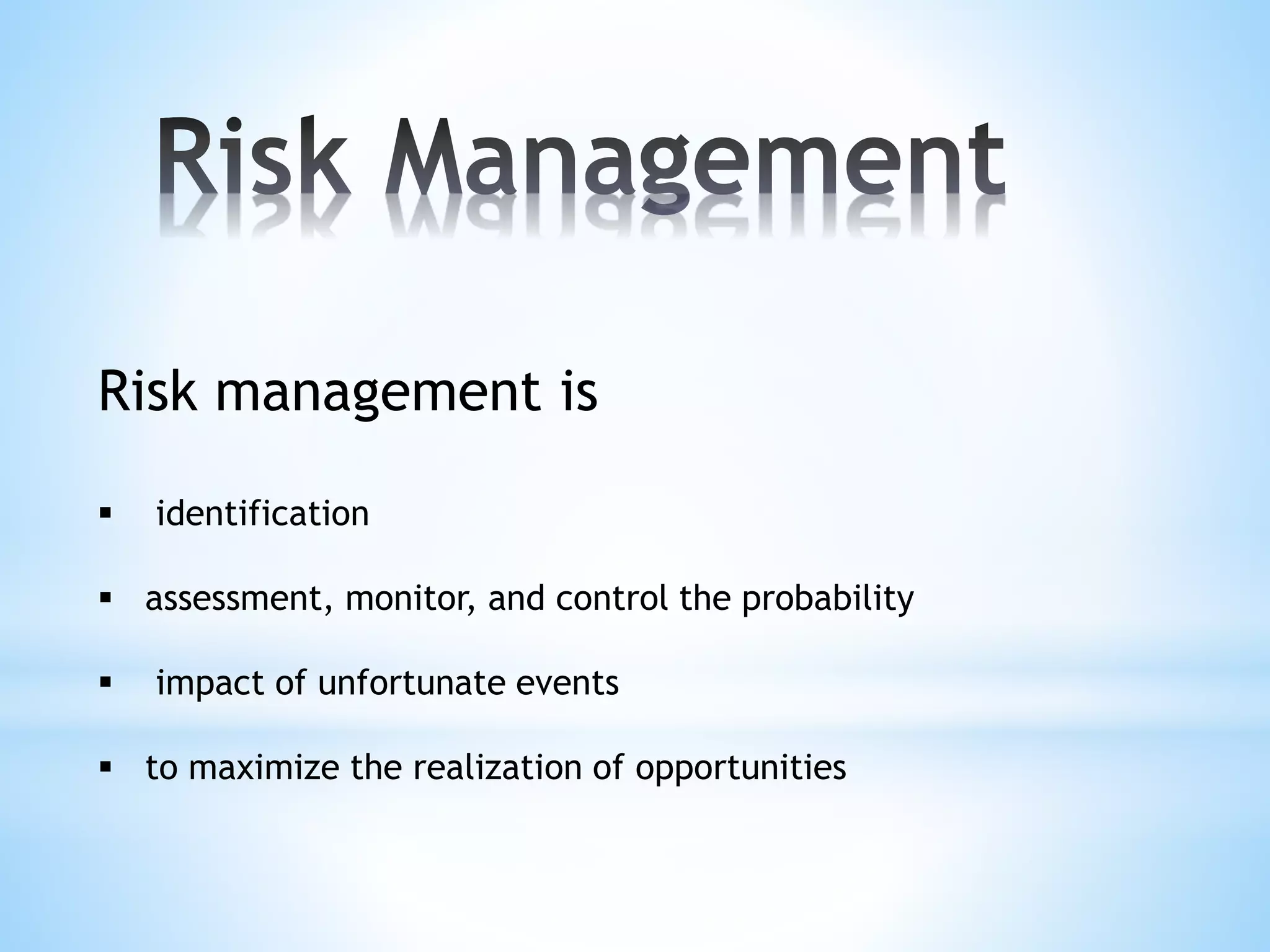
Risk management is
 identification
 assessment, monitor, and control the probability
 impact of unfortunate events
 to maximize the realization of opportunities
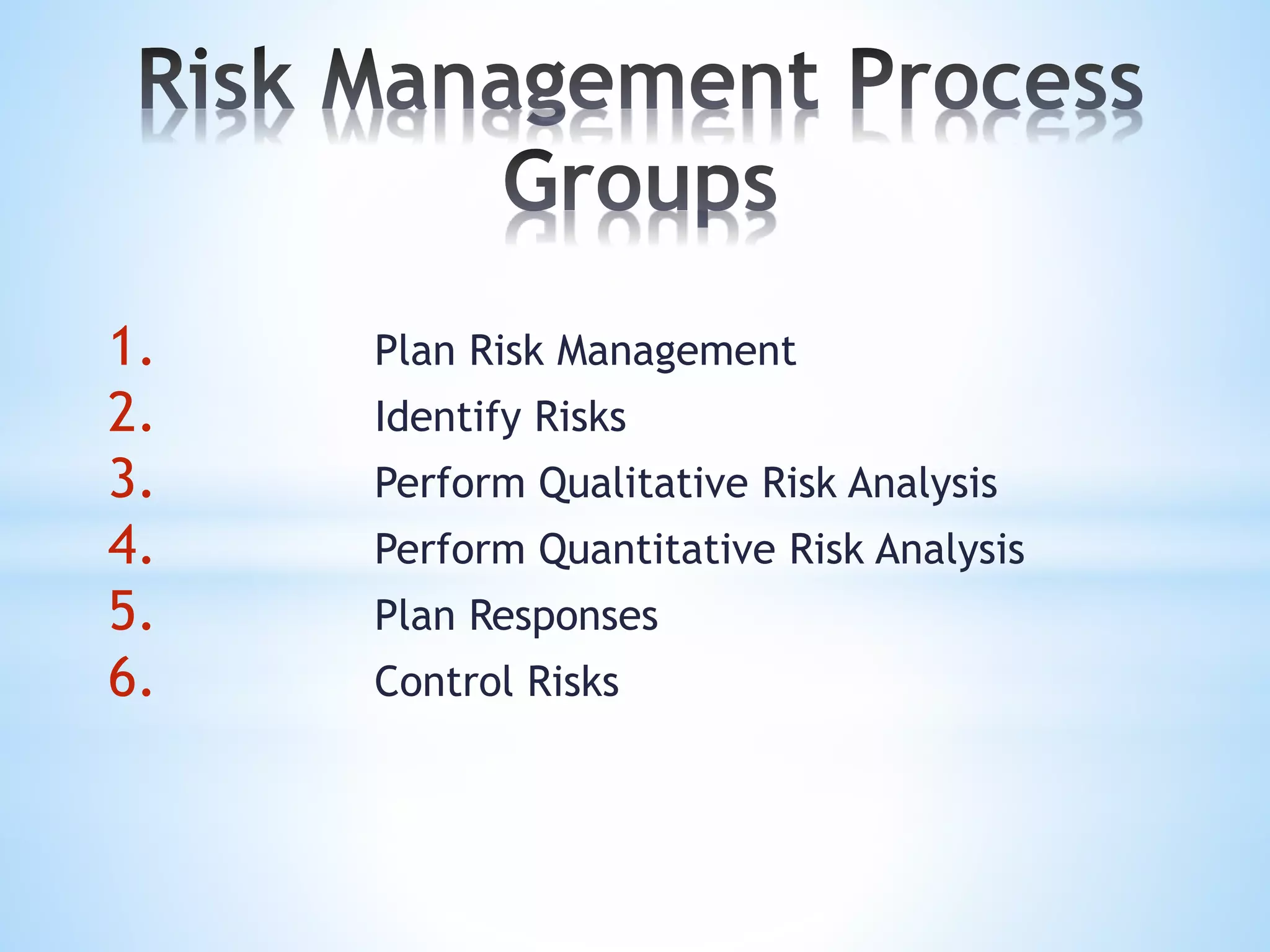
Risk Management process groups
1. Plan Risk Management
2. Identify Risks
3. Perform Qualitative Risk Analysis
4. Perform Quantitative Risk Analysis
5. Plan Responses
6. Control Risks
 Planning process with the risk management plan as its sole output
 Understand the general level of risks your project faces
 Project team or organizational tolerance for risk
 Domain Tasks:
 Identifying, analyzing
 Defining risk response strategies
 To manage uncertainty throughout the project life cycle
Project Management Plan process:
 Project charter
 Stakeholder register
 Enterprise environmental factors
 Organizational process assets
 Tools and techniques
 analytical techniques
 Expert judgment
 Meetings
Risk management plan:
o The particular risk methodology and approach to be taken on the
project
o The individual roles and responsibilities within the team and the wider
group of stakeholders
o Any approved budgets for managing risk, which should then be included
in the cost performance baseline
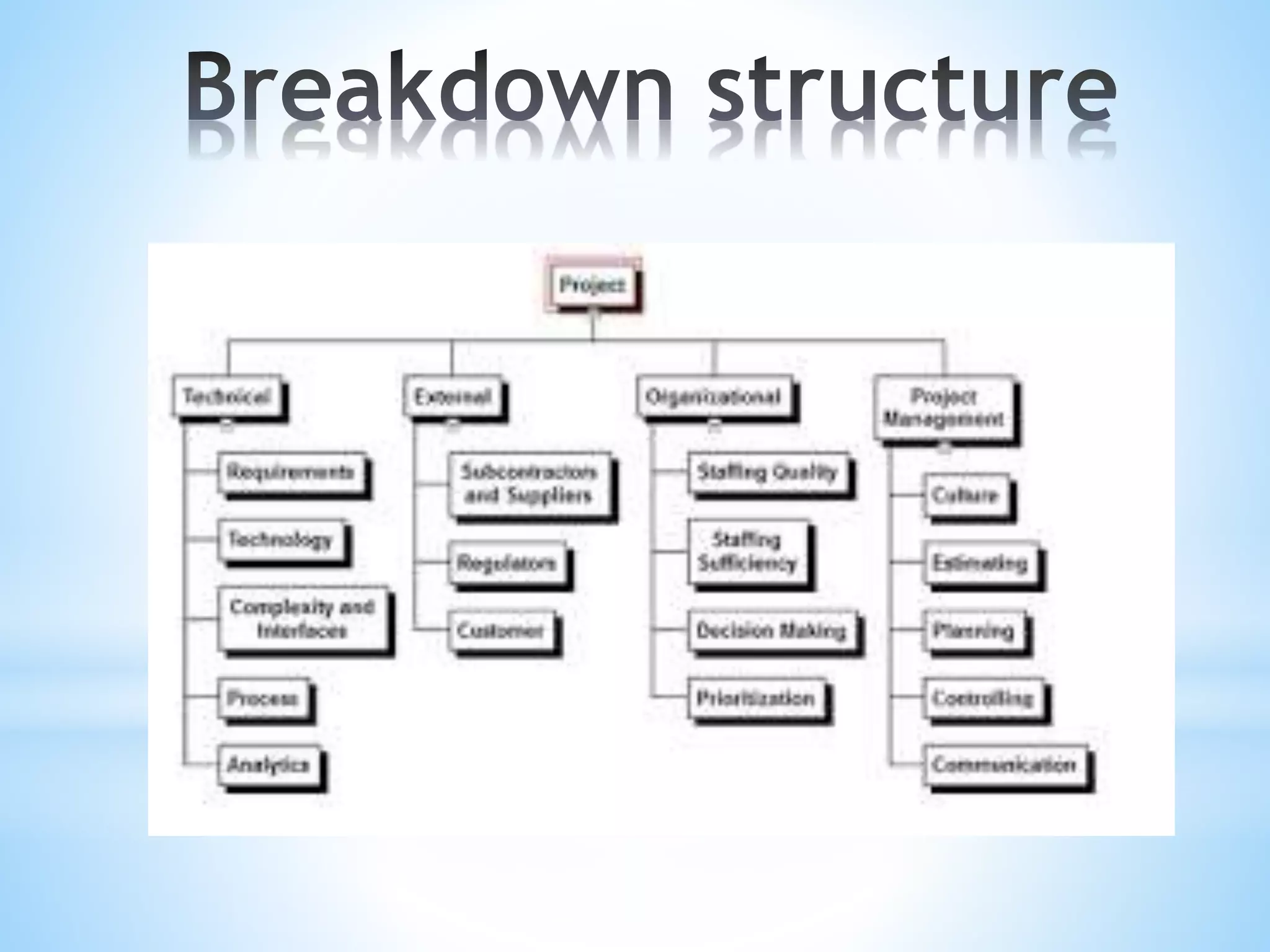
o An initial analysis of the individual risk categories using a risk
breakdown structure
 Uses a wide variety of inputs and tools and techniques to
identify all the risks to the project
 Performed
1. Through the life of the project
2. The risk register is always updated with newly identified risks
current risks that are reassessed by using the other risk planning
processes
 Risk management plan
 Cost management plan
 Schedule management plan
 Quality management plan
 Human resource management plan
 Scope baseline
 Activity cost estimates
 Activity duration estimates
 Stakeholder register
 Project documents
 Procurement documents
 Enterprise environmental factors
 Organizational process assets
 Tools and techniques
I. Documentation reviews
II. Information-gathering techniques
III. Checklist analysis
IV. assumptions analysis
V. Diagramming techniques
VI. SWOT analysis
VII. Expert judgment
o Risk register:
• risk register is highly iterative
• risk register itself should be treated as a live document and
reviewed regularly
• reviewed at all levels
• risk register will take many forms depending on your
organizational risk tolerance and any existing templates
and guidelines
 Focused
 on assigning a qualitative
 subjective
 analysis of probability
 impact to all identified risks
 done on all identified risks
 quick and easy
 Risk management plan
 Scope baseline
 Risk register
 Enterprise environmental factors
 Organizational process assets
 Tools and techniques
 Tools and techniques:
i. risk probability and impact assessment
ii. Probability and impact matrix
iii. risk data quality assessment
iv. risk categorization
v. risk urgency assessment
vi. Expert judgment
o Project documents updates:
• Risk Register
• Assumptions Log
 Focused:
o development of a quantitative objective
o assessment of individual risk probability impact
o by using a metric based on money or time
 Tools and techniques
 Data gathering and representation techniques
 Quantitative risk analysis and modeling techniques
Sensitivity analysis
Tornado diagrams
Expected monetary value analysis (EMV)
Modeling and simulation
 Expert judgment
o Project documents updates:
 updated the risk register
 includes quantitative probabilities of individual risks
 quantitative impacts of individual risks in terms of both cost
and time
 subsequently a prioritized list of quantified risks.
Qualitative: risk-level
Quantitative: project-level
Qualitative: subjective evaluation of probability and impact
Quantitative: probabilistic estimates of time and cost
Qualitative: quick and easy to perform
Quantitative: time consuming
Qualitative: no special software or tools required
Quantitative: may require specialized tools
o Focused on the development of proactive responses to
risks
o Minimizing the potential effects of negative risk
o Maximizing the potential benefits of positive risk on a
project
o Considers responses to unplanned or unforeseen risks
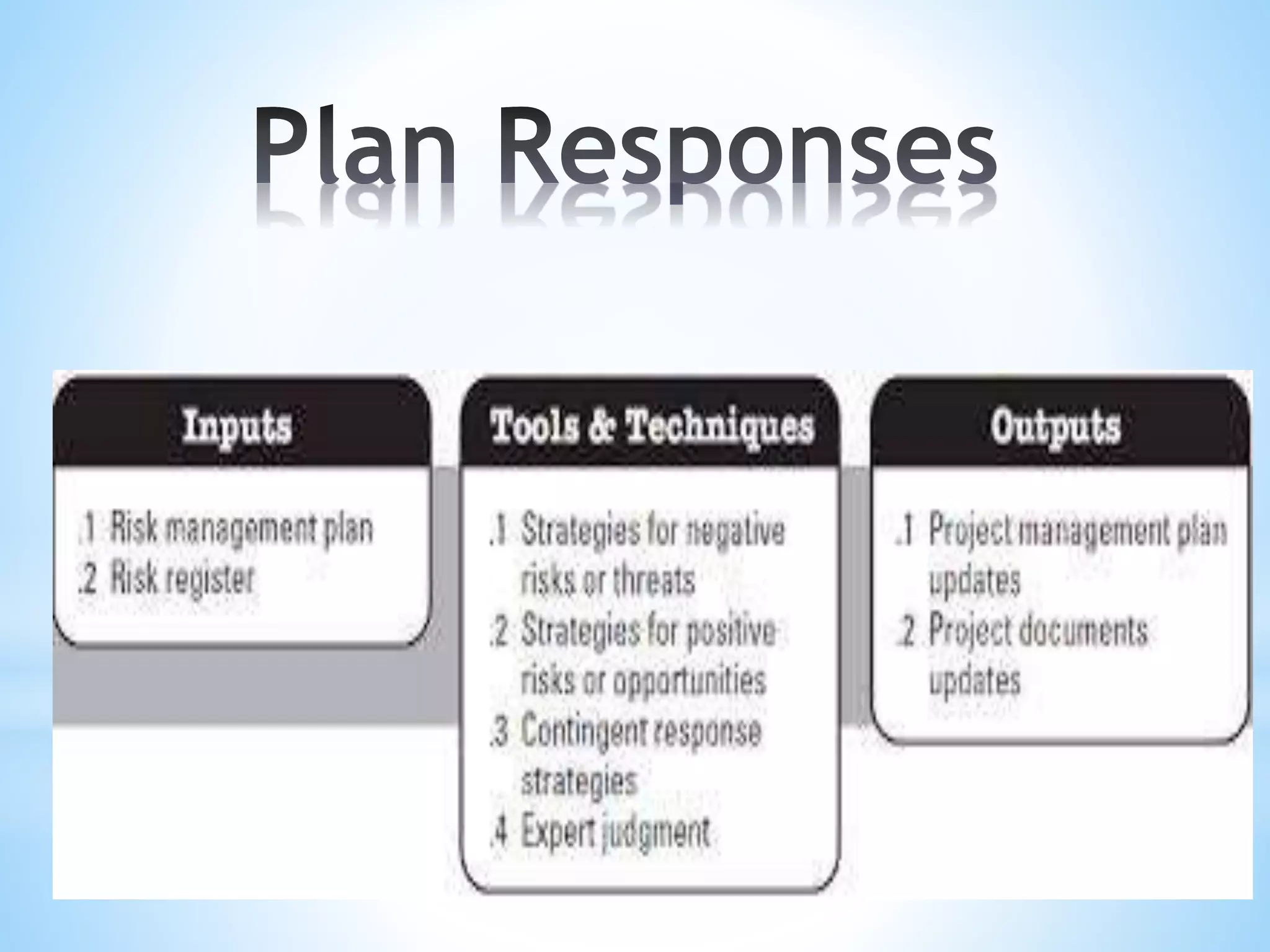
 risk management plan
 risk register
 Tools and techniques
Strategies for negative risks or threats
Strategies for positive risks or opportunities
Contingent response strategies
o Project management plan updates
Project documents updates
revisit these foundational documents
o Project documents updates
updated the risk register and the assumptions log
• Focused on monitoring and controlling the project
• Accordance with the risk management plan and the information
contained within the risk register
• Control Risks process checks the implementation of the plan
• Like other monitoring and controlling processes
• looking out for any variance between what risks you had planned
and what risks are occurring
• New risks, and any new information affecting already identified
risks, and evaluating the overall risk process
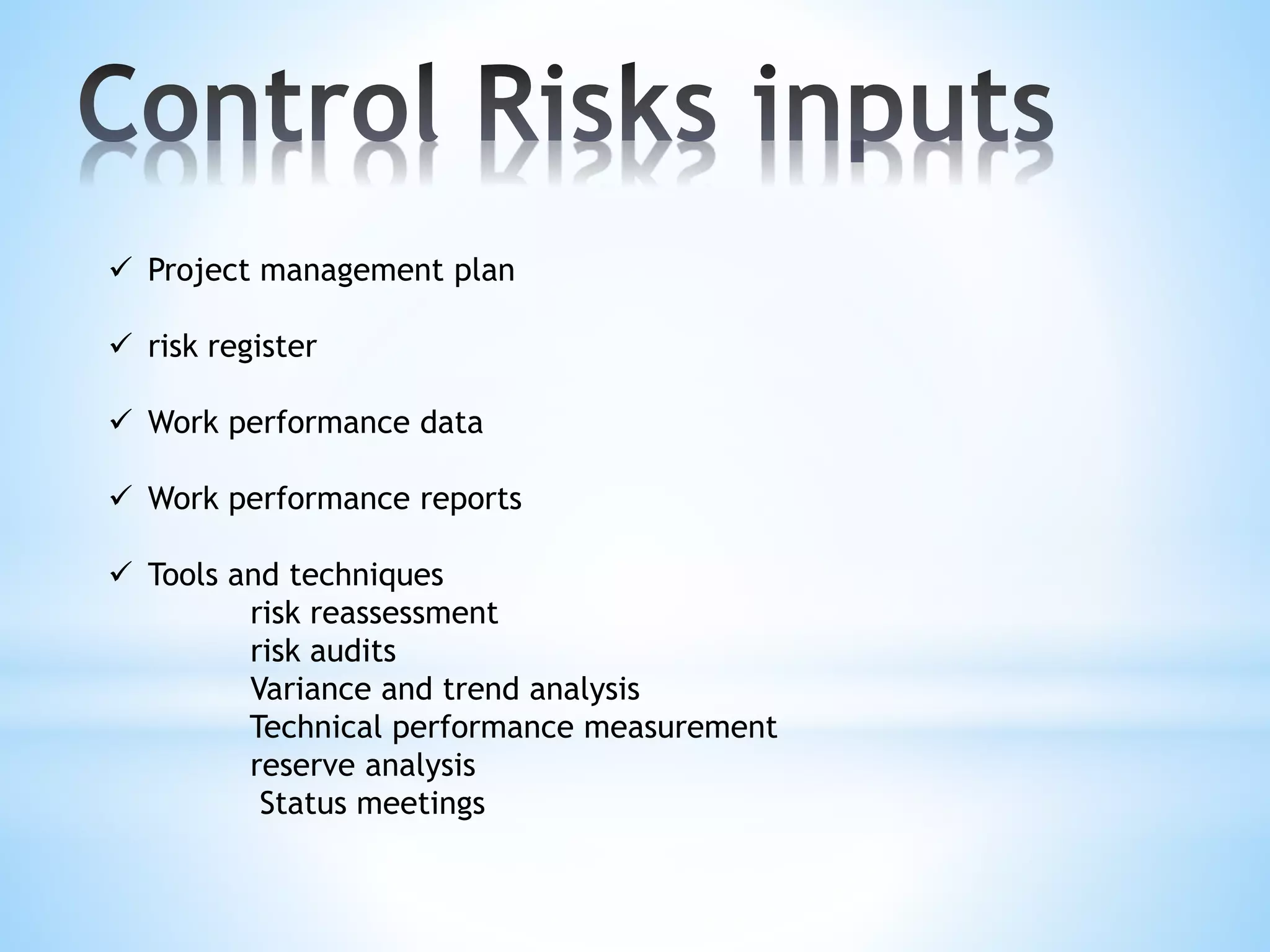
 Project management plan
 risk register
 Work performance data
 Work performance reports
 Tools and techniques
risk reassessment
risk audits
Variance and trend analysis
Technical performance measurement
reserve analysis
Status meetings
o Work performance information
o Change requests
o Project management plan updates
o Project documents updates
o Organizational process assets updates
Risk
Risk management
Risk Management process groups
1. Plan Risk Management
2. Identify Risks
3. Perform Qualitative Risk Analysis
4. Perform Quantitative Risk Analysis
5. Plan Responses
6. Control Risks
Risk management

Risk management

  • 1.
  • 2.
    Badar Ali 12015098-001 AliAhmed 12015098-023 Hamza Mukhtar 12015098-053 Hassan Mir 12015098-105
  • 4.
  • 5.
    According PMI: “ Anuncertain event or condition that, if it occurs, has a positive or negative effect on a project’s objectives ”. Characteristics of risk: Uncertainty – the risk may or may not happen, that is, there are no 100% risks Loss – the risk becomes a reality and unwanted consequences or losses occur Risk……!!!!
  • 6.
  • 7.
    Risk management is identification  assessment, monitor, and control the probability  impact of unfortunate events  to maximize the realization of opportunities
  • 8.
  • 9.
    1. Plan RiskManagement 2. Identify Risks 3. Perform Qualitative Risk Analysis 4. Perform Quantitative Risk Analysis 5. Plan Responses 6. Control Risks
  • 10.
     Planning processwith the risk management plan as its sole output  Understand the general level of risks your project faces  Project team or organizational tolerance for risk  Domain Tasks:  Identifying, analyzing  Defining risk response strategies  To manage uncertainty throughout the project life cycle
  • 11.
    Project Management Planprocess:  Project charter  Stakeholder register  Enterprise environmental factors  Organizational process assets  Tools and techniques  analytical techniques  Expert judgment  Meetings
  • 12.
    Risk management plan: oThe particular risk methodology and approach to be taken on the project o The individual roles and responsibilities within the team and the wider group of stakeholders o Any approved budgets for managing risk, which should then be included in the cost performance baseline o An initial analysis of the individual risk categories using a risk breakdown structure
  • 14.
     Uses awide variety of inputs and tools and techniques to identify all the risks to the project  Performed 1. Through the life of the project 2. The risk register is always updated with newly identified risks current risks that are reassessed by using the other risk planning processes
  • 15.
     Risk managementplan  Cost management plan  Schedule management plan  Quality management plan  Human resource management plan  Scope baseline  Activity cost estimates  Activity duration estimates
  • 16.
     Stakeholder register Project documents  Procurement documents  Enterprise environmental factors  Organizational process assets  Tools and techniques I. Documentation reviews II. Information-gathering techniques III. Checklist analysis IV. assumptions analysis V. Diagramming techniques VI. SWOT analysis VII. Expert judgment
  • 17.
    o Risk register: •risk register is highly iterative • risk register itself should be treated as a live document and reviewed regularly • reviewed at all levels • risk register will take many forms depending on your organizational risk tolerance and any existing templates and guidelines
  • 18.
     Focused  onassigning a qualitative  subjective  analysis of probability  impact to all identified risks  done on all identified risks  quick and easy
  • 20.
     Risk managementplan  Scope baseline  Risk register  Enterprise environmental factors  Organizational process assets  Tools and techniques
  • 21.
     Tools andtechniques: i. risk probability and impact assessment ii. Probability and impact matrix iii. risk data quality assessment iv. risk categorization v. risk urgency assessment vi. Expert judgment
  • 22.
    o Project documentsupdates: • Risk Register • Assumptions Log
  • 23.
     Focused: o developmentof a quantitative objective o assessment of individual risk probability impact o by using a metric based on money or time
  • 26.
     Tools andtechniques  Data gathering and representation techniques  Quantitative risk analysis and modeling techniques Sensitivity analysis Tornado diagrams Expected monetary value analysis (EMV) Modeling and simulation  Expert judgment
  • 27.
    o Project documentsupdates:  updated the risk register  includes quantitative probabilities of individual risks  quantitative impacts of individual risks in terms of both cost and time  subsequently a prioritized list of quantified risks.
  • 28.
    Qualitative: risk-level Quantitative: project-level Qualitative:subjective evaluation of probability and impact Quantitative: probabilistic estimates of time and cost Qualitative: quick and easy to perform Quantitative: time consuming Qualitative: no special software or tools required Quantitative: may require specialized tools
  • 29.
    o Focused onthe development of proactive responses to risks o Minimizing the potential effects of negative risk o Maximizing the potential benefits of positive risk on a project o Considers responses to unplanned or unforeseen risks
  • 31.
     risk managementplan  risk register  Tools and techniques Strategies for negative risks or threats Strategies for positive risks or opportunities Contingent response strategies
  • 32.
    o Project managementplan updates Project documents updates revisit these foundational documents o Project documents updates updated the risk register and the assumptions log
  • 33.
    • Focused onmonitoring and controlling the project • Accordance with the risk management plan and the information contained within the risk register • Control Risks process checks the implementation of the plan • Like other monitoring and controlling processes • looking out for any variance between what risks you had planned and what risks are occurring • New risks, and any new information affecting already identified risks, and evaluating the overall risk process
  • 34.
     Project managementplan  risk register  Work performance data  Work performance reports  Tools and techniques risk reassessment risk audits Variance and trend analysis Technical performance measurement reserve analysis Status meetings
  • 35.
    o Work performanceinformation o Change requests o Project management plan updates o Project documents updates o Organizational process assets updates
  • 36.
    Risk Risk management Risk Managementprocess groups 1. Plan Risk Management 2. Identify Risks 3. Perform Qualitative Risk Analysis 4. Perform Quantitative Risk Analysis 5. Plan Responses 6. Control Risks

Editor's Notes

  • #11 The Plan Risk Management process covers the following domain tasks: Plan risk management by developing a risk management plan, and identifying, analyzing, and prioritizing project risks in the risk register and defining risk response strategies, in order to manage uncertainty throughout the project life cycle.
  • #15 The Identify Risks process covers the following domain task: Plan risk management by developing a risk management plan, and identifying, analyzing, and prioritizing project risks in the risk register and defining risk response strategies, in order to manage uncertainty throughout the project life cycle.