Pervasive, Human Centered Computing
Overview of Project Oxygen
Device technologies
Network technologies
Software technologies
Perpetual technologies
User technologies
Oxygen Today
Conclusion
What is Project Oxygen
 The idea of the project is to make computation
human centered and responsive to human needs
rather than having people catering to expensive
machine
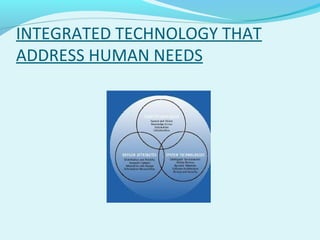
INTEGRATED TECHNOLOGY THAT
ADDRESS HUMAN NEEDS
Vision
 In the future, computation will be human-centered.
 It will be freely available everywhere, like batteries and
power sockets, or oxygen in the air we breathe.
 It will enter the human world, handling our goals and
needs and helping us to do more while doing less.
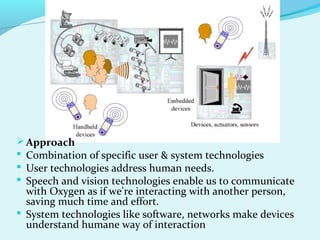
Approach
 Combination of specific user & system technologies
 User technologies address human needs.
 Speech and vision technologies enable us to communicate
with Oxygen as if we're interacting with another person,
saving much time and effort.
 System technologies like software, networks make devices
understand humane way of interaction
Space centered computation, embedded in ordinary
environment
 Connected to sensors, suitably encapsulated into physical
objects
 Communicate with each other and nearby handheld
devices (H21)through Dynamically Configured Networks
(N21)
 E21 provide computational power throughout the system
 E21 software is robust, and configurable among
themselves
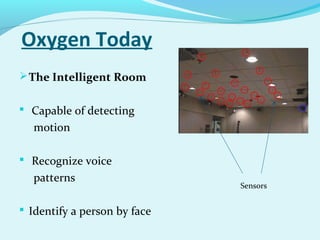
Oxygen Today
The Intelligent Room
 Capable of detecting
motion
 Recognize voice
patterns
 Identify a person by face
Sensors
Generic devices also called Universal Personal Appliances
 They configure themselves according to the person using
them
 Being small and lightweight, they have few transducers
 They have less computational power than E21
 Can be configured to be used as radio, cellphone or even
TV
 Power efficient, the software controls the power
consumption
 E21(Embedded devices ) Intelligent Spaces
 Space centered computation, embedded in ordinary
environment
 Populated by cameras, microphones, displays, sound output
 Controls for physical entities like curtains, lighting, door-locks
 People interact in Intelligent Spaces naturally, using speech,
gestures
 H21(Handheld devices) Mobile Devices
 Person centered devices also the Universal Personal Appliances
 Equipped with perpetual transducers such as microphone,
speakers
 Auto reconfigurable, light weight, inexpensive
 Anonymous generic devices
Networks make it easy to establish ad-hoc collaborating
communities of
 computer devices
 Through algorithms, protocols and middleware, they
 Configure collaborative regions automatically
 Create topologies and adapt them to change
 Provide automatic resource and location discovery
 Provide secure, authenticated and private access
N21 networks use intentional names rather than
conventional static names
They support location discovery through proximity
Software systems adapt - to user, to environment, to
change, to failure
 Project Oxygen's software architecture provides
mechanisms for
 Building applications using distributed components
 Customizing, adapting and altering component behavior
 Person-centric rather than device-centric security
 Disconnected operation and nomadic code
 Eternal Computation: The system must never shut
down or reboot
though components are upgraded, removed and
reinstalled
Two kinds of perpetual techniques
 Spoken Interaction
● Users and machine engage in interactive
conversations
● Highly efficient
 Visual Interaction
● User interacts with perpetual modalities
● Use of body language and gestures
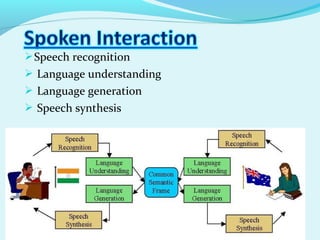
Speech recognition
 Language understanding
 Language generation
 Speech synthesis
 It consists of
 Visual perception subsystem, and
 It recognizes and classify objects and actions
 Complements spoken language subsystem
 Visual rendering subsystem
 Creates 3D scenes from 2D data
 Provide macroscopic view of application supplied
data
 User Technologies include
 Knowledge Access
 Access any time, anywhere, almost anything
 Automation
 Automate control of physical environment
 Collaboration
 Connecting people
ADVANTAGES
Pervasiveness
Ease of use
Personalized data storage and access
Security
Elimination of need to carry around communication
CHALLENGES
To support highly dynamic and varied human activities,
the Oxygen system must master many technical
challenges. It must be-
 embedded
 nomadic
 adaptable
 powerful, yet efficient
 intentional
 eternal
 Bringing abundant computation and communication,
as pervasive as free air, naturally into people's life
 Commercial versions of H21 are ready to be launched
 The E21 and N21 will soon be spread everywhere, not
just the labs
Project Oxygen

Project Oxygen

  • 2.
    Pervasive, Human CenteredComputing Overview of Project Oxygen Device technologies Network technologies Software technologies Perpetual technologies User technologies Oxygen Today Conclusion
  • 3.
    What is ProjectOxygen  The idea of the project is to make computation human centered and responsive to human needs rather than having people catering to expensive machine
  • 4.
  • 6.
    Vision  In thefuture, computation will be human-centered.  It will be freely available everywhere, like batteries and power sockets, or oxygen in the air we breathe.  It will enter the human world, handling our goals and needs and helping us to do more while doing less.
  • 7.
    Approach  Combination ofspecific user & system technologies  User technologies address human needs.  Speech and vision technologies enable us to communicate with Oxygen as if we're interacting with another person, saving much time and effort.  System technologies like software, networks make devices understand humane way of interaction
  • 8.
    Space centered computation,embedded in ordinary environment  Connected to sensors, suitably encapsulated into physical objects  Communicate with each other and nearby handheld devices (H21)through Dynamically Configured Networks (N21)  E21 provide computational power throughout the system  E21 software is robust, and configurable among themselves
  • 9.
    Oxygen Today The IntelligentRoom  Capable of detecting motion  Recognize voice patterns  Identify a person by face Sensors
  • 10.
    Generic devices alsocalled Universal Personal Appliances  They configure themselves according to the person using them  Being small and lightweight, they have few transducers  They have less computational power than E21  Can be configured to be used as radio, cellphone or even TV  Power efficient, the software controls the power consumption
  • 11.
     E21(Embedded devices) Intelligent Spaces  Space centered computation, embedded in ordinary environment  Populated by cameras, microphones, displays, sound output  Controls for physical entities like curtains, lighting, door-locks  People interact in Intelligent Spaces naturally, using speech, gestures  H21(Handheld devices) Mobile Devices  Person centered devices also the Universal Personal Appliances  Equipped with perpetual transducers such as microphone, speakers  Auto reconfigurable, light weight, inexpensive  Anonymous generic devices
  • 12.
    Networks make iteasy to establish ad-hoc collaborating communities of  computer devices  Through algorithms, protocols and middleware, they  Configure collaborative regions automatically  Create topologies and adapt them to change  Provide automatic resource and location discovery  Provide secure, authenticated and private access N21 networks use intentional names rather than conventional static names They support location discovery through proximity
  • 13.
    Software systems adapt- to user, to environment, to change, to failure  Project Oxygen's software architecture provides mechanisms for  Building applications using distributed components  Customizing, adapting and altering component behavior  Person-centric rather than device-centric security  Disconnected operation and nomadic code  Eternal Computation: The system must never shut down or reboot though components are upgraded, removed and reinstalled
  • 14.
    Two kinds ofperpetual techniques  Spoken Interaction ● Users and machine engage in interactive conversations ● Highly efficient  Visual Interaction ● User interacts with perpetual modalities ● Use of body language and gestures
  • 15.
    Speech recognition  Languageunderstanding  Language generation  Speech synthesis
  • 16.
     It consistsof  Visual perception subsystem, and  It recognizes and classify objects and actions  Complements spoken language subsystem  Visual rendering subsystem  Creates 3D scenes from 2D data  Provide macroscopic view of application supplied data
  • 17.
     User Technologiesinclude  Knowledge Access  Access any time, anywhere, almost anything  Automation  Automate control of physical environment  Collaboration  Connecting people
  • 18.
    ADVANTAGES Pervasiveness Ease of use Personalizeddata storage and access Security Elimination of need to carry around communication
  • 19.
    CHALLENGES To support highlydynamic and varied human activities, the Oxygen system must master many technical challenges. It must be-  embedded  nomadic  adaptable  powerful, yet efficient  intentional  eternal
  • 20.
     Bringing abundantcomputation and communication, as pervasive as free air, naturally into people's life  Commercial versions of H21 are ready to be launched  The E21 and N21 will soon be spread everywhere, not just the labs